
When reality meets euphoria: How Google CEO Sundar Pichai warns the industry – and yet continues.
Xpert pre-release

Available in 27 languages 📢
Prefer Xpert.Digital on GoogleⓘPublished on: December 18, 2025 / Updated on: December 18, 2025 – Author: Konrad Wolfenstein
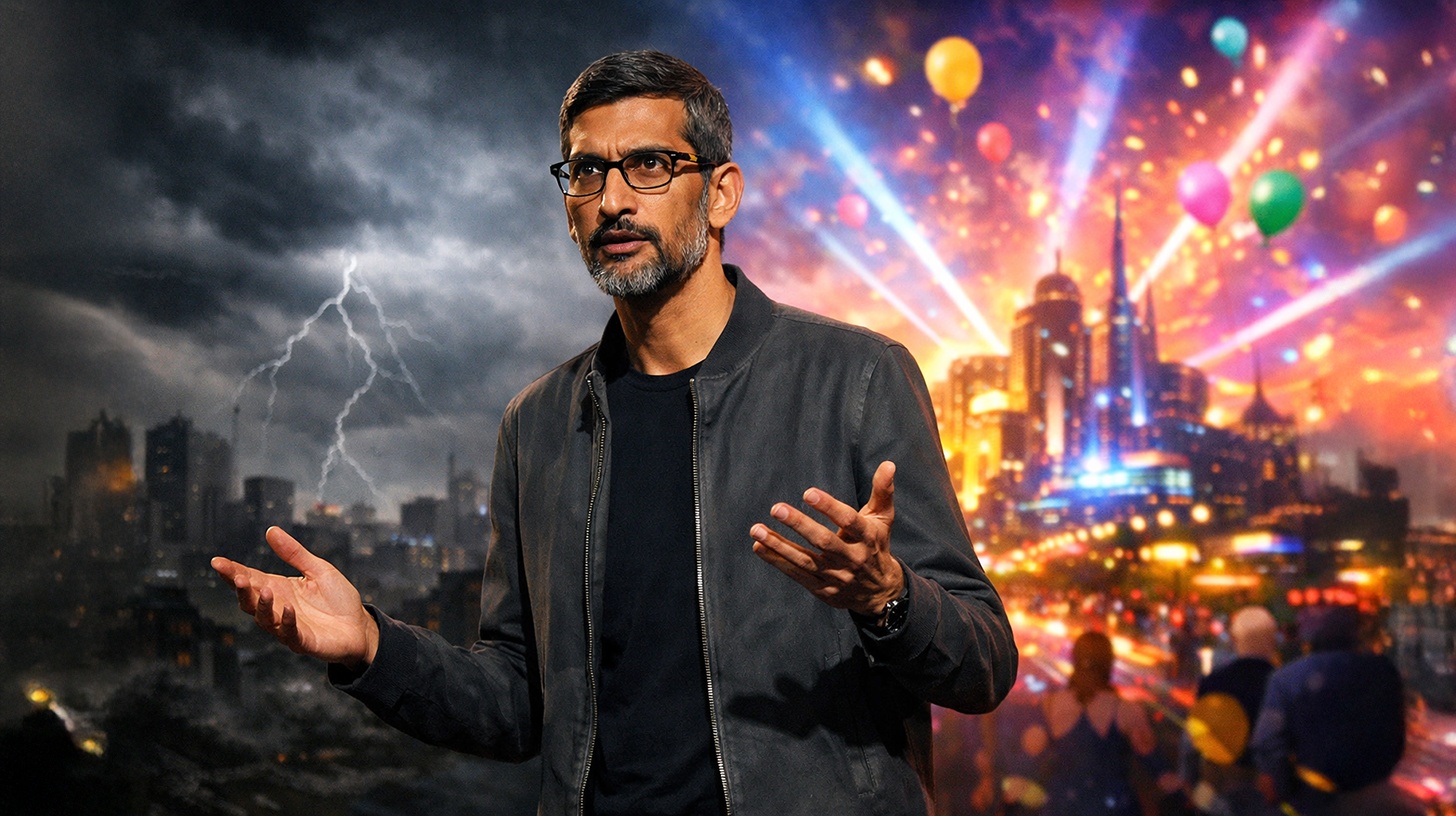
Sundar Pichai between two worlds – How the Google CEO warns the industry and yet continues – Creative image: Xpert.Digital
Trapped in the arms race: Why Google has to invest despite the threat of a bubble
Don't believe every answer: The surprisingly candid confession of the Google CEO
Between euphoria and disillusionment: The fine line of the AI age
Silicon Valley is currently experiencing a state of euphoria unprecedented in history. Driven by the promise of a technological revolution that will redefine human potential, billions are pouring into the artificial intelligence sector. Startups without viable business models are achieving astronomical valuations, and on the stock markets, the belief in perpetual growth seems unshaken. But in the midst of this party, where the music is playing loudest, one of the hosts grabs the microphone and dampens the mood: Sundar Pichai, CEO of Alphabet and Google, warns of the hangover the next morning.
In a remarkably candid discourse, Pichai paints a picture of an industry caught in a dangerous discrepancy between genuine technological progress and speculative market overheating. His warning about “irrational elements” and an inevitable market correction goes far beyond the usual caution of a manager—it is a diagnosis of a systemic risk that will not spare even the industry giants.
But the situation reveals a profound paradox: While Pichai warns of the dangers of a bubble, the unresolved problems of AI-generated hallucinations, and the exploding energy demands of data centers, his company is investing more aggressively than ever before. Google is effectively abandoning short-term climate goals and exploring nuclear power sources to satisfy the insatiable electricity needs of its algorithms. It's a dance on the edge of a volcano, driven by the fear of falling behind in global competition. The following article sheds light on the background of this complex situation, analyzes the physical limits to growth, and explains why the tech giants are forced to continue playing the game with full force—fully aware that the impact of reality could be painful.
A billion-dollar bet against its own warning: Alphabet's risky double life
The technology sector is currently experiencing an unprecedented investment boom. Billions are flowing into artificial intelligence, valuations are soaring, and an almost religious conviction has spread among investors and entrepreneurs: AI will transform the world and create immeasurable wealth. But at the top of the industry, where billions are moved daily and where decisions of global consequence are made, a quiet skepticism is growing. Google CEO Sundar Pichai, one of the most powerful architects of this development, spoke out in an interview with the BBC, issuing a warning that has been partially overlooked by the mainstream media, but whose significance for investors and market participants should not be underestimated.
Pichai speaks of irrational elements in the market. This isn't just the criticism of a skeptic, but the statement of a man at the helm of a company that is a key driver of this boom. This statement deserves closer examination, as it reveals a fundamental tension: The tech giants are aware of the risks inherent in their own expansion strategy, yet they continue to invest with undiminished vigor. This isn't simply a warning against over-optimism, but rather a complex economic situation in which the biggest players are simultaneously driving the industry and warning of its risks.
The appetite of the markets and the irrational elements of a new era
Pichai characterizes the current moment as exceptional in the history of technology. This assessment is not merely a platitude. There are indeed few points of comparison for the current situation. While there have been boom periods in the past—the dot-com bubble, the financial market euphoria before 2008, the cryptocurrency speculation—the current phase of AI differs in that the underlying technology is actually experiencing substantial breakthroughs. The capabilities of modern AI models are objectively impressive. They can generate texts that are virtually indistinguishable from those written by humans, solve complex coding tasks, and mimic or surpass human expertise in many domains.
This technological reality is precisely the problem. It creates a perfect breeding ground for the conflation of real progress with speculative expectations. Investors who are aware of the technology's actual capabilities extrapolate these into the future, assuming exponential growth that will be sustainable not only technologically but also economically. Pichai warns against the irrational elements that manifest themselves in this mixture. Specifically, he means that investors are pumping massive sums into startups that not only lack profitable business models but whose economic viability has not yet been demonstrated.
Silicon Valley is currently experiencing a gold rush. Anyone involved with AI technology, or even just claiming to be, can raise capital. The valuations assigned to new startups don't reflect current profitability, but rather purely speculative expectations of future dominance in a market whose structure and profitability are still unclear. This is the classic pattern of a speculative bubble: Real technological progress is used as a pretext to construct completely unrealistic financial scenarios.
Pichai emphasizes that a market correction seems inevitable. That's a strong statement. He doesn't use the words "could" or "might possibly," but rather expresses that a correction is a question of when, not if. For anyone who has studied the history of financial bubbles, this is a familiar pattern. Periods of irrational overconfidence are always followed by periods of correction. The question is not whether it will happen, but how painful the adjustment will be.
Particularly noteworthy is Pichai's emphasis that no company is immune to the consequences of a crash, not even Alphabet itself. This is an unusually honest moment from a corporate CEO's perspective. A traditional CEO would likely emphasize how robust their company is and how well-positioned it is. Pichai, however, acknowledges that the interconnections within the technological ecosystem have become so complex and dense that even the most powerful players are not immune to systemic risks. This is an important observation regarding the modern structure of the tech industry.
The interconnections Pichai describes are indeed remarkable. A company like Google isn't isolated, but rather dependent on a network of suppliers, partners, and infrastructure providers. Hardware manufacturers produce the chips that AI systems rely on. Cloud providers supply the infrastructure. Software developers create the applications that build upon these models. If one area collapses or encounters problems, cascading effects occur that impact the entire system. For example, if the demand for AI services suddenly plummets, cloud providers lose revenue. This leads to reduced investment in hardware. Chip manufacturers have to scale back production. Startup ecosystems that depend on this hardware and its associated services collapse. The effect spreads like a crack in glass.
The hidden energy problem: When computing power heats up the world
Most discussions about AI focus on algorithms, model architecture, and market opportunities. But at the heart of this entire revolution lies a very tangible problem: energy. Pichai addresses this issue directly and without sugarcoating. He admits that Google is likely to miss its self-imposed climate targets for 2030 due to the demands of its AI infrastructure. This is noteworthy because Google has positioned itself as a company that is aware of climate change and committed to sustainability.
The energy demands of AI systems are astronomical and constantly growing. Training a large language model like GPT-4 or Gemini requires enormous amounts of computing power, which in turn consumes gigantic amounts of electricity. A large training company can require hundreds of megawatts of power, and that's just for a single model. When you consider that companies are constantly training new versions, developing new models, and then these models need to process inferential queries from millions of users, the energy demand increases exponentially. Google operates data centers worldwide, and many of them are primarily driven by AI requirements.
The fundamental problem is that renewable energies, despite their rapid expansion, cannot keep pace with this growth in energy demand. Pichai mentions that renewable energies alone are “barely meeting” energy demand. This is a crucial point. It means that even ambitious plans to expand wind and solar power will not be sufficient to meet the demands of AI infrastructure. This will lead to conflicts, both economic and political.
Pichai suggests that the solution could lie in nuclear power, specifically in small modular reactors (SMRs). This technology is fascinating because it promises to provide an energy source that is low in CO2 emissions, relatively safe, and feasible on a smaller scale than traditional nuclear power plants. Google has indeed developed plans for such reactors with various partners and regulatory bodies. But Pichai is realistic: This technology takes time. It will be years, possibly decades, before SMRs become operational and meet a significant portion of energy needs.
This creates a temporary problem. Google and other tech companies are under pressure to pursue their AI ambitions now to remain competitive. But the long-term infrastructure to support these ambitions in an environmentally sustainable way is not yet in place. The result will be that companies like Google will be forced to use more electricity from conventional, often fossil-fuel-based sources than they had planned. This will lead to a failure to meet climate targets and simultaneously generate political and reputational pressure.
The irony is profound: AI promises to offer solutions to many of humanity's greatest challenges, including climate change mitigation. But AI itself massively exacerbates one of these problems unless a solution is found through massive investments in new energy infrastructure. This is not a new problem—humanity has experienced it before, for example with the internet boom and its associated energy demands—but it is now far more urgent because the demands are even greater and time is running out.
Pichai also mentions the physical limits to growth. This signals that not only financial and energy-related limits are relevant, but also material ones. Chip production, necessary raw materials like lithium for batteries or specialized silicon variants, the infrastructure for transporting and cooling data centers – all of these have physical limits. These limits are not insurmountable, but they exist and require time, investment, and political decisions for extracting raw materials, building infrastructure, and obtaining environmental permits for new facilities. Once these limits are reached, the growth of AI infrastructure will necessarily slow, regardless of how profitable the business models are.
A new dimension of digital transformation with 'Managed AI' (Artificial Intelligence) - Platform & B2B Solution | Xpert Consulting

A new dimension of digital transformation with 'Managed AI' (Artificial Intelligence) – Platform & B2B Solution | Xpert Consulting - Image: Xpert.Digital
Here you will learn how your company can implement customized AI solutions quickly, securely, and without high entry barriers.
A Managed AI Platform is your all-round, worry-free package for artificial intelligence. Instead of dealing with complex technology, expensive infrastructure, and lengthy development processes, you receive a turnkey solution tailored to your needs from a specialized partner – often within a few days.
The key benefits at a glance:
⚡ Fast implementation: From idea to operational application in days, not months. We deliver practical solutions that create immediate value.
🔒 Maximum data security: Your sensitive data remains with you. We guarantee secure and compliant processing without sharing data with third parties.
💸 No financial risk: You only pay for results. High upfront investments in hardware, software, or personnel are completely eliminated.
🎯 Focus on your core business: Concentrate on what you do best. We handle the entire technical implementation, operation, and maintenance of your AI solution.
📈 Future-proof & Scalable: Your AI grows with you. We ensure ongoing optimization and scalability, and flexibly adapt the models to new requirements.
More about it here:
Strategic dilemma of the tech giants: Why no one can opt out of the dangerous AI game
The technological reality behind the promise: Hallucinations and the limits of reliability
While the world celebrates the capabilities of modern AI systems and overestimates their potential, Pichai also warns of fundamental limitations of the technology itself. He strongly advises users against accepting answers from AI systems without scrutiny. This is an important warning that aligns with the observations of AI security researchers worldwide.
The phenomenon of AI hallucinations is now well-documented. A large language model can, with great conviction and in elegant prose, state things that are completely false. It can invent non-existent scientific studies, describe false historical events, or present statistically impossible situations as real. The problem is not that the model is deliberately deceiving itself or lying—it has no consciousness or intent—but that it attempts to generate text based on probability patterns, and these patterns sometimes lead to misrepresentations.
Pichai emphasizes that despite massive progress, Google has not yet solved this problem of inaccurate factual reporting. This is a significant admission. Google is one of the richest and most technologically advanced companies in the world. If they haven't solved this problem, it's likely a more fundamental issue than just a lack of resources or engineers. The problem lies deeper within the architecture and operation of large language models.
This has far-reaching implications for the use of these systems in safety-critical applications. If AI is used to diagnose medical conditions, hallucinations could lead to misdiagnoses. If AI is used to assist lawyers with case research, it could cite incorrect precedents. If AI is used to assist engineers with bridge design, a hallucinated load calculation formula could lead to a structural failure. The list could go on indefinitely.
At the same time, Google continues to invest aggressively in AI technology and the infrastructure to support it. Pichai specifically highlights the company's commitment in the United Kingdom, where Google is building a new $1 billion data center and acquiring vast office space in London. This investment is emblematic of the double bind that tech giants face. They are aware of the limitations of their technology, they are aware of the speculative elements in the market, they are aware of the energy problems. But they still have to invest because competition forces them to.
If Google didn't invest aggressively in AI, another company—whether OpenAI, Microsoft, DeepSeek, or others—would occupy that space and potentially establish a dominant position. Competition in the AI space is intense and global. China is developing AI systems at a rapid pace. OpenAI is aggressively expanding despite security and ethical concerns. Microsoft is backing OpenAI. Meta is developing Llama. Each of these companies views AI as strategically critical and is investing accordingly. For Google, this means it can't simply slow down, no matter how skeptical Pichai may be.
This is the real dilemma of the modern tech industry: Companies are trapped in a collective action to follow a strategy they partially recognize as risky, but cannot unilaterally abandon. This is not unlike a classic arms race or a tragedy of the commons scenario. Each company acts rationally from its own perspective—it must invest to remain relevant—but the collective result is a system that becomes increasingly vulnerable to systemic risks.
The fine line between necessity and bubble inflation
Pichai urges caution, but, as has been put, “is playing the game with full commitment.” This phrase perfectly captures the tension of the situation. There is no escaping this game for established tech companies. They have to play, but they do so knowing the risks. Pichai isn't blindly trusting, but he also doesn't have the freedom to simply say “no.”
The problem of bubbles is not new. Financial market history shows that there are regular periods in which euphoria and investment far exceed fundamental values. The dot-com bubble of the late 1990s is the classic example: companies with minimal or no profits were valued at billions. When the correction came, it was painful and widespread. Many companies disappeared. Investors lost enormous amounts of money.
The current AI scenario potentially shares some similarities. There are genuine technological advances, but also a great deal of speculation about future applications and profitability. Some companies making massive AI investments may not see the expected returns. When the market correction comes, investors in these companies will suffer significant losses. The only question is how deep this correction will be and how quickly the market will recover afterward.
For Alphabet and other established tech giants, a correction will be painful, but not necessarily catastrophic. They have massive cash reserves, diversified revenue streams, and established customer bases. A startup that relies solely on AI applications and has no other revenue streams could be existentially threatened by a market correction. This is one of the points Pichai likely means when he says the interconnections are so close: A profound crash could bring down the entire startup ecosystem, and this would then also affect established companies that depend on this ecosystem as partners, suppliers, or customers.
The current phase of the tech industry could be described as one of “creative destruction”—a term coined by Joseph Schumpeter to describe capitalist processes in which new technologies destroy old structures and make room for new ones. AI will undoubtedly destroy old business models and create new ones. But the question is whether the current investment phase is realistic or whether it represents a bubble leading to wasteful spending and ultimately massive losses.
Pichai suggests that the current phase contains speculative elements that are not justified by fundamental economic facts. This means that corrections are coming, and these will be painful for everyone. It is a warning, but one that comes from a man who doesn't have the option of ignoring it, because that would mean his own company losing out to the competition.
Long-term structure and future scenarios
When we think about the next few years and decades, we need to consider different scenarios. The first scenario is that of a “soft landing”: A market correction occurs, but it is moderate. Overvalued startups see their valuations reduced, but not to zero. Investors learn to have more realistic expectations. AI continues to develop, but with less spectacular euphoria. The tech industry adapts, and once the unrealistic expectations are removed from the system, growth stabilizes at a more sustainable level.
The second scenario is a deep recession or even depression in the tech sector. A trigger—perhaps a major AI-related accident or a systemic financial crisis—leads to panic. Investments are drastically reduced. Companies announce massive losses. Jobs are cut. The startup ecosystem collapses. Recovery takes years. Established companies survive, but with reduced profits and growth.
The third scenario is one of gradual disappointment. AI continues to develop, but more slowly than hoped. Technological limitations become apparent, similar to what happened with previous innovations. The exponential growth many had hoped for slows to linear or even sluggish growth. Investments are adjusted accordingly. Some startups become profitable, others disappear.
There are also variations and intermediate scenarios. A key factor is how quickly AI systems become more reliable and usable for realistic business applications. If the technological problems are solved quickly, growth can continue and speculative valuations could converge with reality. If not, the disappointment will be profound.
Another important factor is the geopolitical dimension. AI is not just a technological issue, but also a matter of security and power. Countries like China and the US are investing heavily in AI research and infrastructure for strategic reasons. This means that AI investments are not purely driven by economics, but also by national security considerations. This can lead to a stabilization of investments, even if the economic foundations are shaky, because governments will not allow national AI capacity to depend entirely on private market dynamics.
The Paradox of the Warning
Sundar Pichai's warning about an AI bubble and irrational elements in the market is an important and noteworthy observation. It comes from someone in a leading position among the key players involved, which lends it weight and authenticity. At the same time, Pichai's own behavior—continuing massive AI investments—reveals the paradox of modern economics: even when top managers know that the market contains irrational elements, they are compelled to participate in these market dynamics.
This isn't necessarily malicious intent or hypocrisy. It's more a reflex of a system where individual rational decisions can lead to collectively irrational outcomes. Pichai's warning is correct, but he can't simply stop Google's investments in AI, because that would mean a competitor would take over that space. The result is that the industry continues to operate on the edge of a bubble, fully aware of the risks.
For investors, this means caution is advised. Pichai's warning should be taken seriously. A market correction could come, and it could be deeper than many expect. For tech workers, this means job security may not be guaranteed and diversifying skills and income streams is advisable. For society, this means that hopes placed on AI—as a solution for healthcare, climate change, and education—should be viewed with realism. The technology is powerful, but also limited, fallible, and dependent on resources that are not unlimited.
The coming years will show whether the current phase is a bubble with a crash or a transformation with ups and downs. What is certain is that Pichai's warning, even if it doesn't dampen investment, signals that the market is critically examining itself. This isn't the worst sign, but it's no cause for complacency either. The tension between technological potential and market rationality remains unresolved.
Your global marketing and business development partner
☑️ Our business language is English or German
☑️ NEW: Correspondence in your national language!

Konrad Wolfenstein
I would be happy to serve you and my team as a personal advisor.
You can contact me by filling out the contact form or simply call me on +49 7348 4088 965 (Munich) . My email address is: wolfenstein ∂ xpert.digital
I'm looking forward to our joint project.
☑️ SME support in strategy, consulting, planning and implementation
☑️ Creation or realignment of the digital strategy and digitalization
☑️ Expansion and optimization of international sales processes
☑️ Global & Digital B2B trading platforms
☑️ Pioneer Business Development / Marketing / PR / Trade Fairs
🎯🎯🎯 Benefit from Xpert.Digital's extensive, five-fold expertise in a comprehensive service package | BD, R&D, XR, PR & Digital Visibility Optimization

Benefit from Xpert.Digital's extensive, fivefold expertise in a comprehensive service package | R&D, XR, PR & Digital Visibility Optimization - Image: Xpert.Digital
Xpert.Digital has in-depth knowledge of various industries. This allows us to develop tailor-made strategies that are tailored precisely to the requirements and challenges of your specific market segment. By continually analyzing market trends and following industry developments, we can act with foresight and offer innovative solutions. Through the combination of experience and knowledge, we generate added value and give our customers a decisive competitive advantage.
More about it here:









