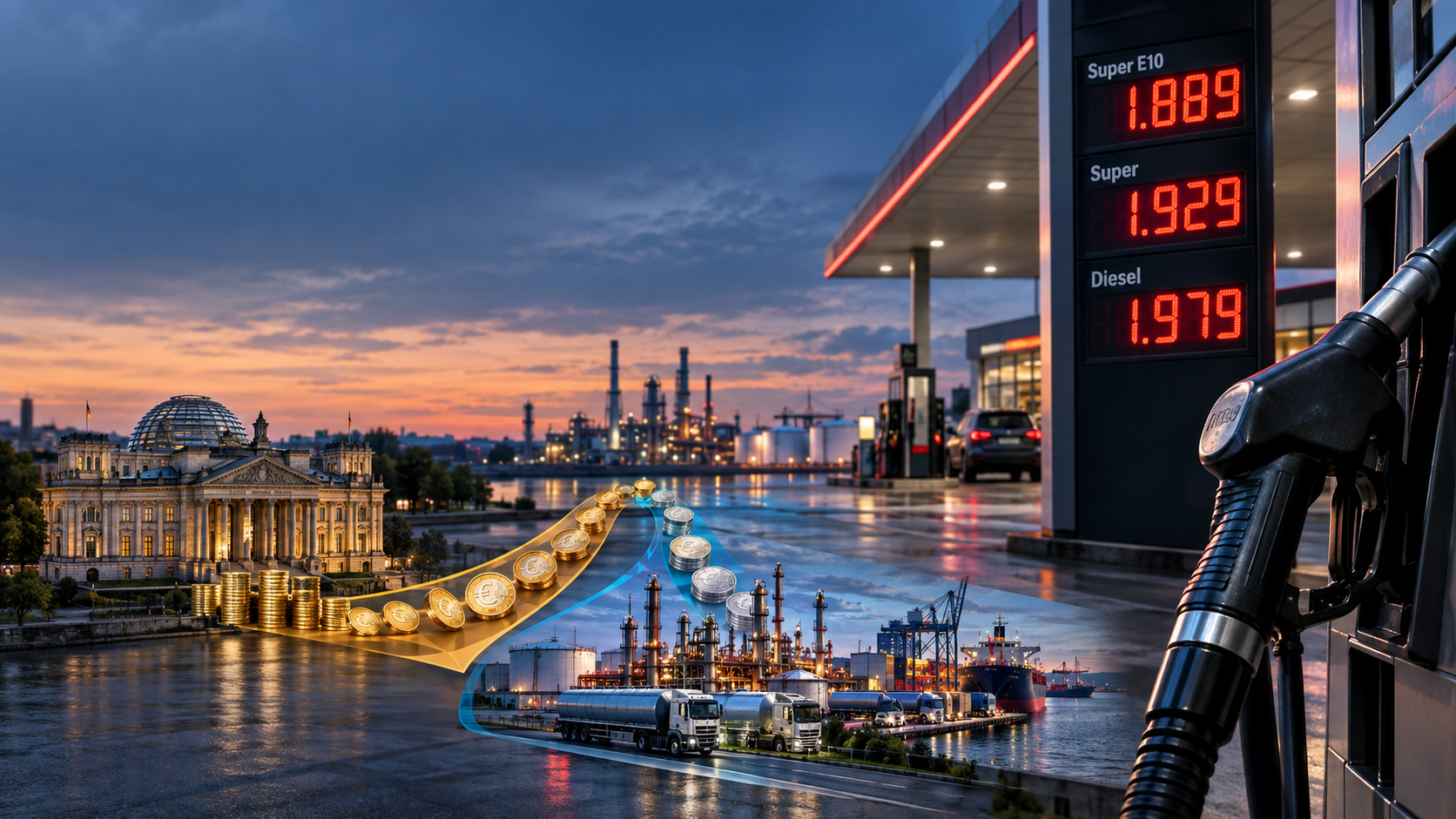
Greedy government, innocent corporations? Fuel price shock 2026: Who's really raking it in at the pump – Creative image on the topic, with AI: Xpert.Digital
Over €1 for the state? The truth about our fuel prices
Diesel at €2.40: Where your money at the gas station really goes
The real price driver: Why the state doesn't win with expensive fuel and why simple fuel discounts are now becoming a problem
Fueling up has once again become a luxury in Germany. When prices for premium gasoline and diesel at the pumps skyrocket, public outrage reliably boils over. The culprits seem to be quickly identified: While some rail against profit-hungry oil companies, others see the government as the secret main beneficiary, shamelessly raking in the profits through taxes and levies. But is it really that simple?
A closer look at the composition of our fuel prices, the complex mechanisms of energy tax, CO₂ pricing, and value-added tax, as well as the global geopolitical crises of 2026, reveals that the reality is far more multifaceted. Anyone who wants to tackle the problem of extreme fuel prices at its root and discuss genuine solutions must understand the entire economic chain of effects – and recognize why simplistic blame games are counterproductive in the current energy crisis. The following analysis breaks down in detail who really profits at the pump, how global crises affect the price per liter, and which relief measures actually make sense now.
Fuel price shock: Is the government really profiting? The government does earn money at the pump – but the biggest driver of these prices isn't necessarily the Ministry of Finance
The claim that the state primarily profits from high gasoline and diesel prices contains a kernel of truth, but leads to an oversimplification from an economic perspective. The truth is: every liter of fuel contains significant government-imposed charges. With a gross price of €2.30 for Super E5, approximately €1.15 to €1.18 goes toward energy tax, CO₂ pricing, and VAT, depending on the CO₂ price. With a diesel price of €2.40, it's around €1.00 to €1.03. Therefore, the order of magnitude of the initial calculation is fundamentally correct. It is also true that a higher net price increases the government's share per liter sold through VAT.
It would be wrong, however, to conclude directly from this calculation that the state is the actual cause of the recent price surge or the sure main beneficiary of the crisis. The energy tax is a fixed cent amount per liter and does not increase with the price at the pump. Similarly, the burden of the national CO₂ price is not based on the selling price at the pump, but rather on the fuel's emission content and the certificate price. Only the value-added tax (VAT) reacts directly to a higher net price. At the same time, high prices often lead to a decrease in the amount of fuel sold, which can reduce revenue from the quantity-based components. Therefore, any statement about the state's profit requires more than just looking at a single liter.
The crucial economic distinction is this: How much government intervention is reflected in the price, what causes the price increase, and who benefits from the additional revenue or profits? These three questions are frequently conflated in public debate. The tax component can be high without a tax increase having triggered the current price surge. The government can collect more sales tax per liter without its overall tax revenue increasing. Oil companies can achieve high absolute revenues without their profit margins automatically being excessive. Conversely, high crude oil and product costs do not preclude exceptional refining or trading margins.
A reliable assessment must therefore consider the entire chain of effects: crude oil price, exchange rate, refinery capacities, prices for finished petroleum products, transport and storage, competition in wholesale and at petrol stations, energy tax, CO₂ pricing and value added tax. Only this perspective shows that the simple juxtaposition of a greedy state and innocent corporations is just as inadequate as the reverse narrative of the price problem being caused solely by businesses.
One liter yields three bills
The final price at the pump can be economically broken down into three main components. The first component comprises the actual product value, including crude oil, refining, blending, procurement of finished fuels, transport, storage, and distribution. This includes the margins of refineries, wholesalers, and gas station operators. The second component consists of the quantity-based energy tax and the cost of CO₂ certificates. The third component is the 19 percent value-added tax (VAT), which is levied on the entire net amount, including energy tax and CO₂ costs.
The standard energy tax for Super E5 gasoline is 65.45 cents per liter. For diesel, it is 47.04 cents. This difference explains a significant part of the historically more favorable tax treatment of diesel. However, it is only one side of the equation, as diesel produces more CO₂ per liter than gasoline and therefore carries a slightly higher CO₂ burden. In 2026, the national CO₂ price is expected to fluctuate between €55 and €65 per ton. This translates to approximately 13.0 to 15.4 cents per liter for gasoline and about 14.7 to 17.4 cents per liter for diesel, excluding VAT.
Value-added tax (VAT) is not calculated as 19 percent of the gross price, but as 19 percent of the net price. Therefore, its share of the gross price is 19 out of 119 parts, or approximately 15.97 percent. At €2.30 per liter, this amounts to about 36.72 cents. At €2.40, it is approximately 38.32 cents. This total VAT amount can be mathematically allocated to the product component, the energy tax, and the CO₂ costs. Such an allocation is permissible, but should not give the impression that several different VATs are being levied. Legally and economically, it is a single VAT on the entire tax base.
For gasoline at €2.30, this results in a government-imposed levy of approximately 115 to 118 cents per liter. For diesel at €2.40, it's around 100 to 103 cents. This range is due to the CO₂ price corridor. The figures of roughly €1.16 for gasoline and roughly €1.01 for diesel are therefore plausible as a snapshot. However, the exact figures depend on the actual certificate price applied, the type of fuel considered, and whether other minor price-affecting components are included.
The remaining amount is by no means equivalent to the profit of the oil companies. In this example, roughly €1.12 to €1.15 remains for gasoline, and about €1.37 to €1.40 for diesel, covering product, refining, logistics, distribution, and all margins. Especially with diesel, the product cost can rise sharply during supply crises because Europe is structurally dependent on imports of finished middle distillates, and bottlenecks on international product markets can be more severe than mere fluctuations in the price of crude oil.
Why percentages can be misleading
The statement that the tax component is approximately 51 percent for gasoline at €2.30 and approximately 42 percent for diesel at €2.40 is largely mathematically sound. However, it only describes the ratio of the government's burden to the respective final price. It says neither which component triggered the price increase nor how the government's overall revenue has changed.
If the product price rises sharply while energy tax and CO₂ costs per liter remain unchanged, the denominator of the calculation grows faster than the fixed tax component. The percentage of tax then decreases, even though the absolute amount of VAT increases. This is precisely why the tax component can be well over 60 percent at a gasoline price of €1.70 and only about half that at €2.30. A decreasing tax component, therefore, does not necessarily mean tax relief. Conversely, a high percentage at a lower final price does not prove that the government is generating higher revenues in this situation.
Percentages are particularly tempting for political communication because they suggest large-scale effects. However, three separate indicators are more economically informative: the fixed government charge per liter, the variable sales tax per liter, and the total revenue from the quantity sold and the tax per unit. Those who only mention the percentage ignore the quantitative impact. Those who only mention the amount per liter may overlook the fact that less fuel is being purchased. Those who only consider the total revenue fail to recognize how heavily individual households or businesses are burdened.
The statement that more than one euro per liter goes to Berlin is also too general. Energy tax revenue belongs to the federal government. Value-added tax (VAT), however, is distributed between the federal government, the states, and municipalities. Revenue from the national emissions trading scheme flows into the Climate and Transformation Fund and is therefore classified differently in terms of budgetary policy than freely available general tax revenue. In a broader sense, all three components are government-initiated payments. However, in a narrower public finance sense, not every cent ends up in the freely available federal budget, and certainly not exclusively with the federal government.
The true additional earnings per liter
The claim that the state earns almost ten cents more per liter compared to the period before the recent surge in demand could be true under certain assumptions. The crucial factor is the magnitude of the price difference. If the gross price increases by, say, 60 cents solely due to a higher product price, the value-added tax (VAT) included in that price rises by approximately 9.58 cents. The fixed energy tax remains unchanged. Similarly, CO₂ costs do not change simply because crude oil, refinery products, or transportation become more expensive.
The marginal government share of a market-driven gross price increase is therefore not 19 percent, but 19 out of 119 parts. Of every ten cents of additional gross price, approximately 1.60 cents are attributable to additional sales tax and about 8.40 cents to the increased net price. This distinction may seem small, but it is crucial for a precise analysis. Colloquially, it is often said that the government collects 19 percent of the price increase. However, when calculated based on the gross price, this is mathematically too high.
The price per liter should not be confused with government profit. A government does not prepare its accounts like a company, and increased tax revenue does not automatically translate into economic gain. Higher fuel prices burden private households, increase business costs, drive up consumer prices, and can dampen growth and other taxable expenditures. If a household spends more on diesel, it may have less money left for restaurants, retail stores, or services. The additional sales tax at the pump can therefore be partially offset elsewhere.
In addition, there are political relief measures. If the federal government lowers the energy tax or provides subsidies, this results in fiscal costs. In May and June 2026, the energy tax on gasoline and diesel was temporarily reduced by 14.04 cents per liter. Together with the lower value-added tax, this corresponded to a potential gross relief of around 17 cents. After the reduction expired, the regular tax rates applied again. In light of the renewed price increase, another temporary reduction of a similar magnitude is planned from October 2026 until the end of the year. A snapshot taken in mid-September does not reflect this dynamic political response.
High prices do not automatically fill the state coffers
The total tax revenue is calculated, in simplified terms, by multiplying the tax amount per liter by the quantity sold. For energy tax, quantity is the dominant factor because the rate per liter is fixed. For value-added tax (VAT), price and quantity affect both. If the price rises, the VAT per liter increases. However, if sales fall sharply enough, the total revenue can still stagnate or even decline.
A simple example illustrates the mechanism. If a liter of gasoline initially costs €1.70, it includes approximately 27.14 cents of sales tax. At €2.30, it includes about 36.72 cents, roughly 9.58 cents more. If the quantity sold decreases as a result of the price shock, the government simultaneously loses energy tax, CO₂ revenue, and sales tax on the unsold liters. Tax cuts can further reduce revenue. Whether there is a net gain therefore depends on the extent of the price and quantity changes. (Note: The grammatical error "des Preis- und Mengenänderung" in the original has been corrected here.)
In the short term, many commuters, tradespeople, freight forwarders, and people in rural areas react only to higher prices to a limited extent. Commuting, customer visits, and delivery obligations cannot be avoided immediately. Therefore, short-term fuel demand is relatively inelastic. However, as the situation progresses, the possibilities for adjustment increase: journeys are combined, speeds are reduced, more efficient vehicles are purchased, transport is optimized, or shifts are made to other modes of transport. This can lead to a more significant decline in sales.
The current trend in energy tax revenue for 2026 contradicts the blanket narrative of a guaranteed fiscal gain from the crisis. For several months, the data indicated declining revenue from the predominantly fuel-related components of the energy tax. The temporary tax cut exacerbated this effect. Therefore, even if the VAT per liter increases, this will not necessarily result in higher overall revenue from fuels.
Furthermore, there is a cyclical feedback loop. Higher diesel prices burden logistics, construction, agriculture, industry, and bus companies. Higher transport costs are passed on to goods prices with a time lag. Real incomes and consumer spending power decline, companies postpone investments, and the government can be indirectly burdened through weaker income, corporate, and excise tax revenues. A comprehensive fiscal balance sheet would have to take such second-round effects into account. A simple calculation based on fuel consumption alone cannot do this.
The war has an impact on more than crude oil
The recent price surge is primarily due to an external supply shock. The war with Iran and the repeated threats to vital shipping lanes have not only driven up crude oil prices but also increased uncertainty, insurance premiums, and freight rates. The Strait of Hormuz and the Red Sea route are particularly critical. If supply flows are disrupted or tankers are forced to take longer routes, costs and delivery times rise far beyond the immediate impact of individual production losses.
Oil prices in September were significantly higher than pre-war levels. At times, the price increase for refined products was even more pronounced. This is crucial for understanding diesel prices. The price of a liter of diesel at a German gas station is not solely determined by the current price of crude oil. The relevant factor is the European wholesale price for the finished product. If refinery capacity is disrupted, imports become scarcer, or global demand for middle distillates remains high, diesel can become disproportionately expensive despite similar crude oil costs.
The exchange rate also plays a role, because crude oil and many petroleum products are traded in US dollars. A weaker euro makes imports even more expensive. This is followed by refining, quality adjustments, legally mandated blending, storage, inland logistics, and distribution. Low water levels on the Rhine, for example, can limit the transport capacity of inland vessels and increase costs in regions heavily reliant on this transport route.
The sharp price movement cannot therefore be reliably explained solely by taxes or solely by the price of crude oil. It arises from the combination of a global geopolitical shock with bottlenecks in product markets, European import dependencies, and regional logistics costs. However, it is precisely in such situations that margins can expand. Acknowledging genuine scarcity is therefore not an excuse for every price increase.
Our EU and German expertise in business development, sales and marketing


Our EU and German expertise in business development, sales and marketing - Image: Xpert.Digital
Industry focus areas: B2B, digitalization (from AI to XR), mechanical engineering, logistics, renewable energies and industry
More information here:
A thematic hub offering insights and expertise:
- Knowledge platform covering global and regional economies, innovation and industry-specific trends
- A collection of analyses, insights, and background information from our key areas of focus
- A place for expertise and information on current developments in business and technology
- A hub for companies seeking information on markets, digitalization, and industry innovations
Surplus profit: Myth or reality?
Corporate profits need a different examination
The term "excess profit" is politically effective but economically imprecise. A high absolute profit can arise from large sales volumes, substantial capital investments, exceptional risks, or a temporary scarcity rent. An abusively inflated price, on the other hand, presupposes market power and an unreasonable deviation from competitive cost and margin ratios. These two things are not the same.
To assess potential excess profits, it is insufficient to simply compare the final price with the price of crude oil. Data on refinery margins, wholesale prices, import parities, transportation costs, inventory levels, capacity utilization, regional price differences, and the margins of individual value chain stages are required. The so-called crack spread, i.e., the difference between the value of refined products and the cost of crude oil, is particularly revealing. A sharp increase in this spread indicates either scarcity or higher margins in refining. Whether these margins are justified by competitive factors or reflect market power must be examined separately.
The German fuel market has many points of sale at the service station level, but is significantly more concentrated at the refinery and wholesale levels. Transparent market prices can promote competition because customers can compare prices. However, highly detailed and almost real-time information about the behavior of other suppliers can also facilitate parallel pricing at upstream levels. Therefore, the Federal Cartel Office investigates not only service station prices, but also refineries, wholesalers, and the role of price information services.
The Market Transparency Unit processes data from approximately 15,000 gas stations. Every relevant price change must be reported promptly. This infrastructure facilitates price comparisons and enables close monitoring. However, it does not replace cost audits at the refinery and wholesale levels. A high gas station price may result from a high purchase price, while the actual margin expansion occurs earlier in the supply chain.
An objective analysis should therefore neither make blanket pronouncements of price gouging nor ignore the possibility of exceptional crisis margins. The right political response is data-driven oversight of abuses. Companies should be able to explain how their prices are composed of procurement, processing, logistics, and a reasonable margin. At the same time, the evidence must remain legally sound. Otherwise, there is a risk of popular interventions that weaken investment and security of supply without creating permanently lower prices.
Value added tax acts as both a windfall and a stabilizer
Value-added tax (VAT) increases the government's contribution per liter as soon as the net price rises. In this limited sense, the government automatically benefits from the price increase. However, this mechanism is not unique to the fuel market. VAT is generally also levied on excise taxes and other price-determining components. The fact that VAT is charged on energy taxes and CO₂ costs is often criticized as a tax on a tax. While this criticism is politically understandable, the tax base systematically follows the general VAT principle.
Economically, value-added tax (VAT) has a proportional effect. It amplifies net price increases and passes on a portion of net price decreases. If the net price of a product falls by ten cents, the gross price decreases by 11.9 cents if the full reduction is passed on. If the net price increases by ten cents, the gross price rises accordingly. VAT is therefore not an independent cause of price fluctuations, but rather a multiplier.
In an acute energy crisis, this mechanism can be politically problematic because the state initially profits from an externally caused price shock. An automatic return of the unexpected additional revenue could mitigate this impression. However, it would be administratively challenging because the actual crisis-related additional revenue cannot be neatly isolated. Changes in sales volume, tax distribution, and spending shifts would have to be taken into account.
A blanket reduction in VAT on fuels would also not be a perfect instrument. It would favor frequent drivers and households with high fuel consumption more than people without a car or with low consumption. Furthermore, the actual relief depends on how fully the reduction is passed on to consumers. The advantage lies in its rapid, visible effect. The disadvantages are high fiscal costs, poor targeting, and a diminished incentive to save energy.
The CO₂ price is not an ordinary tax item
The national CO₂ price is often referred to as a CO₂ tax in everyday discussions. While this simplification is understandable when considering the cost at the pump, institutionally it represents costs arising from the national emissions trading system. Suppliers of fossil fuels must purchase certificates and typically pass these costs on through higher prices. The amount depends on the carbon content of the fossil fuel and the price of the certificates.
In 2026, a price corridor of €55 to €65 per ton of CO₂ will apply for the first time. Compared to the fixed price of €55 in the previous year, the maximum additional cost amounts to only a few cents per liter. The CO₂ price thus explains a small part of the increase compared to 2025, but by no means the massive price jump caused by the war. Anyone who attributes the entire difference between normal and current gas station prices to climate policy is misinterpreting the magnitude of the issue.
At the same time, it would be equally wrong to dismiss CO₂ pricing as irrelevant. Its purpose is to gradually increase the cost of fossil fuel-based mobility and make climate-friendly alternatives more economically attractive. Its steering effect is limited in the short term because many people and companies cannot switch immediately. In the long term, however, it influences vehicle choice, fleet investments, logistics planning, residential decisions, and the demand for alternative drive systems.
Social acceptance depends crucially on how the revenues are used. If they are visibly channeled into lower electricity costs, charging infrastructure, public transport, building renovations, or direct repayments, the levy can appear as part of a comprehensible transformation path. If its use remains abstract for citizens and businesses, it quickly creates the impression of an additional source of income. Especially during a geopolitical price crisis, a lack of transparency exacerbates this loss of trust.
Taxes pursue more than one goal
The energy tax fulfills several functions. It generates revenue, prices a portion of the costs caused by road traffic, and influences consumption. These costs include infrastructure wear and tear, congestion, the consequences of accidents, air pollution, noise, and climate damage, insofar as these are not already covered by other instruments. However, a precise allocation of individual tax payments to specific external costs is not possible because the energy tax is not earmarked for a particular purpose.
From a public finance perspective, fuel is an attractive taxable commodity. The tax base is easily measurable, distribution is concentrated, tax evasion is relatively controllable, and short-term demand is relatively inelastic. These very characteristics make the tax lucrative, but also politically sensitive. People without realistic alternative modes of transportation perceive the burden not as a steering mechanism, but as a compulsory levy.
The different taxation of gasoline and diesel fuel historically arose from economic and transport policy considerations. Diesel was taxed at a lower rate, while diesel vehicles were subject to higher vehicle tax. The lower per-liter tax rate was particularly significant for commercial freight transport and many fleets. Today, this structure partially conflicts with climate, air pollution control, and technological neutrality goals.
A consistent tax system must openly prioritize fiscal, environmental, and distributional objectives. If high tax rates are justified solely on the grounds of climate protection, even though large portions flow into the general budget, a credibility problem arises. If they are defended solely as a source of revenue, their steering effect is ignored. Good policy identifies both functions and explains how burdens and reliefs interact.
Who actually bears the burden
The legal obligation to pay taxes says little about who ultimately bears the economic burden. Petroleum companies remit energy tax and value-added tax, but attempt to pass these costs on to consumers through their sales prices. The extent to which this is successful depends on demand, competition, inventory levels, and international prices. In tight markets, consumers typically bear a large share. With weak demand or intense competition, companies can absorb some of the burden through lower profit margins.
The same applies conversely to tax cuts. Experience with previous fuel rebates shows that a significant portion can be passed on to consumers. However, this pass-through is neither complete everywhere nor at all times. In regions with little competition and in locations with good transport links, it may be lower. Inventory levels, purchasing times, and rapid changes in international product prices also complicate the assessment.
A tax cut of 17 cents (gross) therefore does not guarantee an immediate price reduction of 17 cents at every pump. A reliable impact assessment requires a comparative scenario: How would the German price have developed without the reduction? Neighboring countries without comparable tax changes are often used for this purpose. A simple before-and-after comparison is insufficient because crude oil prices, exchange rates, and product prices all fluctuate simultaneously.
The economic incidence also explains why the moral comparison between corporate profits and government revenue falls short. Both can be affected differently by the same crisis. The government receives higher sales tax per liter but may lose revenue due to lower volumes or tax relief measures. Companies achieve higher sales but may simultaneously face significantly increased procurement costs. Individual refineries or distributors may profit, while gas stations with tight margins and declining volumes come under pressure.
The social imbalance caused by high fuel prices
Fuel prices don't affect all households equally. Those particularly burdened are people with long commutes, low incomes, shift work, or living in areas with poor public transportation. They can hardly reduce their journeys in the short term and spend a larger portion of their disposable income on mobility. While wealthier households often consume more fuel overall, they can more easily absorb the additional costs or switch more quickly to more efficient or electric vehicles.
Businesses are also exposed to varying degrees. Freight forwarders, construction companies, agriculture, mobile care services, tradespeople, and delivery services bear high direct fuel costs. Market-dominant companies can enforce surcharges, while smaller businesses with long-term contracts often cannot. Thus, high diesel prices become a liquidity and margin problem before they can be fully passed on to customers.
Flat-rate fuel discounts reach these groups, but are crude in terms of distribution policy. Those who drive a lot receive a greater absolute reduction. While this can be sensible for those with high fuel consumption due to their profession, it also encourages voluntary high consumption and the use of heavy vehicles. Targeted mobility payments, an income-based climate allowance, or temporary aid for particularly affected businesses could be fairer, but these require data, administrative procedures, and political lead time.
The commuter allowance is also not a complete replacement. It is implemented via income tax, providing delayed relief and depending on the individual marginal tax rate. Households with a low tax burden benefit less. Furthermore, it is based on commuting to work, not on other unavoidable journeys. A balanced crisis policy must therefore weigh speed, precision, and administrative costs against each other.
Inflation, wages and competitiveness
Fuel prices directly affect the consumer price index and indirectly impact almost all goods with a transportation component. In August 2026, fuel prices were significantly higher than the previous year and contributed substantially to increased overall inflation. Excluding energy, inflation was noticeably lower. This demonstrates that the current inflationary impetus is largely external and not solely a reflection of an overheated domestic economy.
Monetary policy faces a dilemma. Higher interest rates cannot create additional oil supply, nor can they open blocked transport routes. However, they can prevent the energy price shock from becoming permanently entrenched in wages, expectations, and the prices of other goods. Excessive monetary tightening would simultaneously hamper investment and economic growth. Fiscal measures should therefore not indiscriminately neutralize the price shock, as they can support demand and weaken the incentive to save.
Industry suffers twofold: directly through higher logistics and operating costs, and indirectly through a loss of purchasing power among its customers. Diesel is particularly critical for road freight transport, construction, and agriculture. Rising freight rates drive up the prices of intermediate goods and finished products. Export companies can be disadvantaged if competitors produce in countries with lower energy or transport costs.
Temporary tax relief can therefore be justified from a macroeconomic policy perspective if the shock is exceptional and clearly limited in duration. Permanent tax cuts, on the other hand, would be expensive and could delay structural change. A credible exit strategy is crucial. Companies make investment decisions based on expected long-term prices. Constant short-term interventions increase uncertainty and can discourage investment in both fossil fuels and climate-friendly technologies.
What a smart relief measure should achieve
A good crisis response should combine four objectives: It must provide immediate relief to those most affected, safeguard competition, prevent unnecessary inflation, and maintain long-term incentives for adjustment. No single instrument fulfills all four requirements. Therefore, a mix of measures is more sensible than searching for a supposedly perfect solution.
A temporary reduction in energy tax has a quick effect and is noticeable at the pump. It can cushion extreme price spikes, but it is expensive and not very targeted. Its implementation must be verified using price data and international benchmarks. Any extension should be linked to objective criteria such as crude oil, product, or average prices to prevent a crisis measure from becoming a permanent subsidy.
Targeted transfers are more socially precise. They can support households based on income, commuting distance, or lack of alternatives. For particularly energy-intensive small and medium-sized enterprises (SMEs), temporary liquidity assistance or clearly defined hardship provisions are conceivable. Such measures should not permanently preserve inefficient business models, but rather allow for an adjustment period.
From a competition policy perspective, a comprehensive analysis of the entire supply chain is needed. Gas station apps empower consumers but do not solve potential problems at refineries or in wholesale. Authorities require timely data on costs, quantities, inventory levels, and margins. Rules against abusive price markups should be precise and must not categorically prohibit legitimate scarcity pricing. Otherwise, supply bottlenecks are likely because importers will no longer be willing to bring expensive additional quantities to Germany.
In the medium term, only reduced dependence on oil and products will reduce vulnerability. This includes more efficient vehicles, electrification, a reliable expansion of charging infrastructure, rail and public transport, better logistics planning, and alternative fuels in applications that are difficult to electrify. This strategy is not only climate policy, but also security and economic policy. Every liter of oil avoided reduces dependence on geopolitically risky supply chains.
The judgment on the initial thesis
The statement that the government profits handsomely from high fuel prices is accurate in describing the burden on a single liter. In the example prices mentioned, taxes and CO₂ costs for gasoline significantly exceed one euro, while for diesel they are approximately one euro. The claim of additional revenue of nearly ten cents per liter can also be plausible if the gross price has increased by around 60 cents compared to the previous point in time and the other government components remain unchanged.
However, this explanation for the price shock is incomplete. The regular energy tax did not cause the war-related jump because it remained unchanged as a fixed amount. The CO₂ price explains at most a few cents compared to 2025. The far greater part of the increase in the product category resulted from geopolitical risks, crude oil, shortages of refined products, diesel shortages, exchange rates, and logistics. Whether inappropriate margins were also demanded is a legitimate question, but one that requires separate empirical investigation.
The statement that the money goes to Berlin is also too simplistic. Value-added tax (VAT) is distributed across the federal states, and CO₂ revenues flow into the climate and transformation fund. Most importantly, however, a higher government contribution per liter does not necessarily translate into higher overall fiscal revenue. Declining sales, temporary tax cuts, relief spending, and negative economic effects can all offset or even exceed the additional VAT revenue.
The moral analogy of good government tax revenues versus bad corporate profits therefore works better in the media than in economics. (Note: The word "overtaxing" from the original has been corrected here for grammatical and logical precision.) Government levies are politically decided, transparently quantifiable, and democratically amendable. Corporate margins arise in the market, can signal scarcity, but can also be inappropriate in cases of market power. Both sides need oversight: The government must justify levies, their use, and their distributional effects; companies must face effective competition and robust abuse control.
The clearly reasoned perspective is therefore this: The state has a significant stake in every expensive liter of fuel and initially profits from market-driven price increases through value-added tax. However, it is not automatically the biggest winner of the crisis, and certainly not the main cause of the current shock. Those who point solely to taxation distract from the causes, just as politicians who only talk about corporate profits and ignore their own burden on the economy do. A factual debate must accommodate both perspectives simultaneously: Germany's fuel taxes are high, and the exceptional price jump of 2026 is primarily a supply shock caused by geopolitical and market forces.
The political test begins after the crisis
Immediate relief is understandable, but it must not obscure the long-term lesson. Germany remains vulnerable as long as large parts of its mobility, freight transport, and production depend on imported crude oil and scarce refinery products. A purely tax-cutting strategy shifts the costs of the shock from the fuel consumer to the state budget, but it eliminates neither the physical scarcity nor the geopolitical dependency.
At the same time, it would be politically risky to view high prices merely as a welcome climate signal. An unpredictable wartime price is no substitute for a predictable CO₂ pricing system. Businesses and households can invest and react to a planned, gradual price path. They often respond to abrupt price jumps with a loss of purchasing power, production cuts, or political resistance. Climate policy, therefore, does not automatically win if fossil fuels become expensive due to war.
The best response combines short-term stabilization with accelerated structural adjustment. Relief measures should be temporary, verifiable, and targeted as precisely as possible. Competition control must be implemented where market power can actually emerge. Revenues from CO₂ pricing should be used transparently for transformation and social safety nets. Infrastructure policy must create alternatives before rising prices become the dominant steering instrument.
This shifts the central question. It's not who profits most morally from a single liter, but rather who permanently reduces dependence that will determine the outcome of the next crisis. The government must prove that high taxes are not merely a means of replenishing public funds. The oil industry must demonstrate that scarcity is not used as a pretext for inappropriate profit margins. And energy and transportation policies must ensure that citizens and businesses have genuine alternative options in the future. Only then will fuel prices lose their role as a recurring amplifier of social and economic crises.
🎯🎯🎯 Data-driven B2B industry hub as a quasi-in-house solution


The quasi-in-house solution: How Xpert.Digital closes operational gaps in B2B marketing and sales – Smart Content-Driven Business - Image: Xpert.Digital
Xpert.Digital is a data-driven B2B industry hub led by Konrad Wolfenstein . The company acts as an external, quasi-in-house solution for industrial partners, closing operational gaps in marketing, content, and sales – without requiring additional resources on the client side.
More information here:
Your global marketing and business development partner
☑️ Our business language is English or German
☑️ NEW: Correspondence in your native language!

Konrad Wolfenstein
I and my team are happy to be available to you as your personal advisor.
You can contact me by filling out the contact form here wolfenstein@xpert.digital:or simply call me at +49 7348 4088 965. My email address is
I'm looking forward to our joint project.