Google DeepMind | From Prompt to Simulation: Why Genie 3 is the missing piece for Extended Reality and intelligent robots
Xpert pre-release

Language selection 📢
Published on: December 15, 2025 / Updated on: December 15, 2025 – Author: Konrad Wolfenstein

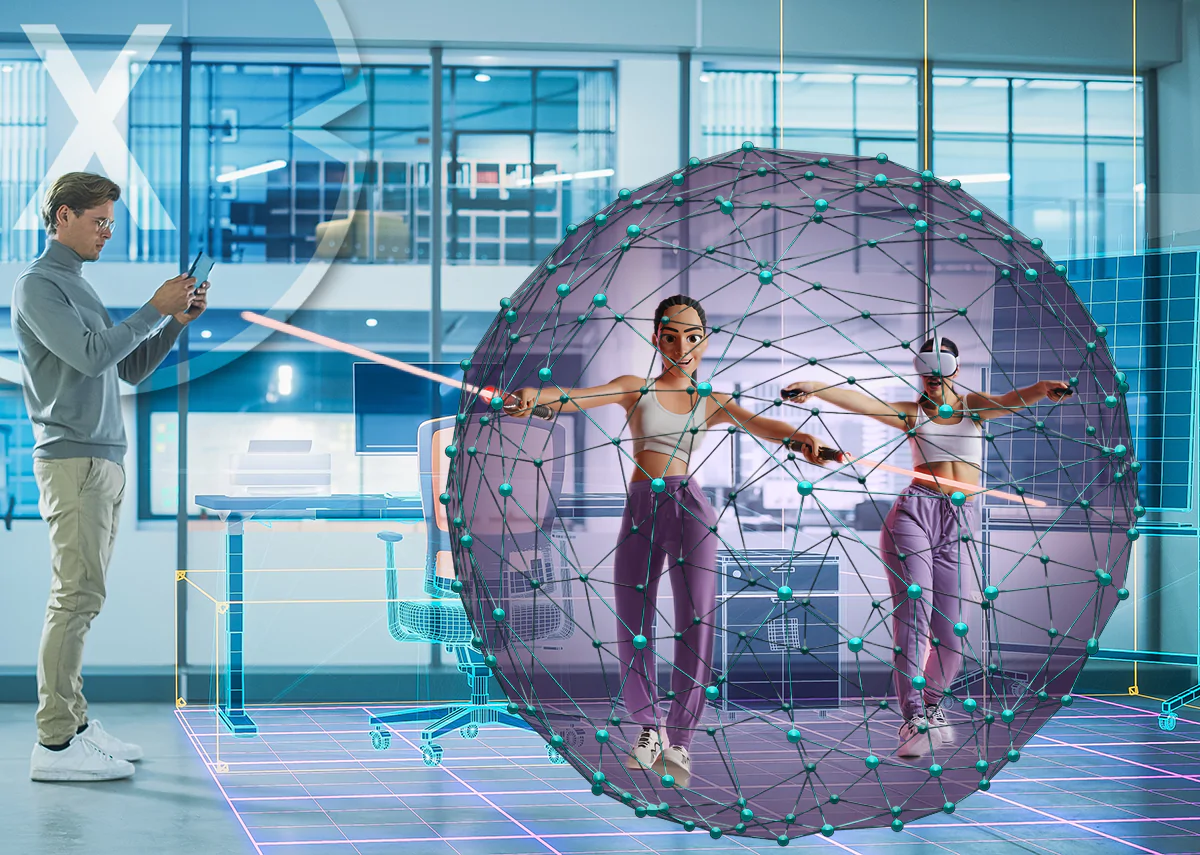
From prompt to simulation: Why Genie 3 is the missing piece for extended reality and intelligent robots – Image: Xpert.Digital
Extended Reality | Google Genie 3 for VR/AR: Create complete three-dimensional worlds from a simple text prompt
### Google DeepMind: New AI generates endless training data for the industry ### Content creation revolution: When an AI dreams entire video game levels ### Beyond Sora and Runway: Why Google's Genie 3 is technologically in a league of its own
The boundaries of digital creation are shifting: How Google Genie 3 is revolutionizing the creation of virtual realities and the training of artificial intelligence.
The concept sounds like something out of a futuristic novel: A user enters a simple text prompt, and an artificial intelligence generates, in real time, not just a flat video, but a fully navigable, physically coherent three-dimensional world. With the unveiling of **Genie 3** by Google DeepMind, this vision has left the realm of science fiction and become technological reality. But anyone who thinks of this innovation merely as the next stage of video game development or consumer electronics is vastly underestimating the significance of this breakthrough.
Genie 3 marks a paradigm shift that goes far beyond mere graphical gimmicks. It is a so-called "world model" that, through the analysis of massive amounts of video footage, has developed an intuitive understanding of physics, object permanence, and causality. Unlike its predecessors or pure video generators like OpenAI Sora, Genie 3 creates persistent environments in which objects remain even when they leave the field of view. This ability to simulate consistent realities positions the technology as a potential key to one of the biggest problems in modern AI research: the lack of training data for robotics.
In the following analysis, we not only examine the impressive technical specifications of this system, but also delve deeply into its economic implications. From the democratization of game development and the multi-billion dollar market for digital twins to the strategic race against giants like NVIDIA – we demonstrate why Genie 3 is finally blurring the lines between fiction and industrial value creation, and what role it plays on the path to artificial general intelligence (AGI).
Simulation as a business model: Why Google's latest stroke of genius is finally blurring the lines between fiction and value creation
The idea of an artificial intelligence that creates complete three-dimensional worlds from a simple text prompt and makes them navigable in real time sounds like science fiction. But with Genie 3, which Google DeepMind presented in a research preview report on August 5, 2025, this vision has become technological reality. However, the implications of this development can only be understood by looking beyond the technical specifications and considering the fundamental economic shifts triggered by such world models. What initially appears to be a scientific curiosity reveals itself upon closer examination as a potential turning point in how digital content is produced, how AI systems are trained, and how economic value is generated in an increasingly virtualized economy.
Suitable for:

The technological dimension of the paradigm shift
Genie 3 represents the third evolution of a model series that Google DeepMind has been developing for several years. While the original Genie model could only extract rudimentary two-dimensional environments from video footage, and Genie 2 already generated initial three-dimensional spaces lasting ten to twenty seconds, Genie 3 marks a significant leap in both quantity and quality. The system creates interactive environments with a resolution of 720p at 24 frames per second and maintains these worlds coherently for several minutes. This seemingly marginal improvement in duration is actually crucial, as it enables, for the first time, longer interaction sequences and more complex tasks.
The technical architecture is based on an autoregressive model that generates each frame individually, drawing on the entire previous sequence. This design allows the system to develop an emergent visual memory function that is not explicitly programmed but arises from scaling and training. Objects located outside the field of view remain consistent in the model's memory, so that upon returning to the original location, the environment is found unchanged. This capability fundamentally distinguishes Genie 3 from pure video generators like Sora or Runway Gen-3, which, while capable of producing impressive visual sequences, do not establish a persistent, interactive spatiality.
The model was trained on massive amounts of video footage, though DeepMind has not released detailed information on the exact data volume or model size. It is known, however, that the system developed an intuitive understanding of physical laws through self-supervised learning, without requiring explicit coding. Unlike traditional physics engines such as PhysX, which rely on mathematical equations, Genie 3 learns the rules of gravity, object interaction, and motion dynamics from observation. This approach presents both advantages and risks: while it allows for unprecedented flexibility and generalizability, it also leads to occasional physical inconsistencies that can be problematic in critical applications.
The economic infrastructure of synthetic training data
Genie 3's central economic significance lies in its function as a generator of synthetic training data for AI systems. The development of artificial intelligence, particularly in the areas of embodied AI and robotics, is increasingly encountering a fundamental limitation: the lack of high-quality, diverse training data. While text-based models have been able to draw upon the entire digital text corpus of humankind, systems that must operate in the physical world rely on interaction experiences that are costly, time-consuming, and sometimes dangerous to obtain.
Google DeepMind explicitly positions Genie 3 as a solution to this problem. Combined with the SIMA-2 system, a Gemini-based generalized agent capable of navigating and performing tasks in virtual worlds, a closed loop is created: Genie 3 generates an unlimited number of diverse training environments, SIMA-2 interacts with these environments, learns from its experiences, and continuously improves. This self-reinforcing loop could fundamentally change the traditional development path for robotics and autonomous systems. Instead of spending months collecting data in the real world, which involves significant safety risks and costs for autonomous vehicles or industrial robots, developers can generate millions of simulation hours in controlled virtual environments.
The economic implications of this shift are considerable. The global market for digital twins and simulation technologies is estimated by MarketsandMarkets to reach $110.1 billion by 2028, although different analysts use varying definitions and forecasts. Genie 3 could accelerate the adoption rate of such technologies by drastically lowering the barriers to entry for creating interactive simulation environments. While traditional approaches require specialized 3D artists, game designers, and physics programmers, Genie 3 enables the generation of training scenarios through simple text descriptions. This democratization of content production has the potential to shorten development cycles and increase the speed of innovation.
This development is particularly relevant for industries where the sim-to-real-world transfer problem has previously been a bottleneck. In logistics automation, where autonomous mobile robots must navigate warehouses, or in industrial assembly, where collaborative robot arms interact with human workers, training environments generated by Genie 3 could significantly reduce development costs. Several studies indicate that simulation-based training can reduce deployment costs for digital twins by up to thirty percent, enabling shorter return-on-investment cycles.
Market structures and competitive dynamics
The launch of Genie 3 comes in an increasingly competitive landscape for AI-driven world models and simulation technologies. On one side are traditional vendors like NVIDIA with its Omniverse platform, which is based on physically accurate simulations and tightly integrated with OpenUSD standards and hardware-based acceleration. NVIDIA positions Omniverse as an operating system for physical AI and targets the estimated $50 trillion market for industrial digitization. The platform is already used by over 300,000 users and has achieved 252 enterprise implementations, with companies like BMW, Amazon, General Motors, and Siemens reporting quantifiable ROI.
On the other hand, there are game development-oriented solutions like Unity and Unreal Engine, each pursuing its own AI integration path. Unity offers simulation functionalities in Google Cloud, while Unreal Engine scores points with high-resolution graphics but demands a five percent revenue share for projects over one million dollars. However, none of these providers has yet demonstrated a neural world model approach at the scale and quality of Genie 3.
Google DeepMind's strategic positioning is noteworthy. While NVIDIA focuses on industrial precision and interoperability, and Unity and Unreal Engine build on established developer ecosystems, Google pursues a generalist approach with Genie 3, relying on emergent capabilities through scaling. This strategy reflects the company's broader philosophical orientation, which assumes that sufficiently large models can develop complex capabilities without explicit programming. The success of this approach has not yet been definitively proven empirically, particularly regarding the reliability and predictability required for industrial applications.
Interestingly, Google positions Genie 3 not as a direct competitor to Omniverse or Unity, but as a complementary technology that unlocks new use cases. While NVIDIA focuses on deterministic physics engines and precise CAD integration, Genie 3 aims for rapid prototyping, diverse scenario generation, and flexible adaptability. A collaboration between these ecosystems seems quite plausible, with Genie 3 being used for exploratory phases and variant generation, while Omniverse would be used for final implementation and precise simulation.
In the realm of video generation, Genie 3 indirectly competes with systems like OpenAI Sora and Runway Gen-3, with the fundamental differentiation lying in interactivity. Sora is optimized for cinematic quality and passive viewing, focusing on storytelling and visual coherence across longer sequences. Runway Gen-3 offers creative control and artistic freedom for shorter clips. Genie 3, on the other hand, generates navigable spaces with persistent physics, representing a completely different use case. This distinction is crucial for understanding its market positioning: Genie 3 primarily addresses simulation infrastructure, not content creation.
Industrial application scenarios and value chains
The practical applications for Genie 3 span multiple economic sectors, each with specific value drivers and implementation challenges. In game development, the technology could be particularly transformative for independent studios. Average development costs for AAA titles have multiplied over the past two decades, with modern blockbuster games reaching budgets of several hundred million dollars. A significant portion of these costs is allocated to asset creation, level design, and the implementation of physics systems. The AI-powered game generation market is projected to reach $21.26 billion by 2034, with an annual growth rate of 29.2 percent.
For smaller studios working with limited budgets, Genie 3 could democratize access to high-quality game worlds. However, its current limitations are significant: the generated environments are limited to a few minutes of coherence, physics accuracy is inconsistent, and gameplay options are primarily restricted to navigation. Realistic expectations suggest that Genie 3 will be used more for rapid prototyping and concept visualization than for final gameplay in the near future. Developers could quickly generate environments to validate ideas before investing in costly production with traditional game engines.
In the education sector, Genie 3 opens up possibilities for immersive learning experiences. Instead of using static textbooks or two-dimensional videos, students could experience historical events in walk-through virtual reconstructions, navigate through biological ecosystems, or manipulate physical phenomena in real time. Educational research consistently shows that interactive, experience-based learning methods lead to higher retention and deeper understanding, especially among visual and kinesthetic learners. The ability to generate individualized learning environments for each student could take personalized learning to a new level, with the costs of such individualization drastically reduced through automated generation.
However, the practical hurdles should not be underestimated. Educational institutions typically operate with limited IT budgets, and the computing resources required by Genie 3 are substantial. The system currently runs exclusively in the cloud and is not available for public use, but only as a limited research preview for selected academics and creative professionals. Even if broader availability were achieved, licensing models, data privacy issues, and pedagogical integration strategies would need to be resolved before mass adoption in schools would be realistic.
Corporate and professional training represent another promising area of application. Organizations invest billions annually in employee training, yet many scenarios are difficult, dangerous, or costly to replicate in the real world. Emergency drills, operational safety training, machine handling, and customer interaction simulations could be generated using Genie 3, with promptable events allowing for the spontaneous introduction of complications and preparing employees for unexpected situations. Several companies have already implemented AI-powered simulations for warehouse management and logistics optimization, with documented efficiency gains ranging from 30 to 70 percent.
Robotics development is perhaps the most economically significant application area. Developing autonomous systems typically requires extensive testing phases in controlled environments, followed by gradual implementation under real-world conditions. This process is time- and resource-intensive. Google DeepMind demonstrated that SIMA-2 agents can navigate Genie-3 worlds and perform tasks they have never seen before, demonstrating unprecedented generalization capabilities. If these capabilities could be transferred to physical robots, it would dramatically shorten development cycles.
The challenge of sim-to-real-world transfer remains considerable, however. Historically, robots trained in simulation have often struggled when placed in the messy, unpredictable real world. Genie 3's physics accuracy is not on par with specialized simulators, meaning that guidelines learned in Genie worlds may not be directly transferable to real-world hardware. Nevertheless, Genie 3 could serve as a complementary data source, diversifying existing training methods and generating edge cases that are rare in the real world but important for robustness.
🗒️ Xpert.Digital: A pioneer in the field of extended and augmented reality
Find the right Metaverse agency and planning office such as a consulting firm - Image: Xpert.Digital
🗒️ Find the right Metaverse agency and planning office such as a consulting firm - search and search for top ten tips for consulting & planning
More about it here:
From mega-deals to job transformation: The economic explosiveness of Genie 3 and world models
Economic implications and labor markets
The broader economic impact of world-model AI such as Genie 3 extends to labor markets, productivity gains, and industrial restructuring. The global AI market is estimated by various analysts at different sizes, ranging from $638 billion in 2025 to $3.68 trillion in 2034, with annual growth rates between 19 and 31 percent. Generative AI, specifically, is growing at a CAGR of 22.9 percent, reaching valuations that reflect the transformative nature of the technology.
Venture capital investments are showing a dramatic shift toward AI-related megadeals. According to WIPO data, the global VC deal value surged from $83.5 billion in the third quarter of 2024 to $120.7 billion in the third quarter of 2025, a 45 percent increase, with AI now accounting for 53 percent of total VC deal volume, up from 32 percent the previous year. This concentration is driven by a small number of very large deals, including funding for OpenAI ($6 billion), xAI ($11 billion), and Anthropic ($8 billion in 2024, $13 billion in 2025). Geographically, the investment is heavily concentrated in the United States, which will account for nearly 70 percent of global VC investments in 2025, while Asia's share has fallen from 30 percent in 2023 to just 13 percent.
These investment patterns reflect the belief that generative AI, and world models in particular, will have fundamental economic impacts. Valuing Genie 3 specifically is difficult, as it is an internal Google DeepMind project, not an independent startup. Nevertheless, Google's strategic priorities suggest that the company views world models as a critical building block on the path to general artificial intelligence, which in turn is seen as key to the next stage of economic productivity.
The impact on labor markets is complex and ambiguous. On the one hand, certain professions could be threatened by automation. 3D artists, level designers, environment designers, and technical artists in the gaming industry might find their skills partially replaced by AI generation. Similarly, roles in the creation of training simulations or educational content could be restructured. Historically, technological disruptions have always caused transition costs in the form of job displacement, with the speed of transformation often being crucial to the social impact.
On the other hand, new categories of work are emerging. Prompt engineering for world generation, quality assurance for synthetic training data, AI agent training and supervision, and the integration of world models into existing production pipelines require new skills and create new roles. Furthermore, productivity gains from cheaper, faster content production could expand the overall size of markets, creating additional demand for human creativity and strategic planning. The net effect of these developments is difficult to determine ex ante and will depend on regulation, educational policy, and the speed of technological diffusion.
Regulatory challenges and ethical dimensions
The development of technologies capable of generating realistic synthetic worlds raises significant ethical and regulatory questions. The deepfake problem, previously discussed primarily in the context of faces and voices, is expanding to encompass entire environments. The ability to create convincing virtual scenarios that are virtually indistinguishable from real-world recordings creates potential for disinformation, manipulation, and fraud. An actor could theoretically stage fake events in seemingly authentic environments, with the persistence and interactivity of Genie-3 worlds potentially increasing the persuasiveness of such forgeries.
Google DeepMind is aware of these risks and has chosen a cautious rollout approach. Genie 3 is currently only available as a limited research preview for a small group of academics and creatives, without a public release date. This phased rollout allows the company to gather feedback, identify risks, and develop security measures before considering wider availability. DeepMind emphasizes its commitment to responsible development and limiting unintended impacts, and continuously evaluates the practical implementation of these principles.
The question of intellectual property rights to AI-generated worlds remains legally unresolved. Who owns an environment generated by Genie 3? The user who entered the prompt? Google DeepMind as the model's developer? Or the creators of the training data on which the model is based? Different jurisdictions are developing different approaches to AI-generated content, with the EU establishing regulatory frameworks through the AI Act and the US through various state initiatives. This uncertainty could delay commercial implementation, as companies prefer legal clarity before making substantial investments.
Bias and representation in trained models pose a further ethical challenge. Because Genie 3 was trained on extensive video datasets representing human content, societal biases and stereotypes could be embedded in the generated worlds. If the model under- or overrepresents certain demographic groups, cultural contexts, or socioeconomic realities, the synthetic training data it produces could reinforce these biases. Using such data to train further AI systems could create a self-reinforcing cycle that perpetuates existing inequalities. Transparency regarding training data, bias audits, and mechanisms for correcting systematic biases are therefore essential for ethically sound implementations.
The environmental impact of large AI models has received increasing attention. Training and operating systems like Genie 3 require significant computing resources and, consequently, energy. While DeepMind has not published specific figures on training costs or energy consumption, it is known that large-scale models require millions of GPU hours and leave a corresponding carbon footprint. Real-time generation of 720p video at 24 frames per second is computationally intensive, which would make operating costs and environmental impact significant with widespread use. Efficiency optimizations, renewable energy sources for data centers, and the balancing of benefits against environmental costs are all part of the responsibility discussion.
Long-term strategic perspectives and AGI implications
Google DeepMind explicitly positions Genie 3 as a building block on the path to general artificial intelligence. The ability to simulate consistent, interactive worlds is considered a fundamental element of intelligence. True understanding requires not only pattern recognition but also the grasp of causality, the anticipation of consequences, and the navigation of complex, dynamic environments. A system that demonstrates these capabilities shows a deeper level of world understanding than one that merely learns static correlations.
The integration of Genie 3 with SIMA 2 and the Gemini models demonstrates the broader strategic vision. Gemini provides multimodal understanding capabilities and advanced reasoning, SIMA 2 offers agent-based interaction capabilities, and Genie 3 provides the environments in which these capabilities can be developed and tested. This combination creates a feedback loop in which agents learn in synthetic worlds, contribute their experiences to improving the world models, and iteratively develop more robust capabilities. The vision is that such systems can eventually be transferred to physical robots and real-world scenarios, enabling embodied AI assistants that operate safely and effectively in human environments.
The timeline for these developments is highly uncertain. While the technological advances are impressive, fundamental challenges exist. The sim-to-real gap is larger than often assumed, physical inconsistencies in simulated worlds can lead to flawed policies, and generalizing from virtual to real environments requires more than just visual similarity. Furthermore, many of the skills required for AGI, such as abstract reasoning, social intelligence, and genuine language comprehension, are not adequately addressed in world models alone.
Nevertheless, this strategic direction is revealing for understanding the economic priorities of large tech companies. Google is investing heavily in this area because the potential returns are enormous. A system that truly demonstrates generalized intelligence would transform virtually every sector of the economy. The market capitalizations of companies that achieve such breakthroughs would rise accordingly. This explains the intense competition and the billion-dollar investments we are currently witnessing. In this context, Genie 3 is a strategic move that positions Google in the race for AGI, regardless of whether the specific system is directly monetized.
The competitive dynamics among the major AI labs are remarkable. OpenAI, with GPT and DALL-E, pursues a different approach, focusing more on language-based interfaces and generative creativity. Anthropic emphasizes safety and constitutional AI. DeepMind, with its heritage in reinforcement learning and games, has a natural focus on agents and environments. These strategic differentiations reflect differing theories about which path is most likely to lead to AGI, and markets are betting accordingly through their capital allocation.
Hybrid instead of replacement: Why Genie 3 could merge with Omniverse and game engines to form a new AI stack
The analysis of Genie 3 reveals a complex picture of technological possibilities, economic potential, and practical challenges. The system represents a genuine advancement in the ability to generate interactive, coherent virtual worlds, opening up new use cases in training, education, game development, and research. Its central economic proposition lies in the dramatic reduction in the costs of generating synthetic training data and simulated environments, which could accelerate innovation cycles and drive the development of embodied AI systems.
At the same time, the current limitations are significant. Interaction duration is limited to a few minutes, physics accuracy is inconsistent, complex multi-agent scenarios are not robustly manageable, and the geographical accuracy of real-world locations is insufficient. These limitations restrict immediate commercial applicability and mean that Genie 3 will remain primarily a research tool for the time being. The lack of public availability and an unclear monetization strategy add further uncertainty.
Genie 3's market positioning is not intended as a direct replacement for existing solutions, but rather as a complementary technology that provides new capabilities. Combined with precise physics simulators like NVIDIA Omniverse or traditional game engines, a hybrid approach could emerge, leveraging the strengths of different systems. The competitive landscape is likely to consolidate, with partnerships and integrations between various technology stacks.
The broader economic implications depend on factors beyond pure technology: Regulatory frameworks will determine how quickly and in what form such systems can be deployed. Educational policy will influence whether and how world models are integrated into learning environments. Labor market policy and social security systems will determine adaptability to technology-driven job shifts. And ethical standards and societal norms will define which applications are acceptable.
For companies, this means that a watchful-waiting strategy might be appropriate. Early experimentation with world models in controlled pilot projects can enable organizational learning and build technical expertise without incurring substantial risks. Identifying specific use cases where current limitations are not critical allows for incremental value creation. At the same time, technological developments should be continuously monitored, as the rate of improvement in AI systems has historically been exponential, and Genie 4 or subsequent versions may overcome current limitations.
For investors, world models and related technologies represent exposure to fundamental trends in AI and digitalization. Valuations are already high, which makes risk-return calculations complex. Diversification across different approaches and companies seems advisable, as it is unclear which specific technological path will prevail. The long-term nature of investment horizons should be emphasized, since many of the most transformative effects will only materialize over years or decades.
For society as a whole, the development of such powerful synthetic world generators requires an informed public debate about desired regulation, ethical boundaries, and the distribution of benefits and costs. Technological capability alone does not determine social outcomes; these are shaped by collective decisions and institutional frameworks. Finding a balance between innovation and caution, between economic dynamism and social stability, is the central political challenge of the AI age, and Genie 3 is a concrete example where these questions crystallize.
The long-term economic significance of Genie 3 will depend on overcoming current technical limitations, developing robust applications that deliver real added value, and addressing ethical and regulatory challenges. If these conditions are met, the technology could indeed mark a turning point in digital content production and the development of artificial intelligence. If not, it will remain a fascinating research artifact that has provided important insights into the possibilities and limitations of neural world modeling but has not triggered a broad economic transformation. The coming years will reveal which scenario unfolds.
Your global marketing and business development partner
☑️ Our business language is English or German
☑️ NEW: Correspondence in your national language!

Konrad Wolfenstein
I would be happy to serve you and my team as a personal advisor.
You can contact me by filling out the contact form or simply call me on +49 89 89 674 804 (Munich) . My email address is: wolfenstein ∂ xpert.digital
I'm looking forward to our joint project.
☑️ SME support in strategy, consulting, planning and implementation
☑️ Creation or realignment of the digital strategy and digitalization
☑️ Expansion and optimization of international sales processes
☑️ Global & Digital B2B trading platforms
☑️ Pioneer Business Development / Marketing / PR / Trade Fairs
🎯🎯🎯 Benefit from Xpert.Digital's extensive, five-fold expertise in a comprehensive service package | BD, R&D, XR, PR & Digital Visibility Optimization

Benefit from Xpert.Digital's extensive, fivefold expertise in a comprehensive service package | R&D, XR, PR & Digital Visibility Optimization - Image: Xpert.Digital
Xpert.Digital has in-depth knowledge of various industries. This allows us to develop tailor-made strategies that are tailored precisely to the requirements and challenges of your specific market segment. By continually analyzing market trends and following industry developments, we can act with foresight and offer innovative solutions. Through the combination of experience and knowledge, we generate added value and give our customers a decisive competitive advantage.
More about it here: