

Published on: June 11, 2025 / update from: June 11, 2025 - Author: Konrad Wolfenstein
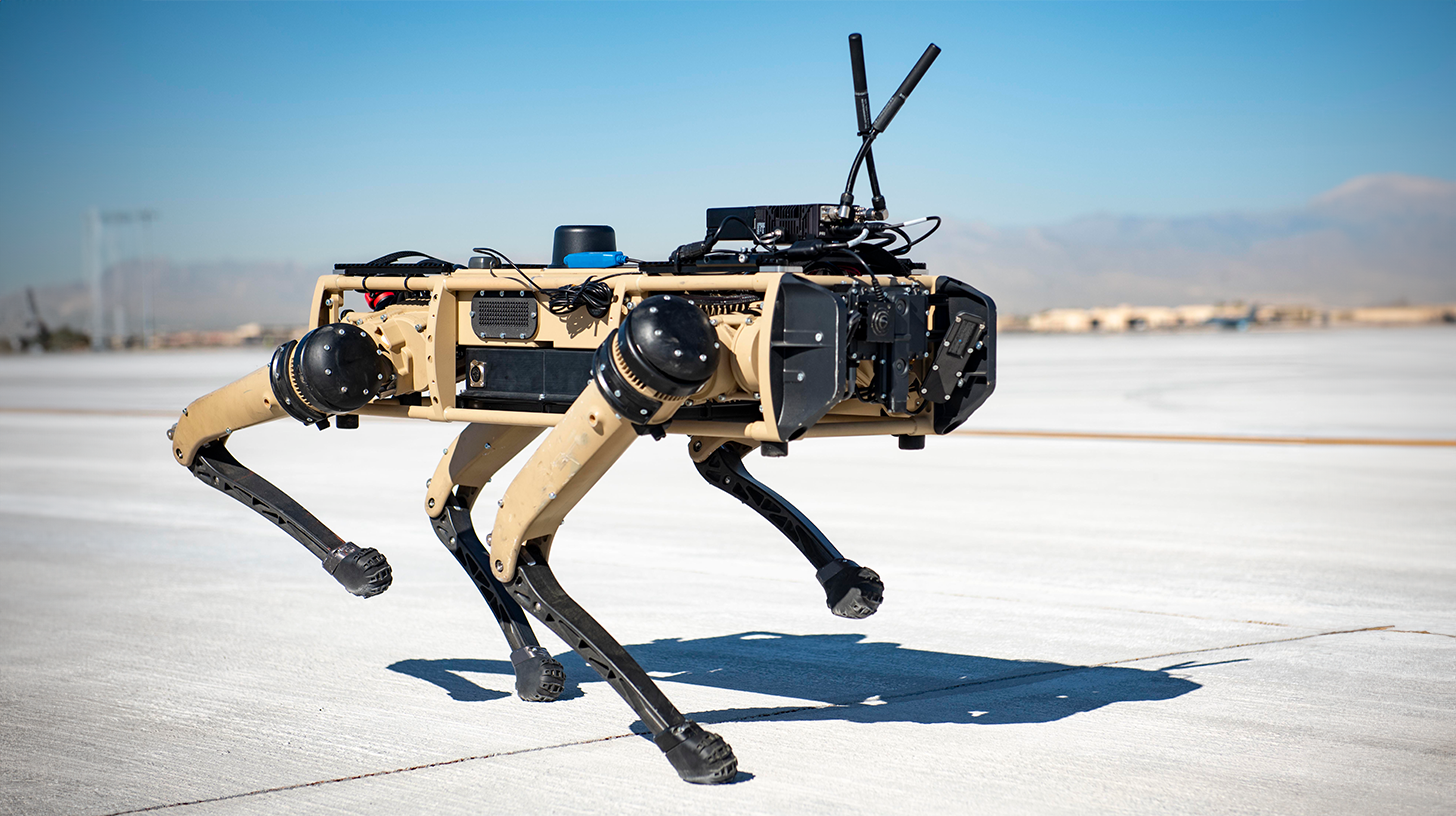
The smart Bundeswehr Hightech robot dog Ghost Vision 60 from the US manufacturer Ghost Robotics-Image: Air Force Airman First Class Zachary Rufus
Strategic procurement: German armed forces test American screaming robots for reconnaissance missions
German armed forces use robot dog technology for improved mining and terrain analysis
The German Bundeswehr has taken an important step to modernize its unmanned soil systems by gaining four GHOST Vision 60 scream robots from the US manufacturer Ghost Robotics. This procurement was made via Thuringian ATC SiPro GmbH as an importer and represents a strategic expansion of the existing robot dog capacities, which were previously mainly represented by the Boston Dynamics Spot model “Wolfgang 001”. The new systems are to be used primarily for testing purposes, with spy tasks and mining education identified as priority fields of application. This development underlines the striving for the Bundeswehr to modernize its technological equipment and to meet the requirements of contemporary warfare.
Suitable for:

Procurement procedure and strategic classification
The Federal Office for Equipment, Information Technology and Use of the Bundeswehr (BAAINBW) awarded the order to the procurement of the four Ghost Vision 60 systems in September 2024 by direct allocation to ATC SIPRA GmbH. This decision was published on the European awarding platform TED on September 20, 2024 and is based on the unique selling point of the manufacturer's technology. A specific prize was not mentioned in the official communications, but media sources of costs around 150,000 euros per unit report on international comparison values.
The comparatively small number of four systems clearly indicates a test character of the procurement. This corresponds to the usual Bundeswehr procedure for new technologies, which are initially extensively tested before larger procurement volume are realized. A similar procedure could already be observed in the vector drones from the German manufacturer Quantum, where 14 systems were initially ordered for the Bundeswehr, while several hundred were delivered to Ukraine.
The procurement fits into the comprehensive digitization efforts of the Bundeswehr, which are promoted under the motto “digitize or die”. Brigadier general Frank Pieper from the Test Association of the Army for Digitization emphasized in 2021 that the Bundeswehr had to develop technologically quickly in order not to draw the loser in future battles.
Technical specifications and performance features
The Ghost Vision 60 presents itself as a robust and versatile unmanned soil system with impressive technical characteristics. The system weighs 51 kilograms in empty weight and can transport a payload of up to 10 kilograms. With a battery life of up to three hours, the robot dog can reach a range of around 12 kilometers, whereby the practical use time can vary depending on the site and task.
The technical equipment includes five on-board cameras with streaming skills that enable real-time data transmission. In addition, the system has visual cameras and thermal cameras for obstacle detection as well as the possibility of integrating a lidar scanner for card creation. This sensor equipment makes the Ghost Vision 60 a highly developed educational system that can operate even in difficult lighting conditions and in complex terrain.
A major advantage of the system lies in its open architecture, which enables the integration of various payloads up to a weight of 10 kilograms. This flexibility opens up a wide range of uses, from the installation of special sensors to the performing of smaller drones that can be started from the back of the robot dog. The Mont Age and disassembly of the system can be mastered in about 15 minutes, which significantly increases operational flexibility.
The system is certified as a NDAA-compliant and designed for all weather conditions. The supplied software enables users to adapt behaviors and AI shares of the platform according to their specific needs. Using an associated app, users can access the system's cameras and carry out technical diagnostics, which significantly simplifies maintenance and operation.
Planned purposes and testing projects
The Bundeswehr plans to first test the Ghost Vision 60 systems for various mission purposes, whereby the spy tasks and the clarification of miners were identified as priority fields of application. These use scenarios correspond to the proven practices of other armed forces who have already gained extensive experience with similar systems.
Mining enlightenment and disposal of ordnance
A particularly promising area of application lies in the mining enlightenment and consolidation of ordnance. The Bundeswehr has already successfully tested the "Minesweeper" software from ASDRO GmbH from Essen, which was originally developed for the detection of fighter in the building ground. This AI-based analysis software evaluates Sensor data in parallel and visualizes min finds and mines-free through alleys on a card.
The integration of magnetometers, ground radar, infrared and thermal technology as well as AI-based systems on the robot dogs could significantly increase the efficiency of mining education. The possibility is particularly valuable to send the systems remote control into dangerous areas without risking human life. This is of enormous importance, since the exploration of miners is not only time -consuming and requires highly specialized staff, but also extremely dangerous for the wealth of ordnance.
The Bundeswehr's cyber innovation hub is already working on connecting the minesweeper software to the Battle Management System Sataware in order to make collected data and minkoordinates accessible to other troops. This networking would significantly expand the operational possibilities of robot dogs and enable their integration into more complex mission scenarios.
Enlightenment and monitoring tasks
The robot dogs are ideal for educational and monitoring tasks in various environments. Their ability to move in rough terrain such as forest areas or multi-storey buildings offers significant advantages over bike or chain-driven unmanned systems. The thermal cameras and visual cameras enable the examination of buildings or confusing terrain using thermal imaging technology.
The possibility of starting small educational drones from the back of the robot dogs opens up additional tactical options. This combination of various unmanned systems could enable new deployment doctrines in the future, in which floor -assisted and air -supported information merges seamlessly.
Comparison with existing systems: Wolfgang 001
The Bundeswehr has had experience with robot dogs through the “Wolfgang 001” system, a spot model from Boston Dynamics. This system was presented to the public in 2021 as proof of the Modernization efforts of the Bundeswehr and has since been used by the Wehrwissenschaftliche Institute for Work and Operational Substances (WIWEB) for testing purposes.
The comparison between Wolfgang 001 and the new Ghost Vision 60 systems reveals interesting differences in the technical interpretation and strategic positioning. With its empty weight of 51 kilograms, the Ghost Vision 60 looks significantly more massive than the approximately 20 kilogram spot from Boston Dynamics. This weight difference reflects different design philosophies: While Boston Dynamics relies on agility and versatility, Ghost Robotics focuses on robustness and military applications.
A significant difference is the attitude of the manufacturers for military use. Boston Dynamics said in 2022 not to make his “spot” robot into a war dog and rejects military arming. Ghost Robotics, on the other hand, is open to use and developments in the military context. In 2021, a version of the Ghost Vision 60 was presented with an integrated weapon system, the light platform from Sword Defense Systems, known as the Special Purpose Unmanned Rifle (lane).
However, for the Ghost Vision 60 systems procured by the Bundeswehr, “no active component (armament) is intended”. This decision reflects the German position on autonomous weapons systems and the planned purpose as an educational and testing system.
International perspective and operational experience
The international distribution and use of robot dogs in various armed forces offers valuable knowledge for German planning. The US armed forces are considered a pioneer in the use of robot dogs and have been using them for more than a decade for securing bases and as part of the Homeland Security Ministry.
Operations in Ukraine
The experiences from the Ukraine conflict are particularly revealing, where robot dogs are intensively used for educational purposes. The Ukrainian armed forces use the screaming robots primarily for unnoticed education in the field, whereby the systems have proven to be particularly valuable in the front -close areas. It is also interesting to develop flying drones that can transport and stop robot dogs, which opens up completely new tactical options.
These operational experiences are of enormous importance for the Bundeswehr because they provide practical knowledge about the performance and limits of the systems in real combat environments. The Ukraine experiences show that robot dogs are not only technically mature, but can also offer measurable surgical added value.
More international applications
Israel also uses Ghost Vision 60 systems, as well as Japan, which the robot dogs mainly uses to search for spilled for earthquakes. These civilian applications demonstrate the versatility of the platform and possible areas of application beyond purely military missions.
The Israeli armed forces use the systems for both information purposes and for pioneer -specific missions. These experiences are particularly relevant for the Bundeswehr because they provide knowledge about the practical use in different use scenarios.
Future prospects and strategic importance
The procurement of the Ghost Vision 60 systems by the Bundeswehr is more than just a technical modernization - it marks an important step in the strategic realignment of the German armed forces in the area of unmanned systems. The testing of various robot dog platforms enables the Bundeswehr to gain extensive experience and identify the optimal system configuration for German requirements.
Integration into existing systems
A critical success factor will be the integration of robot dogs into existing management and weapon systems. The planned connection of the minesweeper software to the Battle Management System Sitarware already shows the direction in which this integration could develop. Future developments could include complete networking of robot dogs with other unmanned systems, sensor networks and management systems.
The open architecture of the Ghost Vision 60 systems offers significant options for the integration of specialized German or European sensor systems and software. This could lead to the development of a configuration specifically tailored to German requirements, which takes into account both national security interests and technological sovereignty.
Technological development
The rapid development in the areas of artificial intelligence, sensors and energy storage promises significant increases in performance of future robot dog generations. Improved battery technologies could significantly extend the operational time, while advanced AI algorithms would enable more autonomous operations.
Developments in the area of swarm intelligence that could make it possible to use several robot dogs are particularly interesting. Such swarm skills would open up completely new tactical possibilities, from large-scale terrain information to complex mining operations.
Training and doctrine development
The successful integration of robot dogs into the Bundeswehr not only requires technical adjustments, but also the development of new training concepts and deployment doctrines. The previous experience with Wolfgang 001 has already shown that specialized training is required for the operation and tactical use of these systems.
The Bundeswehr must develop concepts on how robot dogs can be optimally integrated into existing troop structures. This includes both the operational level and logistical aspects such as maintenance, repair and spare parts supply.
Challenges and risk factors
Despite the promising opportunities, the introduction of robot dogs also brings considerable challenges. The dependence on US technology raises questions about technological sovereignty, especially in security-critical areas. The Bundeswehr must ensure that it does not get into a one -sided dependence on foreign manufacturers.
The practical testing will show to what extent the advertised performance parameters can be achieved under real operating conditions. The battery life under different weather conditions and ranging types as well as the reliability of the systems in the case of longer operations are particularly critical.
The integration of different sensor systems and data transmission in electronically disturbed environments represent further technical challenges. The Bundeswehr must ensure that the systems remain functional even under the conditions of modern electronic warfare.
The introduction of robot dogs also raises ethical and legal questions, especially with regard to the possible future armament of such systems. Although the currently procured systems are unarmed, there is technically the possibility of subsequent armament. The Bundeswehr must develop clear guidelines for dealing with these options.
Suitable for:

Robot dogs in the Bundeswehr - new era of unmanned information begins
The procurement of four Ghost Vision 60 robot dogs marks an important milestone in the modernization of the Bundeswehr and its skills in the field of unmanned soil systems. This strategic investment complements the existing experience with the Wolfgang 001 system and enables the Bundeswehr to compare and evaluate various technology approaches.
The planned purposes of mining and education address concrete operational challenges and promise significant improvements in soldier security and mission effectiveness. Integration with innovative software solutions such as minesweepers shows the potential for synergetic effects between different technological approaches.
At the same time, this procurement illustrates the need for comprehensive strategic planning for the integration of unmanned systems into the Bundeswehr. The successful use of these technologies not only requires technical competence, but also the development of new deployment doctrines, training concepts and organizational structures.
International experience, especially from the Ukraine conflict, shows both the enormous potential and practical challenges when using robot dogs in real battle environments. The Bundeswehr is well positioned to learn from these experiences and to develop its own concepts tailored to German requirements.
In the long term, the successful integration of robot dogs could be an important building block in the comprehensive digitization and modernization of the Bundeswehr. The combination of proven German engineering and innovative international technologies promises the development of solutions that meet both the operational requirements and the strategic goals of German security policy.
Suitable for:
Your global marketing and business development partner
☑️ Our business language is English or German
☑️ NEW: Correspondence in your national language!

Konrad Wolfenstein
I would be happy to serve you and my team as a personal advisor.
You can contact me by filling out the contact form or simply call me on +49 7348 4088 965 (Munich) . My email address is: wolfenstein ∂ xpert.digital
I'm looking forward to our joint project.


