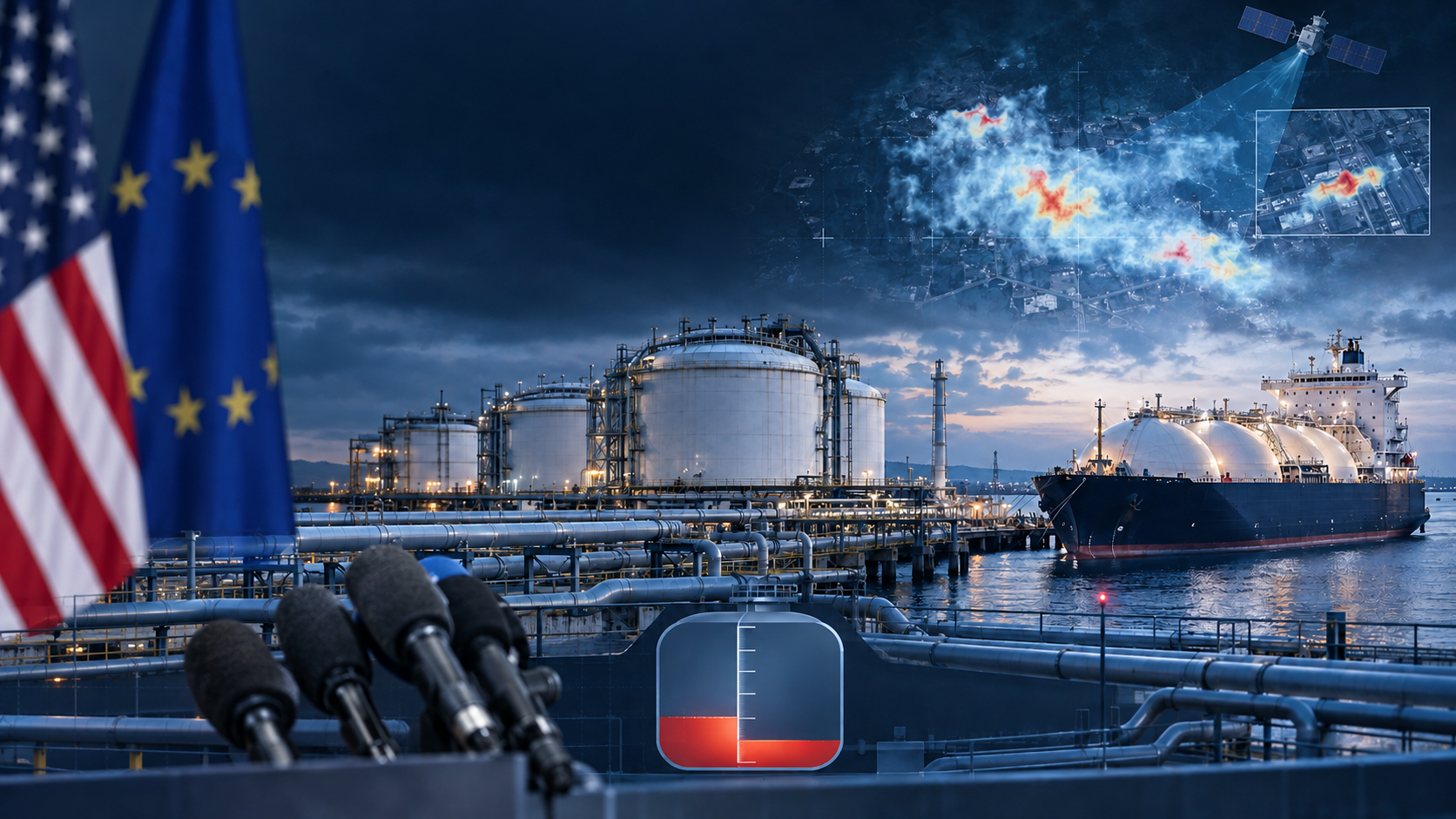
Is a gas shortage looming this winter? The bizarre dispute surrounding Minister Reiche – a creative image on the topic, created with AI: Xpert.Digital
Are methane regulations to blame for empty storage facilities? The big misconception in the gas debate
After meeting in Houston: How Katherina Reiche wants to slow down new EU climate rules
Fears for the winter of 2026? Why Germany's gas storage facilities are really so empty
Germany's gas storage facilities will be emptier in September 2026 than they have been in a long time – and a fierce political battle over who is to blame has already erupted. At the center of the criticism: Federal Minister of Economics Katherina Reiche and her proposal to postpone an ambitious European methane regulation for years. While the fossil fuel industry warns of a massive collapse in gas imports from 2027 onwards, and the minister insists on necessary crisis preparedness, environmental groups accuse her of prioritizing purely lobbyist interests over climate protection. But what is the truth behind these dire predictions? A closer look at the data and facts reveals that those who blame EU regulations for the current storage slump are confusing cause and effect. This is an in-depth analysis of dangerous myths, geopolitical dependencies, and the pressing question of how Germany can safely navigate the coming winters.
Methane regulations, gas storage facilities and the controversy surrounding Katherina Reiche: Those who make the EU regulation the scapegoat are confusing climate policy with crisis preparedness
The debate over the European methane regulation has become a proxy conflict about Germany's energy policy. On the one hand, there are concerns that additional documentation and testing requirements could deter suppliers in a strained global market, drive up prices, and make natural gas procurement more difficult. On the other hand, there are accusations that some politicians and the fossil fuel industry are exaggerating these risks in order to retroactively weaken a climate protection rule already adopted in 2024. Both sides address real problems, but the two debates are often so intertwined that cause, risk, and political responsibility can no longer be clearly distinguished.
The key economic finding is this: the low German storage levels in September 2026 represent a serious precautionary risk, but are not convincing evidence that the EU methane regulation is already causing a physical gas shortage. At the same time, it would be too simplistic to dismiss all concerns from importers and exporters as mere lobbying. The regulation contains demanding requirements, its practical implementation is not yet legally sound in all respects, and the EU is more dependent on flexibly traded liquefied natural gas than before the energy crisis. However, this does not automatically imply a link between regulation and supply disruption. The crucial question is whether authorities, importers, and producers can organize the transition phase in such a way as to increase transparency and reduce emissions without unnecessarily pushing readily available quantities out of the European market.
A technical rule becomes a power struggle
In September 2026, German Federal Minister for Economic Affairs and Energy Katherina Reiche traveled to Houston for the G20 energy ministers' meeting. The Federal Ministry for Economic Affairs and Energy focused the trip on reliable and affordable energy; on the sidelines of the meeting, Reiche issued a press statement on security of supply and price developments. The location carries significant symbolic weight. Houston is not only a host of international energy diplomacy but also a global center for the oil and gas industry. Statements about European import regulations are therefore perceived there simultaneously as German government policy, a signal to American producers, and a domestic political statement.
The conflict goes back further. In March 2026, Reiche attended CERAWeek in Houston and, according to published documents, met with representatives from BP, ExxonMobil, and the American Petroleum Institute, among others. Afterwards, she advocated for a pragmatic application or a postponement of the import rules. In July, she publicly stated that the European Commission recognized significant legal uncertainty and potential risks to security of supply; therefore, it intended to postpone the relevant import regulations by three years.
This transformed a technically complex regulation into a political battle over direction. The Ministry of Economic Affairs considers supply, prices, competitiveness, and contractual capacity to be the core of its remit. The Ministry of the Environment, on the other hand, must simultaneously ensure the effectiveness of climate policy and its implementation in accordance with European law. Such a conflict of objectives is not unusual in a coalition government. It only becomes problematic when internal departmental differences appear as a pre-agreed government position or when objectively distinct risks are publicly linked. This is precisely where the criticism of Reiche's communication begins.
What will really apply from 2027 onwards
Regulation (EU) 2024/1787 entered into force on 4 August 2024. It covers methane emissions in the energy sector and, in addition to European production, gradually includes imports of crude oil, natural gas, and coal. The rules do not require a uniform maximum emission limit for all deliveries from day one. Instead, implementation follows a phased approach, including information obligations, equivalent measurement, reporting and verification, and later requirements regarding methane intensity.
Since May 2025, importers have been required to submit information to the relevant national authorities regarding producers, supply routes, measurement methods, independent audits, and measures against leaks, discharges, and flaring. From January 1, 2027, for supply contracts concluded or renewed on or after August 4, 2024, they must demonstrate that measurement, reporting, and verification measures equivalent to European requirements are in place at the producer level. Alternatively, qualified reporting according to the highest level of the OGMP 2.0 standard, with independent verification, can serve as proof.
For older contracts, no identical stringent proof is required. Importers must make all reasonable efforts to meet the relevant requirements, document their efforts, and provide a comprehensible explanation for any failure. From August 2028, reporting on the methane intensity of production will follow. Binding upper limits for methane intensity will only become applicable to newly concluded or renewed contracts from August 2030. This staggered approach is crucial for economic evaluation. Anyone giving the impression that all gas that is not fully certified will no longer be allowed to enter the EU from January 1, 2027, is describing the legal situation too generally.
No import ban overnight
The regulation is not a classic embargo and does not establish a barrier at the turn of the year 2026/2027 that would automatically lead to the rejection of physical gas shipments. The European Commission has explicitly stated that violations should not result in a blanket import ban. Instead, effective, proportionate, and dissuasive sanctions, to be determined by the member states, are provided for. This approach differs fundamentally from a quantity-based ban: it increases the legal and financial risk of a shipment, but does not automatically prevent it.
This distinction is important from an economic perspective because companies don't always react to regulation by withdrawing from the market entirely. They can provide additional data, adjust contracts, commission independent auditors, reallocate supply chains, factor costs into prices, or temporarily accept the risk of sanctions. Only when uncertainty, expected penalties, and conversion costs appear higher than the profit margin of the European business does a rerouting of cargo become likely. The decisive variable is therefore not just the existence of a regulation, but the expected enforcement practice.
In July 2026, the Commission recommended that Member States suspend sanctions for breaches of import requirements for the years 2027 to 2029, provided this is necessary to safeguard security of supply. The substantive obligations are to remain in place. This combination is intended to force companies to adapt without provoking an abrupt disruption of supplies during a period of geopolitical tension. A three-year postponement of obligations, as demanded by Reiche, and a temporary, coordinated restraint in sanctions are not economically equivalent. The first option weakens the pressure to adapt, while the second maintains the objective and simultaneously reduces the short-term risk of default.
How to correctly interpret the four percent figure
An analysis by Data Desk plays a central role in the political debate. According to this analysis, long-term gas contracts concluded after the cut-off date in August 2024, and subject to stricter requirements in 2027, account for approximately 13 billion cubic meters. This would correspond to about four percent of European gas consumption; by 2030, the share would rise to approximately eight percent. This figure contradicts the claim that the strictest contract requirements would immediately affect a large portion of the entire EU gas market.
However, this figure is often overgeneralized. It does not refer to a flat four percent of all oil and gas imports, but rather to a modeled share of gas consumption or to identified long-term gas contracts. Portfolio contracts and spot purchases are not fully included in this narrow definition. LNG, in particular, is frequently traded via portfolios: A supplier pools quantities from several production areas, liquefies them in various facilities, and only decides on the target market later. Therefore, clearly attributing this to a specific producer can be more difficult than with a long-term pipeline contract.
The data desk analysis thus convincingly refutes the particularly dramatic scenario of an immediate, widespread supply stoppage. However, it does not prove that there is no implementation risk whatsoever. Its economic value lies primarily in limiting the scale of the directly affected segment and highlighting existing compliant quantities or those on the path to compliance. The four percent figure alone is insufficient proof of a completely risk-free implementation. Sound policy should neither ignore it nor use it as a universal answer to every contractual and supply chain issue.
Why industry calculates higher risks
On the other side is an analysis commissioned by industry associations and conducted by Wood Mackenzie. It concluded that by 2027, up to 43 percent of EU gas imports and 87 percent of crude oil imports could face difficulties complying with the rules. These figures seem dramatic, but they measure something different than the Data Desk estimate. While Data Desk limits the scope of strict obligations based on the contract structure, the industry analysis focuses more on which current supply volumes, under a very strict interpretation, might not be able to provide full proof of equivalence in time.
The difference is not a mere calculation error, but rather the expression of different assumptions. Crucial factors include the handling of old contracts, the assessment of reasonable efforts, the management of mixed portfolios, the availability of independent auditors, the acceptance of OGMP data, and the specific sanctioning practices. Anyone who assumes complete non-compliance with every data gap and derives a risk quantity from it will inevitably arrive at a high value. Those who only record clearly newly concluded long-term contracts and consider flexible deliveries as replaceable will arrive at a significantly lower risk assessment.
Furthermore, there is an obvious conflict of interest: An expert opinion financed by oil and gas associations is not automatically wrong, but its questions and assumptions must be examined with particular transparency. The same applies, conversely, to analyses by climate policy-oriented organizations. The robust conclusion lies between these extremes. A physical disruption of 43 percent of gas imports is highly unlikely given the legal framework, transitional rules, and potential suspension of sanctions. However, the need for administrative adjustments, additional costs, and temporary uncertainty regarding certain types of contracts are real.
The real bottleneck lies in the storage facilities
Germany's short-term winter storage capacity is primarily determined by the actual storage level, daily import volume, temperature trends, and demand. At the beginning of September 2026, German storage facilities were only about 53 percent full. This was the lowest level recorded at this time since the start of the fifteen-year data series. The storage association INES estimated that, under favorable conditions, a maximum of about 77 percent could be achieved by November 1st, while with a consistently slow filling rate, a level of around 63 percent would be more likely.
On September 20, the reported fill level was 56.26 percent. The European average at that time was 69.31 percent. This gap is significant because storage facilities are not merely annual reserves. They can deliver large quantities at short notice on very cold days, compensate for fluctuations in imports, and limit price spikes. A system can receive enough gas throughout the year and still come under pressure during a cold spell lasting several weeks if the storage capacity and the available reserves are insufficient.
INES modeled that a storage level of approximately 77 percent would be sufficient for a winter with normal temperatures, leaving a residual stock of around 38 percent at the beginning of April. However, in an extremely cold scenario, shortfalls of up to 25 percent of demand could occur on individual days in January. The Federal Network Agency assessed the situation less alarmistically, pointing out that more than 136 terawatt-hours were already stored, slightly more than were withdrawn in the entire previous winter. Pipeline imports and LNG terminals were also available. Both perspectives could be true simultaneously: Basic supply may currently be stable, while the risk of extreme shortages is significantly higher compared to previous years.
Storage policy is not methane policy
The claim that the methane regulation is responsible for the low storage levels is weak in terms of both timing and cause. The stricter equivalence requirements only take effect from January 2027 and primarily affect contracts concluded or renewed since August 2024. The unusually low storage level, on the other hand, arose during the 2026 injection season due to the interplay of market prices, forward price signals, procurement decisions, geopolitical risks, and the question of who bears the costs of precautionary storage.
Storage facilities are typically filled when traders expect to be able to sell the gas later at a sufficient price premium. If summer prices are high and the expected winter premium is low or uncertain, storage is not worthwhile after deducting storage, financing, and loss costs. A politically desired security reserve then does not automatically arise through market incentives. This is precisely why there are government-mandated fill level targets. For 2026, the general target values are 80 percent by November 1st and 30 percent by February 1st, although special rules for certain storage facilities alter the overall picture.
This leads to a clear logic of responsibility. European methane regulations concern the emission quality and documentation of imported fossil fuels. German storage policy concerns the quantity, timing, and risk buffers of storage. Interactions can occur between these two areas, for example, if regulatory uncertainty increases the cost of contracts. However, a low storage level cannot be attributed to the methane regulations without reliable evidence of quantities and prices. Anyone claiming this connection must demonstrate which specific supply contracts failed to materialize, what quantities were consequently lacking, and why no alternative procurement was possible.
Our EU and German expertise in business development, sales and marketing


Our EU and German expertise in business development, sales and marketing - Image: Xpert.Digital
Industry focus areas: B2B, digitalization (from AI to XR), mechanical engineering, logistics, renewable energies and industry
More information here:
A thematic hub offering insights and expertise:
- Knowledge platform covering global and regional economies, innovation and industry-specific trends
- A collection of analyses, insights, and background information from our key areas of focus
- A place for expertise and information on current developments in business and technology
- A hub for companies seeking information on markets, digitalization, and industry innovations
Who bears the responsibility for the gas storage depletion?
Does the wealthy bear sole responsibility?
The politically motivated accusation that Katherina Reiche alone failed to ensure security of supply goes further than the data allows. As Federal Minister for Economic Affairs, she bears a prominent responsibility for energy market regulations, crisis preparedness, and the coordination of potential interventions. If warnings from the energy storage sector were known for months and government instruments were only considered belatedly, criticism of her leadership, timing, and communication is justified. It would be particularly problematic if the ministry relied on the market even though its price signals clearly did not generate a sufficient safety margin.
Nevertheless, storage levels result from the decisions of many actors. Traders book capacity, storage operators make it available, importers procure quantities, grid operators secure transport routes, the Federal Network Agency monitors the system, and neighboring European countries influence cross-border flows. Added to this are weather, global LNG prices, plant outages, and geopolitical shocks. Political responsibility is therefore real, but not solely due to a single cause.
A fair assessment must also distinguish between precautionary shortfalls and actual supply disruptions. A low buffer increases the likelihood of costly emergency measures and weakens Germany's negotiating position. It does not, however, prove that households or industry will actually be unable to receive supplies during the winter. The Federal Network Agency considers the stored absolute quantity, together with ongoing import options, to be sufficient, while INES warns of an exceptionally cold scenario. Ample storage capacity should therefore be measured by whether the Ministry prepares robust scenarios in a timely manner, enables additional storage, activates demand flexibility, and transparently explains what residual risks remain.
Europe's new dependence on LNG
The dispute can only be understood against the backdrop of the changed European gas market. In 2025, the EU consumed around 339 billion cubic meters of gas, two percent more than in 2024. It imported approximately 289 billion cubic meters; Norway and the United States each accounted for roughly one-third of these imports. Pipeline imports fell to 158 billion cubic meters, while LNG imports rose by 29 percent to 131 billion cubic meters, thus representing 45 percent of total imports.
The US dominated the EU LNG market in 2025 with around 58 percent. In the first quarter of 2026, its share was 57.4 percent, according to Eurostat. Germany was particularly reliant on American supplies for its LNG procurement. This concentration increases the political sensitivity of any European regulation affecting US producers, liquefiers, or traders. It explains why Washington, American companies, and European importers are pressing for clear and internationally compatible documentation.
LNG offers flexibility, but this flexibility comes at a price. Tanker loads can be diverted between Europe and Asia at short notice. In times of high Asian demand or geopolitical disruption, Europe must therefore compete on price. Long-term contracts increase supply security but can lock in fossil fuel dependencies for decades. Portfolio contracts broaden the supply base but make it more difficult to trace emissions back to individual production sites. The methane regulation thus enters a market that has become physically more global and contractually more complex. This is precisely why the EU needs a workable system that improves data quality without effectively making flexible trading models impossible.
Methane is also lost energy
Methane regulation is not just climate policy, but also resource economics. Methane is the main component of natural gas. What escapes from valves, compressors, pipelines, or production facilities, or is routinely flared, cannot be sold, stored, or used for energy supply. The International Energy Agency estimates that global measures to reduce methane losses in oil and gas operations could make nearly 100 billion cubic meters of additional natural gas available annually. A further 100 billion cubic meters could be unlocked by ending non-safety-related flaring.
The IEA estimates that around 70 percent of methane emissions from fossil fuels can be avoided with existing technology. At average energy prices in 2025, more than 35 million tons could be reduced at no net cost, because the value of the captured gas covers the investment and operating costs. Economically attractive measures include systematic leak detection and repair, electric instead of gas-powered pumps, vapor recovery, and better utilization of associated gas.
These figures refute the notion that any methane emission regulation is necessarily just a cost burden. For efficient producers, credible proof of low emissions can become a competitive advantage. It protects the value of the product, reduces losses, and facilitates access to a market with strong purchasing power. However, the potential savings are unevenly distributed. In remote fields without access to pipelines or power grids, high initial investments and a lack of marketing opportunities can mean that technically avoidable emissions do not immediately disappear from a business perspective. Regulation must take this disparity into account without permanently subsidizing inefficient production.
The climate benefits are significant in the short term
Methane has a warming effect more than eighty times greater than carbon dioxide over a period of twenty years. At the same time, it remains in the atmosphere for a significantly shorter period, approximately ten to twelve years. A rapid reduction can therefore dampen the warming rate relatively quickly, while the long-term phase-out of fossil fuels continues to be pursued. Especially in a phase where global climate targets threaten to become unattainable, reducing avoidable methane emissions is of paramount importance.
The question is particularly relevant for LNG. According to IEA estimates, the global LNG supply chain causes around 350 million tons of carbon dioxide equivalents annually, even before the gas is burned by the end user. Approximately 30 percent of these upstream emissions are due to unburned methane leakage. With currently available technologies, emissions from LNG supply could be reduced by more than 60 percent; reducing methane leaks alone could prevent nearly 90 million tons of carbon dioxide equivalents per year.
The regulation thus addresses a measurable market failure. The societal climate damage caused by escaping methane is not fully borne by the producer, while the atmosphere absorbs the costs. Without measurement, large leaks remain invisible, and without comparable standards, emission-intensive suppliers can have a price advantage. A European import standard internalizes some of these external costs and rewards better production methods. However, its legitimacy depends on measurement methods being transparent, technology-neutral, and internationally applicable.
Regulation as an instrument of market power
The EU is a large, solvent import market. It can use this access to influence production standards outside its territory. The principle is similar to the so-called Brussels effect: companies adopt European standards not only for deliveries to the EU, but sometimes for their entire production if separate systems would be too expensive. This leverage is particularly strong with methane because emissions occur at the point of extraction, but the climate benefits are global.
Such an approach can be more efficient than purely voluntary commitments. Without verifiable measurement, there is a risk that companies will claim low emissions when they are only using estimates or incomplete data. Satellites, on-site measurements, and independent verification improve comparability. The highest level of OGMP 2.0 requires harmonization of measurements at the source and plant levels and can serve as an international link standard.
Market power, however, should not be confused with administrative perfection. If the EU clarifies methods, model clauses, or recognition procedures belatedly, it contributes to legal uncertainty. Producers need lead time to install measuring devices, establish data chains, and commission auditors. Importers need contractual rights to this data. Credible regulation therefore combines a firm objective with clear transition paths. Constant postponements weaken investment incentives; unprepared hardship undermines acceptance and security of supply. The most economically sound solution is a binding learning curve, not a deadline without consequences and not a regulatory leap into the unknown.
What actually deters suppliers
Whether a supplier avoids the European market depends on a simple calculation: expected revenue in Europe minus transport, adaptation, legal, and penalty costs, compared to revenue in alternative sales markets. The methane regulation initially increases costs for data, measurement systems, verification, and contract management. For producers with high leakage rates, investments in emission reduction are added to this. However, if European prices are attractive and the market is large, there is a strong incentive to adapt rather than withdraw.
The deterrence hypothesis is therefore only plausible under certain conditions. It gains weight when Asia simultaneously offers high prices, supply contracts are short-term, proof cannot be technically provided, or national authorities impose inconsistent sanctions. It loses weight when the Commission offers standardized verification pathways, temporarily suspends sanctions, treats existing contracts according to a standard of effort, and sufficiently compliant quantities are available.
Company structure also plays a role. Large international corporations are more likely to have measurement systems, legal departments, and access to independent auditors. Small or state-owned producers in countries with weak data infrastructure face higher relative adaptation costs. The regulation could therefore trigger a market consolidation in favor of large providers. This might improve data quality but could reduce competition and narrow the supplier base. Good implementation should offer technical assistance and recognized standard procedures without shifting the costs of poor methane performance onto European consumers or taxpayers.
Prices react to expectations
Gas prices are not only affected when a delivery physically fails. Even uncertainty about future contractual capacity can increase risk premiums. Traders factor potential penalties, legal advice, data verification, and the risk of a subsequent prohibition into their offers. If several suppliers hesitate simultaneously, liquidity on the futures market can decrease. This makes hedging more difficult for municipal utilities and industrial companies.
This expectation channel explains why even a regulation without an import ban can have economic effects. However, it does not justify every alarmist volume forecast. Price risk, contract risk, and physical scarcity are three distinct categories. A higher risk premium can burden consumers, even if sufficient gas remains available at all times. Conversely, a low price can create a false sense of security if storage facilities are insufficiently filled and a cold snap overwhelms daily delivery capacity.
This presents the German government with a twofold task. It must reduce regulatory uncertainty through clear interpretation and European coordination. At the same time, it must prevent short-term price considerations from blocking all precautionary measures. A reserve almost always costs money; its benefits become apparent precisely when the market is disrupted. Those who focus solely on optimizing the cheapest procurement under normal conditions underestimate the insurable value of storage facilities, diversified import routes, and the ability to reduce demand.
Security of supply requires more than gas
Germany consumed a total of 864 terawatt-hours of gas in 2025, 2.2 percent more than in 2024. Around 60 percent of this was used by industrial customers, and 40 percent by households and businesses. Despite the increase, consumption remained significantly below the average of the years before the energy crisis. This pattern demonstrates that a gas shortage would not only be a heating problem. The chemical, glass, paper, metal processing, food processing, and numerous medium-sized businesses rely on gas as a fuel or raw material.
Short-term security arises from a portfolio: full storage facilities, reliable pipeline connections, usable LNG terminals, diversified supply contracts, interruptible loads, efficiency, and alternative fuels. No single element can replace all the others. LNG terminals are of little use if no cargo is available on the global market at affordable prices. Full storage facilities are insufficient for an entire winter if ongoing imports are disrupted. Demand flexibility only helps if contracts, technical infrastructure, and compensation rules are in place.
In the medium term, declining gas consumption simultaneously reduces the risk associated with both volume and price. Heat pumps, building renovations, electrification of industrial processes, renewable electricity, and more efficient production are therefore also safeguards. It would be a mistake to treat climate protection and security of supply as opposites. Dependence on imported fuels remains a geopolitical risk, even if every supplier presents perfect methane data. Conversely, the long-term decline in demand must not be used as a pretext for neglecting short-term winter preparations.
The communication errors of both sides
Critics who are wealthy have a strong point when they do not accept the methane regulation as the direct cause of the current storage problem. Equally justified is the demand for transparency regarding contacts with affected companies and for not confusing the federal government's position with a departmental opinion. Political communication becomes unbelievable when it conflates a future regulatory implementation with an existing storage deficit or derives a concrete winter shortage from abstract supplier warnings.
However, the opposing side also risks exaggeration. The statement that only four percent are affected cannot be repeated without specifying certain gas contracts and without mentioning portfolio and spot transactions. Even less convincing is the claim that only four percent of all oil and gas imports are subject to the regulations. Such oversimplifications weaken an otherwise plausible critique because they allow the industry to point to methodological gaps instead of the exaggerated scarcity thesis.
Personal blame should also be assigned more precisely. Political responsibility can be established, but sole personal responsibility for a potential gas shortage can only be determined retrospectively and based on documented decisions. A sound analysis asks which warnings were issued and when, which instruments were available, who refused to use them, and what additional quantities were therefore not recorded. Outrage does not replace this chain of cause and effect.
A reliable course for 2027
The EU should adhere to the objectives of the methane regulation while simultaneously simplifying its operational implementation. This includes standardized reporting forms, clearly defined data chains for portfolio gas, broad recognition of reputable independent audits, and transparent criteria for reasonable efforts under legacy contracts. A temporary suspension of sanctions can be beneficial if it is linked to verifiable progress and does not lead to a de facto enforcement freeze.
Germany should address the storage issue separately. If the market does not store sufficient capacity despite booked capacity, the government must explicitly order, tender, or secure the desired security level through suitable reserve instruments. The costs should be transparently presented as an insurance premium. At the same time, up-to-date scenarios are needed for normal, cold, and extreme winters, including daily import volume, LNG utilization, demand flexibility, and cross-border solidarity.
The German government should not approach the US and other supplier countries with blanket demands for suspensions, but rather with an offer of standardization. Producers who can reliably demonstrate low methane emissions will gain predictable market access. Companies with high emissions will be given a realistic, yet binding, adjustment path. In this way, regulation will become an investment signal instead of a political threat.
The objective judgment
The exaggerated claim that the EU methane regulation will lead to a gas shortage in Germany during the winter of 2026/2027 is, according to current knowledge, not sufficiently substantiated. The rules will lead to additional requirements from January 2027, but not to an automatic import ban. Only a limited number of clearly identified new long-term contracts fall directly under the stricter verification requirements, while existing contracts are subject to an effort-based assessment, and the Commission has recommended a three-year moratorium on sanctions.
Equally untenable would be the counter-claim that implementation is completely trouble-free. Portfolio trading, spot volumes, missing data, limited auditing capacities, and inconsistent national procedures can generate costs and uncertainty. The four percent estimate is an important corrective against catastrophic scenarios, but it is not a license for administrative negligence.
The specific winter risk lies primarily in Germany's low storage capacity and the possibility of an exceptionally cold winter. On September 20, 2026, the storage facilities were significantly less full than the European average, at 56.26 percent. The German government bears some political responsibility for this, as energy security cannot be left solely to short-term market interests. However, simply blaming the wealthy is insufficient as long as decisions and lost storage capacity are not fully documented.
The most convincing approach combines three goals: consistent methane reduction, legally sound transitional rules, and an independent German storage strategy. Those who pit climate protection against security of supply fail to recognize that avoided methane losses can make additional gas available. Those who reduce security of supply to regulatory relaxation ignore storage, demand, and infrastructure. And those who frame the political debate solely as a moral battle between lobbyists and climate protection overlook the real economic challenge: risks must be measured separately, priced transparently, and managed with the appropriate instruments.
🎯🎯🎯 Data-driven B2B industry hub as a quasi-in-house solution


The quasi-in-house solution: How Xpert.Digital closes operational gaps in B2B marketing and sales – Smart Content-Driven Business - Image: Xpert.Digital
Xpert.Digital is a data-driven B2B industry hub led by Konrad Wolfenstein . The company acts as an external, quasi-in-house solution for industrial partners, closing operational gaps in marketing, content, and sales – without requiring additional resources on the client side.
More information here:
Your global marketing and business development partner
☑️ Our business language is English or German
☑️ NEW: Correspondence in your native language!

Konrad Wolfenstein
I and my team are happy to be available to you as your personal advisor.
You can contact me by filling out the contact form here wolfenstein@xpert.digital:or simply call me at +49 7348 4088 965. My email address is
I'm looking forward to our joint project.