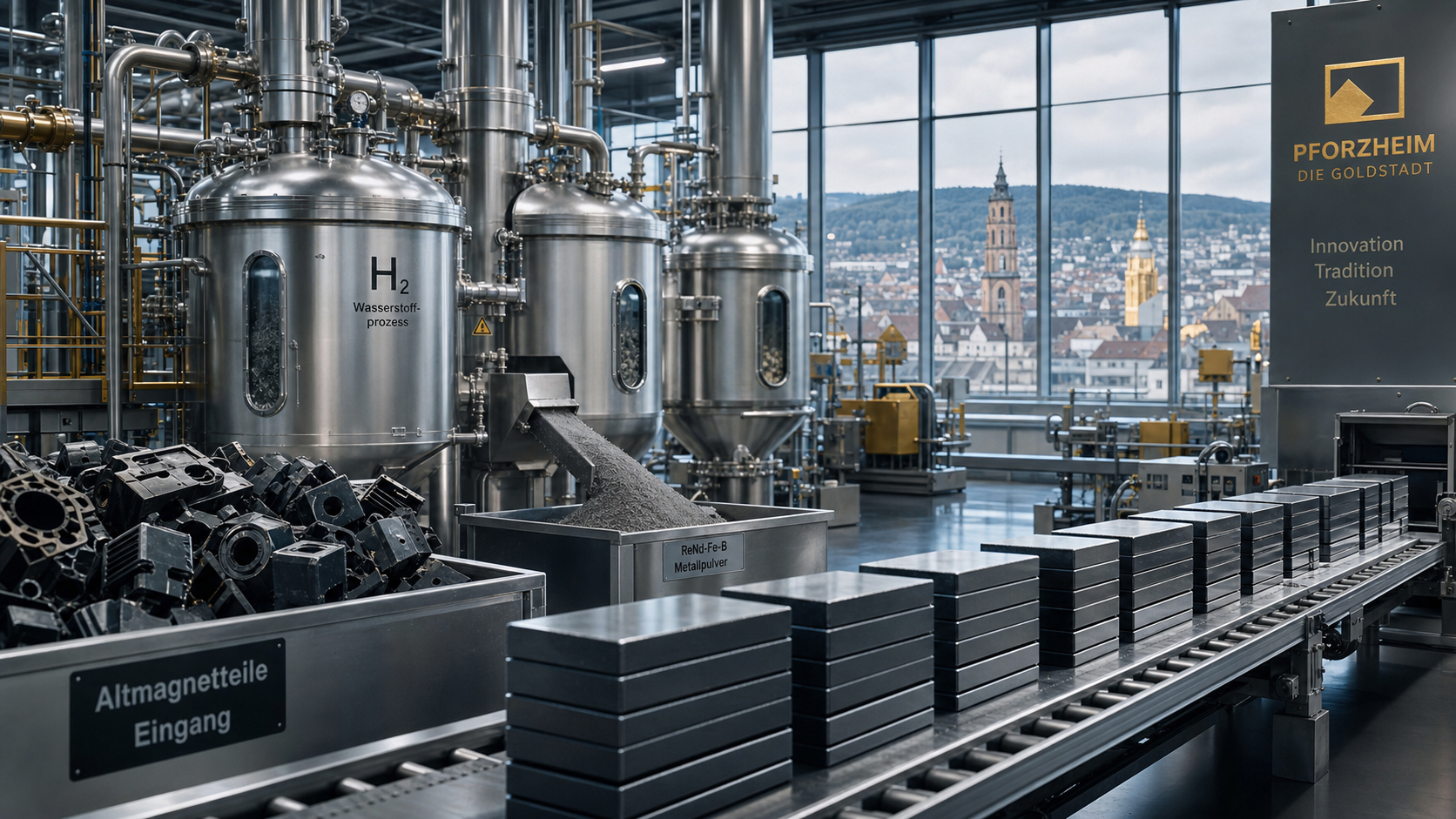
Independent of China: The first EU plant for rare earths shows how we can defend ourselves – creative image on the topic, with AI: Xpert.Digital
Turning old scrap into new gold: This is how Germany is revolutionizing magnet recycling
Europe's answer to China's monopoly: Why Pforzheim is now making industrial history
China's growing monopoly and increasingly stringent export controls on rare earth elements are choking European industry. When essential components for electric motors, industrial robots, or wind turbines are stuck for months in Beijing's bureaucratic bottleneck, domestic manufacturers and suppliers face the threat of a complete production standstill. But in Pforzheim, the historic "Gold City," technological resistance is now taking shape: With the EU's first commercial plant for recycling high-performance magnets, a flagship project is demonstrating how Europe can break free from its Asian dependence. This requires not gigantic new mines and decades-long permitting processes, but a clever circular economy that recovers the most important raw material for the energy transition from old electronic waste – thus becoming Europe's strategic "emergency power generator" in an increasingly fierce global economic struggle.
Related to this:


Europe's blackout insurance against Beijing's waiting room
In German and European industrial halls, a new term has crept into the daily routine of purchasing departments over the past year and a half: end-user certificate. Anyone ordering high-performance magnets from China today, whether for electric motors, wind turbines, industrial robots, or medical imaging, now has to navigate a bureaucratic bottleneck that simply didn't exist in this form until recently. Since spring 2025, Beijing has required a government permit for the export of certain rare earth elements and the magnets made from them. This permit process involves two levels of administration: first, the supplier's provincial government, and then the Chinese Ministry of Commerce (MOFCOM). Officially, these permits are supposed to be issued within 45 days. In practice, however, the procedures often take considerably longer, up to 90 calendar days for certain types of magnets, such as samarium-cobalt alloys, plus potential customs delays of another four weeks if the goods are stopped at the border despite valid documentation.
For an industrialized nation like Germany, whose value creation relies heavily on electric motors, sensors, and drive technology, this is not an abstract footnote in trade policy, but a tangible threat to production. The European automotive supplier association CLEPA has repeatedly reported on production lines that have actually been shut down because magnet deliveries from China failed to arrive or approval processes dragged on for months. Companies that rely on just-in-time production simply cannot afford a three-month wait for a component that is literally in every other electric motor. It is precisely into this vacuum that a plant in Pforzheim has been stepping in since April 2026, demonstrating that technological sovereignty doesn't necessarily require new mines and decades-long approval processes, but sometimes simply lies dormant in one's own scrap metal.
From precious metal to alloy: A city reinvents itself
Pforzheim has been known as the Gold City for generations. For around 250 years, the jewelry and watchmaking industry formed the economic backbone of the city before globalization and the relocation of production to the Far East significantly impacted this tradition. The fact that the first commercial plant in the EU to recycle rare-earth magnets and process them directly into new magnets in a closed loop is now being built at this very location is more than just a charming twist in economic history. It demonstrates that metalworking expertise, precision craftsmanship, and the infrastructure for processing sensitive materials can be preserved at such sites for decades, even if the original product has long since changed.
The plant is operated by HyProMag GmbH, a subsidiary of the British-Canadian HyProMag Group, which in turn belongs to the Canadian resource company Mkango Resources. The technological basis is provided by the University of Birmingham: The HPMS process, short for Hydrogen Processing of Magnet Scrap, developed and patented there, uses hydrogen to selectively break down discarded magnets from electric motors, hard drives, and other end-of-life devices. The hydrogen penetrates the crystal structure of the neodymium-iron-boron alloy, causing the once solid, strongly magnetized block to disintegrate into a loose, demagnetized powder. Coatings, adhesives, screws, and other foreign materials can then be mechanically removed, while the actual metal alloy remains virtually unchanged. New sintered magnet blocks are then pressed from this purified powder – a direct material cycle from the old magnet to the new, without the detour via energy-intensive mining and refining processes.
The Pforzheim site is managed by Carlo Burkhardt, a professor at Pforzheim University of Applied Sciences, who also holds a 20 percent stake in the German company, while Mkango owns 80 percent. The plant began initial test runs in April 2026 and was officially inaugurated on April 28 of the same year by Stefan Rouenhoff, Parliamentary State Secretary at the Federal Ministry for Economic Affairs and Energy. The project is part of the EU research project REEsilience, which specifically promotes the development of resilient European supply chains for rare-earth magnets. Thus, the Pforzheim plant is not only an individual business project but also a politically supported flagship project of European raw materials policy.
Small quantities, big symbolism: What capacities really mean
The raw figures appear modest at first glance. For the current year, 2026, HyProMag in Pforzheim plans to produce around 50 tons of recycled NdFeB products, including alloy powders, sintered blocks, and finished magnets. An increase to approximately 350 tons per year is planned for 2027, while the fully approved capacity is up to 750 tons per year, which is to be reached gradually over the coming years. By comparison, according to consistent industry estimates, China produces well over 90 percent of all rare-earth magnets worldwide annually—a quantity in the hundreds of thousands of tons. Measured against this scale, the Pforzheim plant is a mere trifle.
But this calculation falls short if one wants to understand the actual function of such a system. It's not about replacing the global market, but about remaining operational in an emergency. A helpful analogy is that of an emergency generator: Under normal operating conditions, a company's electricity supply runs on the public grid – reliably, cost-effectively, and available in large quantities. The generator doesn't run continuously, but remains in the background until the regular grid fails. At that precise moment, its existence determines whether a production line comes to a standstill or continues running. Applied to magnets, this means: As long as Chinese export licenses are granted quickly, European industry will continue to source the majority of its supplies from Asia, simply because it's cheaper and possible on a larger scale there. However, if approval is not granted, a delivery is delayed by weeks or months, or Beijing tightens controls again – as already happened in autumn 2025 with further export restrictions on key technologies for processing rare earths – then for the first time there is a place within the European Union that can cover at least part of the demand without waiting for permission from Beijing.
For many medium-sized suppliers who rely on producing just a few hundred kilograms of specialized, high-performance magnets per year, even a capacity of a few hundred tons can mean the difference between production downtime and continued operation. Strategic reserves and backup capacities are not measured by whether they cover the entire market, but by whether they can fill the most critical gaps in a crisis.
Geopolitics on a small scale: Why Beijing is playing the magnetic card
To fully understand the significance of the Pforzheim plant, it is worth examining the mechanics of Chinese export controls. In April 2025, the Chinese Ministry of Commerce placed several rare earth elements and related materials on an export control list as a direct response to new US tariffs on Chinese high-tech products. In October of the same year, Beijing further tightened these measures, explicitly extending the licensing requirement to technologies for mining and processing these strategic metals, as well as to magnet manufacturing itself. Remarkably, the new regulations not only affect products of Chinese origin but also extend to foreign products containing components manufactured in China – a form of extraterritorial control whose scope is reminiscent of comparable American export regulations in the semiconductor sector.
In November 2025, China announced a temporary suspension of planned further tightening of regulations for elements such as holmium, erbium, thulium, europium, and ytterbium, after Washington and Beijing apparently agreed in talks to postpone them until November 2026. However, the controls introduced in April 2025 for seven other rare earth elements, including samarium, gadolinium, terbium, dysprosium, lutetium, scandium, and yttrium, remain in effect, requiring government approval and detailed testing procedures. For European industry, this back-and-forth means one thing above all: there is no planning certainty. Any further geopolitical escalation, such as new American tariffs or technological policy disputes, could lead to new restrictions within weeks, directly impacting European manufacturing companies.
This control policy is no accident, but rather the result of structural market power built up over decades. Since the 1990s, China has systematically invested in the entire rare earth value chain – from mining and the complex and environmentally damaging separation of individual elements to alloy production and magnet manufacturing. Western economies have largely relinquished control of this sector because environmental regulations for processing in Europe and North America are significantly stricter, and Chinese suppliers dominated the global market for years with state-subsidized prices. The result is a concentration that exerts enormous geopolitical leverage, even for raw materials with comparatively small physical volumes. Rare earths, contrary to what their name suggests, are not particularly scarce in the Earth's crust. What is truly scarce is the ability to separate, refine, and process them into high-performance materials in economically viable quantities. It is precisely this bottleneck that China's export control policy addresses.
Our EU and German expertise in business development, sales and marketing

Our EU and German expertise in business development, sales and marketing - Image: Xpert.Digital
Industry focus areas: B2B, digitalization (from AI to XR), mechanical engineering, logistics, renewable energies and industry
More information here:
A thematic hub offering insights and expertise:
- Knowledge platform covering global and regional economies, innovation and industry-specific trends
- A collection of analyses, insights, and background information from our key areas of focus
- A place for expertise and information on current developments in business and technology
- A hub for companies seeking information on markets, digitalization, and industry innovations
Why the circular economy is more than an environmental project
Circular economy as a question of power, not as an environmental project
A key, often overlooked aspect of the Pforzheim plant is its underlying motivation. In public communication, the project is naturally described using the vocabulary of sustainability: reduced emissions, circular economy, resource conservation. In fact, the HPMS process can save up to 90 percent of carbon dioxide emissions compared to primary production from ores, because energy-intensive steps such as mining, chemical separation of the individual rare earth elements, and metal production are simply eliminated. This is ecologically significant and should not be downplayed.
But the real driving force behind the project is something else entirely: supply capability under geopolitical pressure. Companies aren't investing in a new, technically complex recycling plant because they're seeking a sustainability label, but because they calculate that an independent, intra-European source of materials has an economic value that extends beyond the pure production costs. This logic can be clearly expressed in economic terms: the value of a supply chain isn't solely measured by the variable costs per ton, but also by the optionality it offers in a crisis. A plant that, under normal operating conditions, produces at a higher cost than the world market price can still be highly profitable if, in a crisis, it prevents production losses worth tens of millions of euros. This very insurance logic explains why European and American investors, industrial groups, and even government agencies are increasingly willing to invest in capacities that wouldn't be competitive with mass-produced Chinese goods on price alone.
In addition, there is a structural argument that is often underestimated in the debate about critical raw materials: The amount of waste magnets already in circulation in Europe – in discarded electric motors, hard drives, wind turbines, and medical devices – is constantly growing. Every wind turbine, every electric car, and every hard drive installed today is a potential raw material supplier for the future. Those who invest in recycling capacities today secure early access to a material stream that will increase significantly in volume over the next ten to fifteen years with the growing electrification of the economy. The European Union has addressed this connection within the framework of its Critical Raw Materials Act, which, among other things, stipulates recycling quotas for strategic raw materials and provides political support for the development of European processing capacity.
Related to this:

Who owns independence? Rethinking the question of ownership
One point that regularly arises in the public debate about European resource sovereignty concerns the ownership structure of such strategic assets. HyProMag GmbH in Pforzheim is majority-owned by the Canadian company Mkango Resources, which is listed on the London and Toronto stock exchanges. One might argue that an asset considered a building block of European independence is ultimately under the control of North American and British investors, which seems paradoxical at first glance.
However, upon closer examination, this objection is significantly mitigated. What is crucial for actual security of supply is not the nationality of the investors, but rather the physical location of the plant, the location of the workforce, and the availability of local technical expertise. A production facility located in Pforzheim, operated by German and European specialists and subject to German and European regulations, cannot be shut down overnight by a political decision in a distant capital city office, as would be the case with pure import dependence on a single foreign supplier. Furthermore, Canada and Great Britain are close geopolitical and economic partners of the European Union, with whom cooperation in the area of critical raw materials is already intensified. The real vulnerability does not arise from foreign capital per se, but from the geographical concentration of physical production capacity in a single country whose political situation is not entirely predictable. In this respect, the Canadian-British ownership structure of the HyProMag Group can be classified as a comparatively low risk, as long as the plant, personnel, and technical expertise remain firmly rooted in the region.
This assessment aligns with a broader pattern in Western industrial policy over the past few years. Whether for semiconductor factories, battery cell plants, or magnet recycling facilities, governments and industry associations are increasingly less concerned with the pure origin of capital than with whether critical manufacturing steps are physically located within their own economic sphere. This shift marks a remarkable departure from the pure free trade logic of previous decades, in which location decisions were based almost exclusively on cost advantages.
The economic equation: Recycling versus mining
From an economic perspective, the recycling model stands in interesting contrast to traditional rare earth mining projects. New mining projects outside China, for example in Australia, the USA, or Greenland, typically require ten to fifteen years from exploration to commercial production, impose significant environmental regulations, and demand investments in the billions. Furthermore, the real bottleneck rarely lies in the extraction itself, but rather in the subsequent separation and refining of the individual elements – a chemically complex process in which China possesses decades of accumulated expertise.
Recycling plants like the one in Pforzheim circumvent a significant portion of this complexity because they don't start with unprocessed ore, but rather with already alloyed magnets. The HPMS process no longer needs to separate the individual rare earth elements; instead, it preserves the existing alloy and processes it directly. This completely eliminates the most chemically complex and environmentally damaging process steps, drastically reducing both capital intensity and permitting time compared to new mining or refining projects. A plant like the one in Pforzheim can be realized from conception to commercial production in just a few years, while comparable mining projects often fail or are delayed for years due to permitting processes, public protests, and financing difficulties.
The economic drawback, however, lies in the limited availability of raw materials. Recycling capacity can only grow as fast as the number of discarded magnets actually accumulates and is collected – a process that depends on functioning collection and take-back systems for electronic waste, old hard drives, and decommissioned industrial motors. This reveals a structural weakness of the model: as long as the European collection logistics network for magnetic scrap is not fully developed, the supply of raw materials will remain a limiting factor for plants like the one in Pforzheim, regardless of the theoretically large approved production capacity.
One building block, not a breakthrough
The plant in Pforzheim provides important evidence that European resource sovereignty does not necessarily require new large-scale mines or multi-billion-euro state subsidy programs, but can also be achieved through smaller, technologically focused investments in existing material cycles. At the same time, it would be naive to conclude that a single recycling site with a target capacity of 750 tons per year will lead to a fundamental shift in the global balance of power regarding rare earths. Chinese dominance in mining, separation, and magnet manufacturing will persist for the foreseeable future, and the Pforzheim plant will not fundamentally change that.
What has changed significantly, however, is the strategic calculation of European industrial companies. Where previously decisions were based almost exclusively on the lowest purchase price, the question of security of supply now plays an equally important role in procurement strategies. Companies are beginning to reorganize their supply chains according to the principles of diversification and strategic redundancy, similar to what has already happened in the energy sector following its experience with dependence on Russian natural gas. In this sense, the Pforzheim plant is less a large-scale industrial project than a signal: Europe is beginning to seriously work on its own tools so that, in the next geopolitical bottleneck, it is not again entirely dependent on the goodwill of a single foreign regulatory authority. Whether this actually results in a robust, widely effective supply chain will depend on whether further plants of this kind follow, whether the collection logistics for magnetic scrap metal in Europe are expanded, and whether the European Union has the political staying power to support such projects over a longer period instead of losing sight of them after the initial easing of the crisis.
📈🚀 From visibility to trust 👀🤝 Your scalable path with Xpert.Digital

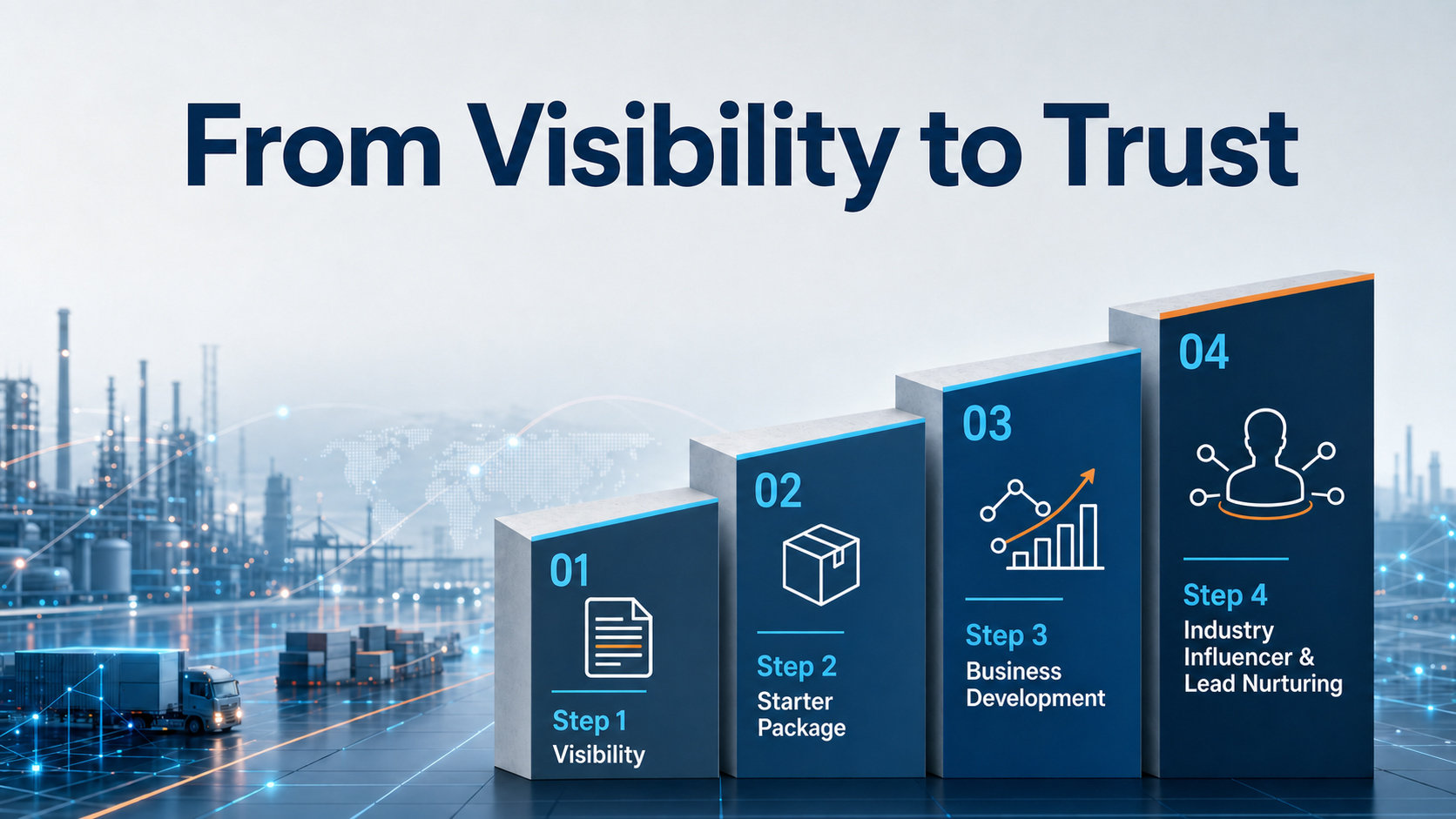
From visibility to trust: Your scalable path with Xpert.Digital - Image: Xpert.Digital
In industrial B2B, sustainable business relationships rarely emerge overnight. They develop step by step – through visibility, professional relevance, recurring touchpoints, and growing trust. Xpert.Digital's 4-stage model addresses precisely this: It offers a structured path that begins with a manageable entry point and can evolve into deeper collaboration in business development if needed.
Instead of relying on loud marketing promises, this model puts the relationship at the forefront. Companies start with clearly defined, easily calculable measures and then decide, based on their own experience, how far they want to expand the collaboration. A key factor for this undisturbed trust-building process: The platform completely avoids annoying advertising ads, so the editorial focus remains solely on the companies' expertise.
More information here:
Your global marketing and business development partner
☑️ Our business language is English or German
☑️ NEW: Correspondence in your native language!

Konrad Wolfenstein
I and my team are happy to be available to you as your personal advisor.
You can contact me by filling out the contact form here wolfenstein@xpert.digital:or simply call me at +49 7348 4088 965. My email address is
I'm looking forward to our joint project.