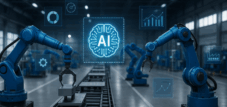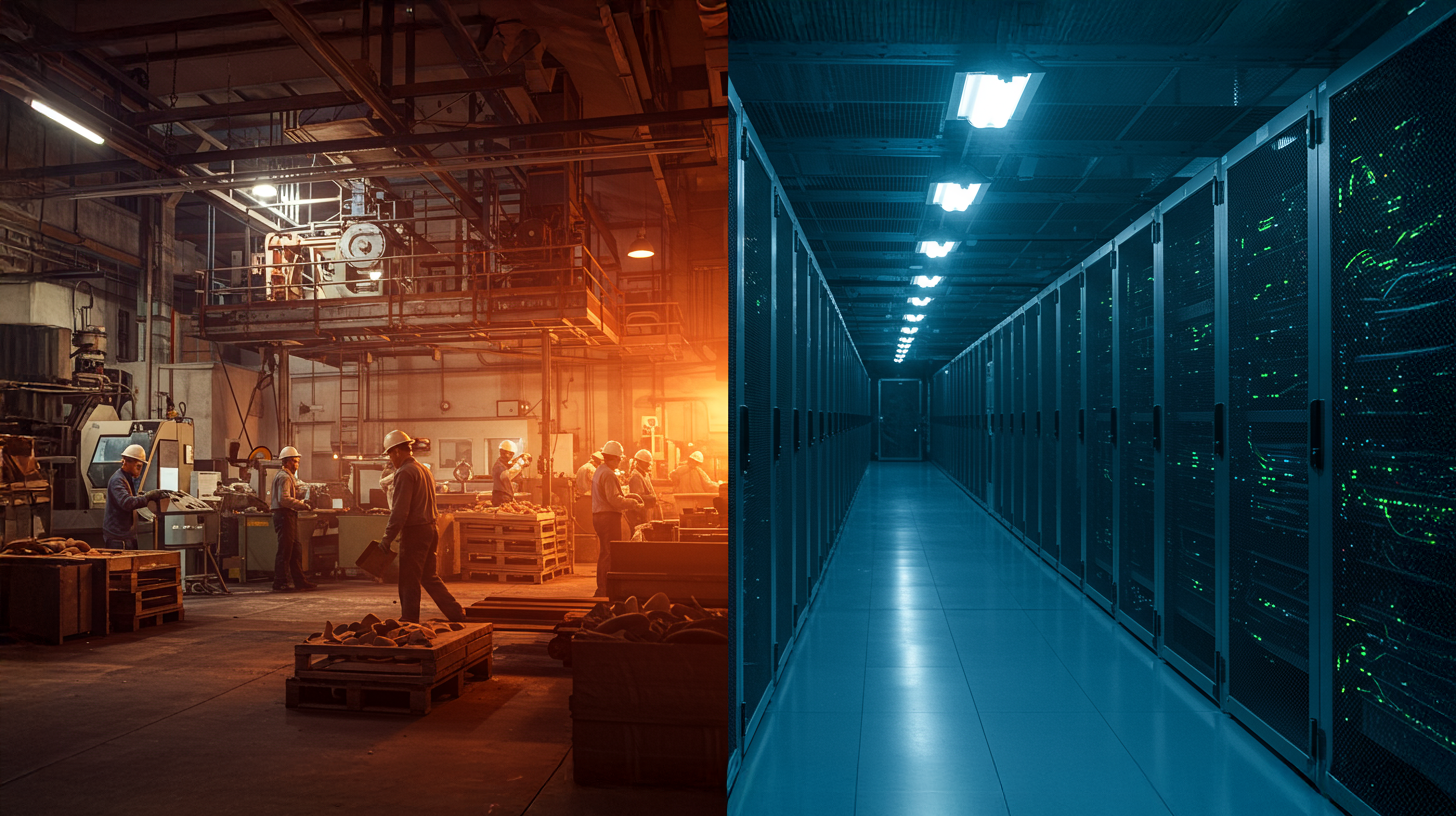
Strategic questions of understanding: Factory versus data center? Fast & risky vs. slow & stable? – Image: Xpert.Digital
Strategic decision for the economy: Faster success with the cloud or traditional business?
Infrastructure development in the 21st century: A comparison between information technology and manufacturing in Germany
The strategic question of which type of economic infrastructure – information technology (IT) or manufacturing – is easier and faster to establish given available financial resources is central to modern industrial policy. This analysis provides a nuanced answer that goes beyond a simple comparison of construction times and illuminates the crucial non-monetary bottlenecks in the areas of technology, human capital, and regulation.
The central conclusion is that core information technology infrastructure, particularly in the form of modular data centers and cloud-based service models, can demonstrably be implemented more quickly in terms of operational deployment. This speed results from industrialized construction methods, the standardization of core components, and more agile access to global talent pools. However, the concept of "simplicity" is more complex and leads to a more nuanced assessment. While the physical and technological construction of IT infrastructure can proceed more rapidly, the manufacturing sector in Germany benefits from a more established, albeit slower, regulatory and educational framework. This established path can make the process more predictable and protect against novel legal challenges that are increasingly shaping data center development.
Related to this:


The analysis is based on four pillars:
Physical structure
Modular construction methods offer a significant time advantage for IT infrastructure. A data center can be built in months, while a complex factory takes years.
Technological supply chains
The IT industry benefits from highly standardized and commodified components that enable rapid integration. This contrasts with the long lead times for custom-built machinery in the industrial sector. However, this speed of IT depends on fragile, globally concentrated supply chains.
Human capital
The IT sector can scale its workforce more quickly through more flexible training pathways and the easier integration of international specialists. The German dual vocational training system for industry produces excellent specialists, but is inherently slower in its structure and scaling.
Regulatory hurdles
Here, the picture is partially reversed. Factory permitting follows a slow but established and therefore predictable process. Data centers, on the other hand, face new, rapidly changing, and complex regulations (e.g., energy efficiency laws) that lead to unpredictability and delays.
Ultimately, the decisive factor for speed and simplicity is not the sector itself, but the interplay of chosen construction and technology methodology, the resilience of supply chains, the strategy for developing human capital, and the political will to overcome bureaucratic inertia.
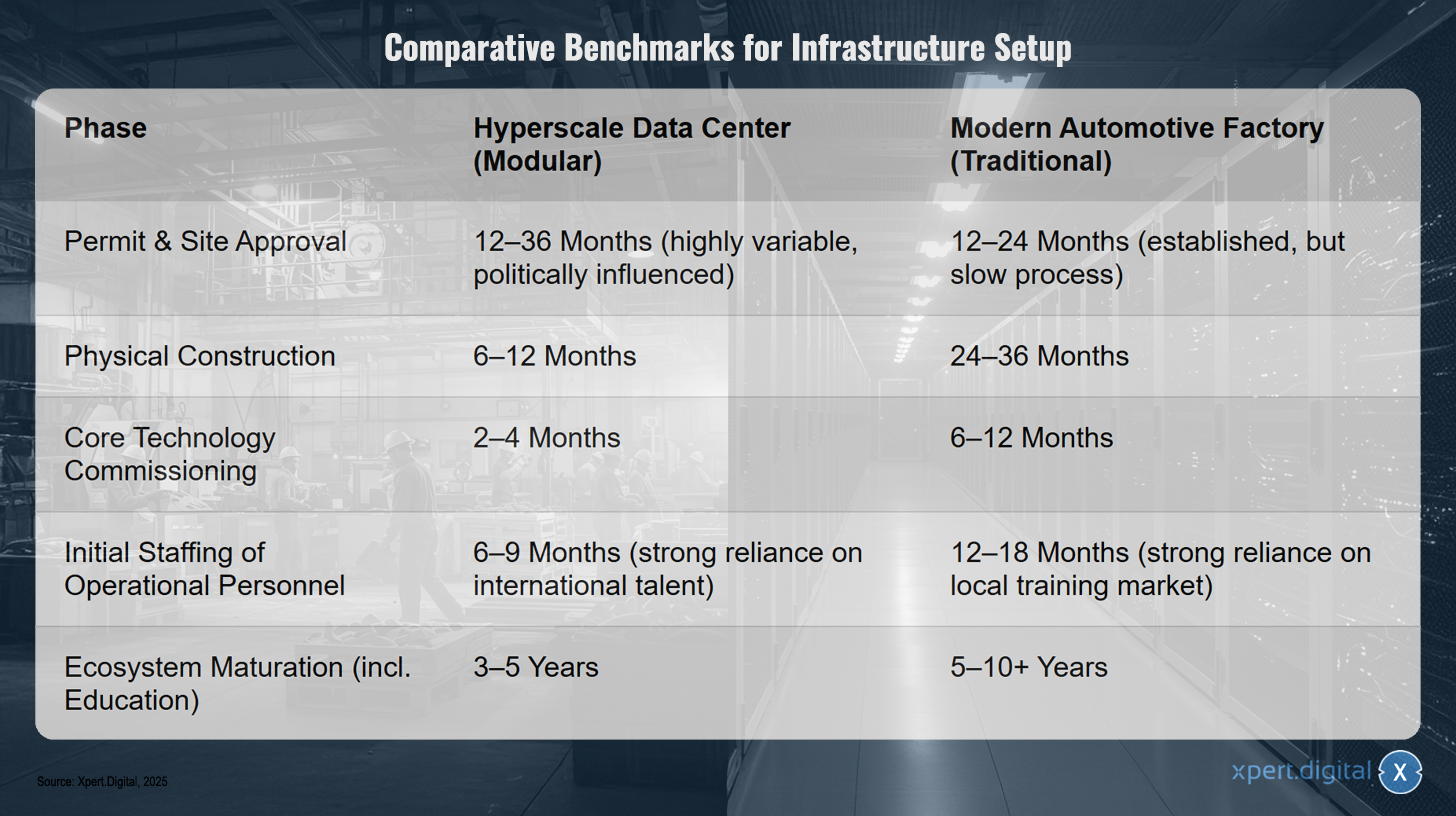
Comparative benchmarks for infrastructure development
Comparative benchmarks for infrastructure development – Image: Xpert.Digital
Comparing benchmarks for infrastructure development reveals that the approval and site authorization process for a hyperscale data center is modular and highly variable, taking between 12 and 36 months, and is also subject to political influence. In contrast, this established but slower process takes 12 to 24 months for a modern, traditionally constructed automotive factory. The physical construction of a modular hyperscale data center requires 6 to 12 months, while the automotive factory is estimated to take 24 to 36 months. Commissioning of the core technology occurs within 2 to 4 months for the data center, whereas it takes 6 to 12 months for the automotive factory. Recruiting the initial operational staff for the hyperscale data center is heavily dependent on the international talent pool and takes 6 to 9 months, while for the automotive factory, recruitment depends on the local training market and takes 12 to 18 months. Finally, the ecosystem, including educational measures, matures within 3 to 5 years at hyperscale data centers, while at modern automotive factories the development can take more than 5 to over 10 years.
The physical basis: Construction times and methodologies
The construction of the physical shell – the building itself – represents the first and most visible phase of any infrastructure project. Analyzing the methods used and the resulting timelines reveals fundamental differences between the construction of IT data centers and industrial production facilities.
Data centers: Acceleration through modularity and prefabrication
Traditional data center construction is a lengthy undertaking, often taking 12 to 18 months or more. However, this classic approach has increasingly given way to a paradigm shift focused on modularity and prefabrication. These modern methods have the potential to dramatically reduce construction times. Case studies impressively demonstrate the effectiveness of this approach: For example, in the climatically challenging Zhangbei region, where construction work is impossible for almost half the year, Alibaba was able to erect two massive data centers in just one year by consistently employing prefabricated modular construction.
The time savings are even more radical with fully modularized concepts. Here, the completion of a data center can be reduced to just one to two months, compared to one to two years with conventional construction methods. The key to this acceleration lies in decoupling and parallelizing the work steps. While the basic excavation work, the construction of the foundation and the building envelope take place on site, the highly complex technical modules – IT racks, cooling systems, uninterruptible power supplies (UPS), and power distribution units – are produced in a controlled factory environment on an assembly line-like production line. These prefabricated modules only need to be erected and assembled on site, which significantly reduces the technical complexity and labor required at the construction site. This shift from a sequential to a parallel approach is the crucial lever for compressing the critical path in the project schedule.
This industrialized construction method is only made possible by the high degree of standardization of a data center's core components. A data center is essentially a high-tech warehouse, a "machine that houses machines." It contains thousands of standardized servers, storage systems, and network devices in equally standardized racks. This homogeneity of function allows for homogeneity of form. The resulting structure is highly repetitive and therefore ideally suited to the "copy-and-paste" logic of modular manufacturing. Technological innovations such as Corning's high-speed interconnect cables, which accelerate cabling between data centers by up to 70%, further advance the vision of a "data center in a day.".
Production facilities: The challenge of scale and customized design
In contrast, the construction of a modern, large-scale production facility is a project that extends over several years. Mercedes-Benz's "Factory 56" in Sindelfingen, one of the most modern automotive factories in the world, took 2.5 years to build. The construction of the Tesla Gigafactory in Berlin-Brandenburg was also a multi-year undertaking. Such facilities are characterized by their immense size – Factory 56 covers a footprint of 220,000 square meters – and their highly specialized process requirements.
The crucial difference to a data center lies in the dominance of the production process over the building structure. While a data center building houses standardized IT hardware, a factory's architecture is fundamentally shaped by the unique, often linear, and physically massive manufacturing process it must enclose. In automotive manufacturing, for example, the individual stages such as the press shop, body shop, paint shop, and final assembly require completely different and highly specialized structural conditions. Heavy presses need massive foundations, and paint shops require dust-free cleanrooms with complex air handling and exhaust systems. This customized, process-driven nature severely limits the use of standardized, repeatable modules, as are common in data center construction, and necessitates a more traditional, sequential construction process, which is inherently slower.
While serial and modular construction methods, such as element or room module construction, do exist in industrial construction and offer time advantages for buildings with repetitive structures like hotels, schools, or hospitals, their application to a complex, heterogeneous factory structure is very limited, usually taking the form of hybrid construction methods where, for example, prefabricated sanitary units are integrated into an otherwise conventionally constructed structure.
The complexity increases further when dealing with "brownfield" projects, meaning the modernization of existing industrial plants. Retrofitting existing plants with new sensors and control technology is a common, cost-effective strategy for digitalization, but it adds further planning steps and interface problems. "Greenfield" projects on a greenfield site, such as Factory 56 or the Tesla Gigafactory, offer more design freedom, but require immense logistical and infrastructural preparatory work for transport and supply connections, which also extends the overall project time.
Comparative judgment regarding the physical structure
In terms of pure physical construction, IT infrastructure has a clear and significant speed advantage, which, however, is almost exclusively based on the use of modular and prefabricated construction methods. A traditionally built data center with a construction time of 12 to 18 months is already approaching the timeline of smaller industrial plants. The inherent systemic need of the manufacturing industry for large-scale, process-specific, and customized structures makes new construction from the ground up fundamentally slower.
🎯📊 Integration of an independent and cross-data-source AI platform 🤖🌐 for all business needs


Integration of an independent and cross-data-source AI platform for all business needs - Image: Xpert.Digital
AI Game Changer: The most flexible AI platform - Tailor-made solutions that reduce costs, improve your decisions and increase efficiency
Independent AI platform: Integrates all relevant company data sources
- This AI platform interacts with all specific data sources
- From SAP, Microsoft, Jira, Confluence, Salesforce, Zoom, Dropbox and many other data management systems
- Rapid AI integration: Tailor-made AI solutions for businesses in hours or days, instead of months
- Flexible infrastructure: Cloud-based or hosting in your own data center (Germany, Europe, free choice of location)
- Maximum data security: its use in law firms is irrefutable proof
- Deployment across a wide variety of enterprise data sources
- Choice of own or different AI models (DE, EU, USA, CN)
Challenges that our AI platform solves
- Lack of fit of conventional AI solutions
- Data protection and secure management of sensitive data
- High costs and complexity of individual AI development
- Shortage of qualified AI specialists
- Integration of AI into existing IT systems
More information here:

Infrastructure development using Germany as an example: pace, risks and regulatory hurdles
The technological core: procurement, integration and supply chain dynamics
Once the physical shell is erected, the focus shifts to the technological core that makes the respective infrastructure functional. Analyzing the procurement, installation, and commissioning of these core technologies reveals profound differences in complexity, speed, and the underlying supply chains.
Related to this:
The global IT hardware supply chain: concentrated, complex, and volatile
The IT hardware supply chain is exceptionally complex. The components of a single notebook travel through a global, multi-stage network, from raw material extraction in mines through various smelters, refineries, and component manufacturers, before reaching the end user. This complexity, which involves thousands of workers, is a key reason for the relatively low cost of hardware, but it also poses significant risks regarding labor rights, human rights, and sustainability. Another characteristic is the high concentration of control over critical components. Particularly with high-performance processors (CPUs) and graphics processing units (GPUs), which are essential for AI applications, a few designers and manufacturers dominate the global market. This creates systemic risks and vulnerability to shortages. Furthermore, the short lifecycle of IT hardware necessitates structured procurement and regular upgrade cycles to maintain performance and security.
Despite this profound complexity in manufacturing, the procurement and integration of IT hardware at the data center build level can be remarkably fast. This is due to the high degree of standardization and commoditization of the products. Servers, switches, and storage systems are standardized units that can be ordered in bulk. A company can place an order for thousands of servers. Integration then primarily involves physical installation in the racks and subsequent software configuration. This process is highly automatable. The global IT industry has created a level of abstraction that makes the server a "Lego brick," enabling rapid assembly at scale.
The acceleration brought about by cloud services is even more radical. Providers like Amazon Web Services (AWS), Microsoft Azure, and Google Cloud Platform (GCP) completely abstract the physical layer. A company can access a ready-made AI infrastructure via colocation or hybrid cloud models without having to build a single data center of its own or even touch a single server. Provisioning massive computing capacities becomes a software-defined process that takes minutes instead of months.
Related to this:


This speed and ease of deployment, however, rest on a fragile foundation. The high geographic concentration in the manufacturing of critical components, particularly advanced semiconductors, creates a systemic vulnerability. A single geopolitical event, a natural disaster, or a pandemic can severely disrupt the global supply chain, leading to massive delays and price explosions, as the recent GPU shortages have demonstrated. The speed of IT infrastructure is thus heavily dependent on a stable global trading environment. The sector has traded local complexity for global, systemic risk: the supply chain is efficient and fast when it functions, but brittle and slow when it breaks down.
Related to this:

The industrial machinery ecosystem: diversified, specialized, and customized
Production facilities are equipped with a wide range of highly specialized machines, from CNC machining centers and robots to complex, interconnected production lines. Many of these systems are not standard products but are custom-designed or at least heavily modified for a specific production task. Lead times for such systems can be considerable, ranging from months to years. The ecosystem includes large machine manufacturers, highly specialized component suppliers, and system integrators that implement automation solutions. The trend is clearly moving toward intelligent, networked systems in line with Industry 4.0 principles, utilizing sensors, IoT gateways, and AI for process control and predictive maintenance.
The primary time bottleneck in equipping a factory lies in the development, manufacturing, delivery, and installation of these custom-built machines. These are often massive, complex systems that are themselves small factories. The "machine-building machine" problem results in significant lead times, which are less common in the commodified IT world. While a company can purchase 10,000 identical servers, a factory requires a heterogeneous collection of often unique, interconnected, and frequently custom-built machines. The time required to specify, design, build, and test each of these individual machines leads to a significantly longer and more complex procurement and commissioning cycle.
This slower, but tailored supply chain could, however, be more resilient in some respects. It is more geographically and technologically diversified than the highly concentrated semiconductor industry. A German company can often source high-quality machinery from suppliers in Germany or the European single market, reducing its dependence on transcontinental transport routes and the associated geopolitical risks. The strong German mechanical engineering sector (the "Mittelstand") forms a robust regional backbone here. This represents a clear trade-off: slower speed for potentially greater supply chain stability.
Commissioning and integration: Software-defined flexibility versus mechanical rigidity
Commissioning an IT infrastructure is primarily a software and network challenge. It involves configuring servers, deploying operating systems and applications, and establishing network connections. These processes can be largely controlled by scripts and automation tools.
In contrast, commissioning a factory is a fundamentally mechanical and physical process. It involves the physical installation, calibration, and integration of heavy equipment. Machines must be precisely aligned, mechanically and electrically connected, and fine-tuned in lengthy test runs. Even though modern factories are highly automated through control software and AI, the initial setup is a massive physical undertaking that cannot simply be modified via a software update.
Comparative assessment of technological equipment
The technological core of an IT infrastructure, due to standardization, mass procurement, and software-defined integration, can be acquired and commissioned significantly faster than that of a production plant. However, this speed is contingent on a functioning and stable global supply chain. The manufacturing industry faces a slower and more complex process of acquiring and installing customized machinery, but may benefit from a more diversified and regionally based supplier base, which can offer greater resilience.
The Human Capital Pipeline: A Story of Two Skills Shortages
The most complex and often most time-consuming factor in building a new infrastructure is the development of human talent and the supporting educational environment. Without qualified personnel who can plan, build, operate, and maintain the technology, even the most modern systems remain unproductive. This is where perhaps the most profound differences between the IT and industrial worlds become apparent.
Related to this:

The evolution of the digital workforce: pathways, duration, and global talent pools
Pathways into IT professions in Germany are becoming increasingly flexible and accessible. A notable development is the possibility of being recognized as an "IT specialist" and obtaining a work permit with just two years of documented professional experience, even without a formal vocational or university degree. This represents a significant departure from the traditional German emphasis on formal qualifications. The classic route, the dual vocational training program to become an IT specialist (e.g., specializing in system integration), lasts three years. This training is modern and practically oriented, imparting a broad range of in-demand skills, from network and server administration to cloud computing, IT security, and the application of AI tools. For more highly qualified roles, such as in AI research or software architecture, a university degree (Bachelor's or Master's) is often required, but the field is known for its openness to highly talented career changers. Furthermore, Germany actively utilizes instruments like the EU Blue Card to recruit highly qualified IT professionals from abroad.
These structural conditions enable a more agile and faster scaling of the IT workforce. The combination of shorter, more flexible training paths, lower formal entry barriers for experienced international professionals, and the fact that the work itself is less language-dependent (code is a universal language) opens access to a global talent pool. Many tasks can also be performed remotely, further reducing geographical limitations.
The speed and agility of the IT sector come at a price: the rapid obsolescence of knowledge. Technologies, programming languages, and platforms are evolving at breakneck speed. A three-year apprenticeship is merely the starting point for a lifelong learning process. The list of new technologies that IT professionals must now deal with is long, ranging from blockchain and edge computing to AI programming assistants. The IT "knowledge environment" is therefore less defined by static institutions like schools and universities, and more by a dynamic ecosystem of online courses, vendor certifications, corporate training, and a high degree of self-motivation. Building a sustainable IT workforce is thus not a one-off act of "building schools," but a continuous process of establishing learning systems.
The forging of the industrial workforce: The German dual system and the art of engineering
The backbone of the German industrial workforce is the internationally recognized dual system of vocational training. The apprenticeship to become an industrial mechanic lasts 3.5 years and combines theoretical instruction at a vocational school with practical work in a training company. This training is exceptionally comprehensive and imparts in-depth knowledge of manufacturing processes, assembly, maintenance, control technology, and technical communication. Increasingly, digital skills such as CNC machine programming, additive manufacturing processes (3D printing), and IT-supported plant modifications are also being integrated. For advanced specialist and management positions, formal further training as an industrial master craftsman or state-certified technician, or a university degree in engineering disciplines such as mechanical engineering, is required, which takes several more years.
The German industrial apprenticeship model prioritizes depth, quality, and standardization over speed. The long apprenticeship duration of 3.5 years ensures a high level of competence, versatility, and problem-solving skills. This system produces highly qualified, reliable, and internationally respected skilled workers, but is inherently slow to scale. You can't train a master craftsman in a rush. The human capital pipeline for the manufacturing sector is therefore a long-term, strategic investment with considerable lead times.
The development of a production infrastructure is inextricably linked to the development of the local educational infrastructure. It relies on a dense network of vocational schools, universities of applied sciences, technical universities, and application-oriented research institutions such as the Fraunhofer Society. To bridge the gap between traditional training and the demands of Industry 4.0, innovative concepts such as "learning factories" are being developed at vocational schools, where commercial and industrial-technical trainees learn together on realistic production processes. This illustrates that establishing a new industrial location requires not only the construction of a factory but also ensuring that the local educational ecosystem can provide the necessary qualifications – a process that can take years or even decades to mature. Industry's dependence on this physically embedded knowledge environment is far greater than that of the globally oriented IT sector.
The skills shortage: A comparative analysis of a critical national bottleneck
Germany is suffering from a severe shortage of skilled workers across all sectors. This bottleneck is hitting both sectors examined here particularly hard. A 2017 study for Baden-Württemberg predicted an increase in the IT skills gap from 3,000 to 6,700 by 2030. At the same time, the skilled trades sector, which includes many production jobs, reports "pronounced skills shortages." A 2023 report by the Association of German Chambers of Industry and Commerce (DIHK) confirms the dramatic situation: 54% of industrial companies and 53% of construction companies are unable to fill vacancies. This shortage is considered a significant risk to Germany's economic competitiveness. The Baden-Württemberg Chamber of Industry and Commerce (IHK) anticipates a skills gap of 863,000 in the state by 2035.
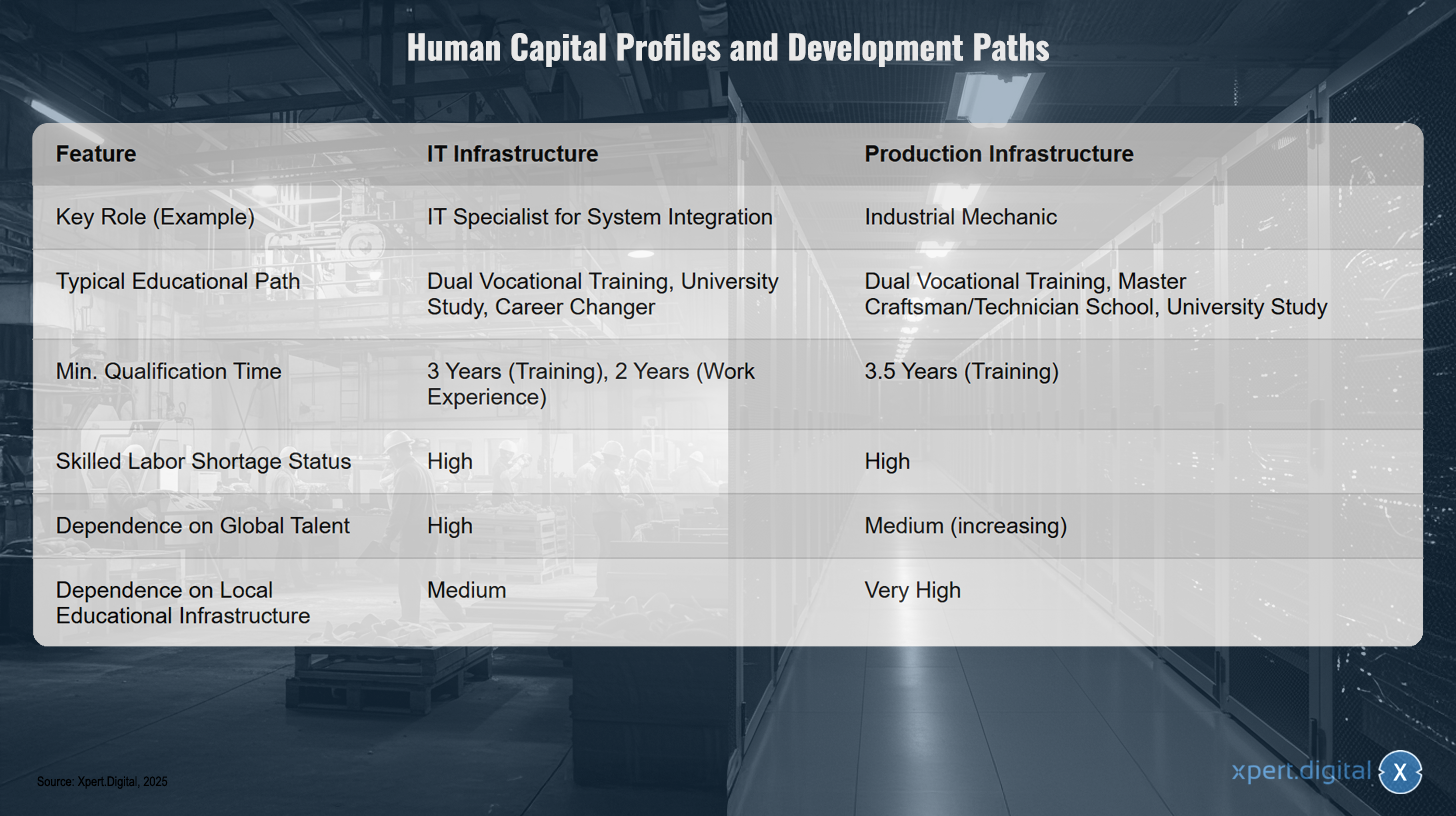
Human capital profiles and development pathways
Human capital profiles and development paths – Image: Xpert.Digital
Human capital profiles and development paths differ between IT and production infrastructure. In IT infrastructure, the IT specialist for system integration plays a key role, while in production infrastructure, the industrial mechanic is central. Typical educational pathways in IT include dual vocational training, university studies, or career changes, whereas in production, in addition to dual vocational training, master craftsman or technician training, as well as university studies, are common. The minimum qualification period in IT is three years of training plus two years of professional experience, while in production it is approximately 3.5 years of training. Both sectors are experiencing a significant shortage of skilled workers. The IT industry is heavily dependent on global talent, while the dependence in production is moderate but increasing. Local educational infrastructure plays a moderate role in IT, but a very high one in production. Furthermore, the IT sector has more agile mechanisms to counteract the shortage of skilled workers, while the manufacturing industry is more strongly tied to the domestic education system.
Comparative judgment on human capital
Both sectors are severely hampered by the shortage of skilled workers. However, the IT sector has more agile and faster mechanisms to mitigate this bottleneck. Flexible entry paths, a stronger global focus, and the option of remote work allow for quicker access to talent. The human capital pipeline in the manufacturing sector is slower and more closely tied to the domestic, formalized German education system, making the skills shortage a potentially more persistent and long-term bottleneck. Therefore, building the human capital required for a new IT infrastructure is likely to be faster, though not necessarily easier, than building a new manufacturing infrastructure.
The regulatory gauntlet: Navigating the German bureaucracy
Regardless of financial resources, legal and administrative hurdles often prove to be the biggest and most unpredictable bottleneck for large infrastructure projects in Germany. An analysis of the permitting processes for data centers and factories reveals a complex picture of established inertia and novel complexity.
The approval of data centers: In the tension between energy, environment and data law
The construction of a data center in Germany is subject to a dense and rapidly evolving network of regulations. In addition to traditional building law, the process is increasingly dominated by specific, technology-driven legislation. At the forefront is the Energy Efficiency Act (EnEfG), which came into force in 2023. It prescribes strict limits for power usage effectiveness (PUE) – a maximum PUE of 1.3 must be achieved by 2030 – and includes binding requirements for the utilization of waste heat. These requirements present operators with considerable technical and planning challenges. At the same time, data centers must comply with the stringent requirements of the General Data Protection Regulation (GDPR) and implement comprehensive cybersecurity measures to protect the data they process.
The combination of these factors leads to notoriously slow approval processes. Industry experts report timeframes ranging from "many months to years," which stands in stark contrast to the "few weeks" that are often sufficient in other EU countries. This delay is considered a serious competitive disadvantage for Germany as a business location.
The real challenge, however, lies not only in the slow pace but also in the novelty and complexity of the regulations, which create a high degree of unpredictability. Investors face a "moving target" as laws at the national and EU levels change and overlap rapidly. The obligation to report different and sometimes inconsistent key performance indicators to national registers and EU databases further increases the bureaucratic burden. The demand by industry associations to extend the Investment Acceleration Act to data centers is a clear admission that the current process is no longer considered sustainable. Added to this is the increasing politicization of data centers. Their enormous energy and water consumption brings them into the focus of public and political debate, which can further complicate and delay permitting procedures.
The approval of production facilities: The traditional path of land use and emission control
The permitting process for industrial plants in Germany is, by comparison, a much more established procedure. It is primarily regulated by the Federal Immission Control Act (BImSchG), which stipulates clear procedures and deadlines. A formal permitting process for a new plant should take a maximum of seven months, a simplified process three months. Although these deadlines are often exceeded in practice, they nevertheless provide a legal framework. The process includes detailed environmental impact assessments, public participation, and coordination with numerous authorities, the so-called public bodies. Even the general building permit process can take several weeks to months, depending on the workload of the responsible authority. Furthermore, the entire construction industry suffers from a generally "increasing bureaucracy.".
The crucial difference lies in the predictability afforded by precedents. Decades of industrial development have created a vast body of experience, established procedures, and specialized consultants and officials. An investor planning a factory faces a slow and bureaucratic, but familiar system. The "rules of the game" are clearer, and the process is more linear than with the novel and overlapping challenges of data center regulation. For an investor, predictable delays may represent a lower risk than unpredictable ones.
Case study: Lessons learned from the Tesla Gigafactory
The construction of the Tesla Gigafactory in Brandenburg is a prime example of the dynamics of modern large-scale projects. The extraordinary speed, the so-called "Tesla pace," was made possible by a high-risk strategy: construction began based on preliminary permits, long before final approval was granted. This process was characterized by the immense political will of the state government to implement the project. At the same time, it led to significant conflicts with the public, particularly regarding issues such as water consumption and a perceived lack of transparency in communication, which severely damaged trust in the responsible authorities.
The Tesla case vividly demonstrates that political will can be the ultimate accelerator. The "Tesla pace" was less a characteristic of the German system than the result of a concerted political effort to create an exception for a project deemed strategically important. This suggests that the speed of construction of a large-scale facility depends less on the sector (IT vs. industry) and more on the strategic importance that political actors attribute to it. The regulatory system is not a law of nature, but a human system that can be bent or accelerated with sufficient political capital.
Key regulatory hurdles in Germany
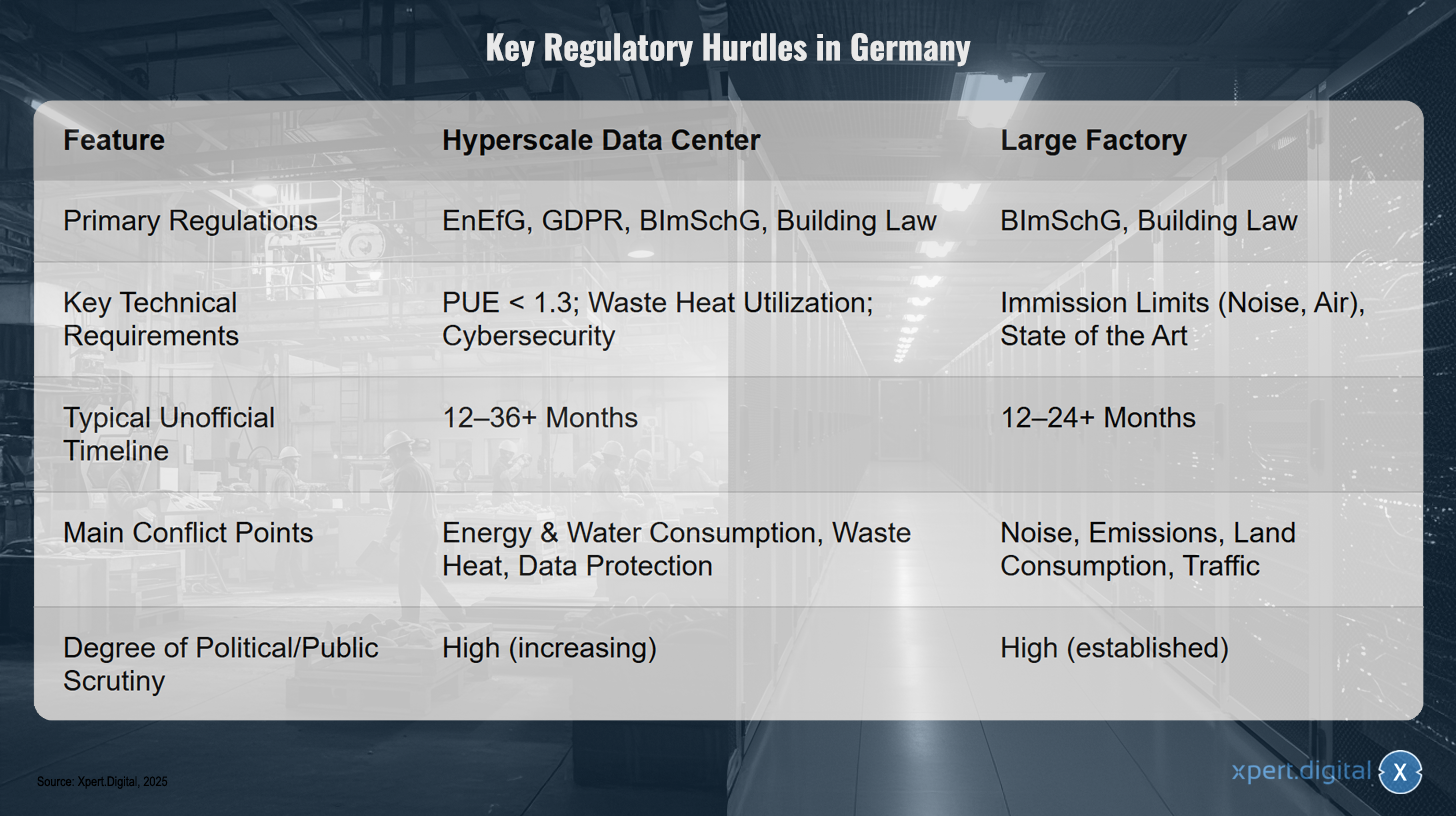
Key regulatory hurdles in Germany – Image: Xpert.Digital
In Germany, key regulatory hurdles for hyperscale data centers and large factories present distinct challenges. For hyperscale data centers, the Energy Efficiency Act (EnEG), the General Data Protection Regulation (GDPR), the Federal Immission Control Act (BImSchG), and building regulations are particularly relevant, while for large factories, the BImSchG and building regulations are the primary considerations. Technically, data centers must demonstrate energy efficiency with a PUE (Power Usage Effectiveness) value below 1.3, utilize waste heat, and meet stringent cybersecurity requirements. For large factories, the focus is on emission limits, such as those for noise and air quality, as well as adherence to state-of-the-art technology. Average processing times for data centers range from 12 to over 36 months, while for large factories, they range from 12 to more than 24 months. The main points of contention for data centers are energy and water consumption, waste heat utilization, and data protection, whereas for large factories, noise, emissions, land use, and traffic are the primary concerns. Both are subject to intense political and public scrutiny, with increasing for data centers and already well-established for large factories.
Comparative ruling on regulation
The regulatory environment presents a paradox. The manufacturing industry faces a slow but relatively predictable approval process. The IT and data center industry has a potentially faster path, but one complicated by newer, more complex, and less predictable regulations. From a purely risk management perspective, building a factory might therefore be "easier." An IT infrastructure could only be "faster" if it receives prioritized political support to overcome these new bureaucratic hurdles.
🎯🎯🎯 Benefit from Xpert.Digital's extensive, five-fold expertise in one comprehensive service package | BD, R&D, XR, PR & Digital Visibility Optimization

Benefit from Xpert.Digital's extensive, five-fold expertise in a comprehensive service package | R&D, XR, PR & Digital Visibility Optimization - Image: Xpert.Digital
Xpert.Digital possesses in-depth knowledge across various industries. This allows us to develop tailored strategies precisely aligned with the requirements and challenges of your specific market segment. By continuously analyzing market trends and monitoring industry developments, we can act proactively and offer innovative solutions. The combination of experience and expertise generates added value and provides our clients with a decisive competitive advantage.
More information here:
Future-proof infrastructure: A balance between agility and stability
Synthesis and strategic conclusions
A comparative analysis of the four crucial dimensions – physical construction, technological equipment, human capital, and regulation – allows for an integrated and nuanced answer to the initial question. The juxtaposition of speed and simplicity reveals that no single sector possesses a general superiority, but rather a complex network of specific advantages and bottlenecks.
Related to this:

The Matrix of Speed and Simplicity: A Holistic Comparison
The results can be summarized in a matrix that compares the factors speed and simplicity (in terms of complexity and computability):
speed
IT infrastructure has a clear advantage here. This is supported by its rapid, modular construction, the procurement of commodified hardware in large quantities, and the more agile scaling of the workforce through flexible training pathways and global talent acquisition. However, this speed advantage is contingent on two essential conditions: a stable global supply chain for critical components such as semiconductors and the political will to accelerate the novel and complex approval processes. If either of these conditions is lost, the time advantage can quickly erode.
Simplicity/Predictability
The picture here is mixed. The manufacturing sector is "easier" to implement in the sense of being more predictable. It relies on established regulatory procedures (Federal Immission Control Act) and a standardized dual education system that has evolved over decades. While the processes are slow, they are familiar. The IT infrastructure is technologically "easier" to implement because it is software-defined and highly standardized. It is also "easier" in terms of talent acquisition, as it can access a global pool of skilled workers. The biggest "difficulty" for both sectors lies in overcoming German bureaucracy and the shortage of skilled workers. For data centers, the unpredictability of new, rapidly changing environmental and energy laws adds another layer of difficulty.
Deconstructing the premise: Why non-financial resources are the true pacesetters
The initial question assumes that "the necessary [financial] resources are available." However, the analysis shows that financial capital is often not the primary bottleneck. The true limiting factors that determine speed and success are non-monetary resources:
- Time-to-approval (bureaucratic capital): The ability to navigate administrative processes efficiently or to expedite them through political influence. In Germany, this is a critical obstacle for both sectors.
- Time-to-talent (human capital): The lead time required to train or recruit a qualified workforce. This factor represents a structurally greater bottleneck for industry due to longer training cycles.
- Time-to-component (supply chain capital): The lead time for critical, often globally sourced technologies. This is the Achilles' heel of IT infrastructure.
- Time-to-consensus (Social/Political Capital): The ability to secure and maintain public and political support for a major project, as the Tesla case impressively demonstrates.
The sector that can manage these four non-financial forms of capital more effectively will ultimately be the one that is faster and easier to establish.
Related to this:

Strategic implications for national and regional development
The analysis yields clear, yet nuanced, recommendations for policymakers aimed at strengthening Germany's position as a location for both types of infrastructure. A one-size-fits-all strategy would be doomed to failure.
For the promotion of IT infrastructure:
- Regulatory acceleration: Creation of a standardized, accelerated, and digitized approval process specifically for "digital infrastructures." Extending the Investment Acceleration Act to data centers would be a first step. Harmonizing German regulations (EnEfG) with EU directives is urgently needed to reduce the bureaucratic burden.
- Talent acquisition: Further liberalization and acceleration of the procedures for recruiting qualified IT professionals from abroad (e.g. through a faster and less bureaucratic EU Blue Card) and recognition of professional experience.
- Supply chain resilience: Targeted support and incentives for building production capacities for critical IT components in Germany and Europe to reduce dependence on individual global manufacturers.
For the promotion of production infrastructure:
- Reducing bureaucracy: Consistent digitization and streamlining of existing approval procedures under the Federal Immission Control Act (BImSchG) and building law to shorten planning and approval times without lowering protection standards.
- Education initiative: A massive investment and modernization program for the dual vocational training system, especially for vocational schools. The nationwide establishment of "learning factories" and the continuous adaptation of curricula to the realities of Industry 4.0 are essential to combat the skills shortage in the long term.
- Construction innovation: Creating incentives for the application of modular and serial construction methods, also in industrial construction, to shorten construction times and increase efficiency.
A successful national industrial strategy must acknowledge the fundamentally different structures, bottlenecks, and ecosystems of the digital and industrial worlds. It must enable both the agile, globalized speed of the IT world and preserve and modernize the deeply rooted strength of the German manufacturing sector, which is geared towards quality and long-term sustainability. The answer to the question "What is easier and faster?" is therefore not "IT" or "industry," but depends on which path—the fast but volatile one or the slow but stable one—an economy strategically deploys and optimizes its non-monetary resources for.
We are here for you - Consulting - Planning - Implementation - Project Management
☑️ SME support in strategy, consulting, planning and implementation
☑️ Creation or realignment of the AI strategy
☑️ Pioneer Business Development

Konrad Wolfenstein
I would be happy to serve as your personal advisor.
You can contact me by filling out the contact form below or simply call me on +49 7348 4088 965 .
I'm looking forward to our joint project.
Write to me


Xpert.Digital - Konrad Wolfenstein
Xpert.Digital is a hub for industry focusing on digitalization, mechanical engineering, logistics/intralogistics and photovoltaics.
With our 360° Business Development solution, we support renowned companies from new business to after-sales.
Market intelligence, smarketing, marketing automation, content development, PR, mail campaigns, personalized social media and lead nurturing are part of our digital tools.
You can find more information at: www.xpert.digital - www.xpert.solar - www.xpert.plus
Keep in touch