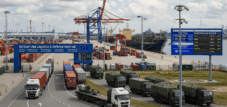
Europe's new defense axes: Four military corridors in the TEN-T system, dual-use hubs and the strategic EU infrastructure – Image: Xpert.Digital
100 billion euro offensive: These are the 4 new military corridors across Europe
Countdown for logistics: Secret dual-use hubs – How AI and robots form Europe's new line of defense
What for decades primarily served civilian trade, travel, and economic networking is now being rapidly adapted for warfare in light of a fundamentally altered geopolitical threat landscape. Russia's war of aggression against Ukraine has ruthlessly exposed Europe's logistical shortcomings. To prevent troops and heavy military equipment from being bogged down in weeks of bureaucratic and infrastructural bottlenecks in a crisis, the EU is pushing ahead with the development of a "military Schengen Area." At the heart of this gigantic, multi-billion-euro transformation are four strategic military corridors within the existing TEN-T system, as well as the construction of decentralized, highly automated "dual-use hubs." These intelligent logistics nodes are intended not only to revolutionize the continent's defense capabilities but also to address two of the biggest economic megatrends of our time: the circular economy and nearshoring. The largest infrastructure offensive since the Second World War has begun – and it is making asphalt, railways, and automated warehouses a matter of geopolitical destiny.
At the presentation on November 19, 2025, EU Transport Commissioner Apostolos Tzitzikostas estimated the total investment required for 500 identified infrastructure hotspots along the four corridors at "around €100 billion"—a figure explicitly confirmed by the European Parliament in its December 2025 resolution. This involves bridges, tunnels, railway lines, ports, and airports that need to be upgraded to support the weight of modern military vehicles (a main battle tank weighs up to 60 tons).
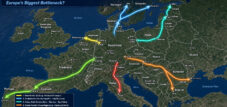
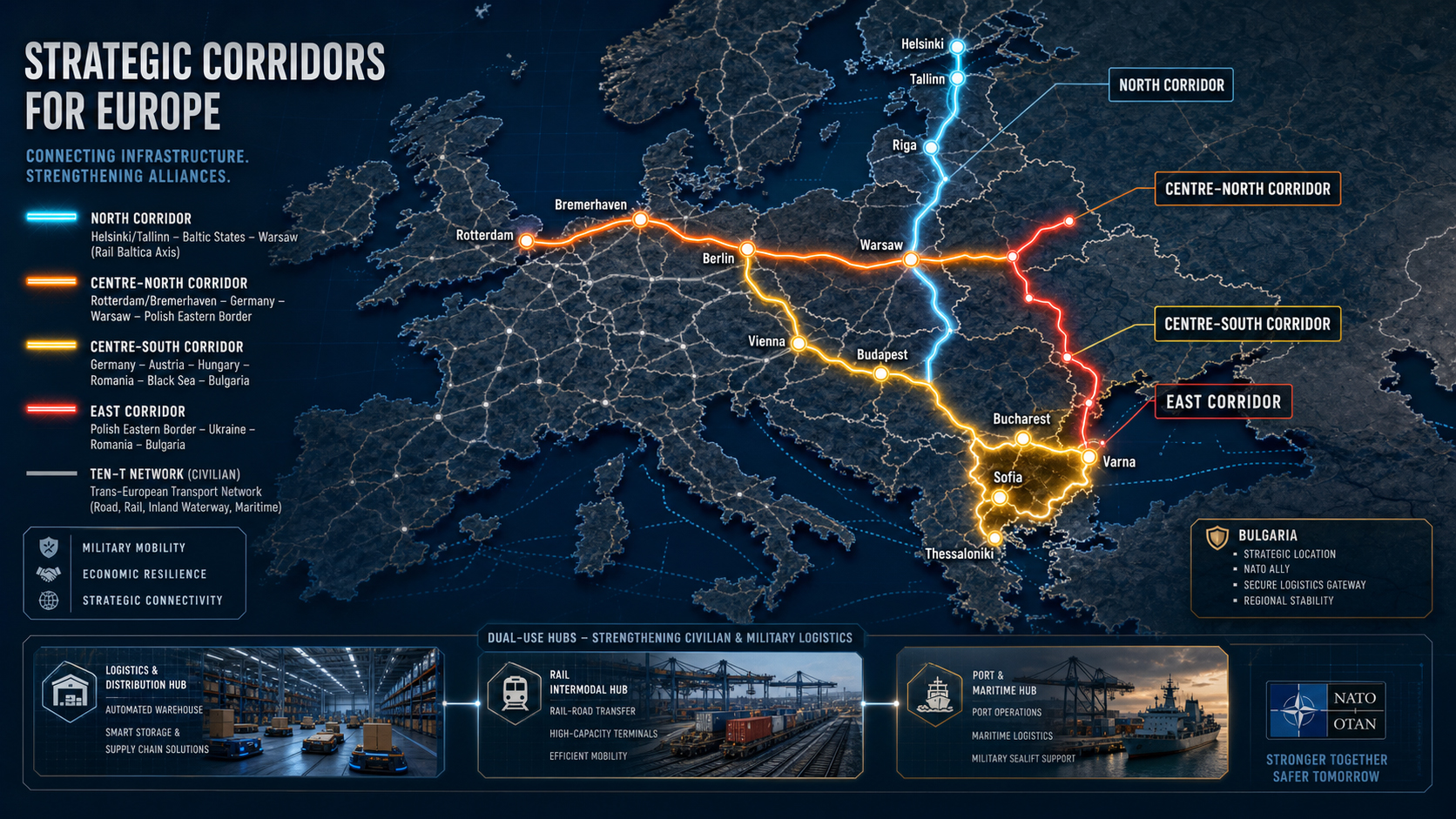
The four corridors are also named: northern, central-northern, central-southern, and eastern corridors — all explicitly listed in the European Parliament's decision of December 2025. They run from north to south and from west to east across Europe.
The “100 billion euro offensive” sounds like a unified EU program with guaranteed funding—but it isn't. The 100 billion euros represent the estimated total need, which the EU is currently addressing with just 1.7 billion euros in its budget until 2027—a figure Tzitzikostas himself described as “a drop in the ocean.” The next EU budget for 2028–2034 allocates 17.65 billion euros—a tenfold increase, but still nearly 83 billion euros short of the actual need. This gap is to be filled by cohesion funds, SAFE defense loans, national budgets, and private investment.
Related to this:


When highways and railways become a logistical weapon — why Europe needs to reinvent its asphalt
Europe is currently undergoing one of the most profound reassessments of its transport network since the end of the Second World War. What for decades was considered purely economic infrastructure—railways, bridges, ports, highways—is rapidly moving to the center of the continent's defense planning. The reason is well-known: Russia's war of aggression against Ukraine has revealed that the ability to rapidly deploy troops and heavy equipment over long distances cannot be taken for granted. Currently, it takes up to 45 days to transport military equipment from Western European ports through the EU to NATO's eastern flank—a strategically unacceptable timeframe that undermines the alliance's entire deterrence logic.
In December 2025, the European Parliament unequivocally stated that, despite significant progress, major administrative and financial hurdles to military mobility remained, and explicitly called for the capability to deploy troops and military equipment within 24 hours in crisis situations. The EU's political institutions responded: in March 2025, the Council of the European Union established four priority corridors for military mobility—the Northern Corridor, the Central-Northern Corridor, the Central-Southern Corridor, and the Eastern Corridor—thus creating the geographical framework for the largest infrastructure offensive in the history of EU defense policy.
From trade route to military road: The four corridors in the TEN-T system
The nine-part TEN-T network and its military translation
The four military priority corridors of the EU Council are not a parallel structure alongside the existing trans-European transport network, but rather a strategic selection and prioritization within this system. Since Regulation (EU) 2024/1679, the TEN-T network has been divided into nine European Transport Corridors, which form the framework for the core and extended core networks. These nine corridors—including the Baltic-Adriatic Corridor, the North Sea-Baltic Corridor, the Scandinavian-Mediterranean Corridor, the Rhine-Danube Corridor, and the Orient/Eastern Mediterranean Corridor—form the physical basis upon which the four military corridors are built.
The allocation is not a direct translation, but rather a geopolitically motivated stratification. The Northern Military Corridor essentially corresponds to the North Sea-Baltic Corridor (TEN-T Corridor 2) and the northern branch of the Baltic-Adriatic Corridor, i.e., the axis that leads from the Finnish and Baltic ports through the Baltic states and Poland to the Central European heartland. Its central construction project is Rail Baltica, the 1,060-kilometer-long new standard-gauge railway line from Warsaw via Kaunas, Riga, and Tallinn to Helsinki. With EU funding of approximately 27 billion euros, it represents the most important TEN-T investment project in the history of the Baltic states and is simultaneously the most strategically sensitive transport project in Europe.
The Central-North military corridor utilizes the infrastructure of the North Sea-Baltic Corridor on its western and central branches, as well as the German east-west routes. It forms the main axis from Bremerhaven and Rotterdam via Hamburg, Berlin, and Frankfurt an der Oder to Warsaw and onward to the Polish-Ukrainian border. Germany is both the core and the weakest link in this corridor: The first cross-border model corridor for troop movements in Europe, agreed upon by Germany, the Netherlands, and Poland in January 2024 and successfully tested in September 2024, follows precisely this axis. However, the structural infrastructure deficiencies on German soil—dilapidated bridges, overloaded rail lines, and a lack of capacity for simultaneous civilian and military use—remain unresolved.
The Central-South military corridor follows the Rhine-Danube corridor and the southern branch of the Orient/Eastern Mediterranean corridor, running from Germany through Austria, Hungary, and Romania towards the Black Sea and the Romanian and Bulgarian NATO bases. It secures the logistical supply of the southeastern flank and provides access to those Black Sea littoral states that serve as platforms for potential operations in the Black Sea region and the Caucasus.
Finally, the Eastern Military Corridor connects Poland and the Baltic region with Ukraine via various routes, thus forming the most direct axis to the front lines of the active conflict and for supplying those NATO countries geographically closest to the Russian threat. It overlaps with the eastern sections of the North Sea-Baltic Corridor and includes those border regions for which the Pan-European Corridor III – Dresden–Wrocław–Katowice–Lviv–Kyiv – was also historically significant.
Bulgaria: Dual integration into two TEN-T corridors
Bulgaria occupies a remarkably privileged, yet structurally undervalued position within this architecture. The country is integrated into two core European transport corridors: the Orient/Eastern Mediterranean Corridor (OEM), which runs from Hamburg via Prague, Vienna, Budapest, Bucharest, Sofia, and Thessaloniki to Athens and Nicosia, and the Rhine-Danube Corridor, which connects the Rhine-Main axis via Austria, Slovakia, and Hungary with Romania and the Bulgarian Black Sea ports of Varna and Constanța.
Militarily, Bulgaria is thus connected to two of the four priority corridors—the Central-South Corridor (via the Rhine-Danube Corridor and the OEM Corridor) and the Eastern Corridor (via the Black Sea axis). The port of Varna and the strategically important port of Burgas serve as the easternmost deep-sea ports of NATO territory on the Black Sea and could serve as alternative unloading points for NATO materiel in the event of a defense emergency, should the North Sea ports be disrupted.
Bulgaria's active role in military mobility diplomacy is noteworthy. In July 2024, at the NATO summit in Washington, Bulgaria signed two memoranda of understanding to establish harmonized military mobility corridors: one with Italy, Albania, and North Macedonia within the framework of Pan-European Corridor VIII—which connects the Adriatic and Black Seas—and another with Greece and Romania, intended to link Thessaloniki, Alexandroupolis, Varna, and Constanța. Pan-European Corridor VIII, running from Durrës via Skopje and Sofia to Burgas and Varna, is also receiving new impetus from the agreement reached between North Macedonia and Bulgaria in November 2025 regarding the Deve Bair border tunnel—completion by 2030 is considered realistic.
Nevertheless, there are significant investment backlogs. On the OEM corridor, the European Rail Traffic Management System (ERTMS) is still implemented in Bulgaria at a far below-average level, and national planning does not foresee full implementation until 2030. While the connection from Sofia to Plovdiv and onward to the Black Sea ports and Thessaloniki exists, it lags behind the performance level of the Western European corridors—a deficit that directly impacts NATO's planning for the southeastern flank.
The November 2025 package: Europe's infrastructure revolution
On the way to a military Schengen area
November 19, 2025, marks a turning point in European infrastructure and security policy. On this day, the European Commission, together with High Representative Kaja Kallas, presented the most comprehensive legislative proposal in the field of military mobility that Europe has ever undertaken. The goal is explicitly stated: By 2027, a "military Schengen Area" is to be created in which troops, equipment, and military resources can circulate as freely as civilian goods in the EU single market.
The structural paradox this project seeks to resolve is compelling: A Belgian truck driver crosses the German-Polish border without being checked; a military convoy requires weeks of advance permits, multiple copies of customs documents, and national exemptions. Currently, the transport of heavy military equipment such as battle tanks requires individual permits from all transit states, the processing of which can take up to 45 days in some cases. The new regulations set a maximum processing time of three days for regular cross-border military transports and harmonize customs formalities across the EU.
EMERS, solidarity pool and digital information system
The European Military Mobility Enhanced Response System (EMERS) is the centerpiece of the emergency response framework. In a crisis, it ensures priority access to strategic infrastructure for EU and NATO armed forces and replaces the previous authorization procedure in genuine emergencies with a simplified, notification-based system that dramatically reduces response times. In June 2026, the European Parliament's Committees on Transport (TRAN) and Security/Defense (SEDE) approved the regulations, including the digital transport system, the Solidarity Fund, and EMERS.
The solidarity pool provides shared logistics capacities from member states, which can be activated as needed. The planned digital information system for military mobility creates the necessary data transparency for coordinated, multinational logistics management—from permit administration and real-time tracking to dynamic route planning. This digital layer is not only relevant to security policy but also generates, as a byproduct, an information infrastructure that can be used for the efficient management of civilian goods flows.
The financial dimension: Historical budgets for a historic task
The financial dimension of the package is unprecedented in EU transport policy. Under the Connecting Europe Facility (CEF), €17.65 billion is explicitly earmarked for military mobility in the next Multiannual Financial Framework (MFF) for 2028–2034—a tenfold increase compared to the current budget of €1.7 billion. By comparison, in the original MFF for 2021–2027, the Commission had proposed €6.5 billion for this purpose, but this was slashed to €1.7 billion by the Council. This about-face is dramatic and reflects a complete shift in the geopolitical awareness of the EU member states.
The European Court of Auditors, in its Special Report 4/2025 on military mobility, documented that eight EU-funded megaprojects examined, with a total value of €54 billion – including €7.5 billion in EU co-financing – all suffered significant construction delays, averaging eleven years. The total cost for modernizing the necessary EU infrastructure is estimated at around €100 billion. Defense experts believe that Germany alone requires a special fund of at least €30 billion for the most urgent repairs to those sections of rail and motorway needed for heavy military transport.
Hub for Security and Defense - Advice and Information


Hub for Security and Defense - Image: Xpert.Digital
The Security and Defence Hub offers expert advice and up-to-date information to effectively support companies and organizations in strengthening their role in European security and defence policy. Working closely with the SME Connect Defence Working Group, it particularly promotes small and medium-sized enterprises (SMEs) that wish to further develop their innovative capacity and competitiveness in the defence sector. As a central point of contact, the Hub thus creates a crucial bridge between SMEs and European defence strategy.
Related to this:
Dual-use logistics: Why hubs are the backbone of nearshoring and the circular economy
Decentralized, automated dual-use hubs: The backbone of the new architecture
Three strategic transformations at one crossroads
The most intellectually original and economically impactful concept in the current debate on military mobility and infrastructure is not the rail project or the bridge upgrade—it is the idea of the decentralized, highly automated dual-use logistics hub. These hubs are so strategically attractive because they simultaneously combine three of Europe's most significant structural transformations into a single physical infrastructure element: defense autonomy, the circular economy, and the nearshoring comeback of European industry.
Europe is at a historic turning point: The changed geopolitical threat landscape demands unprecedented military mobility, while at the same time the transition to a circular economy and the trend towards nearshoring are completely upending global supply chains. What at first glance appears to be entirely separate challenges in defense, ecology, and the economy, in reality, are all failing due to the exact same infrastructural bottleneck. This triple overlap of functions is the true economic and strategic potential of the concept—not a coincidence, but structural logic.
The PESCO LogHub network as an operational blueprint
The PESCO project "Network of Logistic Hubs in Europe and Support to Operations" embodies the emerging logistical backbone of the EU's defense capabilities in its most practical form. Far more than a collection of warehouses, this network, coordinated by a central coordination center in Wilhelmshaven and supported by 15 EU nations, forms the emerging logistical spine for the European Union's operational capability. Currently, the network comprises 25 logistics hubs across Europe, providing essential functionalities such as warehousing, transport, transshipment, and material support.
Germany is involved as coordinator in this PESCO project, a role stemming from its strategic function as a central transit nation: In the event of an alliance conflict, the Federal Republic must be able to transport and supply up to 800,000 soldiers and 200,000 vehicles across its territory. The NATO Joint Support and Enabling Command (JSEC) in Ulm coordinates all of the alliance's troop movements in Europe—and is thus the operational linchpin of precisely the infrastructure that is to be strengthened through decentralized hubs.
With investments totaling billions, the participating logistics centers are being gradually transformed into highly automated smart warehouses, where robots, artificial intelligence, and digital systems optimize material flow. The PESCO 2025 progress report confirms that almost half of the current 74 PESCO projects have reached the implementation phase. Automation solutions in these hubs reduce picking times by up to 30 percent and ensure guaranteed availability for time-critical deliveries—an operationally critical metric in a military context.
Related to this:
Technical architecture: What makes a true dual-use hub
A dual-use hub, in its basic form, is more than just a large warehouse with military connections. In civilian operation, it must achieve maximum picking speeds for e-commerce returns and industrial deliveries, while simultaneously being able to switch to military operation within a very short time in a crisis – without lengthy conversion work, personnel changes, or system replacements. This requires modular system architectures in which warehouse management systems (WMS), autonomous mobile robots (AMRs), and automated high-bay warehouses are configured so that operational changeover can be completed in minutes, not days.
AI-supported planning and inventory optimization play a key role: In civilian operations, they maximize warehouse throughput and minimize idle capacity; in a military context, they enable the prioritization of critical supplies and dynamic route planning under variable transport conditions. Integrating these systems into the European Commission's planned digital information system for military mobility (EMERS data layer) creates the necessary data transparency for coordinated, multinational logistics management.
Trimodality is a fundamental technical requirement: A fully-fledged dual-use hub needs connections to rail, road, and—where possible—waterways. From a military perspective, rail is dominant: With €874 million (50 percent of CEF funds for military mobility in the period 2021–2023), the largest share of funding goes to rail transport—clearly reflecting the strategic prioritization of heavy rail transport. A US Armored Brigade Combat Team requires approximately 5,000 railcars for its deployment alone; without efficient rail connections to the hubs, any other automation investment is worthless in a crisis.
Four corridors, four hub networks: The geographical solution
A differentiated hub topology can be derived along the four military priority corridors. For the northern corridor, hubs in Estonia (Muuga near Tallinn), Latvia (Riga), Lithuania (Kaunas), and Poland (Gdynia/Danzig, Warsaw-Praga) are the natural nodes, which are also the most important intermodal transshipment points for civilian freight flows in the Baltic states. The Rail Baltica line, still under construction, will physically connect these hubs and only then achieve its full military capability—which is why the project's delays (realistically not expected until 2030) should be classified as a security policy issue, not just a construction problem.
In the Central-North Corridor, multimodal hubs in Bremerhaven and Wilhelmshaven (as NATO primary unloading ports), Hamburg, Berlin/Brandenburg, and Szczecin (where the CEF-cofinanced MULTIRAILHUB project explicitly pursues dual-use standards) are the core nodes. This axis has already completed an operational test run with the model corridor Netherlands–Germany–Poland and can be considered the most developed segment of the future hub network.
In the Central-Southern corridor, Vienna/Fischamend, Budapest-Soroksár, Constanța (as the largest Black Sea port), and Galați are the logical locations. The connection between the Danube region and the Black Sea via the Rhine-Danube corridor is of particular importance: The Danube itself, as Corridor VII of the old pan-European system, offers considerable advantages for strategic mobility—it can carry heavy loads that would be too large for roads and many bridges, and connects Bavaria to the Black Sea over a distance of 2,300 kilometers.
For the Eastern Corridor, hubs in Lublin, Rzeszów and Lemberg (Lviv, Ukraine) — there within the framework of sectoral support cooperation — as well as in Moldova and Western Ukraine are the most important positions from a security policy perspective, but also those with the greatest security and coordination risks.
Bulgaria's hubs in the Central-South and Eastern Corridors
Bulgaria's dual integration into the OEM and Rhine-Danube corridors results in specific hub location logics. Sofia, as a railway hub and main transshipment point in the interior, Plovdiv, as a secondary logistics hub and simultaneously home to numerous industrial enterprises, and the Black Sea ports of Varna and Burgas, as trimodal entry and exit points, form the natural framework of a Bulgarian dual-use hub network.
The port of Alexandroupolis—just across the Bulgarian-Greek border—takes on a unique significance in this context: it is the shortest sea route to the NATO base in Romania and the Turkish west coast, and the planned LNG terminal will make it both an energy axis and a military logistics base. The trilateral corridor initiatives between Greece, Bulgaria, and Romania, on the one hand, and the Corridor VIII initiative between Bulgaria, North Macedonia, Albania, and Italy, on the other, create the political foundations for an integrated hub architecture that could make Bulgaria the central point of Southeast European defense logistics.
The economic trifecta: Why dual-use hubs simultaneously serve three investment theses
Reverse Logistics: The underestimated trillion-dollar market
While the defense dimension of dual-use hubs attracts considerable public attention, the economic significance of their civilian function as circular economy nodes is often underestimated. The global reverse logistics market was valued at between US$665 billion and US$982 billion in 2025 and is projected to grow to between US$1.0 trillion and US$1.75 trillion by 2034—at annual growth rates between 4.6 and 7.3 percent. Specifically for the European market, the industry recorded revenues of approximately US$136 billion in 2024, which is expected to reach US$452 billion by 2033.
This growth is not a cyclical phenomenon, but rather anchored in regulation: The EU Circular Economy Action Plan, the right to repair, new packaging rules, and ecodesign regulations are systematically increasing the volume of reverse logistics flows. Returned goods require physical hubs with sorting, inspection, and processing capacities—precisely the multifunctional hubs that defense logistics also calls for. In this view, the dual-use hub is the ideal reverse logistics node, offering its military crisis capability as a kind of subsidized added benefit.
Nearshoring: The third line of force
The supply chain disruptions of the COVID-19 pandemic, the energy shock of the Ukraine war, and the uncertainties surrounding Taiwan have forced a business realization that many had long suppressed: Maximum cost efficiency through global outsourcing and resilience are mutually exclusive. According to a 2025 ABB study, 86 percent of the German companies surveyed plan to reshore or nearshore to make their supply chains more resilient. A Capgemini study puts the planned reindustrialization investments of European and US companies over the next three years at $4.7 trillion—flagship projects like the TSMC-ESMC chip factory in Dresden and the VW PowerCo battery factory in Salzgitter demonstrate that this trend goes far beyond mere declarations of intent.
Nearshoring is not just changing where production takes place—it is fundamentally changing which transshipment points the resulting shorter supply chains require. Central and Eastern Europe is gaining strategic importance in this context; 39 percent of the German companies surveyed by KPMG consider the region one of their most important procurement locations in the long term. A network of decentralized dual-use hubs along the four military corridors is therefore also the logistical backbone of the nearshoring boom—a triple investment thesis within a single infrastructure concept.
Related to this:


Financing architecture: Public funding meets private return
The financing architecture for dual-use hubs is complex, but robust in its basic structure. At the European level, in addition to the CEF, funds are also available from the European Defence Fund; at the national level, the SAFE instrument provides low-interest loans of up to €150 billion. The CEF contributes up to 50 percent of the total costs of eligible dual-use infrastructure projects—a clear political signal that the European funding mechanism actively rewards the multiple-use approach.
Dual-use hubs offer a particular appeal for private investors: Public funding significantly reduces investment risk, while stable demand from two independent sectors—civil logistics and defense—creates an unusually broad revenue base. Institutional long-term investors, especially insurance companies, have increased their infrastructure investments from €10 billion to €100 billion over the past decade; dual-use infrastructure is attractive to this investor class because it offers long-term cash flows from usage fees and government concessions and is now explicitly supported by security-policy-motivated public co-investments.
Systemic risks and vulnerabilities
Hybrid threats: The new risk profile of infrastructure
The vulnerability of the four corridors and their hub networks is not solely a matter of bridge load-bearing capacity and track gauge. Digital control systems, signaling technology, fuel supply infrastructure, and communication systems along the corridors are potential targets for hybrid state actors. Attacks on submarine cables in the Baltic Sea, acts of sabotage on railway lines, and suspicious ship movements near critical infrastructure have increased significantly since 2022. The Military Mobility Package explicitly includes measures to safeguard against cyber and physical risks; the ability to rapidly repair damaged infrastructure has been deemed just as important as new construction and modernization.
A network that is critical for military supply in a crisis is an attractive target for state cyber attackers — and an automated hub that relies on warehouse management systems and AI-driven robotics is a dangerous vulnerability rather than a strength without a hardened cybersecurity architecture.
The governance problem: Too much sovereignty in the wrong places
The structural problem of EU defense integration—too much national sovereignty at critical interfaces, too little supranational decision-making authority—threatens to slow down the dual-use hub concept as well. A network of 25 or more LogHubs, intended to operate under national command but according to common standards, requires considerable effort to achieve technical, regulatory, and digital interoperability. The aspired goal of a military Schengen Area by 2027 presupposes the harmonization of authorization procedures in 27 member states—a bureaucratic undertaking that the European Court of Auditors has already identified as progressing insufficiently quickly.
In its special report 4/2025, the Court of Auditors explicitly found that conceptual weaknesses and institutional obstacles have prevented faster progress on military mobility in the EU — a finding that is directed not only at the Member States but also at the EU institutions themselves, which integrated dual-use requirements into the TEN-T planning processes too late.
Implementation speed as a matter of survival
The political priorities are clear and historically unprecedented: The Military Mobility Package has been adopted, the four NATO priority corridors have been identified, and the funding commitments for the next budget cycle, at €17.65 billion, are the highest in EU history. The JSEC in Ulm has an operational mandate and experience from the successful model corridor. The institutional foundations are in place.
What's lacking is speed of implementation. Rail corridors designed to carry tanks need physically upgraded tracks, reinforced bridges, and sufficient capacity for simultaneous civilian and military transport. Approval processes, which currently take weeks, must be condensed to three days—and ideally to two working days. Rail Baltica must be completed before the strategic necessity arises, not after. Bulgaria's connection to the OEM Corridor and the Rhine-Danube Corridor must be technically upgraded to a level commensurate with the strategic role envisioned for the country as NATO's Southeast European logistics hub.
Decentralized, automated dual-use logistics hubs are not just a clever infrastructure concept in this context. They are the structural node where three of Europe's most significant strategic transformations converge and mutually finance each other: defense autonomy, the circular economy, and nearshoring reindustrialization. Neither defense, nor the circular economy, nor nearshoring can be implemented with maximum efficiency on its own if the other transformations are ignored. The integrated infrastructure solution that unites all three functions in a network of physically bundled nodes is not the lowest common denominator of these requirements, but rather their synergistic intersection.
Europe has the financing instruments, the technological building blocks, and—after years of strategic naiveté—finally the political will. What's lacking is the coordinated determination to implement the concept faster than geopolitical and economic crises force it to. Asphalt, railways, and automated warehouses have long since become the continent's most important defense tools—it's time to treat them accordingly.
Consulting - Planning - Implementation

Markus Becker
I would be happy to serve as your personal advisor.
Head of Business Development
Chairman SME Connect Defense Working Group
Consulting - Planning - Implementation
Konrad Wolfenstein
I would be happy to serve as your personal advisor.
You can contact me at wolfenstein∂xpert.digital or
Just call me on +49 7348 4088 965 .