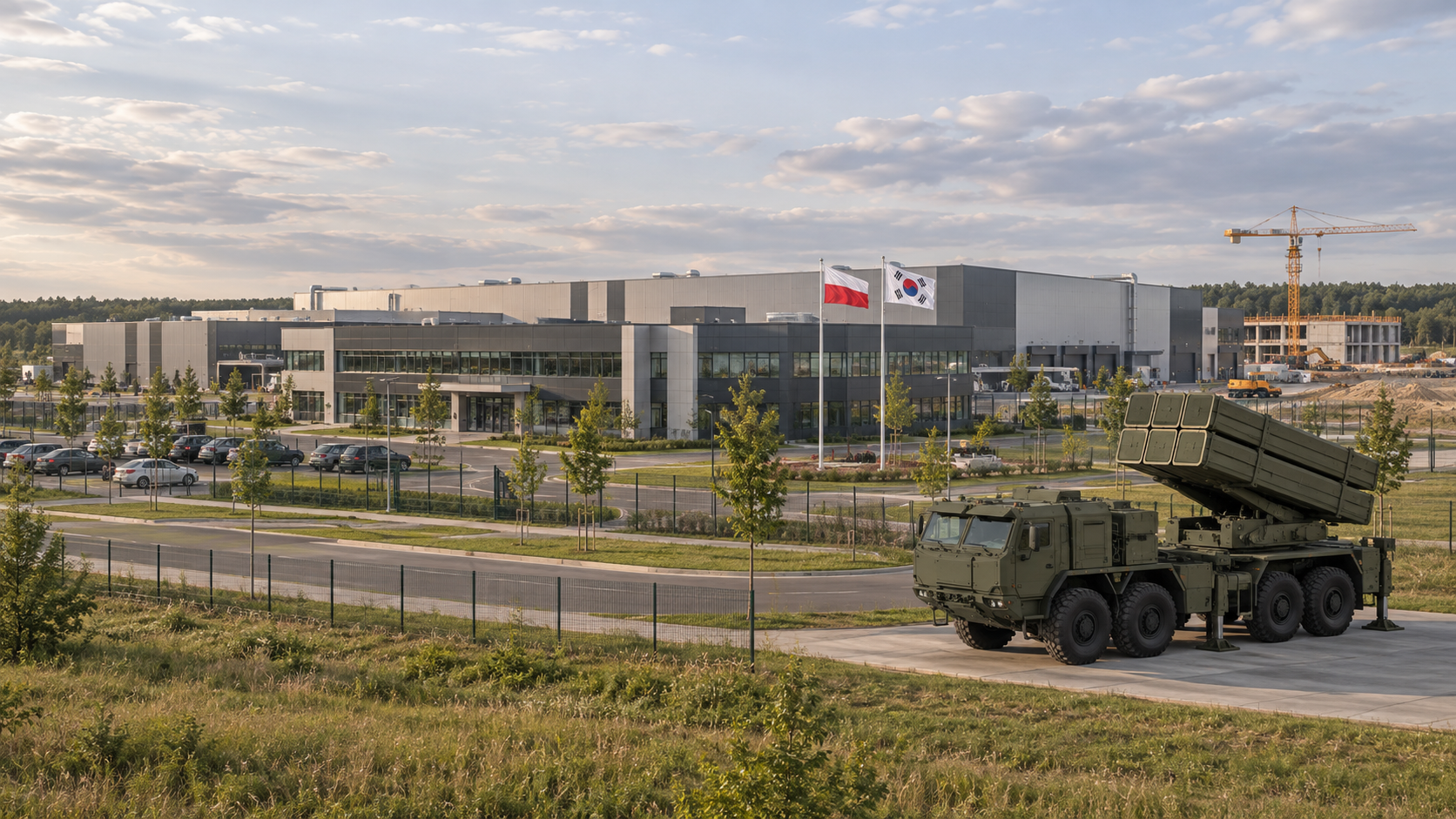
From South Korea to Poland: Europe's new arms factory is slated for full production by 2030 – Hanwha plans to do this in Gorzów Wielkopolski – Creative image on the topic, created with AI: Xpert.Digital
Poland is building a missile factory – what this means for Europe's arms industry
More than 200 jobs: Hanwha builds new guided missile factory in Poland
116 hectares for guided missiles: This is what Hanwha is planning in Gorzów Wielkopolski
Poland not only wants to purchase weapons systems but also to be more involved in their production. Hanwha Aerospace, together with the Polish WB Group, is addressing this need with a new factory for guided missiles of the South Korean Chunmoo system. In Gorzów Wielkopolski, CGR-080 guided missiles for the Polish Homar-K variant will be produced. More than 200 jobs are planned; full production is scheduled to begin in 2030.
The project could provide Poland with additional production capacity and promote the development of its own industrial expertise. However, a factory in the country does not automatically mean that the technology, key components, and decision-making processes are fully integrated there. Crucially, the extent of technology transfer, the tasks undertaken by Polish companies, and whether the site can be utilized sustainably will be key factors. This makes the project a revealing test of how closely defense capabilities, economic value creation, and industrial independence can actually be linked.
Those who only buy defense capabilities remain dependent – Poland wants to profit from production
A factory project with significance far beyond the site
With the construction of a production facility for Chunmoo multiple rocket launcher guided missiles in Gorzów Wielkopolski, Hanwha Aerospace is sending a clear industrial policy signal. The South Korean defense company is building a factory there in partnership with the Polish WB Group, which is intended not only to provide Poland with additional manufacturing capacity. The project also represents an attempt to more closely link military procurement, technological expertise development, and regional value creation.
Construction, which began on November 4th, is being carried out by the joint venture HWBAS. On a site of 1.16 million square meters, CGR-080 guided missiles with a range of 80 kilometers will be produced. These missiles are intended for Homar-K, the Polish version of the South Korean Chunmoo system. More than 200 jobs are planned.
The economic implications, however, are not solely determined by the size of the property and the number of employees. Crucially, what matters is which production steps are actually relocated to Poland, how comprehensive the technology transfer is, and what resulting opportunities for action arise. A locally located factory is an important starting point. Whether it leads to lasting industrial influence, however, only becomes clear through the interplay of vertical integration, the supply chain structure, usage rights, and guaranteed demand.
From purchasing weapons to participating in value creation
The fundamental difference between importing a finished weapons system and building domestic production capacity lies in the distribution of economic effects. With pure import, significant portions of the industrial value chain remain in the manufacturing country. The buyer acquires the military capability but participates only to a limited extent in its production and technological development.
Local manufacturing can change this ratio. A portion of the expenditures would then flow into employment, plant operation, technical services, and potentially domestic suppliers. This opens up the possibility for Poland to more closely link defense spending with the development of industrial expertise.
However, a distinction must be made between domestic production and domestic value creation. A factory may be geographically located in Poland and still remain heavily reliant on imported components, foreign intellectual property rights, or external technical support. Conversely, even a initially limited level of vertical integration can be strategically valuable if it is systematically expanded.
The project should therefore not be seen as proof of already achieved independence. Rather, it is an investment in the possibility of organizing a larger part of the supply chain independently in the future. Its economic success depends on whether this possibility leads to the development of robust industrial capabilities.
A timeline that reveals the complexity of arms manufacturing
The planned milestones demonstrate that establishing a guided missile production facility goes far beyond simply constructing factory buildings. Completion of the plant is scheduled for 2028. This will be followed by installation, technology transfer, testing, and certification. Initial production is slated to begin at the end of 2029, with full-scale production expected to commence in 2030.
Between the completion of construction and the production of the first missiles lies a distinct industrial development phase. During this phase, technical infrastructure, workflows, personnel qualifications, and quality assurance must be integrated. A building alone is not a fully functional production organization.
Economically, this process means that expenditures and operating revenues are staggered. Capital is tied up before a stable production process is achieved. Delays can prolong this phase and incur additional costs. Conversely, acceleration is only beneficial if it does not compromise safety, reliability, or reproducible quality.
Therefore, simply observing construction progress is insufficient for evaluating the project. More meaningful indicators include the successful commissioning of individual production areas, the qualification of personnel, and the approval of the planned manufacturing processes. Only when these steps mesh together does a projected capacity translate into actual, available industrial output.
Why 116 hectares don't reveal any production volume
The factory site covers 1.16 million square meters. This corresponds to 116 hectares or 1.16 square kilometers. This size underscores the spatial scope of the project, but in itself does not allow for any statement about how many guided missiles can be produced annually.
Land area is not synonymous with built-up area. Likewise, the size of a site does not directly reflect revenue, investment volume, or vertical integration. In security-sensitive production, spatial separation, internal traffic routes, storage areas, and potential expansion areas can play a significant role. The available data does not reveal how these elements are specifically distributed in Gorzów Wielkopolski.
The combination of a large property and more than 200 planned jobs is not contradictory. It can reflect various operational and safety-related requirements. However, it is not possible to reliably determine from this whether and to what extent automated processes are planned.
These boundaries are important for a sound economic analysis. Large areas attract attention, but the efficiency of a plant is measured by other factors: stable processes, available plant technology, qualified personnel, guaranteed intermediate products, and a clearly defined output quantity.
A joint venture as a link between two industrial systems
The implementation via HWBAS connects Hanwha Aerospace with the Polish WB Group. The joint venture thus forms the organizational interface between a South Korean systems provider and a Polish industrial partner.
Such a structure can fulfill several economic functions. It creates a joint operational unit in which investments, staffing, and production responsibilities can be pooled. At the same time, it fundamentally opens up the possibility of combining the technological capabilities of the foreign partner with local market knowledge and industrial relationships.
However, this does not automatically imply an equal distribution of influence or economic benefits. For that, ownership structures, decision-making rights, profit sharing, and technological responsibilities would be crucial. These details are not disclosed in the available project data.
Therefore, the decisive factor is not so much the designation as a joint venture, but its actual operation. For Poland, the relevant question is whether local specialists and companies develop independent expertise. For Hanwha Aerospace, the crucial point is ensuring technical standards, product quality, and reliable production processes.
When these interests align, HWBAS can achieve more than simply operating a single factory. The company could evolve into a lasting industrial partnership, fostering the development of further capabilities. The prerequisite for this remains a collaboration that is sustainable beyond the initial setup phase.
Technology transfer is decided in everyday work
The manufacturing process is based on a technology license agreement between Hanwha Aerospace and HWBAS. This provides a legal framework for the use of the necessary technology. However, the term "technology transfer" alone does not reveal the extent of the associated development of expertise.
There is a significant difference between being authorized to manufacture a product according to specified requirements and being able to independently develop it further. Similarly, assembly knowledge, process control, testing expertise, and control over key design decisions differ.
The economic impact depends crucially on which of these skills are actually embedded within the Polish company. Knowledge that is not limited to individuals or temporary support services, but is permanently integrated into the organization, documentation, and training, is particularly valuable.
Technology transfer is therefore not a one-time handover. It takes place through the establishment of processes, training, the solving of production problems, and the gradual assumption of technical responsibility.
A realistic success criterion would therefore not simply be that a missile leaves the production line in Poland. More important is whether the local organization can independently ensure the required quality in the long term and manage operational disruptions with increasing in-house expertise.
Security of supply is more than geographical proximity
Local production of CGR-080 guided missiles can help Poland more closely integrate the supply of the Homar-K system with its own industrial base. It potentially reduces the distance between the end user, the production organization, and the technical contact person.
This can create advantages. Coordination processes can potentially be simplified, certain transport routes shortened, and production issues addressed more directly. Furthermore, manufacturing rooted in the country creates a different access to supplies than sole reliance on imported finished products.
However, it would be an oversimplification to equate local production with complete security of supply. If critical intermediate products, manufacturing facilities, or technical approvals continue to be sourced externally, international dependencies will persist. Their significance depends on how easily they can be replaced and what stocks or alternatives are available.
The crucial question, therefore, is not whether the supply chain is national or international. The crucial question is where it remains vulnerable and how this vulnerability can be mitigated.
A robust strategy would combine local manufacturing with an examination of critical suppliers, appropriate warehousing, and technical contingency plans. The factory can provide an important institutional starting point for this, but it does not replace such a strategy.
The economic logic of specialized missile production
The CGR-080 is a specific product designed for a defined weapon system. The range of 80 kilometers describes a product characteristic but says little about manufacturing costs, production time, or economic viability.
From a business perspective, the primary focus is on pooling expertise. When a plant is geared towards a clearly defined product type, qualifications, testing technology, material supply, and production planning can be coordinated. Recurring processes fundamentally create the foundation for learning and more stable production.
At the same time, a dependency arises on the demand for precisely this product or for technically compatible variants. A high degree of specialization can be efficient, but may limit flexibility in the face of changing requirements.
The extent of this risk in this specific case cannot be quantified without information on annual capacity, guaranteed production volume, and potential expansions. Statements about unit costs would also be premature.
The economic challenge lies in balancing specialization and adaptability. The plant must be able to reliably manufacture the intended missile without making all investments viable only under a single, unchanging demand scenario.
Continuity of demand is more important than a short-term production boost
A factory needs not only a compelling reason for its construction, but also a reliable perspective for its ongoing operation. Especially in technically demanding production processes, personnel, equipment, and quality management cannot be arbitrarily built up and dismantled at short notice.
This creates a fundamental tension. High initial demand can justify building new capacity. However, if this demand later declines significantly, a substantial part of the cost structure remains. Low capacity utilization then increases the cost of production per unit.
Conversely, a plant that is too conservatively sized can reach its limits if demand remains high. Subsequent expansions, in turn, require time, capital, and additional skilled personnel.
For HWBAS, it will therefore be crucial to align production capacity and expected demand as closely as possible. This includes realistic ramp-up planning, long-term personnel development, and the question of how flexibly the plant can adapt to varying production volumes.
The available data does not specify an annual output volume or a long-term capacity utilization rate. Therefore, the economic viability cannot yet be definitively assessed. However, one thing is clear: the real test begins not with the groundbreaking ceremony, but with the transition to a reliably fully utilized operation over several years.
Hub for Security and Defense - Advice and Information


Hub for Security and Defense - Image: Xpert.Digital
The Security and Defence Hub offers expert advice and up-to-date information to effectively support companies and organizations in strengthening their role in European security and defence policy. Working closely with the SME Connect Defence Working Group, it particularly promotes small and medium-sized enterprises (SMEs) that wish to further develop their innovative capacity and competitiveness in the defence sector. As a central point of contact, the Hub thus creates a crucial bridge between SMEs and European defence strategy.
Related to this:
Hanwha Aerospace and the European market: A new strategy
More than 200 jobs – significant, but not an end in itself
More than 200 new jobs are planned for the Gorzów Wielkopolski region. This direct employment impact represents a tangible economic benefit. However, its true significance does not depend solely on the number of jobs.
Key factors include qualification level, length of employment, training opportunities, and the anchoring of technical responsibility at the site. Permanent positions in production engineering, quality assurance, or operational organization can trigger different regional effects than temporary roles during the construction phase.
Another question is where the employees come from. Training local people creates different distributional effects than if staffing needs are primarily met through immigration or poaching existing skilled workers. Both can be beneficial for the company, but their impact on the regional economy differs.
Additional employment with service providers and suppliers is possible. However, its extent cannot be reliably determined from the available data. Applying blanket multipliers would create a false impression of accuracy that the project data does not support.
The appropriate assessment is therefore: The plant can create a significant core of specialized employment. Whether this results in a broader regional growth effect depends on training, local procurement, and the long-term viability of the production facility.
A new business location does not automatically create an industrial cluster
The construction of a single plant can stimulate regional development. However, a sustainable industrial network will only emerge if other companies actually gain access to economically viable tasks.
For local businesses, options could include technical services, maintenance, operational infrastructure, or selected supply chain services. The specific possibilities depend on the production organization and the respective quality and safety requirements.
This is precisely where an important industrial policy distinction lies: A factory can function as a largely self-contained unit or gradually become integrated with its regional environment. In the first case, the effects are primarily focused on direct employment and ongoing site operations. In the second, additional expertise and business relationships can emerge.
However, broader integration requires that regional companies can meet the necessary standards. This may necessitate investments, staff training, and reliable prospects for cooperation.
It would therefore be just as wrong to consider a comprehensive supplier network a given as it would be to rule it out entirely. The crucial question for development is whether geographical proximity will translate into economic cooperation. Only then will the benefits extend beyond the factory boundaries.
Hanwha Aerospace is getting closer to its European customers
For Hanwha Aerospace, this is its first overseas factory for guided missiles. This move therefore has significance beyond the Polish location. The company is shifting part of its industrial presence closer to a European sales market.
A local production base can transform a manufacturer's role. A foreign supplier becomes a company with employees, partners, and long-term assets tied up in the customer's country. This can lead to deeper institutional cooperation.
For Hanwha Aerospace, this potentially opens up the possibility of not exclusively serving European demand from South Korea. The plant could serve as a production and supply center, improving its starting position for further business opportunities.
However, this prospect is no guarantee of sales. Other European countries make their own technical, financial, and security policy decisions. A production facility in Poland does not replace their requirements, nor does it eliminate the need for economically compelling offers.
Furthermore, Hanwha Aerospace assumes additional responsibility with local manufacturing. The company must not only deliver a product, but also successfully integrate a production site outside its home market into its industrial organization. Its European presence is therefore both a market opportunity and an operational obligation.
Localization is changing the competition for industrial participation
The project illustrates that technical product characteristics are not the only determining factor in the arms market. For purchasing nations, the industrial capabilities associated with a system and where the economic benefits will accrue can also be relevant.
A manufacturer that enables local production and technology transfer therefore offers more than just a supply relationship. At the very least, it opens up the prospect of employment, training, and closer integration into the supply chain. This can increase the strategic attractiveness of its offering.
At the same time, more complex comparative questions arise. A larger local production share is not automatically more economical if it incurs significant additional costs. Conversely, a higher price can be justified if it is linked to tangible supply advantages or permanently usable expertise.
A proper assessment must therefore combine several levels: military performance, total costs, delivery capability, industrial involvement and remaining dependencies.
From a European perspective, such competition can be productive if it leads to transparent offerings and increased efficiency. It would become problematic if prestigious location promises were the primary focus, while actual vertical integration and long-term economic viability remain unclear. Gorzów Wielkopolski will be judged by what the announced industrialization actually delivers.
Industrial sovereignty develops in stages
The term sovereignty often suggests a clear separation between independence and dependence. In industrial practice, however, the situation is usually more nuanced. A state can be independent in final assembly and yet still rely on foreign components. It can possess production expertise but have only limited rights to modify a product.
For Poland, a tiered approach is therefore sensible. Even the ability to master certain manufacturing and testing processes domestically can expand its options. The competence to resolve disruptions independently, qualify alternative suppliers, or adapt production processes autonomously goes even further.
It is not possible to fully determine from the available information which of these levels will be achieved with HWBAS. The licensing framework and the planned technology transfer create conditions whose practical scope remains to be seen.
The politically appealing concept of complete autarky is therefore not a suitable sole measure of success. A more meaningful indicator is whether critical dependencies decrease and one's own decision-making options increase.
That would also be the more economically sensible approach: not to eliminate all international division of labor, but to build up additional capabilities where their benefits justify the associated costs and risks.
The costs of security must remain visible
Defense industry investments are not solely driven by the logic of minimizing production costs. They are also intended to create capacities that remain available under challenging conditions. This readiness can have economic value, even if it incurs additional costs during normal operation.
This can include reserves in equipment, personnel, or intermediate products. Similarly, a more robustly secured supply chain can be more expensive than procurement focused solely on short-term efficiency. Whether such measures are worthwhile depends on the specific risk being avoided.
The safety benefits of the Polish plant cannot currently be quantified. Information regarding the investment amount, production costs, capacity, and the extent of potential reserve capabilities is lacking. Therefore, precise statements about the overall economic return would not be reliable.
Nevertheless, the conceptual distinction is important. A project can be more expensive from a business perspective than foreign manufacturing and still create additional safety-related benefits. Conversely, the argument of safety does not justify every cost increase.
A responsible assessment must disclose both: the cost of the additional industrial provision and the concrete capability that actually results from it.
Which risks will be particularly significant by 2030?
The planned production ramp-up involves several interconnected risks. Construction delays could postpone the installation of equipment. Later availability of technology could, in turn, affect training, testing, and certifications. Such dependencies make managing the overall project challenging.
Another risk lies in staffing. Skilled workers not only need to be hired, but also trained in specific processes. If key competencies remain too concentrated in the hands of a few people, this can limit operational stability.
In addition, there is the supply of intermediate products. A fully equipped plant can only deliver its intended output if all necessary components are available on time and in the required quality. Local final assembly does not automatically protect against bottlenecks elsewhere.
Finally, the transition from initial production runs to full-scale production can also present difficulties. A successfully manufactured single product does not necessarily prove that larger quantities can be produced consistently with uniform quality over the long term.
These risks do not mean that the timeline is unrealistic. Rather, they explain why the stated deadlines must be considered operational targets and not as guaranteed results.
Why profitability calculations currently have limitations
The known key data is sufficient to recognize the strategic direction of the project. However, essential figures are missing for a reliable business evaluation.
The total investment, annual production capacity, unit costs, and the precise extent of local value creation are not disclosed. Likewise, reliable information on long-term capacity utilization and the economic distribution within the joint venture is lacking.
Without this information, it is impossible to calculate the amortization period or to assess whether local manufacturing is more cost-effective compared to other production models. A reliable ratio of investment to jobs also cannot be determined.
These data gaps should not be masked with speculative estimates. Especially in strategically important industrial projects, there is a risk of deriving large economic effects from a few visible indicators.
A thorough interim assessment is therefore nuanced: The project offers the prospect of increased productivity, employment, and technological learning. The magnitude of the net economic benefit depends on cost, capacity, and value creation structures that are not yet fully understood. Strategic plausibility and proven profitability are two distinct statements.
Three development paths for the location
Three fundamental development paths can be derived from the available plans. These are not forecasts, but rather help to highlight the decisive influencing factors.
In the best-case scenario, the transition from construction completion in 2028 to initial production at the end of 2029 and to full production in 2030 will be achieved without major disruptions. Technology transfer will be organizationally integrated, capacity utilization will remain stable, and Polish companies will gradually assume additional responsibilities. The plant would then strengthen both military supply and industrial development.
In the medium term, a functioning production facility is established, but its independence remains limited. Key components and technical decisions continue to be sourced outside of Poland. The site creates jobs and shortens certain supply chains, but achieves only a portion of its potential industrial impact.
In an unfavorable scenario, delays, high start-up costs, and insufficient capacity utilization coincide. The factory would then exist, but its economic and strategic potential would be limited.
Which path is more likely is not determined by the size of the site. The decisive factors are project management, capacity building, delivery capability, and a sustainable long-term production demand.
Europe's opportunity lies in additional capacity, not in new duplicate structures
From a European perspective, the plant can create additional production opportunities and another industrial link. However, whether this will result in broader benefits depends on how the capacities integrate into existing and future supply structures.
Additional sites can make supply more robust if they provide usable capacity and reduce critical bottlenecks. However, they can also create economic difficulties if several plants compete for limited demand and are therefore permanently underutilized.
The relevant question is therefore not only whether Europe will get more arms factories. The crucial question is whether the resulting capacities are a good fit technically, economically, and organizationally.
For Gorzów Wielkopolski, this means that the project's European ambition must be proven through concrete delivery capabilities and sustainable business relationships. A geographical location within Europe does not automatically make a site a European supply center.
If this development succeeds, however, the factory could deepen the relationship between South Korean technology and European manufacturing. The benefit would then lie not in symbolic independence, but in a better-positioned, more broadly based, and more resilient industrial supply.
The crucial factor is the capability that remains after the setup
The guided missile factory in Gorzów Wielkopolski represents a logical economic strategy: Poland does not want to exclusively import military products, but rather to anchor a portion of their production and the associated expertise within its own borders. Hanwha Aerospace, in turn, is establishing its first overseas factory for guided missiles, thereby strengthening its industrial presence in Europe.
The key data provide a concrete framework for this approach: 1.16 million square meters of land, more than 200 planned jobs, the production of CGR-080 guided missiles for Homar-K, and a phased development until full production is planned for 2030.
The most convincing assessment lies between euphoria and fundamental skepticism. The project can expand supply options and build economic capacity. However, it can only achieve this effect if local production goes beyond mere geographical relocation.
The long-term benchmark is therefore demonstrably available competence: Can the plant reliably manufacture, ensure quality, solve problems, and respond to changing requirements? Are regional capabilities being developed that will persist even after the start-up phase?
If these questions can be answered positively, the factory would be more than just a new production site. It would be a step towards an industrial policy that not only finances defense capabilities but also actively shapes a larger part of its own economic and technological foundations.
Consulting - Planning - Implementation

Markus Becker
I would be happy to serve as your personal advisor.
Head of Business Development
Chairman SME Connect Defense Working Group
Consulting - Planning - Implementation
Konrad Wolfenstein
I would be happy to serve as your personal advisor.
You can contact me at wolfenstein∂xpert.digital or
Just call me on +49 7348 4088 965 .