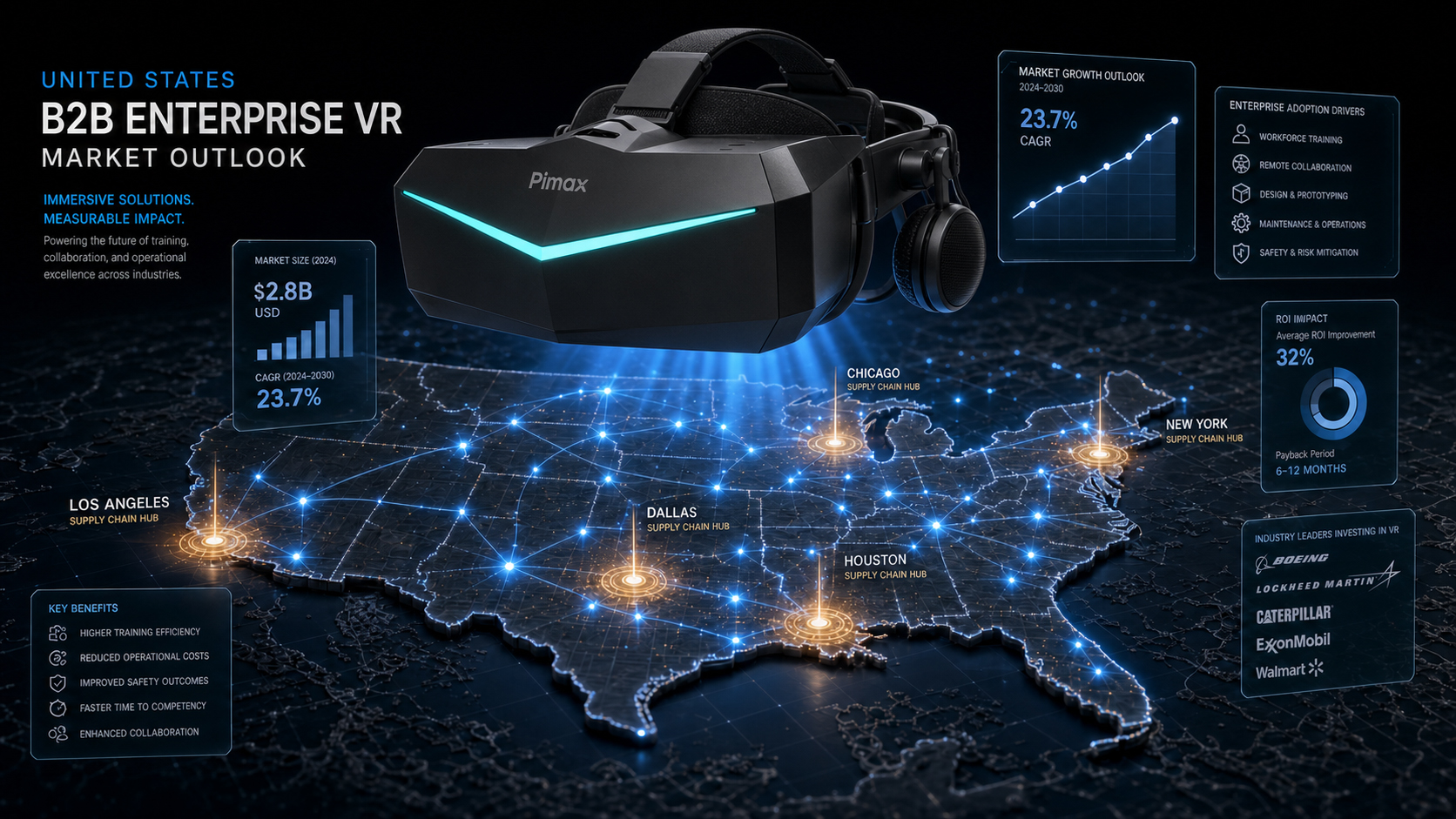
Pimax & Red Stone USA: The strategic B2B partnership for the enterprise VR market in the USA – Image: Xpert.Digital
More than just hardware: How Pimax and Red Stone are conquering the US enterprise market
Exploiting the meta-gap: Why VR pioneer Pimax is now shaking up the US industry
Retina VR meets B2B: The ingenious strategic move by Pimax and Red Stone USA
In April 2026, the up-and-coming VR hardware pioneer Pimax and the North American IT service provider Red Stone USA formed a strategic alliance that goes far beyond a typical distribution agreement. It's a targeted response to a structural weakness in global technology sales: the so-called "last mile" in the B2B market. While market giants like Meta are shifting their focus away from the enterprise sector, and alternatives like Apple's Vision Pro are too expensive for mass-market rollout in companies, a historic market gap is opening up. With its high-resolution, modular PCVR headsets like the Crystal Super, Pimax delivers cutting-edge technology for industrial precision applications. But excellent hardware alone doesn't win over Fortune 500 customers. Buyers demand comprehensive, worry-free packages: from implementation and employee training to real-time support. Red Stone USA brings precisely this commercial clout to the table. A more in-depth analysis reveals why this symbiosis of Chinese engineering and North American service excellence has the potential to completely redefine the rules of the game in the rapidly growing enterprise VR market.
When hardware alone is no longer enough: The strategic background of an unusual alliance
In April 2026, Pimax Technology entered into a strategic B2B distribution partnership with Red Stone USA Inc., a North American enterprise IT service provider. At first glance, this appears to be a routine distribution agreement between an Asian hardware manufacturer and a local reseller. However, closer examination reveals something more fundamental: a structural attempt to address one of the most persistent problems in global technology distribution – the so-called “last mile” in B2B business.
Founded in 2015, Pimax Technology has become one of the most technologically recognized names in the high-performance VR segment within a decade. The company nearly doubled its revenue in the three years prior to the partnership and subsequently closed a Series C1+ funding round of several hundred million yuan, led by Zhuji Economic Development Creative Investment and with participation from existing investor Ivy Capital. With international users accounting for approximately 80 percent of its total customer base, Pimax's fundamental reliance on international markets is evident. Ivy Capital's partner, Fu Lei, emphasized that Pimax has established a unique competitive advantage in the high-end VR headset segment—an assessment clearly supported by the product line's development.
The challenge is nonetheless real: In the North American enterprise market, technical superiority alone is not enough to secure a place on a company's shopping list. IT procurement managers in Fortune 500 companies or mid-sized industrial firms don't make decisions based solely on data sheets. They evaluate implementation risks, response times in case of failures, training requirements, compatibility with existing IT infrastructure, and the supplier's reliability throughout the entire product lifecycle. Until its partnership with Red Stone USA, Pimax lacked a substantial presence in precisely this area of the North American market.
The technological foundation: What Pimax brings to the table
To fully understand the economic logic of the partnership, one must first assess what Pimax is actually bringing to the table. The flagship of the current product line, the Crystal Super in its various configurations, is in a technological class of its own.
The QLED version of the Crystal Super achieves a resolution of 3,840 × 3,840 pixels per eye and, with aspherical glass lenses, offers a pixel density of up to 57 pixels per degree (PPD) – the world's first VR headset to achieve retina-level clarity. The horizontal field of view is over 120 degrees, and the peak brightness is 280 nits. With the Micro-OLED variant presented at CES 2026 in Las Vegas, which combines Sony 4K panels per eye with Pimax's proprietary ConcaveView pancake optics, this benchmark was raised even further: 3,840 × 3,552 pixels per eye with a 116-degree horizontal field of view and over 128 degrees diagonally – the widest field of view ever achieved with Micro-OLED technology in a headset. In addition, there are the Dream Air and Dream Air SE models, also presented at CES 2026, which share the same optical basis and were designed for a wider price and usage range.
Perhaps the most technically important feature for the enterprise market, however, is not the resolution, but the modular architecture of the Crystal Super. The optical engine – lenses and display combined – can be swapped out in seconds. Existing users can upgrade to the new micro-OLED configuration without replacing the entire headset. For enterprise IT departments, this translates into lower total cost of ownership, manageable upgrade cycles, and the ability to switch between different application profiles within a standardized hardware base – from maximum resolution for engineering reviews to maximum image depth for immersive training scenarios. This isn't a product strategy for enthusiasts; it's a product strategy for IT procurement professionals.
The modular design is complemented by Dynamic Foveated Rendering via integrated eye-tracking, which optimizes GPU resources in real time and keeps the Crystal Super functional even on hardware in the RTX 2080 class – an RTX 3070 or higher is recommended. Weighing in at under 600 grams, the headset is lighter than its predecessors. This directly impacts user acceptance in training sessions where wearing the headset for several hours is the norm.
Red Stone USA: More than a reseller, less than a systems integrator, just right for this market
Red Stone USA Inc., based in North Carolina, defines itself not as a distributor, but as an integrated enterprise solutions provider. This self-definition is more than just marketing: it describes the company's actual offering structure, which, for Pimax, fills in precisely what is missing when considering the individual products.
The service portfolio includes hardware procurement and logistics, technical training, after-sales maintenance and support, and customized development services. This is complemented by the integration of Independent Software Vendors (ISVs) for immersive learning platforms, remote collaboration, simulation, wellness applications, and enterprise training. Mobile Device Management (MDM) solutions for the centralized management of device fleets and end-to-end lifecycle services are also offered. This bundle is precisely tailored to the requirements of IT procurement managers in companies: No one buys VR hardware without answers to the questions of who configures the devices, who trains the users, who responds in case of failure, and how the integration into existing IT landscapes works.
Red Stone USA's proven track record of successful commercial implementation with Fortune 500 companies provides the institutional trust that Pimax, as a Chinese manufacturer in this segment, still needs to build. Furthermore, Red Stone USA is one of only three authorized PICO-XR distributors in the US – an indicator that leading VR manufacturers consider the company a qualified market partner and that it possesses in-depth category knowledge in this specific segment. A comprehensive US-wide technical support network with real-time communication across time zones closes the operational gap that Pimax, with its offices in Shanghai, Hangzhou, Hong Kong, and San Jose, cannot bridge on its own.
The partnership's scope extends even further: Red Stone will support Pimax in integrating VR devices with industry-specific software in the fields of manufacturing, IT collaboration, and mental health. In parallel, Pimax plans to establish brand showrooms and experience centers in North America where corporate clients can experience products firsthand. An existing network of experience centers in the US, including locations in Virginia and Miami Beach, already provides an initial infrastructure foundation.
The market that makes this partnership possible: structural shifts in the Enterprise XR segment
A partnership of this kind does not arise in a vacuum. It is a response to market dynamics that changed noticeably in 2025 and 2026.
According to MarketsandMarkets, the North American VR market is projected to grow from $10.25 billion in 2025 to $39.96 billion by 2030 – an annual growth rate of 31.3 percent. A recent forecast even projects a market size of $160.92 billion for North America by 2034, up from $18.99 billion in 2025. The global VR market for corporate training alone was valued at $16.64 billion in 2026 and is expected to reach $41.1 billion by 2031.
These figures reflect a paradigm shift: Enterprise VR training is no longer an experimental technology. A Forrester study commissioned by Meta and published in 2025 shows a 219 percent return on investment (ROI) over three years for a representative organization with 10,000 employees and 3,300 VR-trained users, with a net present value of $4.2 million and a payback period of less than six months. Training time for technical staff is reduced by up to 75 percent, and general training durations are halved. The cost per learner drops to approximately $115 over three years—around 50 percent less than traditional classroom methods. VR is more cost-effective than classroom training for 375 learners, 52 percent more for 3,000 learners, and 64 percent more for 10,000 learners. The economic threshold has thus been crossed for a broad range of companies—this is no longer an argument that applies only to large corporations.
At the same time, there is an unexpected opening on the supply side. Meta discontinued its commercial Quest sales and ended operations of Horizon Workrooms in February 2026. Reality Labs posted a loss of $19.1 billion in 2025 and underwent a 30 percent budget cut. Apple's Vision Pro sold fewer than 45,000 units in the last quarter of 2025 and is not a realistic factor for scalable enterprise deployments. Microsoft HoloLens focuses on AR, not VR. PICO only announced a stronger enterprise focus for late 2026.
The result is an enterprise VR market with growing demand and no dominant provider in the high-performance segment. Pimax enters this landscape with technologically compelling products – and simply needs the right sales arm to fill the gap.
What corporate customers really buy: The service chain as a driver of purchasing decisions
Anyone involved in enterprise technology procurement knows the principle: the purchasing decision rarely hinges on the product with the best specifications, but rather on the package with the least implementation friction and the most convincing safety net. An automotive factory that wants to introduce VR assembly simulations needs not only the headset but also mass procurement logistics, device installation and deployment, the adaptation of hardware and software to operational processes, and structured product training for its own staff. The sum of these requirements far exceeds what a hardware manufacturer can provide without a local service infrastructure.
Red Stone's positioning as a one-stop solution covers precisely this chain. The company combines IT hardware procurement with ISV platform integration, MDM for centralized device fleet management, and technical support available according to US service windows and without time zone issues. Customized development services also enable the adaptation of VR applications to industry-specific requirements—a crucial factor in sectors such as heavy industry, medicine, and defense, where standardized off-the-shelf solutions are insufficient.
The technical training courses, explicitly mentioned as a component of the partnership, address what is arguably the most common failure pattern in enterprise VR projects: poor user acceptance due to insufficient skills development. Even well-designed VR training modules are ineffective if staff cannot operate the hardware safely or if the IT administrator is unable to independently manage software updates and device configurations. Therefore, the depth of training is not an afterthought, but a crucial ROI driver.
After-sales support in the North American enterprise segment follows clearly defined expectations: documented service-level agreements, prioritized ticket processing, and regionally available technicians. Red Stone's existing support system forms the basis on which these promises can be gradually formalized.
🎯🏢🥽 Enterprise XR Solution Hub for B2B projects – from digital twins to customized extended reality solutions

Enterprise XR Solution Hub for B2B projects – from digital twins to customized mixed reality solutions – Image: Xpert.Digital
Xpert.Digital acts as a holistic Enterprise XR Solution Hub, seamlessly integrating high-performance Pimax hardware into industrial B2B workflows. From digital twin analysis in engineering ("top floor") to immersive training on the production floor ("shop floor"), companies receive a customized, comprehensive solution including strategic consulting and support.
More information here:
Why the partnership between Pimax and Red Stone will shape the enterprise VR market
The industry sectors in which the partnership has the strongest leverage
The documented application areas from Pimax's enterprise case study library, combined with current market data, reveal where the Pimax-Red Stone alliance is expected to achieve its greatest market impact.
Industrial training and maintenance training are the most obvious and highest-volume fields. Heavy industry, energy, chemicals, and aerospace are categories where a physical training environment is expensive, dangerous, or time-limited. VR-supported fault diagnosis on heavy machinery—including simulated mechanical, hydraulic, and electrical systems—replaces costly downtime and reduces the risk of injury. One mining company that implemented VR safety training documented a 43 percent reduction in accidents resulting in lost work time. Intel reported a 300 percent return on investment for a five-year VR safety program.
Simulation and design review represent a second, high-spending segment. Pimax's partnership with Microsoft as an official peripheral partner for Microsoft Flight Simulator 2024 demonstrates the company's deep roots in the professional simulation community. The presentation of the Crystal Super Micro-OLED at CES 2026 on motion platforms and flight simulation rigs underscored its targeted positioning for professional simulation and cockpit VR. Architects and engineers utilize PCVR headsets for design reviews where spatial precision is crucial—the ability to identify installation errors in a virtual building before they occur in the actual construction directly reduces building costs.
Education and academic training constitute a third growth area. Pimax's partnership with George Mason University in Virginia—formalized as a collaboration to integrate PCVR into virtual labs, spatial visualization, and experiential learning—provides a reference customer with institutional credibility. Medical schools, engineering schools, and military training facilities have particularly high demands for visual precision, which standalone VR often cannot meet.
Healthcare and mental health services represent a less obvious but growing field. Red Stone's explicit mention of wellness applications in its ISV partner portfolio suggests a targeted approach to this segment. VR-based exposure therapy, pain management, and rehabilitation applications are gaining traction in clinical and outpatient settings, placing demands on image quality and comfort that high-performance headsets are better equipped to meet than consumer models.
Finally, while cultural tourism and immersive entertainment may be smaller in volume, they are significant for brand perception. Publicly visible installations in museums or tourist centers create reference points that give institutional buyers confidence – the fact that a municipal institution or museum uses Pimax headsets on a permanent basis is a stronger signal of trust than any data sheet.
The competitive context: Pimax in a gap without a dominant opponent
Pimax is entering a market that currently lacks a clear leader in the high-performance PCVR segment. While the global VR market is dominated by Meta, Sony, HTC, and Apple, this dominance primarily applies to the consumer and standalone VR segments. In the areas of high resolution, wide field of view, and PCVR for industrial precision applications, Pimax is virtually without direct competitors.
Meta has withdrawn its enterprise focus. Apple's Vision Pro, with a starting price exceeding $3,000, is economically unrealistic for scalable deployments and, technically speaking, not a PCVR device. Microsoft HoloLens is an AR device with different application characteristics. HTC Vive addresses enterprise VR but has no technological advantage over Pimax in the high-resolution segment. PICO is strong in the standalone market but not in the high-performance PCVR segment.
91 percent of companies are already actively using VR and AR for training applications or plan to do so, and 75 percent of Fortune 500 companies will implement VR training by 2026. This demand coincides with a market segment that is currently undergoing a reorganization. It is rare for a hardware manufacturer with technological differentiation to enter a market where its main competitor is strategically withdrawing.
The structural risk for Pimax is nevertheless obvious. The company operates exclusively in the PCVR segment and offers no standalone option. A significant portion of enterprise IT decision-makers prefer standalone headsets due to their easier manageability, lower infrastructure requirements, and simpler deployment processes. The Crystal Super requires at least an RTX 2080 as a minimum configuration and recommends an RTX 3070 or higher, which translates into substantial additional hardware investments for enterprise-wide deployments. Red Stone must actively address this limitation in consulting discussions and clearly define the use cases for which PCVR quality justifies the added value.
What the financing round reveals about the company's direction
The composition and stated uses of the funds in the C1+ series financing round are more revealing than the total amount of capital raised. Led by a regional development fund and backed by a technology-focused institutional investor, it signals a growth strategy that relies on organically scalable structures, not on speculative market share building through capital burn-through.
The funds will be used to expand the research team in the US and establish a new research platform in Europe. This marks the transition from an export-oriented model to a truly global technology company with a local R&D presence in its core markets. For corporate clients in the US, this means a supplier that not only delivers hardware from the Far East but also invests in long-term local market development and technological advancement.
The strategic context of this financing is also that Pimax recognizes and actively occupies the current market window. Companies that build structures in the enterprise PCVR segment over the next two to three years – distribution partnerships, reference customers, service-level agreements, experience centers – create barriers that subsequent competitors can only overcome with considerable investment of time and capital. In this context, Red Stone USA is not a tactical sales channel, but a strategic lever for market positioning.
What this partnership means for the enterprise VR sector
The Pimax-Redstone partnership is more than a bilateral business agreement. It is an early indicator of the ecosystem model that will shape the enterprise VR sector in the coming years: hardware specialists with technological differentiation on the one hand, and local system integrators with deep service offerings and market access on the other.
No single company can simultaneously develop the best hardware, build the broadest service chain, integrate industry-specific software, and meet the complex compliance governance requirements of large North American corporations. The division of labor outlined by Pimax and Red Stone USA reflects the reality of successful enterprise technology adoption: a clear separation of roles, mutual reinforcement, and a shared commercial platform.
75 percent of Fortune 500 companies will be using or planning to use VR training by 2026. Walmart has already trained over one million employees using VR. Boeing documented a 90 percent improvement in initial manufacturing quality through XR-supported training. These are no longer promises for the future—they are operational benchmarks. The market is ready. The technology is available. What was missing was the connection between the two. The partnership between Pimax and Red Stone USA creates precisely this connection—targeted, timely, and with a strategy that builds a resilient market position beyond short-term revenue targets.
Your global marketing and business development partner
☑️ Our business language is English or German
☑️ NEW: Correspondence in your native language!

Konrad Wolfenstein
I and my team are happy to be available to you as your personal advisor.
You can contact me by filling out the contact form here wolfenstein@xpert.digital:or simply call me at +49 7348 4088 965. My email address is
I'm looking forward to our joint project.
☑️ SME support in strategy, consulting, planning and implementation
☑️ Creation or realignment of the digital strategy and digitization
☑️ Expansion and optimization of international sales processes
☑️ Global & Digital B2B trading platforms
☑️ Pioneer Business Development / Marketing / PR / Trade Fairs
🎯🎯🎯 Data-driven B2B industry hub as a quasi-in-house solution


The quasi-in-house solution: How Xpert.Digital closes operational gaps in B2B marketing and sales – Smart Content-Driven Business - Image: Xpert.Digital
Xpert.Digital is a data-driven B2B industry hub led by Konrad Wolfenstein . The company acts as an external, quasi-in-house solution for industrial partners, closing operational gaps in marketing, content, and sales – without requiring additional resources on the client side.
More information here: