
Cologne-Dünnwald solar park will become energy location of the future – Cologne’s largest solar plant is being built
Xpert pre-release

Available in 27 languages 📢
Prefer Xpert.Digital on GoogleⓘPublished on: August 11, 2025 / Updated on: August 11, 2025 – Author: Konrad Wolfenstein
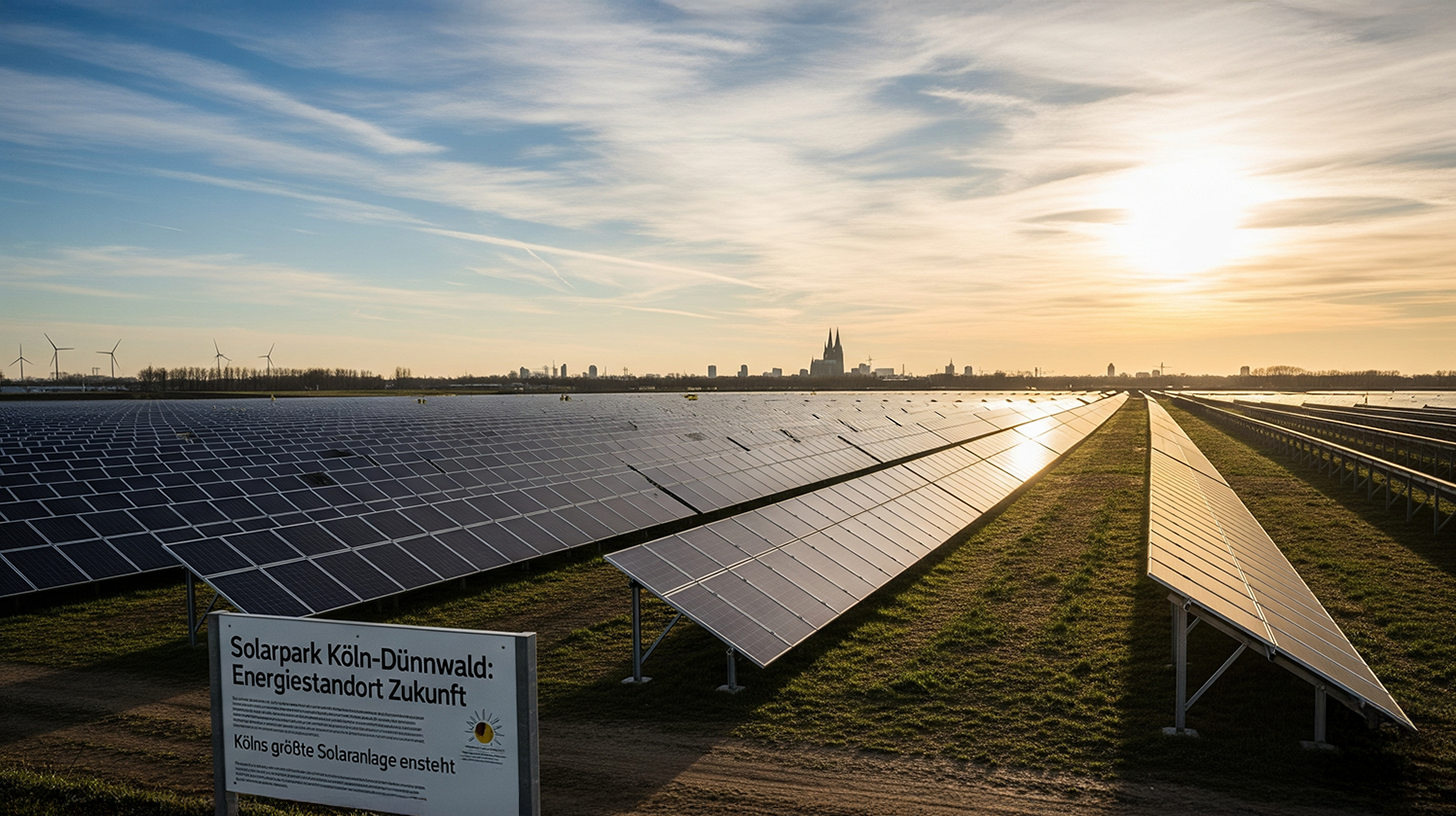
Cologne-Dünnwald Solar Park Becomes Energy Location of the Future – Cologne's Largest Solar Plant Under Construction – Creative Image: Xpert.Digital
Rheinenergie launches major solar park project for sustainable power supply in Cologne
Large solar plant in Cologne-Dünnwald actively shapes urban energy transition
The cathedral city is taking a significant step toward the energy transition. One of the city's largest photovoltaic plants is to be built in Cologne-Dünnwald, which will not only set new standards in local energy supply but also serve as a model for the energy transition in urban areas. The Rheinenergie project impressively demonstrates how ambitious climate protection plans can be put into practice.
Technical dimensions and performance
The planned photovoltaic plant in Dünnwald, with an installed peak capacity of 35 megawatts peak, will be one of the most powerful solar parks in North Rhine-Westphalia. This impressive capacity corresponds to electricity production that could theoretically supply around 11,000 households with climate-neutral energy. The plant will be built on an area of approximately 33.5 hectares, located directly adjacent to the A3 motorway and along the railway line to Leverkusen.
The dimensions of this project become particularly clear when compared to other solar parks in Germany. With a capacity of 35 megawatts peak, the Dünnwald facility even surpasses Rheinenergie's previously largest solar park in Mecklenburg-Western Pomerania, which has a capacity of 32 megawatts peak. This scale roughly corresponds to the energy needs of a small town and underscores the project's strategic importance for the regional energy supply.
Location selection and geographical advantages
The choice of the site in Dünnwald follows proven principles of sustainable land use. The site is strategically located east of the A3 motorway and optimally utilizes its proximity to existing infrastructure. This location offers several advantages: Firstly, the proximity to transport routes minimizes impact on the landscape, and secondly, the existing infrastructure facilitates the technical connection of the plant to the power grid.
The selected land is municipally owned and currently used for agricultural purposes. Local farmers can continue to cultivate their fields until the planned start of construction in November 2025, ensuring a socially acceptable transition. This transitional arrangement demonstrates that existing uses can be taken into account even in large-scale energy projects.
Legal framework and approval procedures
The Cologne City Council has already set the decisive course for the project. In a closed session, the transfer of the municipal land to Rheinenergie was approved in return for corresponding lease payments. The lease is for a term of 25 years from commissioning, with the option of an extension for a further five years.
Particularly noteworthy is Rheinenergie's comprehensive assumption of responsibility. The company will not only cover the costs of planning, construction, and operation of the plant, but also all necessary compensatory measures for environmental impacts and complete dismantling after the contract ends. This arrangement ensures that no legacy contamination will occur after the operational period and that the sites can be returned to their original use.
Rheinenergie as a driving force of the energy transition
The Dünnwald project is part of Rheinenergie's comprehensive expansion strategy, which aims to expand its renewable energy plant portfolio from the current 230 megawatts to 600 megawatts by 2035. This ambitious goal demonstrates the company's commitment to the energy transition and the decarbonization of the energy supply.
Rheinenergie already boasts considerable experience in the field of photovoltaics. The company operates 28 photovoltaic systems on open ground and rooftops throughout Germany with a total installed capacity of approximately 57 megawatts peak. In addition, the company owns 26 wind farms with 107 systems and a combined installed capacity of over 172 megawatts.
A particularly innovative aspect of Rheinenergie's strategy is the integration of battery storage systems. A battery storage system with a capacity of seven megawatt hours was installed for the first time at the company's largest solar park in Mecklenburg-Western Pomerania. This technology makes solar power available even outside of sunshine hours and contributes to grid stability.
Economic dimensions and financing models
The economic viability of solar farms has improved significantly in recent years. Modern ground-mounted photovoltaic systems can now achieve electricity generation costs of only 4 to 6 cents per kilowatt-hour. These low costs make solar power one of the most affordable forms of energy generation and enable profitable projects even without government subsidies.
A typical solar park the size of the Dünnwald facility can generate annual returns of between 5 and 8 percent. These returns make photovoltaic projects attractive not only from a climate policy perspective, but also from a business perspective. An annual electricity yield of approximately one million kilowatt hours can be expected per hectare of solar park, enabling revenues of approximately €60,000 per hectare.
Financing such large-scale projects is increasingly being achieved through innovative models. In addition to traditional EEG subsidies, long-term power purchase agreements (PPAs) are gaining in importance. These often enable higher remuneration than statutory subsidies and provide planning security for all parties involved.
Technological innovation and efficiency improvements
Modern photovoltaic systems benefit from continuous technological advances. Solar cell efficiencies have improved significantly in recent years, while production costs have decreased. High-quality solar modules today achieve efficiencies of over 20 percent and come with warranties of 25 years or more.
Developments in the field of intelligent control technologies are particularly interesting. Modern solar parks are equipped with sophisticated monitoring systems that enable optimal operation. Artificial intelligence helps maximize yield and identify maintenance needs early on.
Rheinenergie relies on proven partners from the solar industry for its projects. For example, the company Goldbeck Solar, which has extensive experience in large-scale photovoltaic projects, was commissioned to build the solar park in Mecklenburg-Western Pomerania.
Environmental impacts and biodiversity
A widespread myth claims that solar farms have a negative impact on the environment. In fact, scientific studies show that well-planned photovoltaic systems can even have positive effects on biodiversity. When intensively used agricultural land is converted into extensively managed solar farms, biodiversity can even increase.
Ground-mounted photovoltaic systems generate about 30 times more electricity per year than biogas plants on a comparable area. This enormous efficiency advantage demonstrates how space-saving solar energy is compared to other renewable energy sources. Furthermore, the foundations of the solar modules are designed to cause minimal soil sealing and can be removed without leaving any residue after their operational life.
Fencing around solar farms creates protected habitats for small mammals and ground-nesting birds. Avoiding fertilizers and pesticides allows specialized plant species that cannot find habitat in intensive agriculture to establish themselves on the land. Studies show that in Germany, 70 to 95 percent of the area of solar farms can be used to promote biodiversity.
New: Patent from the USA – Install solar parks up to 30% cheaper and 40% faster and easier – with explanatory videos!

New: Patent from the USA – Install solar parks up to 30% cheaper and 40% faster and easier – with explanatory videos! – Image: Xpert.Digital
At the heart of this technological advancement is the deliberate departure from conventional clamp fastening, which has been the standard for decades. The new, more time- and cost-effective mounting system addresses this with a fundamentally different, more intelligent concept. Instead of clamping the modules at specific points, they are inserted into a continuous, specially shaped support rail and held securely. This design ensures that all forces occurring – be they static loads from snow or dynamic loads from wind – are evenly distributed across the entire length of the module frame.
More about it here:
North Rhine-Westphalia doubles solar power by 2030 – The Dünnwald project as key
Energy policy significance for North Rhine-Westphalia
The Dünnwald project fits into North Rhine-Westphalia's ambitious energy strategy. The most populous German state aims to double its installed wind and photovoltaic capacity from the current level of approximately 17 gigawatts to at least 34 gigawatts by 2030. Doubling renewable energy capacity in just six years represents a huge challenge that can only be met through projects like the one in Dünnwald.
In North Rhine-Westphalia, there are currently open-space photovoltaic systems with a total capacity of approximately 535 megawatts in operation. The contribution of the Dünnwald project would increase the installed capacity in NRW by more than 6 percent. This demonstrates the supra-regional significance of the Cologne-based initiative.
The state of North Rhine-Westphalia has recognized that the energy transition can only succeed if all available potential is utilized. In addition to wind energy, in which North Rhine-Westphalia is already a national leader, solar energy is also to be massively expanded. Municipal energy suppliers like Rheinenergie play a key role in this.
Area potential and future developments
Germany has considerable potential for the expansion of photovoltaics. Studies by the Öko-Institut show that there is space for 287 gigawatts of solar capacity on the shoulders of highways and railway tracks, above parking lots, and on industrial and commercial sites alone. This significantly exceeds the German government's expansion target of 200 gigawatts by 2040.
These figures demonstrate that the expansion of solar energy does not necessarily lead to conflicts with agriculture. Agricultural land only needs to be used to a very limited extent for conventional solar farms. At the same time, innovative concepts such as agri-photovoltaics open up new possibilities for combining energy generation and agricultural use.
In Germany, 13 million hectares are theoretically available for dual-use photovoltaics, corresponding to 37 percent of the country's total land area. This enormous potential demonstrates that the energy transition will not fail due to a lack of space, even with ambitious expansion targets.
Citizen participation and social acceptance
Public acceptance of energy transition projects is a crucial success factor. Municipal energy providers like Rheinenergie have structural advantages here, as they enjoy trust and local roots as local companies. Profits from such projects remain in the region and benefit the local economy.
Innovative participation models can further increase acceptance. In other regions, community energy cooperatives have proven successful, enabling local people to benefit directly from the energy transition. Direct marketing agreements with local companies also create economic added value in the region.
The city of Cologne has already launched extensive programs to promote community photovoltaics. With subsidies of up to €2,500 for photovoltaic systems and up to €1,300 for battery storage, the city supports private households in their transition to solar energy. These programs demonstrate that the energy transition is understood as a task for society as a whole.
Technical challenges and solutions
Operating large solar parks presents specific technical challenges. The fluctuating feed-in of solar power requires intelligent grid management systems and flexible marketing strategies. Rheinenergie has built up important expertise in this area through its own trading company, Rheinenergie Trading.
Modern solar parks are increasingly being combined with battery storage systems to compensate for fluctuations in solar power production. Rheinenergie has entered into a cooperation with the SMA subsidiary Altenso to jointly develop projects with several hundred megawatts of battery storage capacity. The first joint project is a large-scale battery storage system with a capacity of 64 megawatt hours in Lower Saxony.
The integration of storage technologies opens up new business models. Battery storage systems can be used not only to shift the timing of power feed-in but also to provide system services such as frequency control and voltage stabilization. These additional revenue sources significantly improve the economic viability of the projects.
Climate protection impact and CO2 savings
The climate protection impact of the Dünnwald solar park is considerable. A 35-megawatt-peak photovoltaic system can generate approximately 35 to 40 million kilowatt-hours of electricity annually. Given a CO2 emissions factor of the German electricity mix of approximately 400 grams per kilowatt-hour, this corresponds to an annual CO2 savings of 14,000 to 16,000 tons.
Over the plant's 25-year operating life, CO2 savings total approximately 350,000 to 400,000 tons. This corresponds to the annual emissions of approximately 75,000 passenger cars. These figures illustrate the significant contribution that individual projects can make to achieving climate protection goals.
Rheinenergie has set itself the goal of supplying its customers entirely with climate-neutral energy and heat by 2035. The Dünnwald project is an important building block on this path. Since 2022, the company has been supplying its residential and commercial customers exclusively with green electricity from European renewable energy plants.
Future prospects and scalability
The Dünnwald project is just the beginning of a comprehensive transformation of the energy supply in the Cologne region. The city's climate protection monitoring program has identified additional potential areas for photovoltaic projects. A second project on the A 555 motorway in Cologne-Rondorf is already in the planning phase.
The scalability of such projects is impressive. If just a fraction of the identified potential areas were utilized, the region's installed solar capacity could be significantly increased. Studies show that Germany could theoretically cover ten times its electricity needs with photovoltaics.
Innovative technologies such as floating solar systems on bodies of water or agri-photovoltaic systems over agricultural land open up further expansion potential. These technologies are still in the market launch phase, but have the potential to significantly increase the land-use efficiency of solar energy.
Economic stimulus for the region
Large-scale energy projects like the solar park in Dünnwald not only generate clean energy but also generate economic stimulus for the region. During the construction phase, local companies are contracted for civil engineering, cabling, and installation work. Long-term operation requires regular maintenance and repair work, which can also be handled by regional service providers.
The lease payments to the City of Cologne strengthen municipal finances and create scope for further investments in infrastructure. At the same time, the local economy benefits from affordable, climate-friendly electricity. Energy-intensive companies, in particular, can reduce their energy costs and improve their carbon footprint through long-term electricity supply contracts.
The expansion of renewable energies makes the region less dependent on fossil energy imports and creates added value locally. These regional value creation effects are an important side effect of the energy transition and contribute to the region's economic development.
The project in Cologne-Dünnwald is exemplary of the transformation of the German energy system. It demonstrates that ambitious climate protection goals can be achieved through concrete projects and that the energy transition can become not only an ecological but also an economic success story. The combination of technical innovation, economic viability, and social benefits makes such projects pioneers for a sustainable energy future.
Look, this little detail saves up to 40% installation time and costs up to 30% less. It's from the USA and patented.

New: Assemble-ready Solar systems! This patented innovation accelerates your solar construction massively
The heart of ModuRack's innovation is its departure from conventional clamp fastening. Instead of clamps, the modules are inserted and held in place by a continuous support rail.
More about it here:
Your partner for business development in the field of photovoltaics and construction
From industrial roof PV to solar parks to larger solar parking spaces
☑️ Our business language is English or German
☑️ NEW: Correspondence in your national language!

Konrad Wolfenstein
I would be happy to serve you and my team as a personal advisor.
You can contact me by filling out the contact form or simply call me on +49 7348 4088 965 (Munich) . My email address is: wolfenstein ∂ xpert.digital
I'm looking forward to our joint project.







