
Copilot, ChatGPT, or AI agent? Anyone who doesn't understand the massive difference risks their competitiveness
Xpert Pre-Release

Available in 27 languages 📢
Prefer Xpert.Digital on GoogleⓘPublished on: March 5, 2026 / Updated on: March 5, 2026 – Author: Konrad Wolfenstein
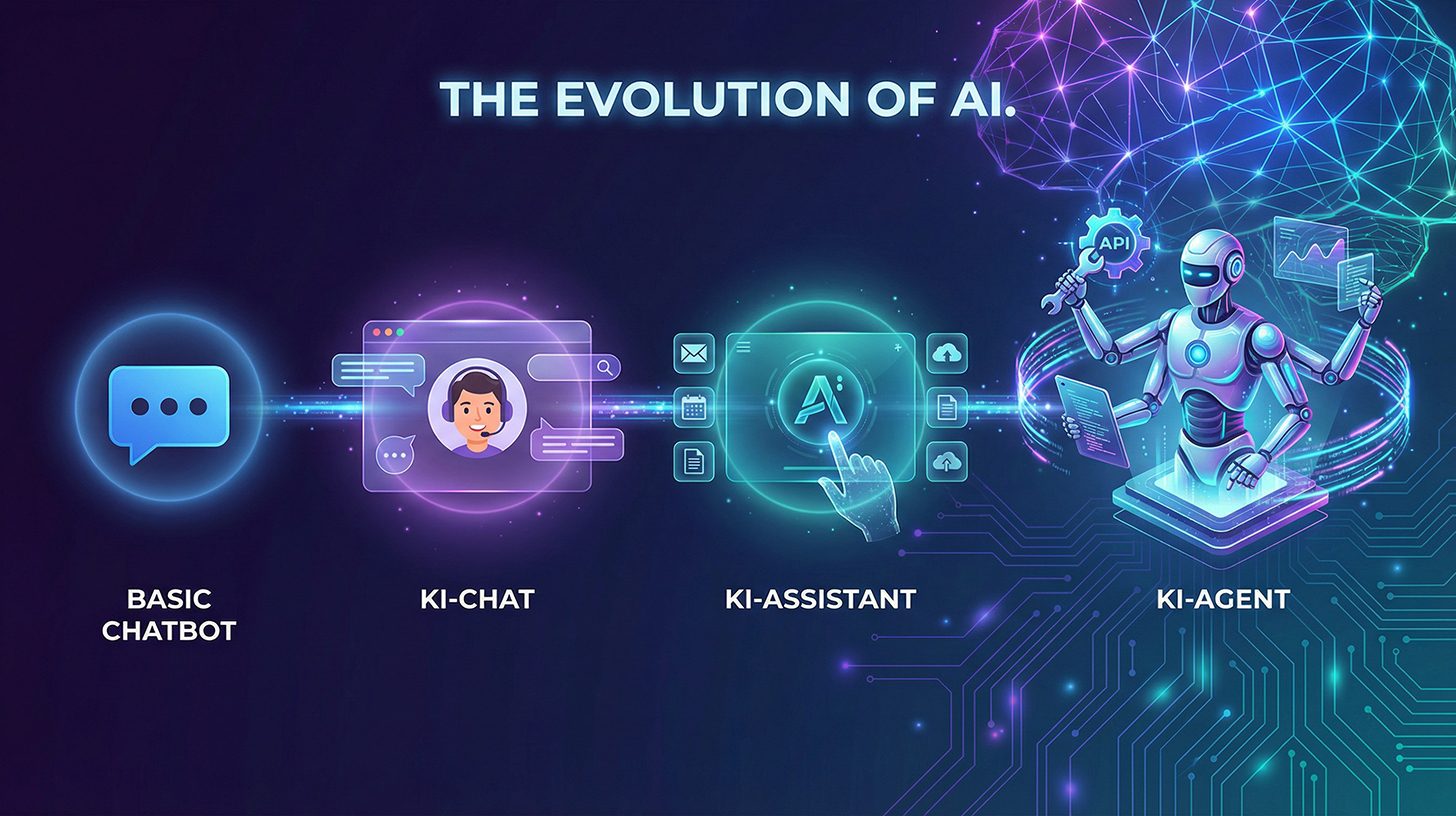
Copilot, ChatGPT, or AI agent? Those who don't understand the significant differences risk their competitiveness – Image: Xpert.Digital
Chatbot vs. AI agent: The fatal mistake that could cost companies millions
The 4 stages of AI: Why most companies need to rethink their software strategy now
In the executive suites and IT departments of the world, a dangerous confusion of terms reigns. Whether chatbot, copilot, or AI agent – these terms are used almost interchangeably in meetings and sales pitches, as long as they bear the coveted label of "artificial intelligence." But this casual use of buzzwords is no longer a harmless marketing gimmick; it's evolving into a genuine strategic risk. Anyone who buys a simple, rule-based chatbot today and believes they've equipped their company for the AI age is living under a costly illusion. The evolution of machine assistants has long since progressed further: from the digital "ticket machine" that merely executes rigid commands to the autonomous AI agent that independently orchestrates complex processes. The following article examines the four fundamental stages of artificial intelligence in business applications. He explains why understanding these massive technological differences will determine future competitiveness and how companies can successfully master the leap into the era of autonomous AI ecosystems, according to current Gartner forecasts.
From automated answer system to digital colleague: The four stages of artificial intelligence in business use
Why most companies don't know what they've actually bought
The terminology surrounding artificial intelligence is used so casually in companies, at conferences, and in sales pitches that it's problematic. AI chatbot, AI chat, AI assistant, AI agent – it all seems to mean essentially the same thing, just with different marketing labels. This is fundamentally wrong. Behind these terms lie fundamentally different technologies with different capabilities, different implementation efforts, and, most importantly, different value creation potential. For companies, failing to recognize the difference is now a strategic risk, because according to Gartner, by the end of 2026, around 40 percent of all enterprise applications will contain task-specific AI agents – a massive jump from less than 5 percent in 2025.
The AI chatbot: The digital ticket machine
At the lower end of the performance spectrum is the classic AI chatbot. It's a software application that simulates human conversations through text or voice interactions. Essentially, it recognizes keywords and phrases in the user's input and then accesses pre-programmed answers or scripts. The chatbot operates according to fixed rules: if the user asks X, answer with Y. Typical applications include FAQ bots on websites that provide opening hours, check order status, or allow users to fill out simple forms.
The chatbot's strengths lie in its cost-efficiency and scalability. Once implemented, it can handle any number of inquiries simultaneously, is available around the clock, and delivers consistent answers within its defined scope. For clearly defined use cases with predictable questions and answers, it is a robust and reliable solution.
However, its limitations are equally clear. It cannot solve complex tasks, it cannot use external tools, and it has no memory to recall previous conversations. If a request deviates from the predefined paths, the chatbot reaches its limits and, at best, produces an apology; at worst, an incorrect answer. It is reactive and waits for input without ever taking initiative. A chatbot is like a ticket machine: it dispenses what is ordered, but it doesn't think for itself.
The AI chat: The conversational interface
AI chat represents the next evolutionary stage and differs from traditional chatbots through its use of large-scale language models. Products like ChatGPT, Claude, Gemini, and Mistral Le Chat are examples of AI chat. Based on the GPT, Claude, or Gemini architecture, they are capable of understanding and generating natural language at a level that far surpasses rule-based chatbots.
The key difference to a chatbot lies in its flexibility. An AI chat can answer freely formulated questions, explain complex issues, summarize and translate texts, generate creative content, and even provide support in programming. It is not limited to predefined answer patterns but dynamically generates its responses based on its training and the conversational context.
However, AI chat remains a fundamental conversational tool. It receives input, processes it, and provides a response. It does not perform any independent actions; it does not book flights, open support tickets, or transfer money. Its world ends at the edge of the text window. AI chat is therefore a powerful tool for information processing and text generation, but not a tool for completing tasks.
A new dimension of digital transformation with 'Managed AI' (Artificial Intelligence) - Platform & B2B solution | Xpert Consulting

A new dimension of digital transformation with 'Managed AI' (Artificial Intelligence) – Platform & B2B solution | Xpert Consulting - Image: Xpert.Digital
Here you will learn how your company can implement customized AI solutions quickly, securely and without high entry barriers.
A managed AI platform is your all-inclusive, worry-free solution for artificial intelligence. Instead of dealing with complex technology, expensive infrastructure, and lengthy development processes, you receive a ready-made solution tailored to your needs from a specialized partner – often within just a few days.
The key advantages at a glance:
⚡ Rapid implementation: From idea to ready-to-use application in days, not months. We deliver practical solutions that create immediate added value.
🔒 Maximum data security: Your sensitive data stays with you. We guarantee secure and compliant processing without sharing data with third parties.
💸 No financial risk: You only pay for results. High upfront investments in hardware, software, or personnel are completely eliminated.
🎯 Focus on your core business: Concentrate on what you do best. We take care of the entire technical implementation, operation, and maintenance of your AI solution.
📈 Future-proof & scalable: Your AI grows with you. We ensure continuous optimization and scalability, and flexibly adapt the models to new requirements.
More information here:
Not just chatting, but taking action: How AI agents are now taking over entire processes
The AI assistant: Integration into everyday work
The AI assistant builds on the technology of AI chat, but goes a crucial step further: It is integrated into existing software ecosystems and therefore has access to context-related data and functions. The best-known example is Microsoft Copilot, which is directly embedded in the Microsoft 365 environment and accesses Outlook, Word, Excel, PowerPoint, and Teams.
This integration fundamentally changes the way people work. An AI assistant can summarize emails, create presentations based on documents, analyze data in Excel, generate meeting minutes, and manage calendar entries—not as an isolated chat window, but directly within the context of the application the user is already working in. It knows the user's data, has access to the SharePoint intranet, and can therefore provide answers tailored to the specific company context.
The AI assistant is thus the first true productivity multiplier. It doesn't automate processes, but it significantly accelerates them. It doesn't make independent decisions, but it prepares them. It doesn't replace employees, but it makes every employee considerably more efficient in certain routine tasks. By the end of 2025, almost all business applications will be equipped with integrated AI assistants of this kind. *(Editor's note: Tense here adapted to the future tense to match the year 2025).*
The AI agent: The autonomous problem solver
The AI agent represents the highest stage of evolution and differs from all previous categories by one defining characteristic: autonomy. Unlike the reactive chatbot, the text-generating AI chat, and the context-integrated AI assistant, an AI agent is an intelligent system that actively perceives its environment, makes rational decisions, and acts autonomously to achieve predefined goals.
The AI agent's core competencies include the ability to break down complex goals into smaller steps, systematically process them, and continuously monitor progress. It actively utilizes tools and APIs, ranging from calendars and CRM systems to payment services and web search. It makes decisions based on real-time data and adapts its strategy as conditions change. It learns from experience and improves its performance over time.
A practical example best illustrates the difference. If a user enters the sentence "My order hasn't arrived," the chatbot replies: "Your order is on its way." The AI agent, on the other hand, checks the shipment status, contacts logistics, initiates a reshipment, and issues a credit note, all without human intervention. It completes the task, not just the conversation.
Gartner's five stages
Gartner has developed a five-stage model for the evolution of agent-based AI in enterprise applications, outlining the path of development. Stage one comprises AI assistants, which are now integrated into almost all applications and boost individual productivity. Stage two, expected to be widespread by 2026, involves task-specific agents capable of independently performing tasks within a given application. Stage three expands this to cross-application agents that operate across the boundaries of individual software. Stage four brings multi-agent systems, in which several specialized agents work together. And stage five, projected for around 2029, describes complete multi-agent ecosystems that autonomously orchestrate complex business processes.
The economic dimension of this development is considerable. Gartner predicts that agent-based AI will account for approximately 30 percent of global enterprise software revenue by 2035, more than $450 billion, compared to just 2 percent in 2025.
The comparison matrix of the four AI categories
The four categories described can be systematically compared along several dimensions. Task complexity ranges from low for chatbots to high for agents. Chatbots cannot use external tools, while AI agents actively access APIs, databases, and web services. Chatbots follow fixed rules and do not make their own decisions; AI agents evaluate alternatives and autonomously select the best course of action. Chatbots completely lack memory, while agents retain user data and contextual information across interactions.
Implementation costs naturally increase with complexity. A chatbot can be implemented in hours or days and is inexpensive. An AI agent requires weeks or months of development time and significantly higher investment. However, Salesforce argues that agents can now go live faster than traditional chatbots because the latter require endless intent training, while agents are based on pre-trained language models plus API setup.
The strategic miscalculation of many companies
The greatest danger for companies lies not in using the wrong technology, but in not knowing which technology they are actually using. Anyone who installs a rule-based chatbot and believes they have artificial intelligence in their company is under a dangerous illusion. Anyone who uses an AI assistant but has no processes that could be automated by an AI agent is missing out on potential.
According to Gartner, CIOs have a critical window of three to six months to define their strategy for agent-based AI and plan the necessary investments. Companies that miss this shift risk being left behind by competitors who are already orchestrating their processes with autonomous agents.
The path doesn't lead directly from chatbot to agent. It leads through a conscious inventory of existing processes, identifying those tasks that benefit from rule-based automation, those that require context-aware assistance, and those that demand true autonomy and decision-making authority. The art lies not in purchasing the most advanced technology, but in using the right technology for the right task. The chatbot isn't inferior to the agent. It's different. And understanding precisely this differentiation is the first step toward an AI strategy that truly creates value.
Your global marketing and business development partner
☑️ Our business language is English or German
☑️ NEW: Correspondence in your native language!

Konrad Wolfenstein
I and my team are happy to be available to you as your personal advisor.
You can contact me by filling out the contact form here or simply call me at +49 7348 4088 965. My email address is: [email protected]
I'm looking forward to our joint project.
☑️ SME support in strategy, consulting, planning and implementation
☑️ Creation or realignment of the digital strategy and digitization
☑️ Expansion and optimization of international sales processes
☑️ Global & Digital B2B trading platforms
☑️ Pioneer Business Development / Marketing / PR / Trade Fairs
🎯🎯🎯 Benefit from Xpert.Digital's extensive, five-fold expertise in one comprehensive service package | BD, R&D, XR, PR & Digital Visibility Optimization

Benefit from Xpert.Digital's extensive, five-fold expertise in a comprehensive service package | R&D, XR, PR & Digital Visibility Optimization - Image: Xpert.Digital
Xpert.Digital possesses in-depth knowledge across various industries. This allows us to develop tailored strategies precisely aligned with the requirements and challenges of your specific market segment. By continuously analyzing market trends and monitoring industry developments, we can act proactively and offer innovative solutions. The combination of experience and expertise generates added value and provides our clients with a decisive competitive advantage.
More information here:










