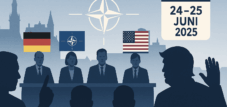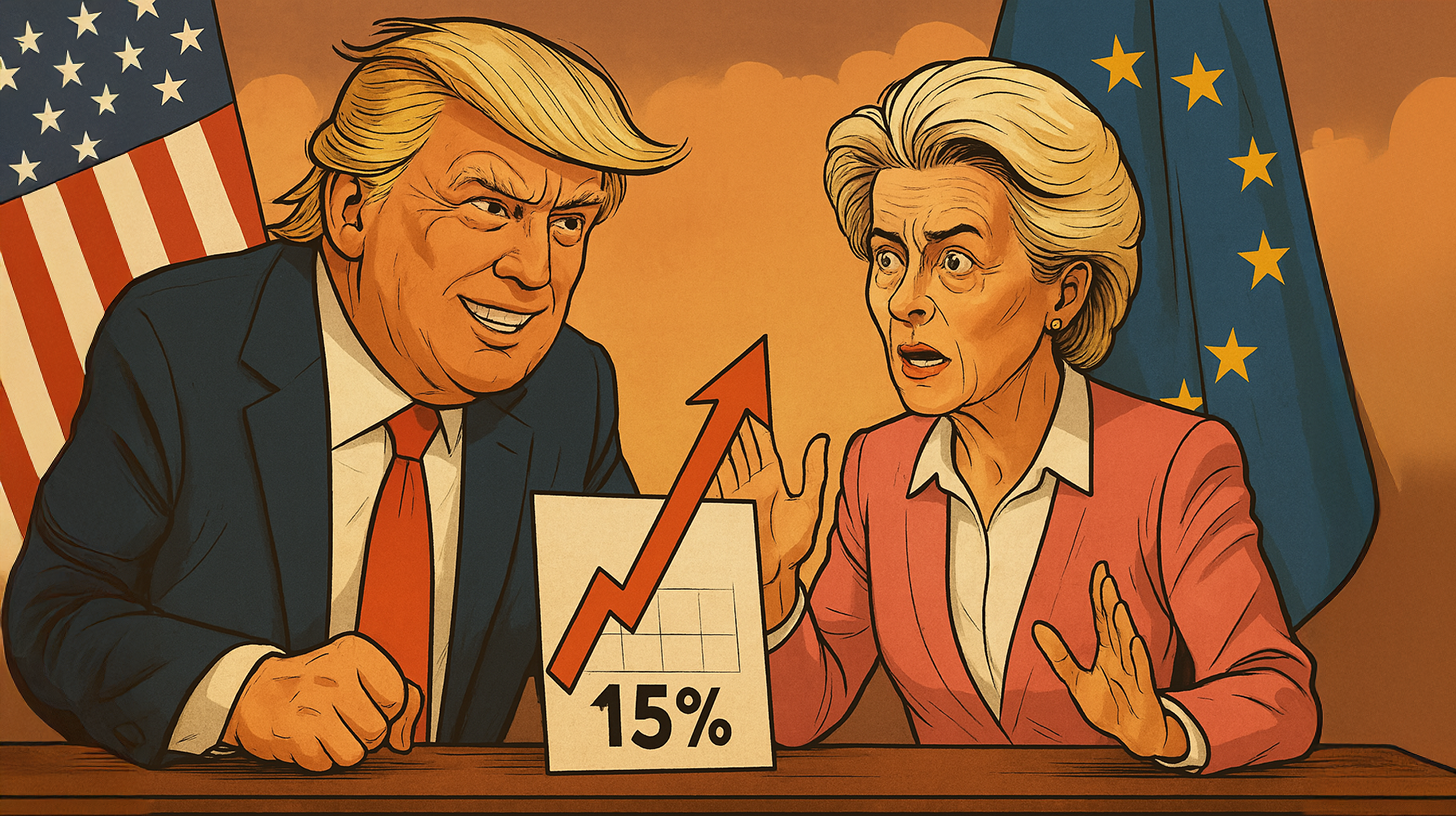
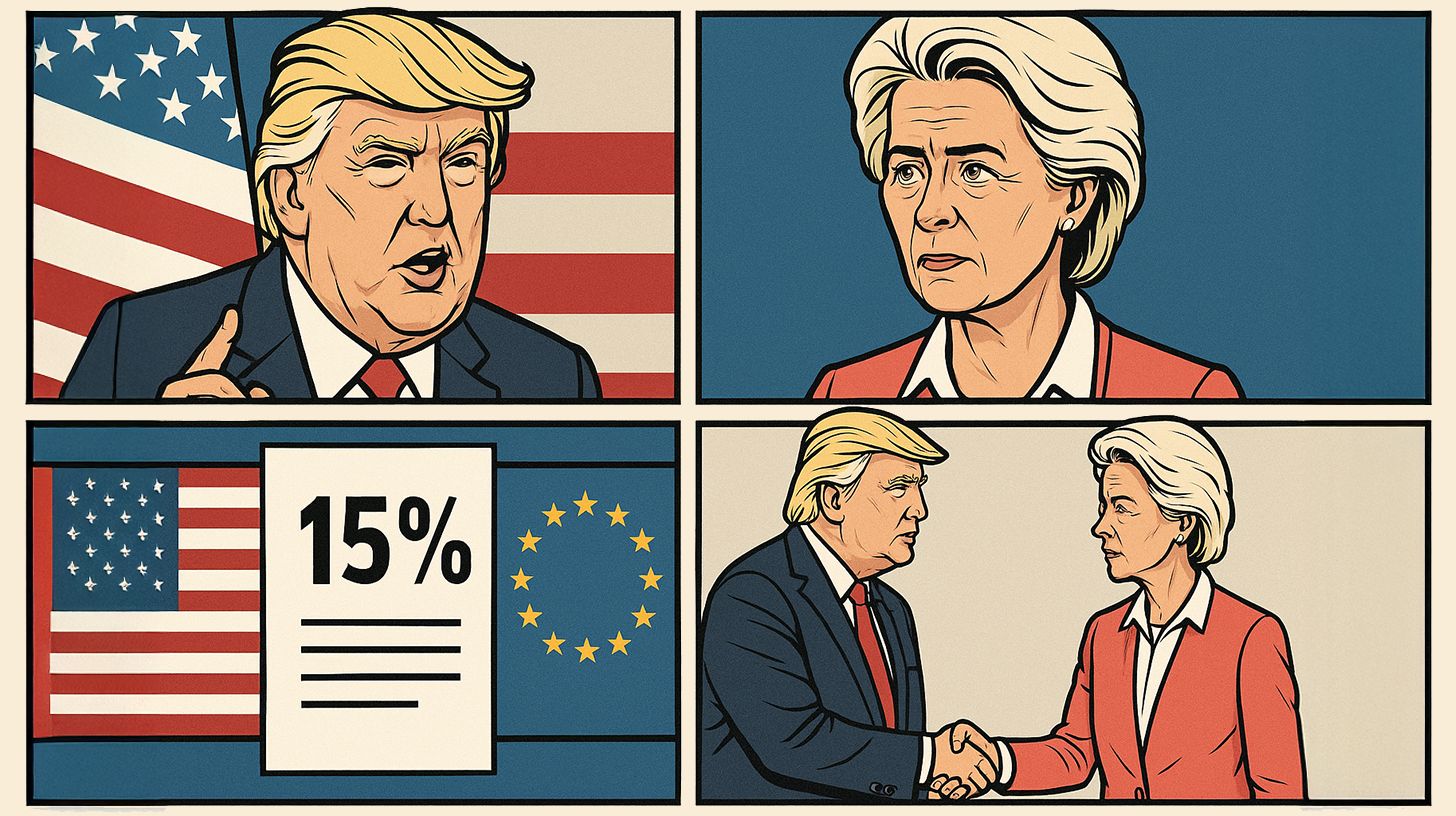
Donald Trump and Ursula von der Leyen – The 15% tariff agreement between the EU and the USA: A comprehensive analysis of the consequences – Image: Xpert.Digital
Trade diplomacy of the highest order? Von der Leyen and Trump strike a mega-agreement – Quis vicit?
What does the agreement in the trade dispute between the EU and the USA mean?
The agreement between the European Union and the United States in the months-long tariff dispute marks a decisive turning point in transatlantic trade relations. Following intensive negotiations between EU Commission President Ursula von der Leyen and US President Donald Trump in Scotland, a compromise was reached that prevents a further escalation of the trade conflict.
The core of the agreement lies in a base tariff of 15 percent on most European imports into the US, thus averting the 30 percent tariffs originally threatened by Trump. This agreement also covers strategically important sectors such as automobiles, semiconductors, and pharmaceuticals. While Trump described this agreement as the "biggest deal of all," business representatives are considerably more reserved in their assessment.
In return, the EU had to make significant concessions: It committed to buying $750 billion worth of US energy by the end of Trump's term and to additional investments of $600 billion. These commitments are intended to help reduce the US trade deficit with the EU, which was a key point of criticism from the Trump administration.
Related to this:

How did the German economy react to the tariff agreement?
Reactions from German businesses to the tariff agreement range from mixed to critical. Helena Melnikov, CEO of the German Association of Chambers of Industry and Commerce (DIHK), summed up the ambivalent mood: German businesses can "breathe a sigh of relief for now," but the deal "has its price, and this price is also at the expense of the German and European economies.".
The Federation of German Industries (BDI) was considerably more critical, describing the agreement as an "inadequate compromise" that sends a "fatal signal" to the closely intertwined economies on both sides of the Atlantic. Wolfgang Niedermark of the BDI warned that even a tariff of 15 percent would have "immense negative consequences for Germany's export-oriented industry.".
The BDI (Federation of German Industries) was particularly critical of the fact that no agreement was reached on steel and aluminum exports and that tariffs will remain at 50 percent. This, they said, was an "additional blow" to a key industry already facing enormous challenges in international competition.
The German Foreign Trade Association (BGA) called the tariff agreement a "painful compromise" and warned that every percentage point of tariff was one percentage point too many. President Dirk Jandura stated that the tariff increase represented an "existential threat" for many traders.
What specific effects will the agreement have on German companies?
The effects of the tariff agreement on German companies are multifaceted and impact different sectors to varying degrees. For the German automotive industry, which exported goods worth €23.4 billion to the US in 2023, the reduction of tariffs from 27.5 percent to 15 percent represents a noticeable relief. Chancellor Friedrich Merz therefore welcomed the agreement, particularly for the automotive sector.
The mechanical engineering and chemical industries, traditionally strong exporters to the US, must prepare for higher costs. Wolfgang Große Entrup, Managing Director of the German Chemical Industry Association (VCI), commented: "Those who expect a hurricane are grateful for a storm," but emphasized that the price is high for both sides and that Europe's exports will lose competitiveness.
For small and medium-sized enterprises (SMEs) that lack their own lobbying channels in Washington, the tariffs pose a particular challenge. Helena Melnikov warned before the agreement was reached that many successful SMEs would be affected, ranging from aluminum processors and automotive suppliers to chemical and pharmaceutical companies, as well as wineries.
The German Chamber of Industry and Commerce (DIHK) fears that German companies could lose one billion euros per month in US exports if the uncertainty persists. Trump's tariff announcement in April had already reduced German exports by 10.5 percent compared to the previous month, followed by a further decline of 7.7 percent in May.
Related to this:
Why did the EU accept this deal despite the criticism?
The EU accepted the deal for several strategic reasons, with avoiding further escalation being paramount. Without an agreement, tariffs of 30 percent on European products would have been threatened from August 1, 2025, which could have led to a full-blown trade war.
A decisive factor was the concern that Trump could create additional threats if the trade conflict escalated further. This included fears that he might again question NATO's mutual defense commitment or reduce support for Ukraine – both extremely sensitive issues given the threats posed by Russia.
The EU was in a structurally weaker negotiating position due to its dependence on the US on security policy issues. As ZDF correspondent Ulf Röller analyzed: "The EU is simply vulnerable to blackmail." If the Europeans weren't so dependent on the US in the area of defense, they might not have accepted the deal.
Economically, the EU, with its approximately 450 million citizens in 27 countries, is a genuine market power that could seriously harm the US in a trade conflict. However, due to security policy dependencies, this strength has not been fully translated into negotiating power.
What role does the unequal trade balance between the US and the EU play?
The trade balance between the US and the EU is a complex issue that goes far beyond mere goods figures. Traditionally, the EU has a significant surplus in goods trade with the US, while the US dominates in services trade.
In 2024, the EU recorded a trade surplus of approximately €157 billion in goods trade with the US. At the same time, however, the US has a significant surplus in services trade – the EU recorded a services deficit of €109 billion with the US in 2023. This imbalance is particularly pronounced in digital services, where US companies such as Google, Amazon, Meta, and Microsoft dominate the European market.
An important aspect often overlooked in traditional trade statistics is how digital services are recorded. Many US technology companies generate substantial revenue in Europe, but this is frequently booked through subsidiaries in countries like Ireland and Luxembourg and therefore does not appear as direct US exports to the EU.
It is estimated that the US exported digital services worth $283 billion to Europe in 2021. An EU-wide digital tax could generate almost €40 billion in additional revenue for the EU as early as next year if a 5 percent tax is levied on all EU business transactions by large digital companies.
🎯🎯🎯 Benefit from Xpert.Digital's extensive, five-fold expertise in one comprehensive service package | BD, R&D, XR, PR & Digital Visibility Optimization

Benefit from Xpert.Digital's extensive, five-fold expertise in a comprehensive service package | R&D, XR, PR & Digital Visibility Optimization - Image: Xpert.Digital
Xpert.Digital possesses in-depth knowledge across various industries. This allows us to develop tailored strategies precisely aligned with the requirements and challenges of your specific market segment. By continuously analyzing market trends and monitoring industry developments, we can act proactively and offer innovative solutions. The combination of experience and expertise generates added value and provides our clients with a decisive competitive advantage.
More information here:
Digital impotence: Europe's secret dependence on US digital giants
Digital impotence: Europe's secret dependence on US digital giants – Tariff agreement: Victory and defeat – USA and EU – Image: Xpert.Digital
How dependent is Europe on US digital services?
Europe's digital dependence on the USA is considerable and extends across all major technology sectors. A full 70 percent of the world's used base models for artificial intelligence originate in the USA, while European products account for only seven percent of applications in the areas of software, the internet, and microchips.
The dependency is particularly pronounced in cloud computing: Nearly 40 percent of German companies stated that they are highly reliant on non-European cloud providers, while less than a quarter use European cloud services. The situation is even more dramatic in the field of artificial intelligence – only about ten percent of German companies use European AI offerings.
This dependency has geopolitical dimensions. The CLOUD Act allows US authorities to access data stored by American technology companies, even if that data is stored outside US borders. This has sparked fears that sensitive European data could fall under US legal control.
Experts warn of the danger of digital blackmail. Dennis-Kenji Kipker of the Cyberintelligence Institute emphasizes: "A lack of digital sovereignty makes Europe's economy and IT vulnerable to blackmail – politically, economically, and technologically." This structural dependency is also evident in the fact that Denmark was the first EU country to decide to phase out the use of Microsoft products.
Related to this:

What does digital sovereignty mean for Europe?
Digital sovereignty describes the ability of states, companies, and individuals to control, shape, and use their digital infrastructures, technologies, services, and data in a self-determined and independent manner. For Europe, this means a fundamental reorientation of digital policy.
Claudia Plattner, President of the Federal Office for Information Security (BSI), defines digital sovereignty as having "decision options." This requires, on the one hand, "competitive European products," and on the other hand, the integration of international technologies in such a way "that they are more secure and allow us to use them with data sovereignty.".
The path to digital sovereignty requires massive investments. In 2023, Europe lagged far behind the US in investments in artificial intelligence, with $2.4 billion compared to the US's $22.4 billion. The EU receives only five percent of the globally available venture capital, while the US receives 52 percent and China 40 percent.
Two main paths to digital sovereignty are being discussed: a neoliberal territorial approach and a planetary approach. Both aim to create Europe's own clouds, networks, and data flows. The EuroStack initiative calls for billions of euros in investment to make Europe more competitive in the global race for digital sovereignty.
What impact will the agreement have on transatlantic relations?
The tariff agreement between the EU and the US has far-reaching consequences for transatlantic relations and reveals structural changes in the global distribution of power. The agreement demonstrates that the traditional partnership of equals has given way to an asymmetrical relationship in which the EU increasingly acts in a reactive position.
The geopolitical realignment of the US has been observed since the early 2000s, with American interest increasingly shifting towards the Indo-Pacific region. This development is independent of the respective US president and reflects the strategic focus on China as the main rival.
For Europe, this means it can no longer blindly rely on the US and must find its place in a new world order. Transatlantic relations are no longer of paramount strategic importance to the US, leading to turbulent times for Europe, and especially Germany.
The Transatlantic Trade and Technology Council (TTC), established in 2021 as the most important forum for transatlantic cooperation, remains a key instrument for conflict prevention. However, progress in transatlantic trade has proven limited – after almost three years, successes have been achieved in technological security, but only slight progress has been made in trade liberalization.
How should Europe respond to these challenges?
Europe faces the challenge of developing a more independent and assertive economic policy that simultaneously stabilizes transatlantic relations. The BDI demands that the EU demonstrate "that it is more than just a single market" and must act as a "power factor".
A key strategy lies in strengthening the European single market. If existing trade barriers and restrictions within the EU single market were reduced by half, German industrial exports to most EU member states could grow by an additional one percent per year until 2035. With a complete removal of these barriers, growth could almost double.
Diversifying trade relations is another important building block. Helena Melnikov calls for the ratification of the Mercosur agreement and the continuation of negotiations with India, Indonesia, and Australia. "An export-oriented economy like Germany needs open markets now more than ever, not new barriers," she emphasizes.
Europe must make massive efforts in the area of digital sovereignty. The new German government should make European economic policy a top priority and appoint a dedicated coordinator in the Chancellery. Cooperation with the largest EU countries, which together with Germany generate two-thirds of European GDP, should be prioritized.
Related to this:
What lessons can be learned for the future of European trade policy?
The tariff agreement between the EU and the US highlights fundamental weaknesses in the European negotiating position and demonstrates the need for structural reforms. A key insight is that economic strength alone is insufficient if it is not accompanied by corresponding political and security independence.
Europe must learn to translate its economic power—with 450 million consumers and a GDP exceeding €15 trillion—more effectively into political bargaining power. This requires greater integration of European foreign and security policy and the development of its own defense capabilities.
Diversifying economic relations is increasingly becoming a matter of survival. One-sided dependence on the US in critical technology sectors makes Europe vulnerable to blackmail and restricts its freedom of action. A strategic realignment must include both strengthening European technology companies and building alternative partnerships.
The experience with the tariff dispute also shows that traditional trade instruments are reaching their limits in a digitized global economy. The EU must develop new approaches that reflect the reality of a networked, service-oriented economy. This includes revising trade statistics to capture the true extent of economic interdependence.
Related to this:

Between damage control and strategic realignment
As Helena Melnikov aptly put it, the tariff agreement between the EU and the US merely represents "damage control." While it prevented a further escalation of the trade conflict, it did not solve the structural problems in transatlantic economic relations.
The deal reveals Europe's digital and security policy dependence on the US and highlights the limitations of an economic policy strategy that relies too heavily on external partners. The future requires a fundamental reorientation towards greater European self-reliance without damaging valuable transatlantic relations.
Europe faces the historic task of establishing itself as an independent power bloc capable of acting economically, technologically, and in terms of security policy. While the customs agreement may have provided short-term planning certainty, in the long term it underscores the urgent need for European emancipation within a multipolar world order.
Paradoxically, the path to a more balanced transatlantic partnership leads through greater European independence. Only a strong, self-confident Europe can negotiate with the US on equal terms and defend shared Western values and interests in an increasingly fragmented world.
XPaper AIS - R&D for Business Development, Marketing, PR and Content Hub
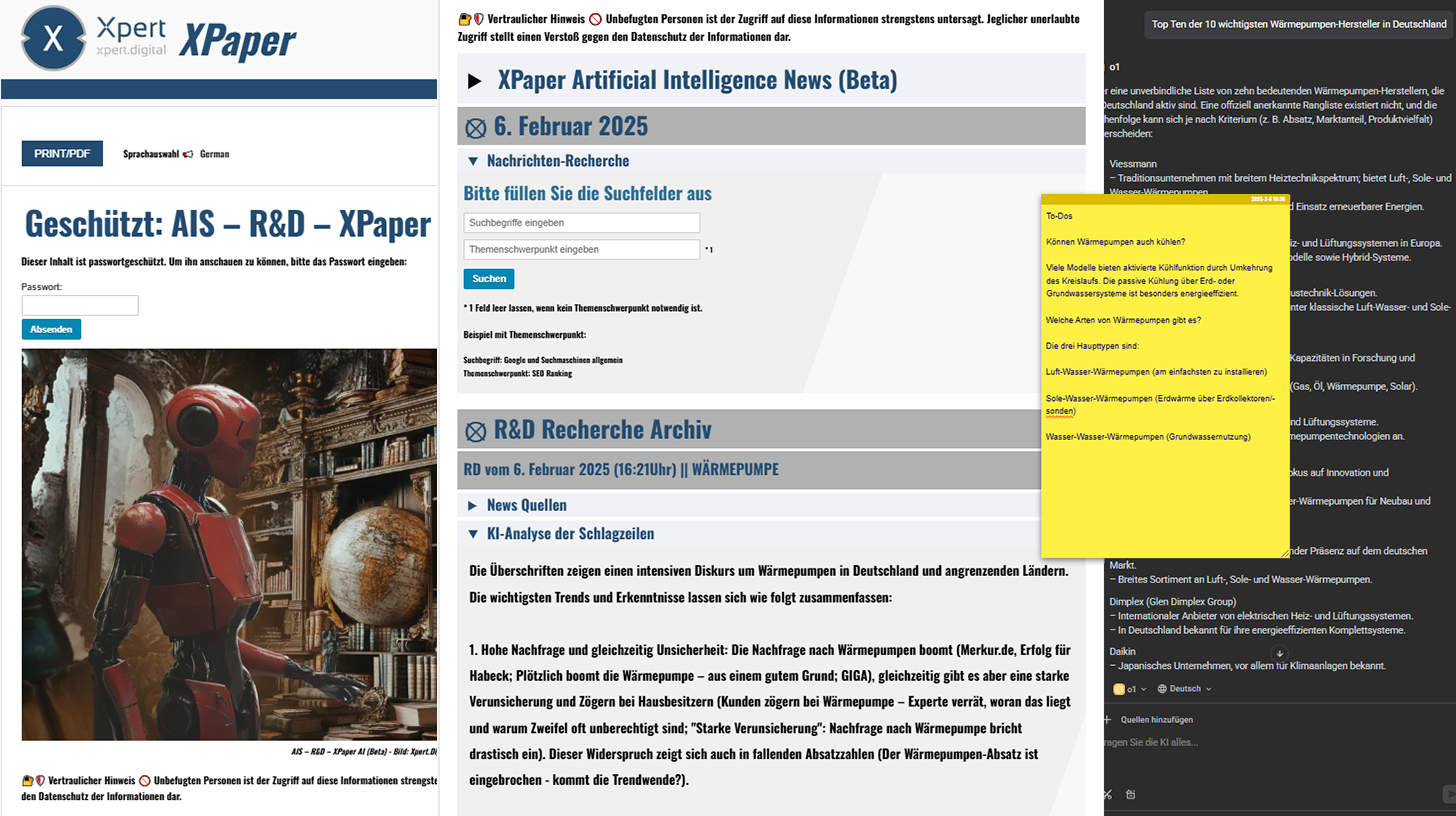
XPaper AIS application possibilities for business development, marketing, PR and our industry hub (content) - Image: Xpert.Digital
This article was handwritten. I used my self-developed R&D research tool, 'XPaper,' which I primarily use for global business development in a total of 23 languages. Stylistic and grammatical refinements were made to make the text clearer and more fluid. Topic selection, drafting, and the collection of sources and materials are all handled by an editorial team.
XPaper News is based on AIS (Artificial Intelligence Search) and differs fundamentally from SEO technology. However, both approaches share the goal of making relevant information accessible to users – AIS on the search technology side and SEO on the content side.
Every night, XPaper sifts through the latest news from around the world with continuous, round-the-clock updates. Instead of investing thousands of euros monthly in cumbersome and generic tools, I've created my own tool to stay up-to-date in my work in Business Development (BD). The XPaper system is similar to tools used in the financial sector, which collect and analyze tens of millions of data points every hour. At the same time, XPaper isn't just for business development; it's also used in marketing and PR – whether as a source of inspiration for the content factory or for article research. The tool allows you to evaluate and analyze all sources worldwide. No matter what language the data source speaks, it's no problem for the AI. Various AI models are available for this purpose. The AI analysis quickly and clearly generates summaries that show what's currently happening and where the latest trends lie – and XPaper offers this in 18 languages. XPaper allows for the analysis of independent subject areas – from general to specific niche topics, in which data can be compared and analyzed with past periods, among other things.
Your global marketing and business development partner
☑️ Our business language is English or German
☑️ NEW: Correspondence in your native language!

Konrad Wolfenstein
I and my team are happy to be available to you as your personal advisor.
You can contact me by filling out the contact form here wolfenstein@xpert.digital:or simply call me at +49 7348 4088 965. My email address is
I'm looking forward to our joint project.