

Criticism: TOP 100 SEO not that great at all

Language selection 📢
Published on: February 12, 2021 / Updated on: October 1, 2024 – Author: Konrad Wolfenstein
It's a hot topic, yet the question has been on my mind for a long time: How much of the SEO services offered by search engine optimizers and agencies is truly good SEO? How can I quickly find out who knows their craft using simple methods? I myself was once one of the first search engine optimizers (2001/02) with my SEO.AG domain (which I still have).

TOP 100 SEO not so top after all – Image: Rawpixel.com|Shutterstock.com
SEO is important, but I haven't pursued it as a standalone business model for a long time, because my focus has shifted towards international business development. There, SEO is just one factor among many, and I bring partners on board as needed. Admittedly, SEO is a thankless job. Client expectations are high. Sometimes it felt like you were expected to conquer the world for pocket change. The best were the "lucrative" offers: success-based. Sure, you painstakingly build the SEO landscape for others and then expect to be compensated accordingly. I can understand the other side, too. And because SEO is a very intensive business that only works on a foundation of trust and patience, I was able to develop my skills through new contacts and reach my current area of expertise.
It all started much earlier, when suddenly almost every print agency that had just barely managed to get online started offering search engine optimization (SEO) in large print. And because SEO is an opaque market where you could use all sorts of tricks to make the numbers look good, all sorts of people, and consequently all the opportunists in a gold rush mood, gathered under the SEO sun. Nowadays, SEO is practically ubiquitous. Some still treat it like a secret science, while for others it's already all-inclusive in their various standard, premium, gold, and whatever-else packages. Others have figured out how to inflate the numbers to make them look "great." Great, but in the literal sense of unbelievable to downright outrageous.
So, I'm out of the loop and can honestly say that I'm not polluting the internet or engaging in SEO bashing. But I quite often receive "great" SEO offers via LinkedIn from both domestic and international sources, and when you take a closer look, you quickly realize how much hot air is actually behind them. The question is: If I'm getting all these "great" offers, who else is getting this spam and can still distinguish between those who are truly good and those who aren't?
Because SEO isn't some people's core competency (which they usually know themselves), they use it as a stepping stone to integrate their actual, different packages and promote them as equally important. Sales are the real business.
They don't skimp on high-profile references either. But it's almost never clear what exactly was done. Who actually did the work. Usually, the company's internal IT or marketing department has already done a good job. They've done some things right. But then they bring in external SEO support because they want to improve things even further, and suddenly the entire service is listed as an SEO reference on the external support site. I've seen it all before.
Admittedly, it's also difficult to implement desired SEO measures for clients. The larger the company, the greater the internal politics and obstacles to getting such necessities approved. It's also exhausting to fight for every little point through countless meetings and discussions. That's why some people say, "Hey, why should I break my leg here? I'll just do business as usual. If they're happy with that, fine! I'll get paid for the hassle." I can understand that, but it's difficult to maintain a passion for SEO in the long run.
But not everyone is like that. That applies to the customer and it also applies to SEO. Those who mean well need to find each other, and that's not so easy.
On the one hand, those who make the most noise are precisely those whose SEO performance is questionable, and on the other hand, clients can't find the right SEO specialist for them because they tend to work quietly and discreetly. SEO is a complex craft involving analysis, research, and observation.
This has led me to wonder how someone who doesn't understand the SEO market can distinguish the good from the bad. Surely there must be a way, beyond the marketing showbiz and the boastful references, to find at least some clues for more critically examining the SEO service or the SEO agency in question.

SEO is important, but it's intensive work – Image: Rawpixel.com|Shutterstock.com
I proceeded similarly to my solar installer project and put forward two key points that can be verified externally:
- HTTPS protocol
- Page Speed
The HTTPS protocol is the front part of the URL that is needed when we access a website : https://xpert.digital
When we type the website's domain address into the browser, the http:// or https:// protocol is automatically added before it, depending on which protocol is set as the default in the browser. These days, it should be the HTTPS protocol.
Suitable for:
Since switching from HTTP to HTTPS protocol doesn't require significant effort from IT, I considered it an indicator in the analysis described above of whether someone is preparing for digitalization or not. If the old protocol was still in use, the conclusion was that no digital transformation was taking place. As I said, this may not apply to everyone, but it is an indicator and, taken together, sufficient for an assessment.
I actually found two SEO providers that still only use the old HTTP protocol. I immediately removed them from the list for further evaluation.
Furthermore, I checked the respective websites several times over a period of three months. That should also be sufficient, especially in the case of a temporary technical error.
The next difficult task was to determine who to include in the further evaluation, as nowadays almost everyone who considers themselves online or digital offers search engine optimization.
I scoured several SEO provider directories and listing services. Anyone who registers or has themselves listed there already has a certain claim to being an SEO expert. I excluded others, and I believe that a total of 1653 SEO providers are representative enough for my small project. It's not like I have unlimited time and am just doing this on the side. As a numbers and statistics enthusiast, I demand that the data be reliable and sufficient for my own purposes. Ultimately, I need the assurance that I'm working with a good SEO professional.
Let's return to the conditions:
- The website was repeatedly tested against the two conditions I described below to rule out temporary technical problems. Testing took place from November 2020 to January 2021, with ten randomly selected tests performed in each month. The tests were automated and programmed by me.
- HTTPS protocol testing. Any site that falls below 80% of the tests is excluded from the statistics. However, only two sites actually scored 0%. I manually double-checked to make sure I hadn't made a mistake, especially since these were seemingly well-organized SEO firms. Appearances can be deceiving.
Page Speed Test!
What's the deal with page speed?
I actually once had a case where I had to have a discussion with a client's IT department who claimed that Google PageSpeed wasn't very important for Google ranking. It was quite something to presume they knew more than Google itself. All I really wanted was for the IT department to take steps to speed up the website because it was incredibly slow. What can you say to that? Any diplomacy or indirect help is difficult when they're so outright resistant.
As early as 2010, Google used page speed as a signal for Google ranking in search results. In 2018, Google extended this ranking factor to mobile search.
In 2020, page speed became part of the page experience (user-friendliness) .
It states, among other things:
Optimize user-friendliness
- Information on tools you can use to measure and report speed values can be found here . These tools can measure LCP, FID, and CLS values.
- Use the Mobile-Friendly if your site is optimized for mobile devices.
From March 2021, only the mobile version of websites will be indexed, and presumably from May onwards, the new ranking signals “Core Web Vitals” will be incorporated into Google's website ranking: Core Web Vitals: Google's measure for Page Experience
In short, and to put it simply, this is Google PageSpeed. PageSpeed scores can vary. In my three-month analysis, I consistently used the highest score at the end.
You can check it yourself here at Google: https://developers.google.com/speed/pagespeed/insights/?hl=de
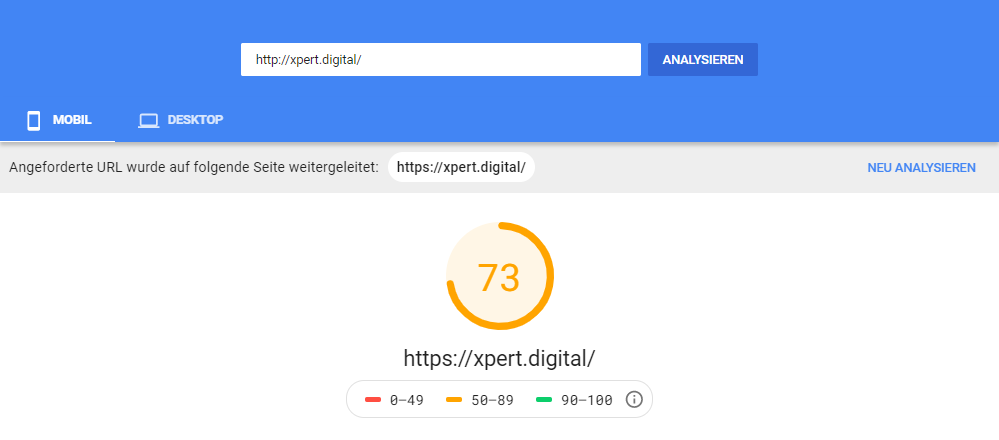
Mobile Page Speed by Xpert.Digital (February 12, 2021) – Image: @Google
I regularly check my Xpert.Digital score and am relatively well positioned in the market, especially in the mobile sector. Even Google only gives me a PageSpeed score of 57 here.
This alone reveals whether a website is responsive, i.e., mobile-friendly, or not. Websites that are not mobile-friendly automatically end up in the red zone for technical reasons.
My Xpert.Digital is certainly not SEO perfect. I'm working on it as best I can, as time allows. I'm not an agency. I'm a well-connected one-man show, operating as an in-house solution from a management perspective. To do things right, I need to be able to tinker with them myself and understand them in order to collaborate, discuss, coordinate, and make decisions with external service providers and company employees.
Now, let's look at the evaluations of the 1653 SEO providers mentioned above:
A total of 16 out of 1,653 were in the green zone with a PageSpeed score of over 90.
182 were in the brown range between 50 and 89.
1,455 out of 1,653 were in the red zone below 49. That is 88 %.
This means that 88% of the analyzed SEO providers have failed to optimize their own website in the mobile version for Google search in a way that meets the SEO standards described above, which will change dramatically this year.
Finally:
- No, I will not disclose which SEO providers were included in the evaluation and how they performed.
- I have outlined some ways above how you can investigate this yourself.
- Please bear in mind that SEO is an intensive business that cannot be run seriously with a monthly budget of €200. Therefore, companies should reconsider their budget planning and not neglect it. Depending on company size and current SEO status, good SEO starts in the four-figure range.
- Certainly, SEO isn't just about page speed. It's one of several factors. These include content development, backlinking, on-page optimization, and much more. But page speed is among the most important and is a metric that can be evaluated transparently and clearly from the outside.
- No, I still do not offer SEO services myself.
You can find relevant PDFs on this topic below the following form:
Write to me

Online search usage
Important note: The PDF is password protected. Please contact me. The PDF is, of course, free of charge
.
English version – To view the PDF, please click on the image below
.

Online search usage – PDF download
Mobile search
Important note: The PDF is password protected. Please contact me. The PDF is, of course, free of charge
.
English version – To view the PDF, please click on the image below
.

Mobile Search – PDF Download
Mobile search in the United Kingdom
Important note: The PDF is password protected. Please contact me. The PDF is, of course, free of charge
.
English version – To view the PDF, please click on the image below
.

Mobile search in the United Kingdom – PDF Download
Google in the United Kingdom
Important note: The PDF is password protected. Please contact me. The PDF is, of course, free of charge
.
English version – To view the PDF, please click on the image below
.

Google in the United Kingdom – PDF Download
Search engines in the United Kingdom
Important note: The PDF is password protected. Please contact me. The PDF is, of course, free of charge
.
English version – To view the PDF, please click on the image below
.

Search engines in the United Kingdom – PDF Download
Search engines in China
Important note: The PDF is password protected. Please contact me. The PDF is, of course, free of charge
.
English version – To view the PDF, please click on the image below
.

Search engines in China – PDF download
Keep in touch







