
The end of an era: mixed.de and the devastating consequences of Google's AI revolution
Xpert pre-release

Available in 27 languages 📢
Prefer Xpert.Digital on GoogleⓘPublished on: June 2, 2025 / update from: June 2, 2025 - Author: Konrad Wolfenstein
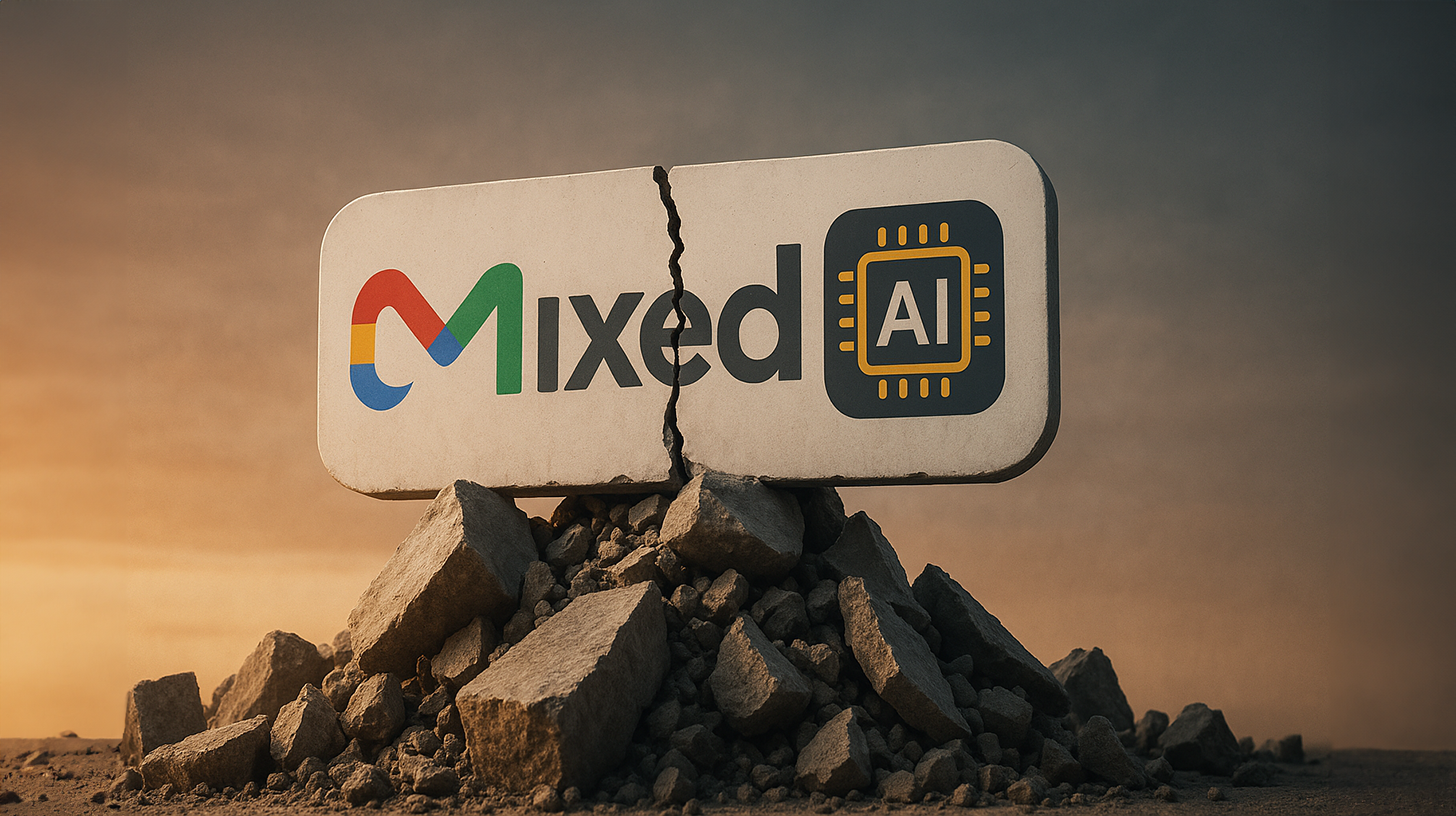
The end of an era: mixed.de and the devastating consequences of Google's AI revolution-Image: Xpert.digital
From traffic crash to: Google's AI changes the media world
Virtual reality hits reality: Why Mixed had to close
The attitude of German-language VR- and AR-Magazins Mixed.de and the English version Mixed-news.com on June 1, 2025 marks a turning point in the history of digital journalism. After ten years of successful reporting on virtual and augmented reality, the magazine became the first prominent victim of Google's radical AI transformation of the internet search. The fate of Mixed illustrates how the integration of artificial intelligence into Google's search engine existentially threatens small and independent online magazines and shakes the foundation of the open internet. The drastic traffic burglaries that have experienced mixed are not an isolated case-they reflect an industry-wide crisis that was triggered by Google's AI Overviews and new AI functions and endangered thousands of publishers in their economic existence.
The closure of Mixed.de as a symptom of a larger crisis
Mixed.de, once the largest German -language source of knowledge for virtual and augmented reality with over 17,000 articles, had to hire the business after ten years of successful reporting. The decision was announced on June 1, 2025, whereby the authors Josef and Tomislav will continue their work at Heise online. However, the end of mixed is not the result of a lack of quality or a lack of readers, but the direct sequence of Google's profound changes in the search engine.
The development of mixed was in several fateful phases. A year and a half ago, the website was well positioned, with a rapidly growing English-language counterpart that benefited from the meta-verse hype triggered by Meta. The turning point came immediately after the Meta Connect 2023, when Google's search algorithm scattered the English side and the traffic collapsed overnight by an estimated 90 percent. Articles that previously achieved four- or five-digit calls suddenly only came to a few hundred views.
This dramatic development was not an isolated case, but concerned thousands of other small and medium-sized online magazines and blogs, the livelihood of which was destroyed overnight. The author Tomislav describes the past nine months as “very stressful” because the traffic had become “unpredictable” and felt like “a roller coaster ride of feelings”. These personal descriptions illustrate the human costs of Google's algorithimic decisions.
The economic effects were devastating. Mixed had a few hundred plus subscribers, but the number of which was declining and never enough to finance the salary of a single editor. As an online magazine, Mixed was therefore dependent on Google advertising revenue, which practically broke away due to the algorithimic changes. This led to a vicious circle: falling income led to scarce resources, which resulted in stronger focus on topics with high click potential, lurid headings and a loss of the diversity.
Google's AI transformation and the introduction of AI Overviews
In the past two years, Google has initiated a radical transformation of its search engine, which is based on the integration of artificial intelligence. In May 2024, Google presented the “AI Overviews” at its developer conference I/O, which were initially introduced in the USA and later also in Germany. These AI summits appear above the traditional list of links to further websites and should offer a quick and convenient way to get information without having to click through several websites.
According to Google, the “overview with AI” is always played out, “if our systems determine that it is the most helpful answer”. According to the first evaluations, this is the case with about every fifth Google search. Google reports that the introduction of “overview with AI” has become one of the most successful product launches in the last decade to increase the use of over 10 percent in the largest markets such as the USA and India.
In May 2025, Google announced further revolutionary changes, including the new “AI Mode”, which can answer more complex inquiries comparable to chat tools such as chatt or perplexity. CEO Sundar Pichai spoke of a “complete redesign of the internet search”. The AI mode uses a method in which a question is divided into individual sub-topics and at the same time a variety of search queries are carried out. Technically, AI mode is based on a tailor-made version of Gemini 2.5.
With this AI offensive, Google takes an enormous risk because the group earns its money, especially with advertising in the area of the web search. Extensive changes to the core product can harm the business model. For the search group, the step seems to be without alternative, since “Google massively under pressure” is, as Georg Zöller, co -founder of the Center for Ai Leadership in Singapore.
Suitable for:
- Google Ai Overviews: Global expansion and new monetization strategies transform the search landscape


Massive traffic burglaries in online publishers
The effects of Google's AI transformation on online publishers are devastating. An exclusive report by the US news agency Bloomberg, which is based on interviews with 25 publishers and data from the analysis company Similarweb, shows the extent of the crisis. Small and medium -sized websites experience an almost historical break -in of traffic, with some pages losing 70 percent of their traffic, some even more.
A particularly dramatic example are Debra Corbeil and Dave Bouskill from Canada, which have been operating the travel blog The Planet D since 2008. In 2024, their traffic collapsed by 90 percent, they had to dismiss and then hire the company. They felt particularly painful that Google's AI had even taken over her Canadian slang, without any remuneration or recognition. "I feel betrayed," says Bouskill, and Corbeil confirmed: "Review - that's the word".
The operator of the outdoor portal Mountain Weekly News, Mike Hardaker, made $ 250,000 sales in 2023, but is now dependent on food aids. These personal fates illustrate the dramatic consequences of Google's algorithimic decisions for real people and their livelihoods.
Niche areas such as traveling, cooking or do -it -yourself are particularly affected. This is also confirmed by SIMILARWEB from the US metropolis of New York, whereby the travel category has hit it hardest-just at the time when Google rolled out a lot of AI functions for it. The publisher Gisele Navarro from the air purifier blog Housefresh reports that her content now appears more often in Google's AI Overviews, but the click on the website fails.
Some platforms, such as the media company Raptive from New York, estimate that long-term up to 25 percent of the total website traffic is lost through AI Overviews. And that was conservatively appreciated. Google is currently testing further features such as recipe summary directly in the search, which could mean the loss of up to 50 percent of traffic for food blogs.
🎯🎯🎯 Benefit from Xpert.Digital's extensive, fivefold expertise in a comprehensive service package | R&D, XR, PR & SEM

AI & XR 3D Rendering Machine: Fivefold expertise from Xpert.Digital in a comprehensive service package, R&D XR, PR & SEM - Image: Xpert.Digital
Xpert.Digital has in-depth knowledge of various industries. This allows us to develop tailor-made strategies that are tailored precisely to the requirements and challenges of your specific market segment. By continually analyzing market trends and following industry developments, we can act with foresight and offer innovative solutions. Through the combination of experience and knowledge, we generate added value and give our customers a decisive competitive advantage.
More about it here:
Search engine break, market power and monopoly: Why Google's AI revolution changed everything
Google's attempted justification and the reaction of the industry
In October 2024, Google invited around 20 website operators to the California Mountain View to talk about the effects of increasing AI use. The participants report: Google apologized, praised their content - and then said that there was no hope of improvement. The search is just different now. This attitude illustrates that Google accepts the collateral damage of its AI transformation as inevitable.
Google emphasizes that you want to prefer content with experience and expertise. In fact, an analysis by Brightedge shows: the most benefit from the AI Overviews large pages such as Tripadvisor, Wikipedia or Google's own YouTube. Many small publishers report that they now lose in the visibility competition against forums such as Reddit or Quora-or against AI generated spam pages that are hardly distinguishable on the outside.
The media industry is increasingly vehemently reacting to these developments. The News/Media Alliance (NMA), a lobby organization with almost 2000 members from the media sector in the USA and Canada, complains: "Now Google simply takes content and uses it without paying. This is the definition of theft". Danielle Coffey, President of the News/Media Alliance, said that links in the Google hit lists were “the last positive quality” of the search engines “that gave the outlets of traffic and sales”.
The NMA particularly criticizes that publishers can only remove their content completely from the training of the AI models, but then no longer appear in the search results. This is an unsuitable solution, especially for smaller media companies. The organization calls on the US Justice Ministry to take measures to break the company's dominance on the Internet.
Suitable for:

Core updates as an additional stress factor
In addition to the AI functions, Google's regular core updates also play a crucial role in the traffic burglaries. These updates are designed to improve the quality of the search results, but can have a significant impact on website rankings. Google released several important core updates in 2024 alone, including November 2024 Core Update and December 2024 Core Update.
November 2023 Core Update brought profound changes in the evaluation of AI content by Google. This update emphasized the importance of high -quality, relevant content for users, regardless of whether they were created by human minds or by AI. At the same time, it led to considerable ranking shifts, many of which were negatively affected by smaller websites.
It is particularly problematic that Google carries out thousands of updates per year, but only announces a few notable updates. This non-transparency makes it difficult for website operators to understand why their rankings suddenly collapse. Pandu Nayak, Google's Vice President Search, confirmed to the US Ministry of Justice that Google uses different ranking signals, including traditional signals and those that are created using machine learning.
For Navboost, a system for measuring user interactions, Google only uses data from the past 13 months. This means that the weighting of different factors can change constantly, which leads to unpredictable traffic fluctuations. This systemic uncertainty makes it practically impossible for small publishers and mixed to plan and survive in the long term.
Suitable for:

The transformation of the search market and new competitive dynamics
Google's AI offensive is also a reaction to the growing competitive pressure through AI chatbots such as Chatgpt, Claude or Perplexity AI. In addition to search engines, more and more users are also falling back on these chatbots, which threatens Google's core business. Google boss Sundar Pichai is under particularly high pressure to justify, since the search generates the vast majority of the profits.
The introduction of AI Mode is Google's attempt to defend its market leadership before competitors become too strong. The group therefore takes “a very big risk”, as Leo Bgebie, analyst at CCS Insights, explains. After all, the search for Google is by far the most important product, and the USA is the largest market. In the past, small changes to the algorithm sometimes had serious consequences.
For 2025, Google Ads is planning a massive integration of artificial intelligence that initiates a transformation in search marketing, which, according to companies, will be larger than the mobile revolution. Brendon Kraham, Vice President for global search ads and Commerce, describes this development as a “greater change than the mobile revolution”. This indicates further fundamental changes that will influence digital marketing and visibility of websites.
Effects on the Internet ecosystem and the variety of information
The concentration of the information power on Google and the preference for large platforms such as YouTube, Wikipedia or Reddit have far -reaching consequences for the diversity on the Internet. When central visibility channels suddenly break away, entire business models start to falter. This development not only threatens small publishers, but the entire ecosystem of the open website.
Anyone who produces high-quality content should not be permanently disadvantaged to AI generated aggregates, otherwise the open web will lose its plural core. In addition, the fundamental henne egg question arises: If no one generates content, which then Google shows in its AI overviews? The AI systems are dependent on human-created content, but at the same time their implementation destroys the incentives for creating this content.
Georg Zöller from the Center for Ai Leadership warns of the long -term consequences: "The foundation of the Internet is destroyed". The vision of the open, decentralized internet, in which various voices and perspectives can be heard, gives way to an increasingly centralized structure in which few large platforms control the distribution of information.
A turning point in digital journalism
The end of mixed.de marks a turning point in digital journalism and illustrates the dramatic consequences of Google's AI revolution for the Internet ecosystem. The transformation of the search engine from a mediator to a direct response threatens the livelihood basis of independent online magazines and changes fundamentally how information is found and consumed on the Internet.
The numbers speak a clear language: traffic burglaries of 70 to 90 percent in small publishers, the closure of traditional magazines such as mixed and the increasing concentration of visibility on large platforms. This development is not only a technological, but also a social problem, since it threatens the diversity of information and pluralistic discourse on the Internet.
For the future of digital journalism, this means that new business models and distribution paths have to be found that are less dependent on Google's algorithmic decisions. The takeover of the mixed authors by Heise Online shows a possible way: integration into larger, already established media organizations. At the same time, regulatory approaches have to be discussed in order to limit the market power of tech giants like Google and create fair competitive conditions for small and independent publishers.
The history of Mixed.de is more than just the closure of a VR magazine-it is a symptom for a fundamental transformation of the Internet, the effects of which extend far beyond digital journalism and the way we find and consume information will be sustainable.
Our recommendation: 🌍 Limitless reach 🔗 Networked 🌐 Multilingual 💪 Strong sales: 💡 Authentic with strategy 🚀 Innovation meets 🧠 Intuition

From local to global: SMEs conquer the global market with clever strategies - Image: Xpert.Digital
At a time when a company's digital presence determines its success, the challenge is how to make this presence authentic, individual and far-reaching. Xpert.Digital offers an innovative solution that positions itself as an intersection between an industry hub, a blog and a brand ambassador. It combines the advantages of communication and sales channels in a single platform and enables publication in 18 different languages. The cooperation with partner portals and the possibility of publishing articles on Google News and a press distribution list with around 8,000 journalists and readers maximize the reach and visibility of the content. This represents an essential factor in external sales & marketing (SMarketing).
More about it here:
Summary of the key points and a brief analysis
Mixed.de, the largest German-language online magazine for virtual reality and augmented reality, ends its reporting after ten years on June 1, 2025. During this time, more than 17,000 Germans and over 5,000 English articles have been published since the end of 2021, which form an extensive archive.
Main reasons for the task
- Google Search Algorithm changes: In-depth changes in the past two years have made the visibility and economic basis for small magazines such as mixed massively difficult. A “core update” led to a traffic slump in about 90%overnight on the English side. The German side also hit later.
- Increasing competition: The struggle for reader attention has grown (other blogs, YouTuber, general entertainment offers).
- Upcoming AI transformation: Ki is expected to further tighten the competition.
- Stagnant interest in VR/AR: The public interest in the core issues has not increased strongly enough to compensate for the downward trend.
- Economic reality: Mixed was never very lucrative and lived from the passion of the authors. The income from a few hundred plus subscribers was not enough to finance. The dependence on Google advertising revenue was high.
- Changed media usage behavior: Younger generations prefer video and audio content to text.
Internal consequences of decline
- Psychological stress for the authors.
- Unpredictable traffic.
- Resource shortage led to stronger focus on click potential, which damaged quality and topic and triggered a vicious circle.
Suitable for:

Short analysis
- The case of Mixed.de is symptomatic of the challenges that specialized, independent online media are looking for today:
- Dependence on gatekeers: The extreme dependence on Google (both for traffic via the search and for advertising revenue) makes small publishers very susceptible to algorithm changes. A single “core update” decision on Google can threaten existence.
- Difficulty monetarization: It is extremely difficult to operate niche journalism profitably. Even with a loyal readership, voluntary subscription models often do not sufficient to cover the costs if the range breaks through external factors.
- Competition pressure: The attention economy is brutal. Specialized content not only competes with direct competitors, but with the entire website.
- AI as a new challenge: The concern that AI generated content and AI-supported search results (such as Google's Ai Overviews) further reduce traffic for publisher is real and is explicitly mentioned as one of the reasons for the task. Mixed.de is called the “first prominent victim” of this development in the title.
- Market cycles and hypes: Mixed benefited from the Quest-2 boom and the Metaverse hype. When this hype escaped and the general interest in VR/AR did not grow quickly enough to compensate for the other negative factors, the situation became critical.
- The closure of Mixed.de is a loss for German -language reporting on immersive technologies. It underlines the need for the media to develop diversified sources of income and strategies for traffic generation in order to become more independent of individual platforms-an immense challenge.
We are there for you - advice - planning - implementation - project management
☑️ SME support in strategy, consulting, planning and implementation
☑️ Creation or realignment of the AI strategy
☑️ Pioneer Business Development

Konrad Wolfenstein
I would be happy to serve as your personal advisor.
You can contact me by filling out the contact form below or simply call me on +49 7348 4088 965 (Munich) .
I'm looking forward to our joint project.
Write to me

Xpert.Digital - Konrad Wolfenstein
Xpert.Digital is a hub for industry with a focus on digitalization, mechanical engineering, logistics/intralogistics and photovoltaics.
With our 360° business development solution, we support well-known companies from new business to after sales.
Market intelligence, smarketing, marketing automation, content development, PR, mail campaigns, personalized social media and lead nurturing are part of our digital tools.
You can find out more at: www.xpert.digital - www.xpert.solar - www.xpert.plus
Keep in touch










