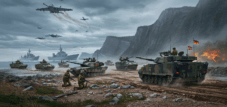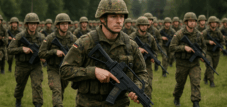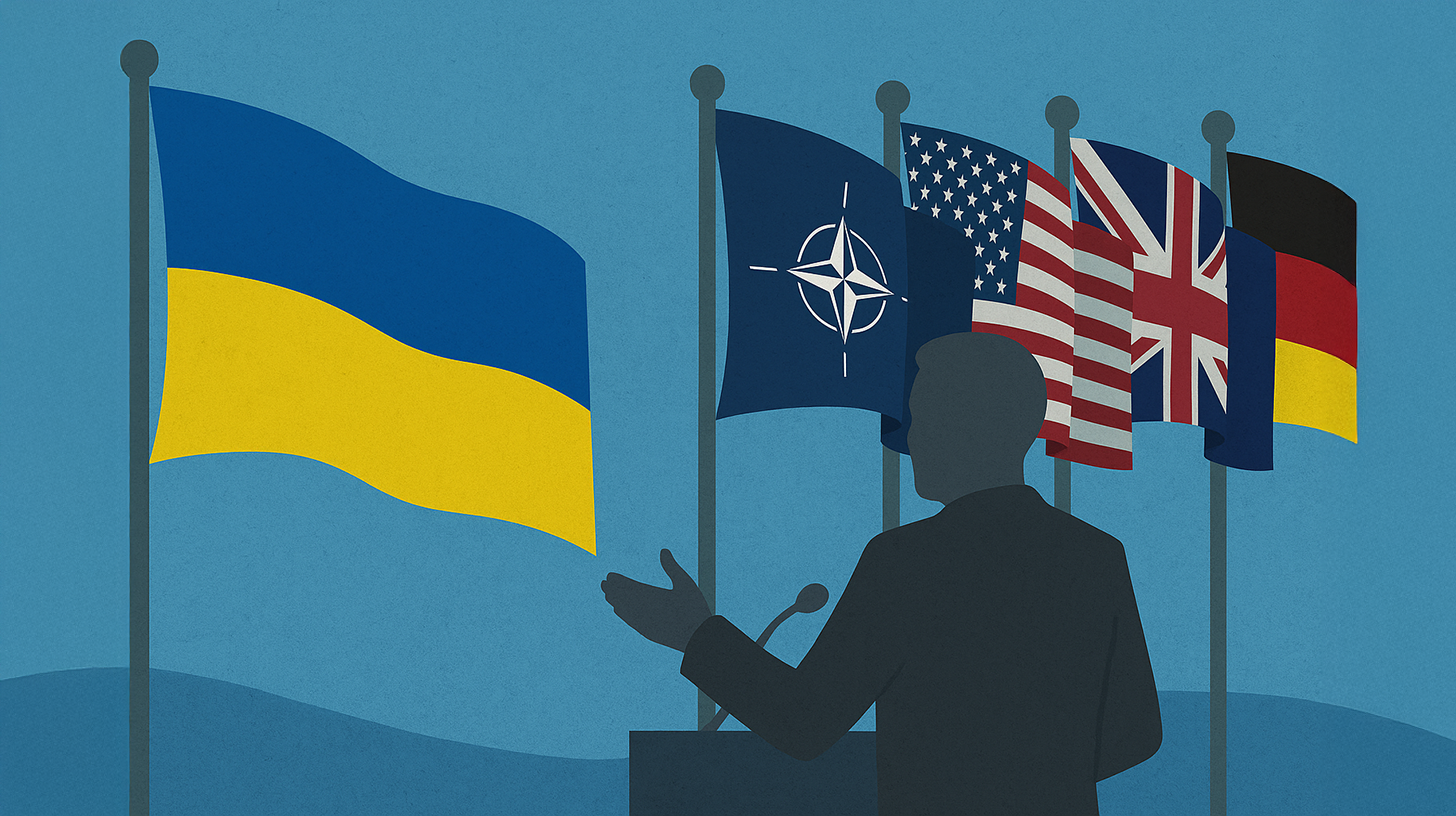
Macron and the security guarantees for Ukraine: The coalition of the willing and Germany's position – Image: Xpert.Digital
Europe's new army for Ukraine? Macron's bombshell announcement divides the West
### Ground troops for Ukraine: Why Chancellor Merz is putting the brakes on Macron's plan ### "Heated phone call" with Trump: How Europe's Ukraine plan angers the US ### Escalation after the war? Why European soldiers could soon become "legitimate targets" ###
A new era: How Macron's "coalition of the willing" is now challenging NATO
A bombshell announcement from Paris has put the European security architecture to a new test: Following a summit on September 4, 2025, French President Emmanuel Macron announced the formation of a "coalition of the willing," in which 26 states have agreed to send troops to Ukraine. This initiative aims to secure peace after a potential end to the war and is a direct response to the changed geopolitical landscape under a re-elected US President Donald Trump. The plan envisions not sending combat troops to the front lines, but rather stationing peacekeeping forces in defined areas to safeguard Ukraine's sovereignty and send a clear strategic signal to Moscow.
But this push for European self-reliance reveals deep rifts within the West. While Macron is pushing for a strong European defense independent of the US, Germany, under Chancellor Friedrich Merz, is reacting with strategic restraint. Berlin is setting clear conditions for participation: first, the financing and arming of the Ukrainian army must be further expanded, and German involvement depends significantly on the role of the US and the outcome of negotiations.
The situation is further complicated by the stance of external powers. In a phone call described as "heated," US President Trump accused the Europeans of continuing to fill Russia's war chest through oil deals and demanded greater contributions from them. At the same time, the Kremlin responded with unambiguous threats: any foreign troop presence in Ukraine would be considered a legitimate target and destroyed. This initiative thus raises fundamental questions: Is this the beginning of a genuine European defense union or a high-risk maneuver? Can such an operation succeed under international law and militarily without the full support of Washington? And what role will Germany play at this crucial moment for the future of the continent?
Troops for Kyiv: Macron rushes ahead, Merz hesitates, Putin threatens – this is what's really behind it
What lies behind Emmanuel Macron's announcement that 26 countries are ready to send troops to Ukraine to secure peace?
This message from September 4, 2025, marks a significant turning point in European security policy and simultaneously raises fundamental questions about the future of transatlantic relations.
The emergence of the Coalition of the Willing
What is the background of this initiative and why did it arise now?
The so-called Coalition of the Willing, comprised of approximately 35 predominantly European states, met in Paris on September 4, 2025, to discuss security guarantees for Ukraine following a potential end to the war. This meeting was not only a response to the ongoing military conflict but also a strategic reply to the changed stance of the United States under President Donald Trump.
What are the specific goals of this coalition? According to Macron, 26 countries have formally committed to stationing troops in Ukraine as a backup, or to maintaining a presence on land, at sea, or in the air to strengthen Ukraine after the end of the war and to secure peace. This force is not intended to wage war against Russia, but rather to secure peace and send a clear strategic signal. The troops would be deployed within the framework of a ceasefire, not on the front line, but in geographical areas that are currently being defined.
What legal and international legal foundations underlie such missions? Peacekeeping missions of any kind are not explicitly provided for in the UN Charter. The United Nations Security Council bears the primary responsibility for maintaining international peace and security. If peacekeeping missions involve military measures, they comply with international law only if the UN Security Council has granted the respective organization a corresponding mandate. Furthermore, a fundamental principle of peacekeeping missions is that the parties to the conflict, or at least the government of the affected state, must consent to the deployment.
Germany's position and the role of Friedrich Merz
How does Germany position itself in this initiative?
Germany's stance is characterized by restraint and strategic caution. Chancellor Friedrich Merz, who participated in the conference via video link, emphasized through his spokesperson Stefan Kornelius that the initial focus must be on financing, arming, and training the Ukrainian armed forces. Germany has become Kyiv's most important partner in this endeavor and is also prepared to expand this assistance.
What specific conditions does Germany set for potential participation? Germany will decide on military involvement in due course, once the framework conditions have been clarified. This includes, among other things, the nature and scope of any US involvement, as well as the outcome of any negotiation process. Stefan Kornelius also pointed out that the Bundestag has the final say in any Bundeswehr deployment. This constitutional requirement underscores democratic control over Bundeswehr deployments abroad.
What does the appointment of Stefan Kornelius as government spokesperson mean for this policy? Stefan Kornelius, who has served as government spokesperson and head of the Federal Press Office since May 2025, brings extensive foreign policy experience. The former head of the political section at the Süddeutsche Zeitung is considered extremely well-connected and is a member of numerous foreign and security policy think tanks. This expertise is of considerable importance for the complex challenges of current security policy.
How exactly does Germany plan to support Ukraine? According to media reports, the German government plans to increase the number and effectiveness of Ukraine's air defense systems by 20 percent annually. Furthermore, Ukraine is to be equipped with long-range precision weapons such as cruise missiles, which will be manufactured within the country with financial and technological support from Germany, among others. In addition, Ukraine is to be provided with the equipment for four mechanized infantry brigades, which would amount to approximately 480 infantry vehicles per year.
The American role and Trump's stance
What role do the USA play in this European initiative?
US participation remains a critical factor for the success of the security guarantees. Macron announced after the meeting that the form the US contribution to these guarantees would be determined in the coming days. Following the meeting, a group call with US President Donald Trump took place, but it led to contentious discussions.
What did Trump criticize about the European stance? During the phone call, Trump accused the Europeans of continuing to import oil from Russia despite their opposition to the country, thereby supporting Putin's war efforts. He demanded an end to oil deals and more pressure on China. Media reports described the phone call with the Europeans as heated.
What are Trump's expectations of Europe? Trump has repeatedly made it clear that Europe must play a greater role in its own defense. NATO member states have already agreed to increase their defense spending to five percent of their gross domestic product. This demand by Trump reflects his long-standing argument that European taxpayers should no longer primarily have American taxpayers foot the bill for Europe's security.
Hub for Security and Defense - Advice and Information
Hub for Security and Defense - Image: Xpert.Digital
The Security and Defence Hub offers expert advice and up-to-date information to effectively support companies and organizations in strengthening their role in European security and defence policy. Working closely with the SME Connect Defence Working Group, it particularly promotes small and medium-sized enterprises (SMEs) that wish to further develop their innovative capacity and competitiveness in the defence sector. As a central point of contact, the Hub thus creates a crucial bridge between SMEs and European defence strategy.
Related to this:
26 states, one goal: Paths to a new peace order in Europe
Russia's position and resistance
How is Russia reacting to these plans?
The Russian leadership categorically rejects any form of Western troop presence in Ukraine. Kremlin chief Vladimir Putin declared at the Vladivostok Economic Forum that a long-term peace agreement would not require any foreign troops in Ukraine. He threatened that if any armed forces appeared, especially during the ongoing fighting, they would be considered legitimate targets and destroyed.
What justification does Moscow give for its rejection? Kremlin spokesman Dmitry Peskov explained the repeatedly expressed rejection by stating that the presence of foreign armed forces near the Russian border poses a threat to Moscow. NATO considers Russia an enemy and has enshrined this in its documents. Russian Foreign Minister Maria Sakharova also described the plans as a guarantee of insecurity for the European continent.
What are Russia's fundamental security concerns? Russia argues that discussions about security guarantees cannot be limited to Ukraine; Russia also needs guarantees for its own security. The Russian position is that the war against Ukraine has its roots in NATO's expansion to Russia's borders. Ukraine's security should not be guaranteed at Russia's expense.
International legal framework and security guarantees
What legal instruments are available for security guarantees?
The EU has its own mutual assistance clause in Article 42, paragraph 7 of the EU Treaty, which is even stronger than Article 5 of the NATO Treaty. This clause stipulates that in the event of an armed attack on the territory of a member state, the other member states owe it all the assistance and support within their power. Unlike the NATO mutual assistance clause, which leaves the decision on the type and extent of assistance to each state, the EU regulation contains a more concrete obligation to provide aid.
How do NATO security guarantees work in practice? Article 5 of the NATO Treaty stipulates that an armed attack against one member is considered an attack against all. However, this article does not create a legal entitlement to assistance and military support. The invocation of Article 5 of the NATO treaty is not automatic, and NATO member states decide by consensus, exercising considerable political discretion. An attacked NATO partner has no legal right to demand that Article 5 be invoked.
What alternatives to NATO membership exist? Ukraine's accession to the EU would automatically activate the EU's mutual defense clause, which experts consider even more binding than NATO guarantees. Ukraine is already an EU candidate country and has been conducting accession negotiations since June 2024. EU membership would provide Ukraine with a military security guarantee without making NATO membership mandatory.
Europe is rethinking its approach: training mission instead of peacekeeping force in Ukraine
What practical challenges does a peace mission face?
According to military sources, a troop presence of European NATO states in Ukraine would primarily be conceivable as a large-scale training mission. It would not be a peacekeeping force in the traditional sense. The European NATO members would assume the main responsibility for such a mission. The exact number of troops deployed and their specific tasks are still unclear.
What does this mean for European defense policy? The initiative represents a significant step towards strengthening European ownership in security policy. Given the uncertainty surrounding the American role under Trump, European states are called upon to expand their defense capabilities. NATO member states have already decided to increase their defense spending to five percent of GDP, an unprecedented increase since the Cold War.
What role does EU enlargement play in this context? Ukraine is undergoing an accelerated EU accession process, despite the ongoing war. One of Ukraine's key integration goals for 2025 is the commencement of parallel negotiations in all EU accession clusters. Bilateral screening talks in four of the six negotiating packages have already been completed. EU accession would automatically guarantee Ukraine the EU's mutual assistance clause.
Coalition of the Willing: Europe's Path to Security Policy Independence
What factors will determine the success of this initiative?
The success of the coalition of the willing depends on several critical factors: the specific form American participation takes, the willingness of the participating countries to actually provide troops and resources, and the development of the military situation in Ukraine. Without substantial US participation, particularly in areas such as airspace surveillance and reconnaissance, the deterrent effect against Russia is likely to remain limited.
What are the long-term implications for transatlantic relations? The European initiative for greater self-responsibility in security policy could lead to a fundamental reshaping of transatlantic relations. While Trump is pushing Europe toward greater self-reliance, Europeans are increasingly accepting this challenge. In the long run, this could lead to a more balanced, but also more complex, partnership between Europe and the US.
What significance does this have for the future peace order in Europe? The initiative of the 26 countries represents an attempt to establish a new peace order in Europe that is less dependent on American leadership. At the same time, it signals to Russia that Europe is prepared to assume responsibility for its own security. Whether this strategy will be successful ultimately depends on whether credible security guarantees can be created that both deter Russia and provide Ukraine with the necessary security to achieve long-term peace and stability.
The developments surrounding the Coalition of the Willing thus mark a potential turning point in the European security architecture, the long-term effects of which are likely to become apparent only in the coming years.
Consulting - Planning - Implementation

Markus Becker
I would be happy to serve as your personal advisor.
Head of Business Development
Chairman SME Connect Defense Working Group
Consulting - Planning - Implementation
Konrad Wolfenstein
I would be happy to serve as your personal advisor.
You can contact me at wolfenstein∂xpert.digital or
Just call me on +49 7348 4088 965 .