Capital beats labor: How the rich legally protect their money while the middle class pays the price – Image: Xpert.Digital
A salary of €70,000 and already considered "rich"? Why the top tax rate in Germany affects the wrong people
Working until the state takes its cut: The silent exploitation of the German middle class
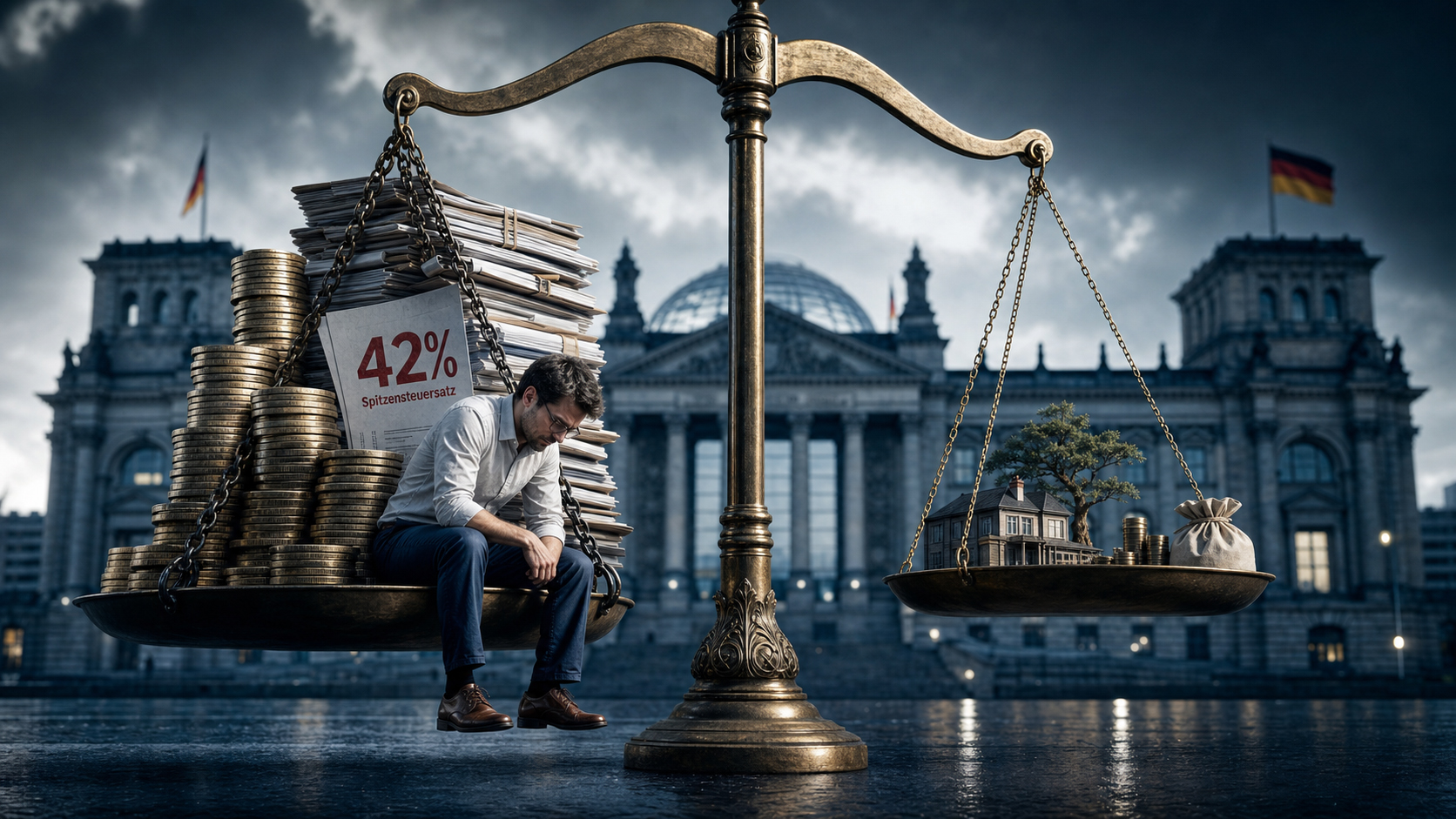
42% tax on wages, 1.5% on billion-euro inheritances: Is the German tax system still fair? – The system rewards passive capital and penalizes active performance
In Germany, those who earn good money are quickly considered wealthy. But the reality on the payslip often tells a very different story: Experienced skilled workers, engineers, and doctors suddenly find themselves in the top tax bracket, while billions in assets and large inheritances change hands almost tax-free thanks to legal loopholes. The burden of the German welfare state increasingly rests on the shoulders of the working middle class – those high achievers who, with a tax burden of almost 50 percent, are among the most heavily taxed citizens in the world. The system rewards passive capital and penalizes active performance. The consequences are disastrous: a massive "middle-class bulge" that swallows up every salary increase, rampant bracket creep, and a growing number of highly qualified professionals who are leaving the country in frustration. This is an in-depth analysis of why the German tax system urgently needs an update – and why the political debate about "wealth" completely misses the real problem.
Who is supporting Germany? The silent overload of high achievers
When the top tax rate becomes the standard tax rate – and why the wealth threshold is moving downwards
At the end of April 2026, CSU leader Markus Söder and ARD moderator Louis Klamroth engaged in a heated exchange on the program "Arena" that reveals more about the state of the German tax debate than many an economics treatise. When asked for his definition of wealth, Klamroth simply replied: "People who pay the top tax rate." However, the top tax rate in Germany kicks in at a taxable annual income of just under €70,000 – an income that by no means conforms to the stereotype of the rich, but rather affects the experienced engineer, the master craftsman with his own business, the doctor in a private practice, or the software developer with ten years of professional experience. Söder reacted with undisguised irritation, pointing out that Klamroth himself reportedly received around one million euros from ARD in 2026 and 2027 – financed by the broadcasting fee. The dispute was quickly over, but the question remains open, uncomfortable, and politically sensitive: Is the taxation of the working middle class in Germany too high? Or do we need to differentiate more precisely – between those who earn money through work and those who remain wealthy through capital and assets?
The top tax rate as a mass phenomenon among skilled workers
In the public perception, the top tax rate is an instrument that targets the wealthy and privileged. The reality of German tax law is different. The top tax rate of 42 percent has applied since 2026 to taxable incomes exceeding €69,879 – the threshold for 2025 was €68,430. According to current estimates, this means that around four million people in Germany pay the top tax rate, including engineers, nursing home managers, master craftsmen with supplementary salaries, tax advisors, teachers in leadership positions, and countless self-employed individuals from the upper middle class. These are not the economic elite, but rather the skilled core of Germany's working population.
Someone earning €70,000 gross per year in tax bracket 1 receives approximately €42,583 net – that's about €3,549 per month. Of every euro earned, exactly 61 cents remain. The remaining 39 cents go into state coffers via income tax (17 percent) and social security contributions (22 percent). A single person earning €70,000 gross pays around €12,220 annually in income tax and around €15,197 in social security contributions – pension, health, long-term care, and unemployment insurance combined. This corresponds to a total tax burden of almost €27,400 per year, or nearly 40 percent of gross income.
The so-called top tax rate, the so-called "wealth tax" of 45 percent, only applies to taxable income above €277,826 – and it has remained unchanged since 2022, while the lower tax brackets are gradually adjusted for inflation. In effect, this means that someone earning just over €70,000 pays the same marginal tax rate as someone with an annual income of €200,000. The term "top tax rate" is therefore deeply misleading because it suggests that it is an exceptional burden for those with exceptional incomes – which is no longer the case.
The middle-class bulge: A structural justice gap
Behind the popular debate about the top tax rate lies a technical, but economically highly relevant phenomenon: the so-called "middle-class bulge." This refers to the disproportionate increase in marginal tax rates in the lower and middle income brackets. In the current German income tax system, the initial tax rate starts at 14 percent and rises to 42 percent before climbing by only three percentage points to 45 percent for significantly higher incomes. The progression is therefore considerably steeper in the lower middle income bracket than in the upper income bracket.
Specifically, this means that in the first tax bracket, an increase in earnings of just €500 raises the marginal tax rate by one percentage point. Therefore, low-income earners or skilled workers who receive a pay raise lose a disproportionately large share of it to the tax authorities – compared to someone already paying the top tax rate who faces only a marginal increase in their tax burden. The German Economic Institute (IW) calculated that the additional burden caused by the "middle-income bulge" alone increased from €25 billion to €37 billion between 2010 and 2018. Completely eliminating this bulge would relieve taxpayers of approximately €35 billion annually.
This structural distortion creates a fundamental incentive problem: In Germany, those who work more, take on more responsible positions, or pursue further training face a disproportionately higher tax burden. This is not an abstract efficiency problem of welfare economics – it is a concrete signal to millions of people who are questioning whether increased effort is even worthwhile. In its economic policy reform proposals for the 2025 federal elections, the ifo Institute explicitly called for a fundamental reform of income tax to strengthen work and performance incentives, as the interaction between taxes and transfers in the current system produces various perverse incentives.
Bracket creep: The invisible tax increase machine
Besides the structural problem of the "middle-class bulge," there is another, often overlooked, burden mechanism: bracket creep. This occurs when salary increases that merely compensate for inflation automatically push taxpayers into a higher tax bracket – without any increase in their real purchasing power. The government then collects more tax revenue without the citizen actually benefiting.
According to the Federation of German Taxpayers, working households have to pay more than half of their income into public coffers. Without political countermeasures, this burden would have been significantly higher, as inflation-related increases in income would have led to considerably higher tax burdens. The coalition government implemented a partial compensation for bracket creep starting in 2025 by adjusting the tax bracket thresholds to the right in line with inflation. The Federal Ministry of Finance raised the basic tax-free allowance to €12,096 (2025) and €12,336 (2026).
However, this compensation is only partially effective. A study by the IMK of the Hans Böckler Foundation shows that the tax relief policies of the traffic light coalition benefited middle-income families the least: Families with two full-time earners, each with a gross annual income of just under €59,000, suffered a loss of purchasing power of €492 despite all the measures. Single parents with a gross annual income of around €43,700 lost €316 in real terms. This made it clear: The tax relief primarily reached those at the extremes of the income distribution, but not the working middle class with children.
The real question is: Who actually finances the German welfare state?
The data on the distribution of income tax revenue are clear and deserve to be taken seriously. In 2018 – the most recent year for disaggregated data – the top 10 percent of income taxpayers held 36.6 percent of total income but contributed almost 55 percent of total income tax revenue. The top 1 percent of income taxpayers held 11.7 percent of income but paid 22 percent of income tax. Conversely, the bottom 50 percent of taxpayers received 17.2 percent of all income but contributed only 6.4 percent to income tax revenue.
To belong to the top ten percent of income taxpayers in 2018, annual income had to be €86,445 or more – a figure that would have to be set even lower by today's standards. The tax system is therefore indeed progressive: those who earn more pay more, both relatively and absolutely. The German Institute for Economic Research (DIW Berlin) considers this finding reliable: the top 30 percent of the income distribution accounts for approximately 80 percent of income tax revenue. At the same time, 2.7 million employed individuals pay no income tax at all due to insufficient income.
Income tax revenue now accounts for roughly 45 percent of total German tax revenue, which rose to €941.6 billion in 2024. Despite a persistent recession, federal and state tax revenues climbed to €861.1 billion – an increase of 3.8 percent compared to the previous year. Never before has the German state collected as much money as in 2024. Total government revenue exceeded the €2 trillion mark for the first time. Germany's structural problem is not one of revenue, but rather one of expenditure.
The international divide: Germany as a high-tax location for work
In a global comparison, the burden on labor income in Germany is strikingly high. The total burden of taxes and social security contributions in Germany amounts to 49.3 percent of labor costs for a single average earner – well above the OECD average of 35.1 percent. Only Belgium has higher figures, at 52.5 percent. By comparison, the comparable burden in the USA is 30 percent.
A study by the German Bundesbank concludes that Germany's tax burden, at 48.5 percent, significantly exceeds the OECD average of 41.5 percent. The situation is hardly better for married couples with children: in Germany, the tax burden is 40.8 percent, while the OECD average is 29.4 percent. Only Belgium, at 45.5 percent, has a higher rate. This means that a married German couple with children pays almost one and a half times more in taxes and social security contributions for their employment than the average OECD household.
These figures reflect the core problem: In Germany, it is earned income that is disproportionately taxed – not assets, not inherited business shares, not capital gains benefited from the withholding tax. For every euro that an average earner in Germany earns, essentially only 61 cents remain after all state deductions. The top tax rate on labor is effectively 42 percent – while the tax rate on dividends and interest income is a flat 25 percent.
The asymmetric tax burden: capital versus labor
The comparison of earned income and capital income reveals a systemic imbalance in German tax law. Since 2009, a flat withholding tax of 25 percent has applied to capital gains – interest, dividends, and capital gains. The then SPD Finance Minister, Peer Steinbrück, justified the measure with the pragmatic argument that it was better to collect "25 percent of x than 45 percent of nothing" – in other words, to curb the previously rampant capital flight abroad.
The result is a structural preference for capital income over earned income. An employee with an annual salary of €80,000 pays 42 percent income tax plus social security contributions on the top portion of their income. A retiree receiving the same amount from interest and dividends pays only 25 percent – without social security contributions. The German Association for Small and Medium-Sized Businesses (BVMW) points out that, even with trade tax credits, the income tax burden for the self-employed can exceed 50 percent at the top end. Here, two systems clash: The employee or self-employed individual who generates income through their time, expertise, and sense of responsibility is systematically burdened more heavily than someone whose income flows passively from investments.
The political debate has been focused on this asymmetry for years, but it has rarely been seriously addressed. The SPD and the Greens advocate abolishing the withholding tax and taxing capital gains according to the personal income tax scale. The CDU/CSU and the FDP reject this, citing potential capital flight. Indeed, this argument has some merit: France experienced a documented capital outflow of around €70 billion in 2012 after announcing a wealth tax, although the actual taxable portion of this remained unclear. In 2023, the OECD determined that Germany is among the few countries where the total tax burden on dividends is even higher than that on earned income – when corporate tax and withholding tax are considered together. Nevertheless, this asymmetrical treatment in direct comparison remains a problem of fairness that many perceive as unjustified.
Our EU and German expertise in business development, sales and marketing


Our EU and German expertise in business development, sales and marketing - Image: Xpert.Digital
Industry focus areas: B2B, digitalization (from AI to XR), mechanical engineering, logistics, renewable energies and industry
More information here:
A thematic hub offering insights and expertise:
- Knowledge platform covering global and regional economies, innovation and industry-specific trends
- A collection of analyses, insights, and background information from our key areas of focus
- A place for expertise and information on current developments in business and technology
- A hub for companies seeking information on markets, digitalization, and industry innovations
The middle class at its limit: When high taxes coincide with poor government services
The inheritance tax problem: When billions in assets remain effectively tax-free
The situation is particularly complex with regard to inheritance tax. In Germany, business assets and agricultural and forestry assets have been largely exempt from inheritance tax since 2009. Up to 85 percent (standard exemption) or even 100 percent (optional exemption) of the transferred business assets can be tax-free. Originally intended to protect small family businesses, this regulation has long since become a legal vehicle for the super-rich to pass on their wealth tax-free.
In September 2025, the Tax Justice Network presented alarming figures: 45 large heirs received a combined fortune of almost €12 billion in 2024 and paid an average of only around 1.5 percent tax on it. The state effectively forwent €3.4 billion in revenue to their benefit. At the same time, small inheritances exceeding the personal allowances – which are €400,000 for children and €500,000 for spouses – are taxed significantly. The progressive principle is effectively reversed in inheritance tax law: the small heirs pay their percentage, while the truly large heirs with cleverly structured business assets pay almost nothing.
Furthermore, the wealth tax has been suspended since 1996. According to calculations by Oxfam and the Tax Justice Network, this suspension cost Germany over €380 billion by the end of 2023 – equivalent to approximately 80 percent of the 2024 federal budget. Since 2001, the wealth of the 100 richest Germans has grown by around €460 billion. The Gini coefficient for wealth distribution in Germany was 0.73 in 2021 – more than twice as high as the coefficient for income distribution. According to calculations by the DIW SOEP (German Institute for Economic Research and Socio-Economic Panel), the top 1 percent holds around 35 percent of total net wealth. The wealthiest 10 percent of households possess more than half of all private wealth.
Brain Drain: When high performers vote with their feet
The abstract economic discussion about tax rates has a very concrete dimension: people with sufficient qualifications and international mobility are turning their backs on Germany. On average, around 180,000 well-educated German citizens leave the country each year to gain a foothold abroad. While approximately 129,000 return after a few years, this ultimately results in a net loss of around 50,000 skilled workers annually. Since 2003, a net total of around 180,000 skilled workers have emigrated to other industrialized nations.
Gabriel Felbermayr, former president of the Kiel Institute for the World Economy, succinctly summarized this: "In the international competition for top talent, net wages, and thus taxes and social security contributions, play a crucial role." In Germany, net wages for highly qualified individuals are relatively low compared to other countries, which makes the location attractive precisely for those migrants who work in the lower wage segment – while highly qualified individuals tend to move to Switzerland or the USA, where working conditions and net earnings are better.
The fiscal costs of this emigration are considerable. The ifo Institute has calculated that the loss of a skilled worker who leaves the country at age 23 represents a fiscal loss of €281,000. For a doctor, the loss is even more significant: if she leaves Germany at age 30, the treasury loses a net amount of almost €1.1 million, taking into account lost taxes and social security contributions as well as education costs. These calculations suggest that a tax system that burdens high earners so heavily that they leave Germany ultimately harms the national budget more in the medium term than it generates in short-term revenue.
Where the rich really leave their money: Legal optimization and structural asymmetry
Perhaps the most uncomfortable aspect of this debate is the fact that the truly wealthy in Germany often effectively pay less tax on their assets than the working middle class pays on their earned income. This is not due to tax evasion, but rather to legal structures. Those who derive their income primarily from capital gains pay a maximum withholding tax of 25 percent on interest and dividends. Those who own and cleverly structure business assets can transfer inheritances almost tax-free. Those who can utilize international structures—holding companies in low-tax EU countries, foundation structures, asset management companies—optimize their overall tax burden to a fraction of what an employee with the same income pays.
A 2024 analysis by WiWo (Wirtschaftswoche) put it succinctly: Middle-class families whose income is earned through employment face deductions of around 43 percent – in Switzerland, comparable income groups only pay 15 percent. Wealthy individuals who work less and live more off investment income pay correspondingly less income tax and no social security contributions on this income. The average worker – someone who works daily, bears responsibility, perhaps runs a business, and has risen into the upper middle class after years of education or training – has no way to optimize their earned income through taxation in a similar way. They pay what the law requires, and that is substantial.
The debate about whether taxation is too low therefore needs to be framed more precisely. It's not "the rich" who pay too little – in income tax, top earners pay a disproportionately high amount. The problem lies in the relationship between earned and capital income, between wages and inheritance, between what burdens regular employment and what barely affects large fortunes.
On the expenditure side: More government, less impact
The high tax and contribution burden would be easier to justify politically and socially if the state used its resources efficiently. However, this is increasingly less the case. Germany's total government revenue exceeded the two trillion euro mark for the first time in 2024 – and yet the budget deficit rose to around 119 billion euros. Expenditure grew faster than revenue, at 5.3 percent. For the first time in 15 years, all four sectors – federal, state, and local governments, as well as social security funds – simultaneously experienced a budget deficit.
Germany's small and medium-sized enterprises (SMEs), the backbone of the economy, are sending alarming signals: According to the KfW SME Panel 2025, the propensity to invest has fallen to its lowest level since the 2009 financial crisis. Only around 63 percent of the SMEs surveyed planned investments in the next six months. Eighty percent cited bureaucracy as their biggest problem. This shows that it's not just the tax burden that's hurting SMEs – it's the combination of high taxes, inadequate government services, and a bureaucratic apparatus that consumes energy and time that could be invested productively.
When the Bundesbank determines that Germany's tax burden exceeds the OECD average by almost seven percentage points, and when at the same time infrastructure is crumbling, bridges are in need of repair, schools are lagging behind in digitalization, and administrative procedures take months, the most egregious imbalance in political economy arises: high taxes with a perceived lack of government services in return. This is fertile ground for political disillusionment and for the unspoken question of whether hard work is still valued in this country.
What a differentiated tax policy should achieve
The findings do not simply justify across-the-board tax cuts. The question is more nuanced. A fair and efficient tax policy would have to address several dimensions simultaneously.
First: The middle-income tax bulge urgently needs to be eliminated. The disproportionate progression in the lower and middle income brackets burdens precisely those who, through their work and qualifications, generate Germany's prosperity. The DIW Berlin has calculated that eliminating the middle-income tax bulge would relieve taxpayers of around 35 billion euros annually. The counter-argument that more than half of this relief would benefit the top 20 percent of earners is not wrong – but it overlooks the fact that this group also contributes by far the largest share of tax revenue.
Secondly, the asymmetry between earned income and capital income needs to be examined more closely. This doesn't necessarily mean raising the tax rate on capital gains and thereby provoking capital flight. It means making the relative burdens more transparent and at least limiting the most extreme privileges – such as the de facto tax exemption of large business inheritances. The fact that 45 large heirs pay only 1.5 percent tax on €12 billion in assets is not an indication of a functioning tax system, but rather one of its obvious failings.
Thirdly: The government's expenditure side must be critically examined. If Germany structurally has the highest or second-highest tax levels in the OECD, the quality of public services must match this standard. Bridges, schools, administration, digitalization, defense – all these are areas where the German state shows significant shortcomings despite record revenues. The pressure on taxpayers can only be legitimized in the long term if it becomes transparent what is being done with the money.
Who is rich in Germany? A sober assessment
The claim that someone earning €70,000 gross per year is "rich" is neither empirically nor economically tenable. A single person earning €70,000 gross in a major West German city has approximately €3,549 net per month. In a city like Frankfurt, Munich, or Hamburg, €1,200 to €1,800 of that typically goes toward rent. After further expenses for groceries, transportation, health insurance contributions, and retirement savings, which, given the uncertain future of the statutory pension system, must be supplemented privately, little remains for wealth accumulation.
In Germany, the wealthy are not those who earn €70,000 or €80,000 gross and pay the top tax rate. Wealthy, in the economically relevant sense, are those who possess substantial assets that generate returns largely independent of active labor. The top one percent of the German population holds approximately 35 percent of total net wealth, while the top ten percent own more than 56 percent of total private wealth – the total private wealth of German households grew to €9.3 trillion in 2024. The 3,300 German super-rich individuals with assets exceeding $100 million control an estimated quarter of total German wealth.
This imbalance is real and poses a socio-political problem. But attempting to solve it by increasing taxes on the already heavily burdened middle class—by declaring an income threshold that affects an experienced skilled worker or engineer as wealth—is both analytically flawed and politically counterproductive. It addresses the wrong side of the problem.
Outlook: Performance and justice as a joint project
The German tax debate suffers from a fundamental conceptual imprecision. It regularly confuses income level with wealth, top tax rate with luxury taxation, and redistribution with fairness. An honest analysis must distinguish between those who work hard and earn a lot – and who already bear the brunt of income tax revenue – and those who own a lot without contributing proportionally to the overall tax burden.
The high achievers of German society are not the enemies of a fair tax policy. They are its most important foundation. Without engineers, master craftsmen, entrepreneurs, doctors, IT specialists, and academics who are willing to perform and take responsibility, there would be neither sufficient tax revenue nor enough innovative capacity to finance the social security systems. To damage this foundation through symbolic rhetoric about wealth and to undermine it through structural incentive distortions would be a costly mistake—more costly than any tax reform.
Germany faces the challenge of modernizing its tax policy – not by increasing the burden on the working middle class, but through more consistent taxation of inheritances and large fortunes, a gradual smoothing of the excessively steep progression in the middle income bracket, and an honest debate about what the state is actually doing with its record revenues. Ultimately, the question of the appropriate tax burden is also a question of the social contract: What does the state owe its citizens for what it regularly demands of them?