Background information on petroleum – Image: Xpert.Digital
Even though petroleum, or rather the “outdated use of petroleum”, is primarily responsible for the greenhouse effect and global warming, it nevertheless remains an important resource.
- Even the production of renewable energy products requires petroleum as a raw material.
- Almost all of our everyday products are based on petroleum.
- Petroleum is not only an energy source, but also an important raw material for plastics.
- Plastic is the colloquial term for all kinds of synthetic materials.
- Synthetic rubber, derived from petroleum, also accounts for 60% of the total rubber demand. Up to 70% of all rubber is used in the production of car tires.
The amount of plastic produced worldwide has increased dramatically in the last 70 years – from 1.5 million tons (1950) to approximately 370 million tons in 2019. This increase has been driven primarily by Asian countries – especially China – over the past 20 years.
In 1950, 0.35 million tons of plastic were produced in Europe. Nearly 70 years later, that figure has risen to approximately 60 million tons!
The number alone should make it clear that this cannot continue indefinitely and that alternatives are needed.
As long as no solid alternatives have been found and renewable energies and industry are unable to produce balancing and sufficient quantities of energy and industrial raw materials, petroleum will continue to play a vital role as an energy source and raw material.
The data collected here is intended to once again illustrate the diversity of petroleum and to raise awareness of alternative pathways.
This isn't about whether global warming exists or not. It's not about whether electric motors are the right alternative to combustion engines. It's not about whether renewable energies can sustainably replace fossil fuels.
We must constantly be able to question our actions, values, and ideologies to determine whether our ways of acting and seeing are still up-to-date, and whether we need to find modifications or even completely new paths for ourselves and ourselves personally (see KAIZEN / see Agile Development – Kaizen).
Well, CO2 taxes and autonomous power supply will force us to rethink our approach
Previously, this only applied to companies in the energy sector, industrial groups and airlines with their greenhouse gas emissions, which they could settle via so-called emission certificates: With the introduction of CO2 pricing on January 1, 2021, this now also applies to companies that petroleum products, natural gas or coal into circulation.
In short: If these additional costs are passed on to buyers, the goods and services affected will become more expensive.
More information here:
Xpert.Digital has long pointed out this fact and that companies like Amazon Logistics are not only pushing ahead with autonomous power supply for purely environmental reasons: "It's about the higher costs that will accompany environmental protection regulations, peak electricity demand (infrastructure and grid stability) and CO2 balance in the future."
Above all, it's about market share and competitive advantages. Companies that haven't yet taken concrete steps in this area need to act quickly to avoid falling behind the competition. The increased cost of their own products and services due to a lack of investment in autonomous power generation through photovoltaics will be another major challenge for the future in the coming years.
Related to this:
Fossil energy: Petroleum in Germany
Important note: The PDF is password protected. Please contact me. The PDF is, of course, free of charge
.
German version – To view the PDF, please click on the image below
.

Fossil energy: Petroleum in Germany – PDF Download
Share of plastic use by application area in Germany
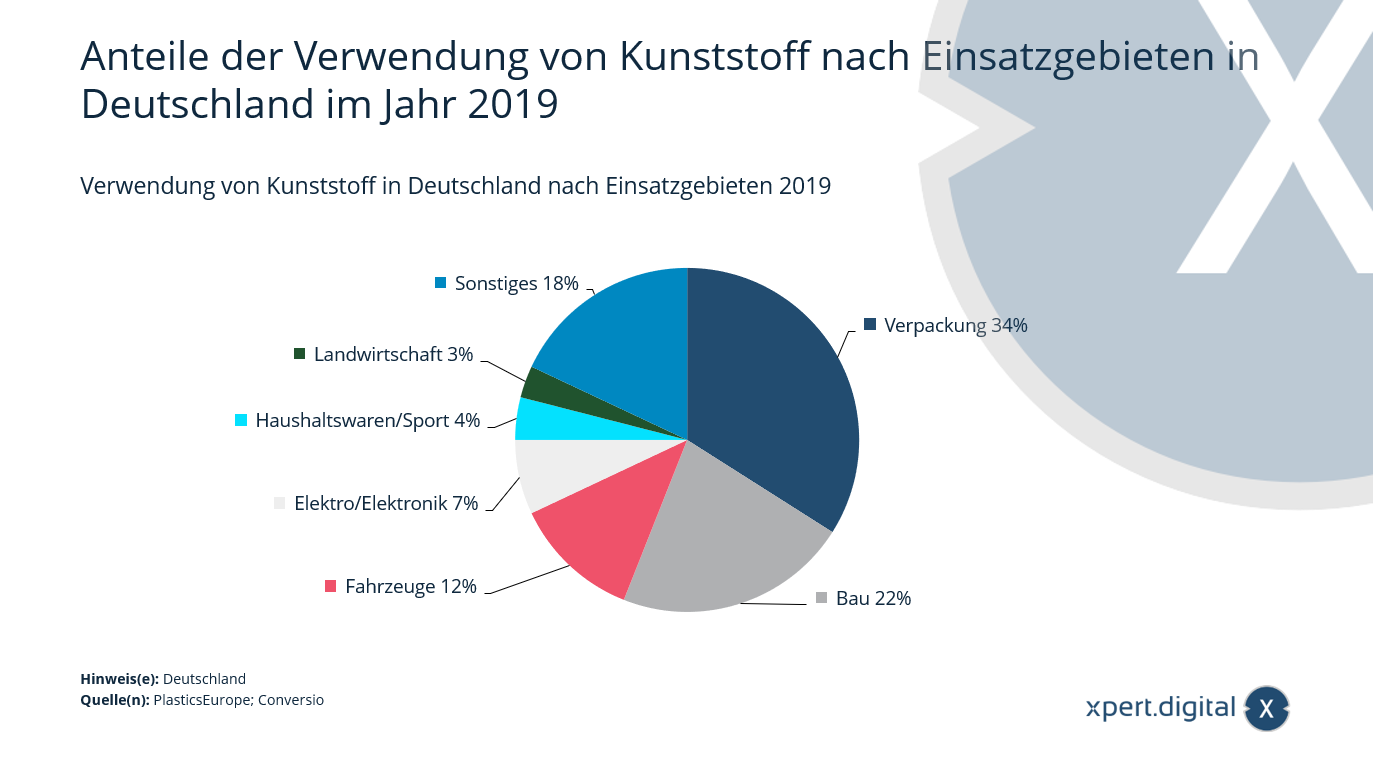
Percentage of plastic use by application area in Germany – Image: Xpert.Digital
Plastics are ubiquitous. The largest share of plastic used in Germany is in packaging – roughly one-third of the total volume in 2019. The construction and automotive industries also collectively account for about one-third of the total plastic volume. However, particularly in construction, recycled plastics are increasingly being used, not exclusively newly produced plastics.
Recovery and recycling of plastics
In Germany, plastics are almost completely recycled. The absolute volume of disposed plastic waste is relatively small. Recycling includes not only the mechanical and feedstock recovery of plastics, but also energy recovery in waste incineration plants and the use of plastics as alternative fuel.
Circular economy
The system that exclusively implements recycling is the so-called circular economy. With regard to plastics, almost half of the volume of plastic used in Germany is recycled – the recycling rate amounted to 46.6 percent in 2019.
Share of plastic use by application area in Germany in 2019
- Packaging – 34%
- Construction – 22%
- Vehicles – 12%
- Electrical/Electronics – 7%
- Household goods/Sports - 4%
- Agriculture – 3%
- Other – 18%
Production volume of the German plastics industry until 2020

Production volume of the German plastics industry until 2020 – Image: Xpert.Digital
This statistic shows the production volume of the plastics industry in Germany from 2006 to 2020. The production figures also include polymers for adhesives, resins, paints, coatings, fibers, and similar products. In 2020, nationwide plastics production in Germany amounted to approximately 18 million tons.
Some older figures were taken from corresponding publications of the previous year. According to the source, the reported quantities for 2014 and 2015 are not comparable with those of previous years. This is due to modifications in the internal recording of production quantities and technical changes in reporting practices, such as the use of revised software.
Production volume of the plastics industry in Germany from 2006 to 2020 (in million tons)
- 2006 – 20.20 million tons
- 2007 – 20.50 million tons
- 2008 – 20 million tons
- 2009 – 17.40 million tons
- 2010 – 20.40 million tons
- 2011 – 20.20 million tons
- 2012 – 19.50 million tons
- 2013 – 19.90 million tons
- 2014 – 18.20 million tons
- 2015 – 18.40 million tons
- 2016 – 19.20 million tons
- 2017 – 19.90 million tons
- 2018 – 18.90 million tons
- 2019 – 18.20 million tons
- 2020 – 17.90 million tons
Plastics production worldwide and in Europe until 2019

Plastics production worldwide and in Europe until 2019 – Image: Xpert.Digital
The amount of plastic produced worldwide has increased dramatically in the last 70 years – reaching approximately 370 million tons in 2019. This increase has been driven primarily by Asian countries, especially China, over the past 20 years. In Europe, the growth has been less rapid. The amount of plastic produced annually in the European plastics industry has stagnated over the last ten years.
What is plastic?
Plastics include thermoplastics, polyurethanes, thermosets, elastomers, adhesives, coatings, and sealants. The most commonly used type of plastic in Europe is PP (polypropylene). The most important application of plastics in Europe is packaging. They are also widely used in construction and vehicle manufacturing.
German plastics industry in European comparison
The plastics industry in Germany is the largest in Europe. While the production volume of the German plastics industry has declined in recent years, it still accounts for approximately one-third of all plastics produced in Europe. Therefore, the recycling of plastics and the development of a functioning circular economy are of paramount importance due to the environmental impact of plastic waste.
Global plastics production from 1950 to 2019 (in million tons)
- 1950 – 1.5 million tons
- 1976 – 50 million tons
- 1989 – 100 million tons
- 2002 – 200 million tons
- 2005 – 230 million tons
- 2007 – 257 million tons
- 2008 – 245 million tons
- 2009 – 250 million tons
- 2010 – 270 million tons
- 2011 – 280 million tons
- 2012 – 288 million tons
- 2013 – 299 million tons
- 2014 – 311 million tons
- 2015 – 322 million tons
- 2016 – 335 million tons
- 2017 – 348 million tons
- 2018 – 359 million tons
- 2019 – 368 million tons
European plastics production from 1950 to 2019 (in million tons)
- 1950 – 0.35 million tons
- 1976 – 19.8 million tons
- 1989 – 27.4 million tons
- 2002 – 56.1 million tons
- 2005 – 61 million tons
- 2007 – 65 million tons
- 2008 – 60 million tons
- 2009 – 55 million tons
- 2010 – 57 million tons
- 2011 – 59 million tons
- 2012 – 59 million tons
- 2013 – 57 million tons
- 2014 – 59 million tons
- 2015 – 58 million tons
- 2016 – 60 million tons
- 2017 – 64.4 million tons
- 2018 – 61.8 million tons
- 2019 – 57.9 million tons
Plastics Industry - PDF Download
Important note: The PDF is password protected. Please contact me. The PDF is, of course, free of charge
.
German version – To view the PDF, please click on the image below
.

Plastics Industry – PDF Download
Plastic waste
Important note: The PDF is password protected. Please contact me. The PDF is, of course, free of charge
.
German version – To view the PDF, please click on the image below
.
Plastic waste – PDF Download
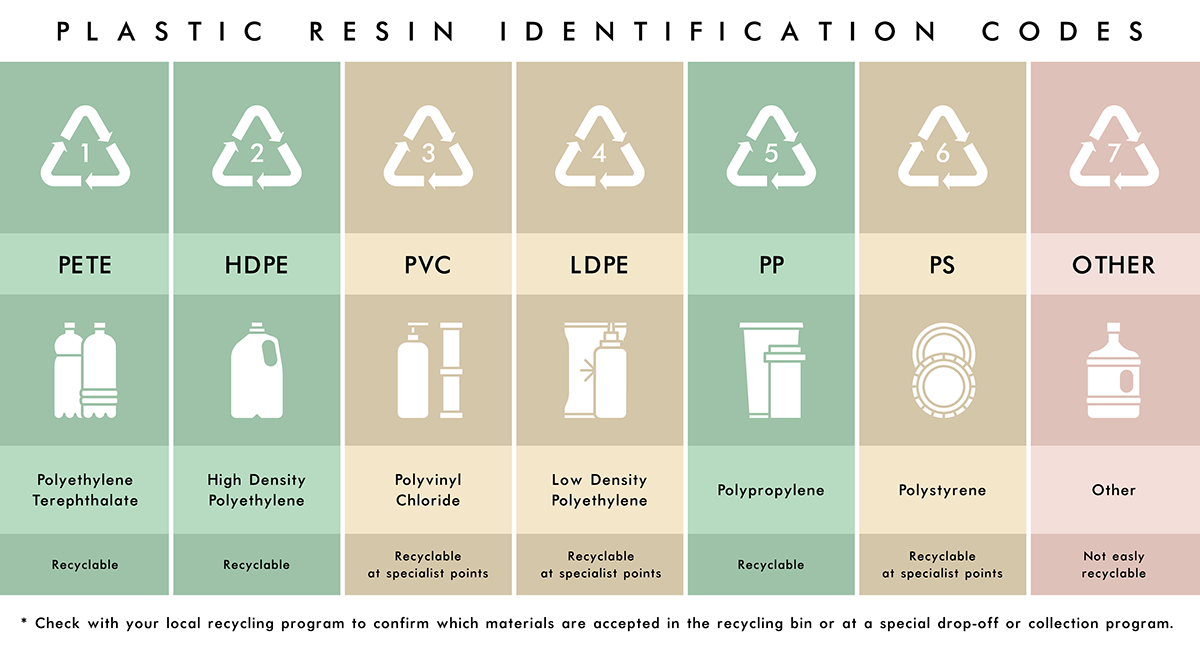
Plastic codes – Image: shopplaywood|Shutterstock.com
Shares of plastic types in Europe
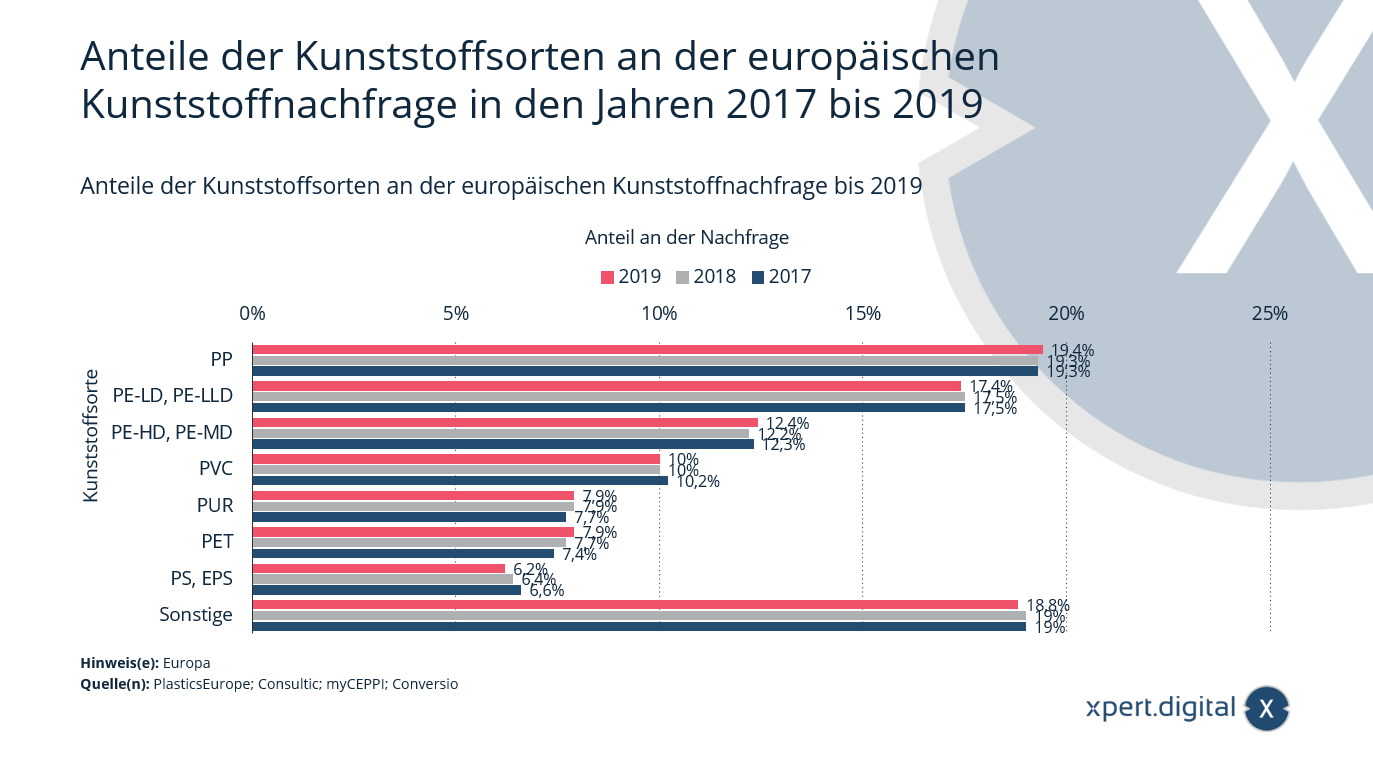
Share of different plastic types in European plastic demand – Image: Xpert.Digital
This statistic shows the share of different types of plastics in European plastics demand from 2017 to 2019. The total volume of plastics demanded in Europe (EU-28, Norway, Switzerland) amounted to approximately 51 million tons in 2019. In that year, PVC accounted for around ten percent of European plastics demand. Approximately ten percent of European plastics consumption was attributable to the automotive and vehicle industries.
Europe-wide plastics production amounted to approximately 58 million tons in the same year.
Share of different types of plastics in European plastics demand in 2017
- PP – 19.3%
- PE-LD, PE-LLD – 17.5%
- PE-HD, PE-MD – 12.3%
- PVC – 10.2%
- PUR – 7.7%
- PET – 7.4%
- PS, EPS – 6.6%
-
Other – 19%
Share of different types of plastics in European plastics demand in 2018
- PP – 19.3%
- PE-LD, PE-LLD – 17.5%
- PE-HD, PE-MD – 12.2%
- PVC – 10%
- PUR – 7.9%
- PET – 7.7%
- PS, EPS – 6.4%
- Other – 19%
Share of different plastic types in European plastic demand in 2019
- PP – 19.4%
- PE-LD, PE-LLD – 17.4%
- PE-HD, PE-MD – 12.4%
- PVC – 10%
- PUR – 7.9%
- PET – 7.9%
- PS, EPS – 6.2%
- Other – 18.8%
Applications - PP = Polypropylene
- It is used in mechanical and vehicle engineering for interior fittings for cars, dashboards and battery housings, as well as for crash absorber elements in vehicle construction, in child seats and in bicycle helmets.
- In electrical engineering, it is used for transformer housings, wire and cable sheathing, and insulating films. BOPP has achieved particularly prominent importance as a dielectric material in plastic film capacitors and power capacitors.
- In construction, it is used for valves, fittings and pipelines; in ventilation and air conditioning technology in corrosive environments and when conveying corrosive gases, mostly in the form of PP-S (S = flame-retardant).
- Polypropylene fibers can be added to steel and prestressed concrete to improve its fire-resistant properties. When heated, the fibers melt and burn, leaving behind pores that allow water vapor to expand and escape.
- In the textile industry, worsted polypropylene yarn is used in Polycolon. PP fibers are further processed into, among other things, home textiles, carpets, sportswear, packaging materials, hygiene products, medical products, buoyant ropes, and geotextiles.
- Polypropylene is used in a variety of ways in the food industry, packaging technology, and in the household: cups (for dairy products), bottle caps, dishwasher interiors, heat-resistant films, reusable containers, thermal transport boxes or insulated containers (EPP), packaging components, drinking straws, adhesive films, etc
- Especially when such products are heated – for example, baby bottles with warmed liquid – large amounts of microplastics are introduced into the body.
- In humid regions, PP is used as a material for plastic banknotes such as the Australian dollar and the New Zealand dollar.
- In model aircraft construction, EPP is used to produce durable, beginner-friendly model airplanes that can withstand a crash much better than classic balsa wood model airplanes.
- In general medical surgery, especially in older patients, more complicated hernias and recurrences, polypropylene meshes are used to close hernias, e.g. in inguinal hernias, in order to strengthen the abdominal wall and prevent a recurrence of the inguinal hernia.
- Air-filled dunnage bags (GrizzlyBag®) are used for securing cargo in freight containers; their outer shells are made of PP.
- In advertising, hollow chamber sheets made of PP (dimpled sheets and multiwall sheets) are used in printed and laminated form for posters and displays.
Applications - PE = Polyethylene and PE types
The following types are distinguished:
- PE-HD (HDPE) /PE-MD (MDPE)
- PE-LD (LDPE)
- PE-LLD (LLDPE)
- PE-HMW
- PE-UHMW
- PE-X
Polyethylene is the most widely used plastic in the world, accounting for approximately 38 percent of global consumption. In 2011, 190 million tons of plastics (polypropylene, polystyrene, ABS, PVC, PET, polycarbonate, polyethylene) were consumed. LDPE accounted for 10 percent of this, LLDPE for 11 percent, and HDPE for 17 percent.
PE-HD (HDPE)
The most important application is in hollow bodies manufactured using blow molding, such as bottles for household cleaning products, but also large-volume containers with a capacity of up to 1000 liters (so-called IBCs). Over 8 million tons, almost a third of the world's total production, were used for this application in 2007. China, in particular, where HDPE beverage bottles were only introduced in 2005, is a growing market for rigid HDPE packaging due to its rising standard of living. HDPE sheets and films produced by extrusion are also thermoformed and used in the packaging industry. Furthermore, HDPE is processed into injection-molded parts, such as packaging and household goods, as well as technical articles. Polyethylene fibers, films, and pipes are produced using extrusion and vacuum forming processes. HDPE is also used to manufacture films for hydraulic engineering and landfill construction, as well as geogrids and geotextiles for landfill construction or road and embankment construction. Another area of application, which is growing particularly strongly in emerging economies, is cable lines and pipes, for example for gas and drinking water supply. Polyethylene pipes made of materials PE 80 or PE 100 are often used here, replacing concrete or PVC pipes. PE-HD is easily weldable, but when laid underground, the pipe must be embedded in sand. Alternatively, PE pipes are now available that are equipped with special protective sheaths, thus enabling trenchless (i.e., without a sand bed) pipe laying.
PE-MD (MDPE)
PE-MD (MDPE) is less scratch-sensitive than PE-HD.
PE-LD (LDPE) and PE-LLD (LLDPE)
This material is primarily used in film production. Typical products made from LDPE include cling film, carrier bags, agricultural films, milk carton coatings, garbage bags, and shrink films. An important application is its use as a sealing medium in composite films. To a lesser extent, LDPE and LLDPE are also used in the production of cable sheathing, as dielectrics in coaxial cables, and for pipes and hollow bodies. LLDPE is mainly used in stretch film, films for industrial packaging, thin-walled containers, and high-performance pouch films. In 2009, global sales of LDPE amounted to approximately €15.9 billion (US$22.2 billion). The global market for LLDPE reached just under €17 billion (US$24 billion).
PE-UHMW
Ultra-high-molecular-weight polyethylene (UHMWPE) is used for pump components, gears, sliding bushings, implants, and endoprosthesis surfaces due to its high wear resistance, where exceptionally smooth operation with minimal abrasion is crucial. In the chemical industry, it is used for seals and membranes. UHMWPE fibers are among the strongest known synthetic fibers (by weight) and are processed into webbing slings and ropes.
PE-X
PE-X is used as an insulating material, specifically as an electrical insulator for medium- and high-voltage cables, as piping for gas and water installations, and for fittings in electrical engineering, equipment manufacturing, and automotive engineering. Unlike other PE materials, it is also suitable for hot water pipes and, due to its high scratch resistance (maximum scratch depth 20% of the wall thickness), is particularly well-suited for trenchless installation methods such as horizontal directional drilling
Applications - PVC = Polyvinyl chloride
PVC plastics are divided into rigid and flexible PVC. Rigid PVC is used, for example, to manufacture window profiles, pipes, and records. Flexible PVC contains plasticizers that give the material its elastic properties. It is used, for example, for cable sheathing and floor coverings.
Applications - PUR = Polyurethane
Polyurethane is used to manufacture wound dressings, mattresses, shoe soles, seals, hoses, floors, insulation materials, paints, adhesives, sealants, skis, car seats, running tracks in stadiums, dashboards, potting compounds, latex-free condoms, cast floors and much more.
Polyurethane is also very easy to produce foams. The special feature of PUR foams is that processing companies can use semi-finished products (foam in pre-cut shapes) or produce foams on-site from liquid components (formed in-place foam). The components can also be applied to or inside industrial parts; the foam then forms there.
Soft polyurethane (PUR) foams are used for a wide variety of purposes, primarily as upholstery material (e.g., for furniture or car seats), mattress foam, carpet backing, textile lamination, cleaning sponges, or filter material. PUR soft foams are mostly open-cell and available in a wide range of hardness and density.
PUR rigid foams are primarily used for thermal insulation, e.g., in buildings, cooling devices, heat and cold storage systems, and some pipe systems (plastic-jacketed composite pipes, flexible composite pipes).
Further, relatively new applications for polyurethane foams exist in vehicle manufacturing (steering wheel, armrest, soft coating of handles, interior trim, dashboard, sound insulation, rattle protection, seals, transparent coating of wood decors). The damping effect of polyurethane also frequently provides wear protection, which is particularly useful for manufacturing safety-relevant components with a long service life.
One of the most important applications of polyurethanes is in paints and coatings. Here, polyurethanes are used as primers due to their excellent adhesion properties and as topcoats and clear coats in many applications due to their high resistance to solvents, chemicals, and weathering. These include, for example, coil coatings and floor coatings. Other applications include textile coatings and finishes, as well as leather treatments. Large-area bonding of various, preferably flexible, materials (in footwear, wood/furniture, and automotive interiors) is also an important area of application for polyurethane systems. In medicine, polyurethanes are used as liners in lower extremity prostheses.
Applications - PET = Polyethylene terephthalate
PET has diverse applications and is used, among other things, to manufacture plastic bottles (PET bottles), films, and textile fibers. In 2008, production reached 40 million tons. Despite increased recycling in recent years, production volume rose to 56 million tons by 2016.
Areas of application - PS = Polystyrene
Polystyrene is one of the standard plastics and ranks fourth in production volume after polyethylene, polypropylene, and polyvinyl chloride. In Germany, approximately 12.06 million tons of plastics (excluding adhesives, paints, resins, and fibers) were processed in 2015, of which 655,000 tons (5.4 percent) were polystyrene and expanded polystyrene (PS/PS-E).
Polystyrene allows for the production of relatively precisely fitting components. For example, audio cassettes and CD cases are made from transparent polystyrene.
Polystyrene is permitted as food packaging, for example as yogurt cups or foam trays, if certain conditions are met.
Injection-molded parts made of unfoamed polystyrene are used in plastic model making.
In electrical engineering, polystyrene is used because of its good insulating properties. It is used to manufacture switches, coil formers, and housings (high-impact polystyrene, HIPS) for electrical devices. Polystyrene is also used for mass-produced items (e.g., standard CD packaging, videocassettes), in precision engineering, and for sight glasses.
Polystyrene is the main component of napalm-B, which is used in incendiary bombs.
Applications - EPS = Expanded polystyrene (Styrofoam)
Styrofoam is commonly known as a lightweight, white packaging and insulation material. It is a rather coarse-pored EPS rigid foam (expanded polystyrene). To manufacture it, granules are placed in a mold and expanded with hot steam. The granule particles adhere to each other but usually do not fuse completely. The spherical, foamed granules are often visible in the final product and can sometimes be separated individually. Depending on the manufacturing process, expanded polystyrene rigid foam is more or less permeable to air and water vapor.
EPS rigid foam boards can be cut from a block to almost any thickness.
Foamed polystyrene is widely used as packaging material and for protective helmets, solid life jackets and surfboards.
Styrofoam is originally a brand name of BASF. Since the 1990s, the IVH (German Association of Rigid Foam Manufacturers) has held the rights to the name Styrofoam. Only EPS manufacturers who meet the IVH's specific quality requirements are allowed to call their material Styrofoam.
Other well-known trade names for EPS are Austrotherm, Steinopor, Sagex, Swisspor, Hungarocell (Hungary), Telgopor (Spanish-speaking countries) and Frigolit (Sweden).
In 2014, the European Manufacturers of Expanded Polystyrene (EUMEPS) introduced the common brand name airpop with the aim of minimizing the large number of names for EPS in Europe. In Germany, the IK Industrievereinigung Kunststoffverpackungen e.V. (German Association of Plastics Packaging Manufacturers) is responsible for implementing the European strategy for EPS packaging.
Applications - Synthetic rubber
Synthetic rubber refers to elastic polymers from which rubber is produced and which are manufactured on the basis of petrochemical raw materials.
Besides synthetic rubber, there are natural rubber types, primarily based on the milky sap (latex) of the rubber tree (Hevea brasiliensis).
Currently, synthetic rubber accounts for approximately 60% of total rubber demand. According to the International Institute for Synthetic Rubber Producers (IISRP), sales in 1998 reached 10.4 million tons, 70% of which went to the automotive industry.
Between 65% and 70% of all rubber is used in the production of car tires. Other major applications include binders for paper coating, carpet backing, and dipped products such as thin gloves.
In its foamed form, rubber is used for mattresses and sponges.
By dipping shiny metal or ceramic molds into an emulsion, condoms, gloves, or balloons – goods with a particularly thin film thickness – are produced. Thicker films are needed for the production of casting molds, vehicle tires, engine mounts, and various rubber/metal composites.
Another important application is rubber sealing profiles, for example for doors and windows.
Innovation expenditures in rubber and plastics processing
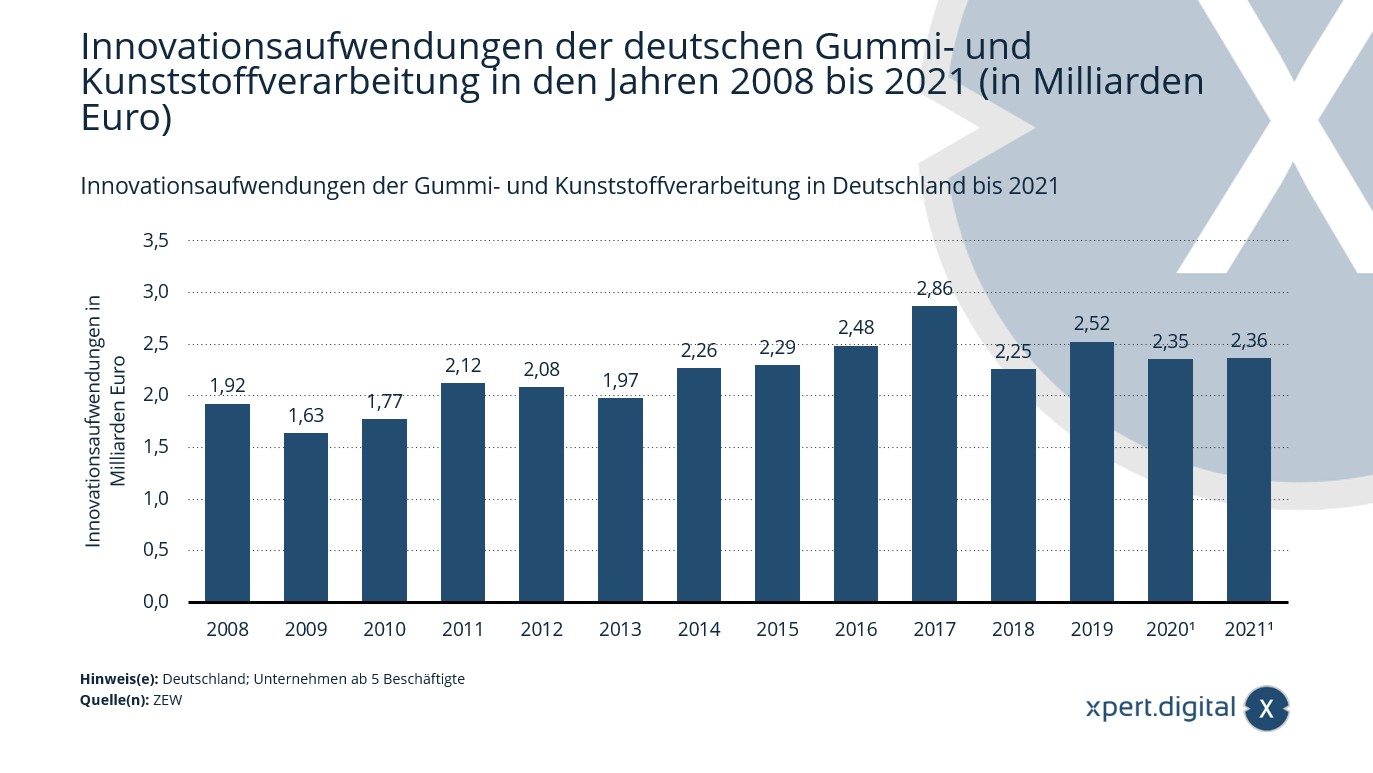
Innovation expenditure in the rubber and plastics processing industry in Germany until 2021 – Image: Xpert.Digital
This statistic shows the innovation expenditures of the rubber and plastics processing industry from 2008 to 2021. These expenditures include research and development, as well as innovation-related spending on tangible and intangible assets, training, marketing, concept development, engineering, design, and production and sales preparation. According to a survey by the ZEW (Centre for European Economic Research), the innovation expenditures of the rubber and plastics processing industry in 2021 amounted to approximately €2.4 billion.
According to the source, the German Innovation Survey has been conducted since 1993 by the Centre for European Economic Research (ZEW, Mannheim) on behalf of the Federal Ministry of Education and Research (BMBF), in cooperation with infas (Institute for Applied Social Sciences) and the Fraunhofer Institute for Systems and Innovation Research (ISI). The survey targets all companies in Germany with at least five employees and a primary economic focus within the listed industry groups. The definitions and
measurement concepts comply with the international standards of the OECD and Eurostat. The Innovation Survey is part of the Eurostat-coordinated Europe-wide Innovation Survey (Community Innovation Survey – CIS) every two years. All figures are extrapolated to the total population of companies with five or more employees in Germany. Approximately 18,500 companies participated in the 2020 Innovation Survey (55% of the sample size), including 458 from the rubber and plastics processing industry.
Rubber and plastics processing: manufacturing and retreading of tires, manufacturing of rubber goods, sheets, films, hoses and profiles made of plastics, packaging materials and building materials made of plastics, as well as other plastic goods.
Innovation expenditures of the German rubber and plastics processing industry from 2008 to 2021 (in billion euros)
- 2008 – 1.92 billion euros
- 2009 – 1.63 billion euros
- 2010 – 1.77 billion euros
- 2011 – 2.12 billion euros
- 2012 – 2.08 billion euros
- 2013 – 1.97 billion euros
- 2014 – 2.26 billion euros
- 2015 – 2.29 billion euros
- 2016 – 2.48 billion euros
- 2017 – 2.86 billion euros
- 2018 – 2.25 billion euros
- 2019 – 2.52 billion euros
- 2020 – 2.35 billion euros
- 2021 – 2.36 billion euros
Rubber - PDF Download
Important note: The PDF is password protected. Please contact me. The PDF is, of course, free of charge
.
German version – To view the PDF, please click on the image below
.
Rubber – PDF Download
Xpert.Digital as a consultant and brand ambassador for your company and your corporate values

Konrad Wolfenstein
I would be happy to serve as your personal advisor.
You can contact me by filling out the contact form below or simply call me on +49 7348 4088 965 .
I'm looking forward to our joint project.
Write to me


Xpert.Digital – Konrad Wolfenstein
Xpert.Digital is a hub for industry focusing on digitalization, mechanical engineering, logistics/intralogistics and photovoltaics.
With our 360° Business Development solution, we support renowned companies from new business to after-sales.
Market intelligence, smarketing, marketing automation, content development, PR, mail campaigns, personalized social media and lead nurturing are part of our digital tools.
You can find more information at: www.xpert.digital – www.xpert.solar – www.xpert.plus
Keep in touch