
The Pentagon and Anduri – Augmented Reality in War: How this new headset is turning US soldiers into “techno-magicians”
Xpert Pre-Release

Available in 27 languages 📢
Prefer Xpert.Digital on GoogleⓘPublished on: March 17, 2026 / Updated on: March 17, 2026 – Author: Konrad Wolfenstein
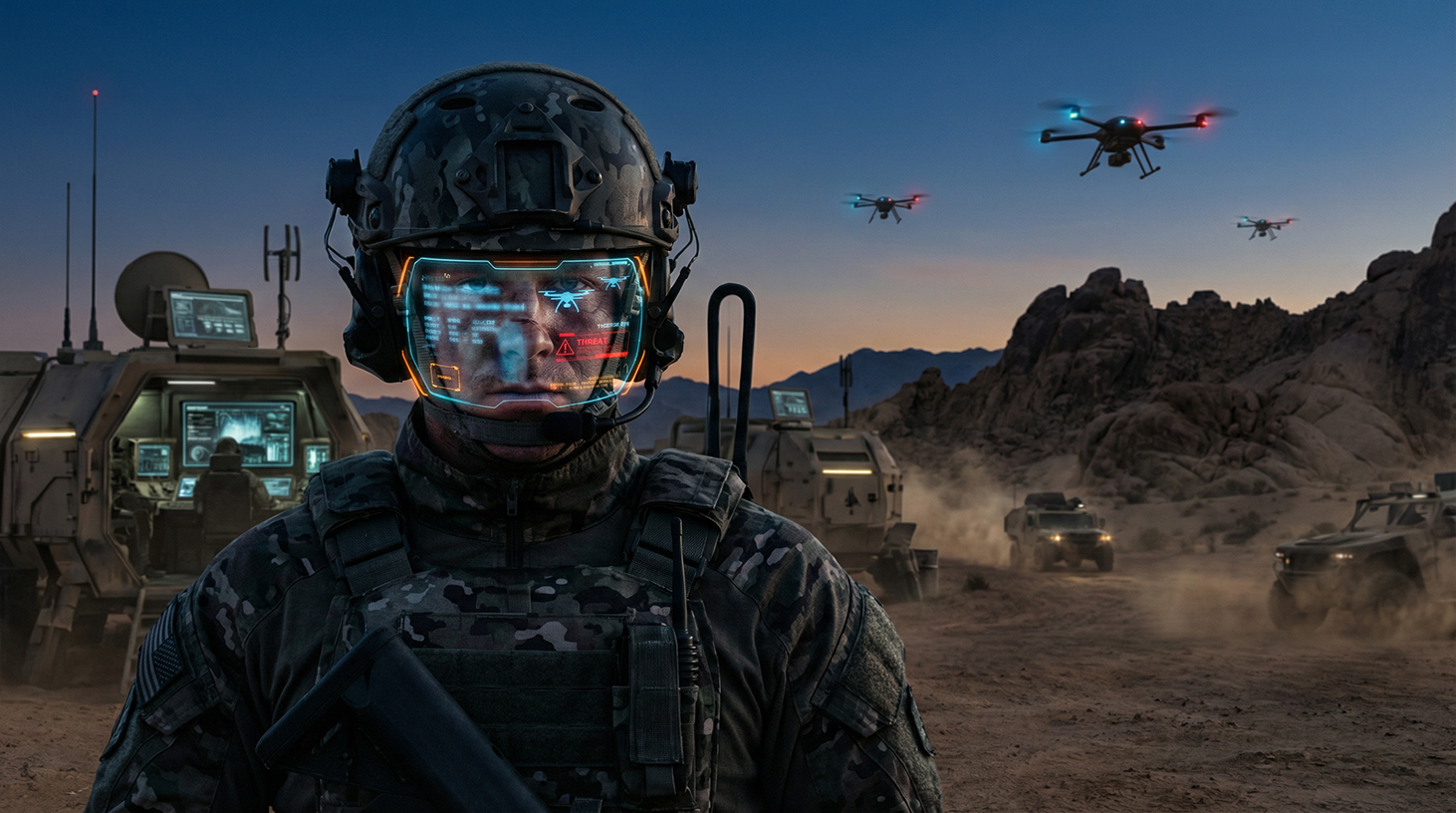
The Pentagon and Anduri – Augmented Reality in War: How this new headset transforms US soldiers into “techno-magicians” – Image: Xpert.Digital
Warfare like in a video game: How augmented reality is changing the battlefield forever
Superhuman perception thanks to augmented reality: The secret 20-billion-dollar project of the US Army
It's a bombshell that shakes the global arms industry to its core: The US Department of Defense has signed an unprecedented $20 billion contract with the Silicon Valley startup Anduril Industries. Instead of relying on established giants like Lockheed Martin or Boeing, the Pentagon is entrusting the digital future of warfare to a company founded by a former—and once-disgraced—Facebook wunderkind. Palmer Luckey's vision is as fascinating as it is terrifying: Artificial intelligence, autonomous drones, and augmented reality glasses are intended to connect the modern battlefield in real time, granting individual soldiers almost superhuman abilities. But this multi-billion-dollar foray into the era of automated warfare doesn't just represent a massive technological revolution. It also raises pressing ethical questions: In the heat of battle, who will decide over life and death—humans or algorithms?
Silicon Valley is ramping up its efforts: How a start-up is reinventing the US Army
The US military has undergone a paradigm shift. Those who want to control the battlefields of the future no longer need factory directors in ties, but programmers in hoodies. In mid-March 2026, the Department of Defense announced that it had signed a framework agreement with the defense startup Anduril Industries worth up to $20 billion. It is one of the largest single contracts ever awarded by a Silicon Valley company to the Pentagon – and it marks the provisional culmination of a rapid industrial transformation that is putting massive pressure on traditional defense contractors like Raytheon, Lockheed Martin, and Boeing.
One consolidates the chaos: What the contract really means
The contract runs for a base period of five years with an option to extend for another five years, potentially reaching its term until 2036. What at first glance appears to be another multi-billion-dollar payment to the defense industry has a structural peculiarity: With this single framework agreement, the US Army is consolidating over 120 previously separate procurement processes. Instead of handling dozens of individual contracts with various suppliers and subcontractors, the Pentagon is combining all hardware, software, and technical services into a single contract. This is not a bureaucratic detail, but a clear strategic break with the old Pentagon logic.
The Army hopes to achieve three things with this: lower costs by eliminating subcontractor margins, significantly faster supply chains, and greater integration of the various systems under a common technological umbrella. Gabe Chiulli, Chief Technology Officer in the Office of the Chief Information Officer of the Department of Defense, succinctly summarized the strategy: The modern battlefield is increasingly dominated by software, and the U.S. must be able to acquire and deploy software capabilities quickly and efficiently.
The man behind it: Palmer Luckey and his second career
Anduril was founded in 2017 – the very year its founder, Palmer Luckey, was fired from Facebook. Luckey had previously founded the virtual reality company Oculus and sold it to the corporation now known as Meta in 2014 for around two billion US dollars. After his dismissal – allegedly due to a $10,000 donation to a pro-Trump group – he founded Anduril, making a radical career change that initially met with little acclaim.
Today, with a market valuation of $30.5 billion, Anduril is the world's most valuable defense technology startup. And this despite the fact that the company isn't even publicly traded. The $20 billion contract with the Army clearly demonstrates that Luckey's bet on the militarization of Silicon Valley technology has paid off. The original vision has always been the same: to give each individual soldier a kind of superhuman perception through technology, so that they know what they need to know in fractions of a second—and interact with autonomous systems as if it were the most natural thing in the world.
The nervous system of the battlefield: Lattice OS explained
The specific product mentioned in the contract is Lattice. This is Anduril's proprietary AI platform that fuses data from heterogeneous sources – radar systems, cameras, drone sensors, ground vehicles, and satellite telemetry – in real time and assembles it into a coherent situational awareness picture. What previously took hours in analysis centers, Lattice accomplishes in seconds on the battlefield.
The system can generate three-dimensional battle maps, automatically classify and prioritize threats, and present the human operator with a structured basis for decision-making. In a public demonstration in late 2024, Anduril showcased an operation in which a truck approached a US military base. The AI-powered Sentry system identified the vehicle as a potential threat and suggested to the operator that a Ghost reconnaissance drone be deployed. The operator clicked once – the rest happened autonomously. By the time the truck disappeared behind a hill and the camera lost contact, the Ghost drone had already regained sight of it. A single person with a mouse and a screen controlled the entire process.
Lattice Mesh: From soldier to autonomous submarine
Lattice has become more than just a software platform – it's the nervous system of an entire ecosystem of autonomous weapons. With the Lattice Mesh extension, Anduril has begun integrating not only air systems, but also autonomous submarines, ground vehicles, and even self-driving supply vehicles into the network. The goal is an architecture in which all military platforms – whether in the air, on land, underwater, or in space – communicate via a common data layer.
One example of the scope of this vision is the Ghost Shark, an autonomous underwater drone developed by Anduril for the Australian Navy. With a diving depth of 6,000 meters, a range of over 500 kilometers, and a unit price of US$140 million, it is the company's most expensive and ambitious single product to date. Like all Anduril products, it is deeply integrated into the Lattice network and can exchange data with other systems in real time.
Hub for Security and Defense - Advice and Information

Hub for Security and Defense - Image: Xpert.Digital
The Security and Defence Hub offers expert advice and up-to-date information to effectively support companies and organizations in strengthening their role in European security and defence policy. Working closely with the SME Connect Defence Working Group, it particularly promotes small and medium-sized enterprises (SMEs) that wish to further develop their innovative capacity and competitiveness in the defence sector. As a central point of contact, the Hub thus creates a crucial bridge between SMEs and European defence strategy.
Related to this:
From HoloLens flop to 20 billion deal: How a startup inherits Microsoft's military debacle
The failure of Microsoft's military HoloLens and Anduril's legacy
To understand why the Pentagon entrusted Anduril with such a comprehensive contract, it's worth looking at the backstory. In 2021, Microsoft won a $22 billion contract with the US Army for the Integrated Visual Augmentation System (IVAS)—a militarized version of the HoloLens designed to provide soldiers with an augmented reality field of view, including a situational awareness map, target identification, and night vision. The project turned into one of the most embarrassing procurement disasters in the Pentagon's recent history. Soldiers complained of headaches, dizziness, and nausea. An internal Army report revealed that the glasses glowed in the dark, thus revealing the wearers' positions to enemy forces. One soldier commented that the devices had killed him.
In February 2025, Microsoft took action and transferred the entire development and production of the IVAS program to Anduril. This was no small gesture: Microsoft relinquished not just a product, but complete program responsibility for one of its most important government contracts. Since then, the company has focused on the cloud infrastructure for the program via Azure, leaving the rest to Anduril.
EagleEye: The headset designed to turn soldiers into techno-magicians
Palmer Luckey is back in the headset business – this time with serious motivation. In October 2025, Anduril unveiled the EagleEye system at the AUSA trade show in Washington, D.C., a product line of mixed-reality head-mounted displays for soldiers. EagleEye is available as a helmet, visor, and goggles. The system overlays real-time situational information onto the wearer: the positions of team members, enemy drones outside the field of view, terrain maps, threat warnings – all directly in the user's field of vision.
Technically, EagleEye relies on an optical platform made of silicon carbide, a material known for its exceptional strength and optical clarity, even under challenging lighting conditions. The system is fully integrated into Lattice and receives its data stream from all networked sensors, drones, and weapon systems on the battlefield. During the presentation, Luckey displayed a level of confidence bordering on arrogance: he had it under control, he had done it before, he had more or less perfected it – an obvious reference to Oculus and an undisguised critique of the failed Microsoft project.
The alliance with Meta: When old enemies become new friends
Perhaps the most spectacular twist in Anduril's history is its partnership with Meta. In May 2025, Anduril and Meta announced that they would jointly develop AR and VR devices for the US military. The irony of this collaboration is hard to surpass: Palmer Luckey, fired from Mark Zuckerberg's company and locked in an open feud with the Meta founder for years, is now working with his former employer on military technology.
Specifically, Meta contributes its years of expertise in AR development, its display technology, and its Llama AI models. The partnership results, among other things, in EagleEye, which is being developed by Anduril, Meta Platforms, Qualcomm Technologies, OSI, and the helmet manufacturer Gentex. For Meta, the alliance is a strategic step toward tapping into the defense market as a new growth channel – the company had already announced in November 2024 that it would release its open AI models to defense and security agencies.
The new defense trinity: Anduril, OpenAI and Palantir
With the newly concluded contract, Anduril joins OpenAI and Palantir as the third major technology company from the Silicon Valley ecosystem to be integrated into the Pentagon's innermost procurement structure. These three companies represent different layers of the same strategy: Palantir provides the overarching data integration and analysis layer with its Maven program, OpenAI contributes generative AI capabilities, and Anduril completes the ecosystem with physical hardware and its own software platform, operating directly at the command post and within the individual soldier's field of vision.
The Pentagon contract for Anduril differs from the others due to its hybrid nature. Anduril not only sells software licenses and cloud services, but also develops and produces physical weapons: aerial and sea drones, defense systems against enemy drones, radar systems, and now also AR headsets. This makes the company the most complete provider of the new generation of defense technology.
The ethical dimension: If AI kills, who decides?
Anduril's rise is not without controversy. The use of AI systems for autonomous threat detection and – potentially – attacks raises questions about decision-making responsibility and international law that remain unresolved. Anduril emphasizes that a human always makes the final decision: In every demonstrated sequence, the operator gave the final command with a mouse click. However, the more the system automates, step by step, the more a conscious judgment becomes a reflex action under time pressure.
The question that concerns arms ethicists, human rights lawyers, and military strategists alike is this: If an AI system classifies a threat in 200 milliseconds, dispatches a drone, and gives the operator three seconds to say no—is a human being still making the decision? Or has consent already degenerated into mere formal compliance? These questions become more urgent with every multi-billion-dollar contract, without the political debate keeping pace with the technological speed.
The message to the world
The $20 billion contract is more than just a business deal. It's a statement of industrial policy: In the global arms race, the US is deliberately relying on the rapid pace of innovation from Silicon Valley rather than the inertia of established corporations. The traditional defense industry is feeling the pressure. Companies like Lockheed Martin and Raytheon are gradually losing contracts to firms that aren't even ten years old.
This is a warning sign for Europe. The continent is only now, and with considerable delay, expanding its defense capabilities. While the US Army is fundamentally changing its procurement logic through AI integration, the EU is still debating regulatory frameworks for autonomous weapons. The race for the digital battlefield is on. And Anduril – with $20 billion in Pentagon funding – is in the lead.
Your global marketing and business development partner
☑️ Our business language is English or German
☑️ NEW: Correspondence in your native language!

Konrad Wolfenstein
I and my team are happy to be available to you as your personal advisor.
You can contact me by filling out the contact form here or simply call me at +49 7348 4088 965. My email address is: [email protected]
I'm looking forward to our joint project.









