
Android XR Smart Glasses – Google's second attempt at the nose of the world
Xpert Pre-Release

Available in 27 languages 📢
Prefer Xpert.Digital on GoogleⓘPublished on: March 3, 2026 / Updated on: March 3, 2026 – Author: Konrad Wolfenstein
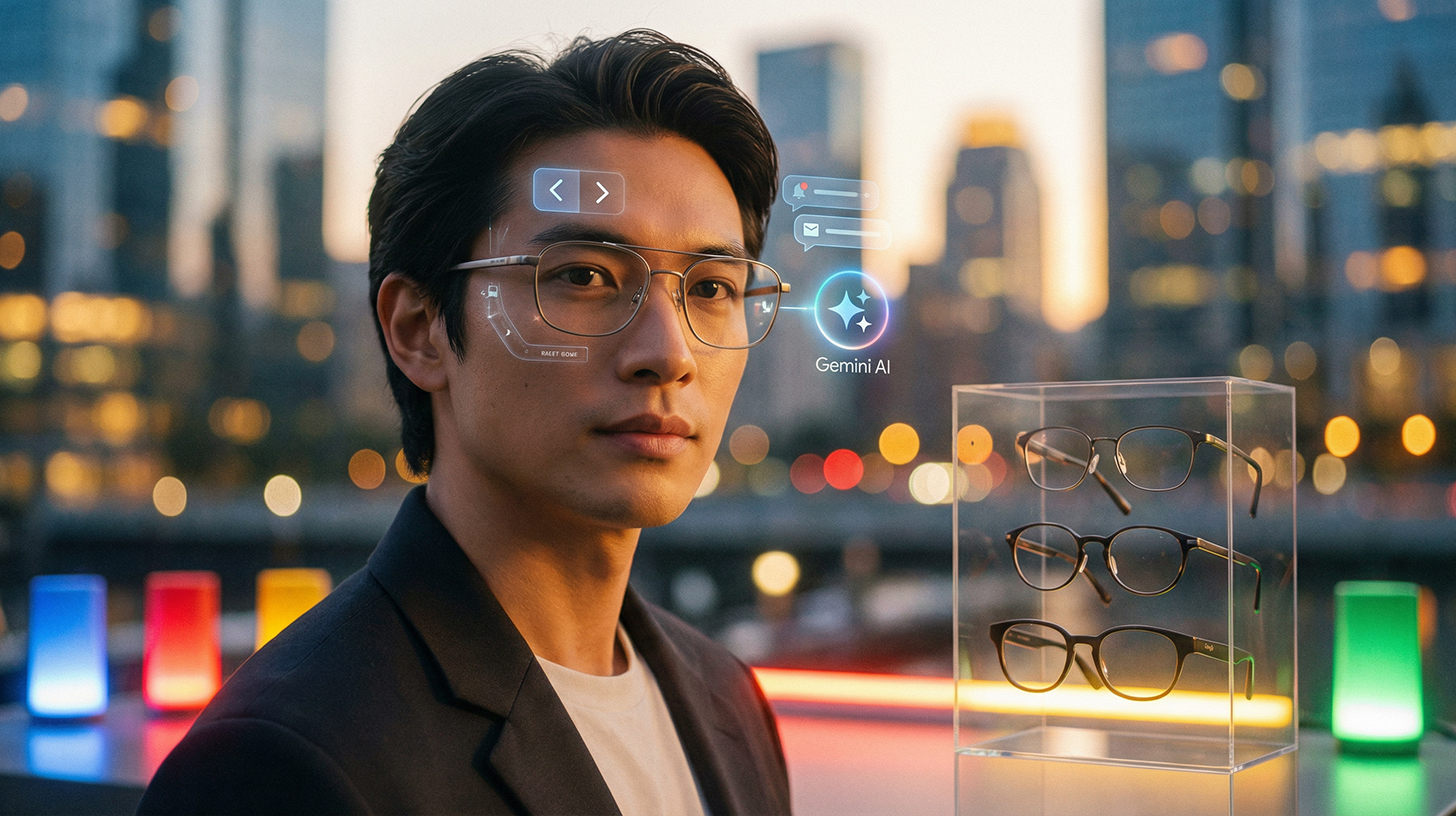
Android XR Smart Glasses – Google's second attempt at the world's nose – Image: Xpert.Digital
From "Glasshole" to ingenious AI glasses: Google's mega comeback with Android XR
A hidden assistant in everyday life: Google is focusing on an ingenious detail and planning three new smart glasses for 2026
More than a decade after the spectacular failure of Google Glass, the tech giant is facing what is probably its most ambitious hardware comeback. By spring 2026 at the latest, the company aims to conquer the rapidly growing smart glasses market – and is launching a direct attack on the current market leader, Meta.
Instead of forcing an exorbitantly expensive, proprietary gadget onto the market, as they did in their first attempt, Google is returning to its greatest recipe for success: an open ecosystem. With the new Android XR operating system, the company is merely providing the smart platform, while renowned partners like Samsung, XREAL, and Warby Parker manufacture the hardware. At the heart of this new strategy is the seamless integration of Google's own Gemini AI, which uses voice, cameras, and contextual information to act as an invisible everyday companion.
To finally shed the social stigma surrounding so-called "glassesholes," Google has learned from past mistakes. Strict hardware specifications for manufacturers, clearly visible external status LEDs for privacy reasons, and an unobtrusive design are intended to regain the trust of users and those around them. With a total of three planned device categories—from basic audio glasses to a high-performance augmented reality version—Google is laying the foundation for a future in which smart glasses could replace the smartphone as our most important personal device.
Related to this:

After the Glasshole disaster of 2013, the tech giant is attempting a fresh start with Android XR, which might succeed this time
In spring 2026, Google is poised for the most ambitious comeback in the history of wearable technology. After the spectacular failure of Google Glass more than a decade ago, the tech giant aims to conquer the smart glasses market with its new Android XR operating system and the integration of its Gemini AI. The first devices will be unveiled no later than May 2026, but possibly even earlier. Unlike its first attempt, Google is not relying on a single proprietary product, but rather on the successful Android formula: Google provides the platform, and its partners supply the hardware.
The strategy is no coincidence. Google co-founder Sergey Brin spoke surprisingly candidly about the mistakes of the first attempt at the Google I/O 2025 developer conference. He admitted that he definitely made many mistakes with Google Glass and wanted to be honest. He said he was overwhelmed both technically and financially at the time. In particular, he underestimated the supply chains in consumer electronics and the difficulty of offering such a product at a reasonable price while simultaneously managing manufacturing.
From Glasshole to comeback
The story of Google Glass is a lesson in technological hubris and social acceptance. When the device was announced as Project Glass in 2012, it caused a huge stir. The idea was enticing: glasses that projected messages, navigation, and notifications directly into the user's field of vision. Starting in 2013, early testers could purchase the device for $1,500. But sobering reality quickly caught up with the project. The first version was expensive, the battery life too short, the operation cumbersome, and the conspicuous camera module became a point of contention.
The derogatory term "Glassholes" was synonymous with users who constantly filmed their surroundings without the knowledge or consent of those being filmed. Privacy concerns and social ostracism sealed the fate of the consumer version, which was discontinued in 2015. A relaunch as an Enterprise Edition for industrial use followed in 2017, but this business model also remained a niche product. In March 2023, Google finally pulled the plug. Internally, the problem was even more fundamental: The development team itself had barely used Google Glass because the product offered no real added value. The glasses were only worn when Sergey Brin was around.
Three pairs of glasses for three target groups
Android XR employs a differentiated product strategy with three clearly defined device categories. The AI Glasses are the slimmest and presumably the most affordable option. They do without a display entirely and focus on AI-assisted audio interaction. Microphones and cameras enable voice control and visual object recognition, while audio output is exclusively through speakers in the temples. This category is aimed at users who want an invisible AI assistant in their daily lives without relying on a display.
Display AI Glasses extend this concept with a monocular micro-display over one eye. This enables visual information such as navigation instructions, notifications, live translations, and other context-sensitive overlays. This variant strikes a balance between everyday usability and enhanced functionality.
The third category is Wired XR Glasses, which rely on a cable connection and therefore offer significantly more processing power and battery life. Since smart glasses need to be physically very slim, the performance of wireless models is currently still limited. The wired version is intended to bridge this gap until miniaturization has progressed further. Google is developing this model together with its partner XREAL under the project name Aura.
Related to this:

Hardware standards and ecosystem strategy
Google has defined strict hardware requirements for Android XR that all manufacturers must meet. Each headset must be easily detachable and have the basic shape of a pair of glasses, not that of a VR headset with a neck rest. The right temple must contain a touchpad, a power button, a camera button for photos and videos, and, on devices with a display, a button to switch between overlay and a clear view.
Particularly noteworthy is the requirement for at least two status LEDs: one for the wearer on the inside and one clearly visible on the outside. These are intended to indicate whether the glasses are recording audio or video, whether they are in standby mode, or whether the wearer is currently interacting with them. Google has learned from the Glasshole debacle and is incorporating transparency mechanisms designed to gain the trust of those around the user.
The touchpad will be the primary control element alongside voice control. Google has developed a simple, standardized gesture concept: tap for play, pause, and confirm; tap and hold to launch Gemini; swipe for navigation; swipe with two fingers for volume; and swipe down to return to the home screen.
🗒️ Xpert.Digital: A pioneer in the field of Extended and Augmented Reality

Finding the right Metaverse agency, planning office, or consulting firm - Image: Xpert.Digital
🗒️ Finding the right Metaverse agency, planning office, or consulting firm – Search and search: Top Ten Tips for Consulting & Planning
More information here:
Google's big counterattack: These AI glasses are intended to break Meta's dominance
The software experience
Google's user interface emphasizes transparency, strong contrast, and very subtle elements. Information is primarily displayed at the bottom of the glasses' screen and features consistently transparent backgrounds. When interacting with the glasses, the image of the surroundings blurs, allowing the focus to be directed to the displayed elements while the environment remains vaguely recognizable.
To avoid startling the user, Google has integrated animations and waiting times of up to two seconds, making the transition smooth and giving the user time to shift their attention from the current situation to the digital content. This design decision demonstrates that Google fundamentally rethinks the user experience compared to a smartphone. The smart glasses are intended to be a companion, not a nuisance.
The integration of Gemini is the key differentiator from the competition. A long press on the touchpad activates Google's AI assistant, which can process multimodal input: speech, camera images, and contextual information. Features such as real-time translation, object recognition, encyclopedic queries, and context-aware assistance are designed to simplify users' everyday lives.
Related to this:

The booming market
Google's timing couldn't be better. The global smart glasses market saw 110 percent growth in the first half of 2025 compared to the previous year. Meta dominates with a 73 percent market share thanks to its highly successful Ray-Ban Meta smart glasses, whose shipments increased by more than 200 percent year-over-year. Particularly noteworthy is the rise of AI-powered smart glasses: they accounted for 78 percent of all shipments, a 46 percent increase in the first half of 2024. The AI segment even grew by over 250 percent.
Market researchers at Smart Analytics Global predict that global sales of AI smart glasses could increase from six million units in 2025 to around 20 million in 2026. The estimated market value is expected to rise from $1.2 billion to $5.6 billion over the same period. The US and China will remain the two largest individual markets and together could continue to account for around 80 percent of global demand.
The competitive landscape
Google is entering a market dominated by Meta, but increasingly fragmented. Meta struck a chord with the Ray-Ban Smart Glasses in collaboration with Luxottica, focusing on style, everyday usability, and ease of use. The success of the Ray-Ban Meta drove EssilorLuxottica's sales to a new high.
Aggressive competitors from China are pushing into the market. Despite a sales period of only about a week in the first half of 2025, Xiaomi's AI Glasses already achieved the status of the fourth best-selling smart glasses model. TCL-RayNeo, Thunderobot, and Kopin are also establishing themselves as significant players. Apple is also rumored to be entering the smart glasses market soon.
The decisive advantage of Google's approach over Meta's closed ecosystem is the platform's openness. Apps from the Galaxy XR universe will run on all Android XR devices in the future. This principle has made Android the dominant platform in the smartphone market: an open ecosystem that offers access to a wide range of hardware partners, thereby generating economies of scale that a closed system cannot achieve.
Partner network as a guarantee of success
Google's partner strategy for Android XR is broad and targets various market segments. Samsung has already launched its first Android XR device, the Galaxy XR Headset, and is reportedly planning Galaxy Glasses. XREAL has been secured as a long-term partner for the see-through devices, with Google and XREAL directly announcing a multi-year extension of their partnership. Their joint Project Aura serves as the reference design for the wired version.
Warby Parker, the American direct-to-consumer eyewear manufacturer, contributes expertise in everyday, stylish eyewear design. Gentle Monster, the South Korean luxury eyewear brand, appeals to a fashion-conscious audience, and Google has even invested several million dollars directly in the company. This diverse partnership ensures that Android XR smart glasses will be available in various price ranges and design styles.
The collaboration with Qualcomm for chip technology and with Sony for sensor components completes the technical ecosystem. Google subsidiary Magic Leap could also play a role in the future.
Challenges and open questions
Despite the optimistic outlook, fundamental challenges remain. Battery life is a limiting factor for all smart glasses. A device that needs recharging after just a few hours isn't suitable for everyday use. The computing power must be sufficient to run AI models in real time without the glasses becoming uncomfortably warm. And the display technology must be advanced enough to ensure that information remains legible even in bright sunlight.
Data privacy remains the most sensitive issue. In Europe, and especially in Germany, concerns about constantly running cameras and microphones are particularly pronounced. The status LEDs are a step in the right direction, but they don't completely solve the fundamental problem. How Google handles the collected data and how transparent the processing is for users and those around them will be crucial.
Pricing will determine market penetration. Google Glass also failed due to a price of $1,500, which was far too high for a product with limited utility. Ray-Ban Meta smart glasses demonstrated that a price between $300 and $500 represents the threshold at which consumers are willing to accept smart glasses as an everyday item. Android XR must be competitive in this price range to build a broad user base.
The vision of an augmented future
Google sees smart glasses not as a niche product, but as a fundamental new device category that could eventually complement or even partially replace the smartphone as the primary personal device. The integration of Gemini as an omnipresent AI assistant that sees, hears, and understands what the user experiences opens up application scenarios that go beyond what a smartphone can offer.
Real-time translation during conversations, navigation without looking at a display, object recognition and context-aware information, hands-free documentation in meetings or inspections – all these are applications that extend the usefulness of smart glasses beyond their mere gadget factor. The prediction of up to 30 percent time savings in everyday tasks such as navigation, translation, and data collection may be optimistic, but it shows the direction in which development is heading.
Whether Google will succeed this time where it failed in 2013 will become clear in the coming months. The technological prerequisites are far superior to those of a decade ago. Gemini's AI capabilities, advanced display miniaturization, powerful and energy-efficient processors, and the lessons learned from the Google Glass failure combine to form a solid foundation. The market is ready, the partners are in place, and Google has learned from its mistakes. Now the products must deliver on the promises: a seamless connection between the physical world and digital intelligence, worn by glasses that you actually want to wear all day.
Your global marketing and business development partner
☑️ Our business language is English or German
☑️ NEW: Correspondence in your native language!

Konrad Wolfenstein
I and my team are happy to be available to you as your personal advisor.
You can contact me by filling out the contact form here or simply call me at +49 7348 4088 965. My email address is: [email protected]
I'm looking forward to our joint project.









