

Amazon's Dash Buttons

Language selection 📢
Published on: April 20, 2015 / Updated on: November 25, 2018 – Author: Konrad Wolfenstein

An example of Amazon's Dash Button (Source: Amazon)
What they could mean for the future of intralogistics
Whether it was ultimately an April Fool's joke or not – Amazon's announcement of a so-called Dash Button , which makes it even easier for consumers to order goods (of course only from Amazon), generated a considerable response in the media.
The idea behind it sounds quite simple, but is all the more effective for it. The button is a thumb-sized plastic housing with a large button, reminiscent of a doorbell. The device has an adhesive strip on the back for mounting. A transmitter installed in the housing allows the system to connect to the Amazon app on the user's smartphone via the home Wi-Fi network. When the button is pressed, the product is added to the Amazon shopping cart.
To prevent accidental incorrect orders, the button is locked after a single press – essentially acting as a built-in child safety lock. Further orders can only be placed after the goods have been delivered to the customer. Additionally, each purchase must first be confirmed in the app before the order is finalized.
Direct networking with the customer as the goal
Amazon has already established a number of partnerships with household product manufacturers and labeled the button with the corresponding brand logos. Users then attach the Dash Button to the places where the household items are needed – for example, in the bathroom or kitchen.
Currently, the Amazon buttons are tied to predefined products. This would force users to install a large number of these rather unsightly buttons in their homes. However, it is foreseeable that the individual units will be assigned further functions in the near future, such as the ability to store additional products and services via the Amazon app.
The underlying idea is anything but new. Various manufacturers have been working on similar order buttons for years, but unlike Amazon's approach, these are integrated directly into the devices. Printers that use an integrated order button to ensure a continuous supply of ink cartridges, or coffee machines that automatically order pods when supplies are running low, are therefore nothing new.
However, when an industry heavyweight like Amazon takes on the topic, it takes on a completely different dynamic and dimension; after all, the model makes it possible in principle to order a wide variety of consumer goods.
Amazon 's goal is clear: to further advance the networking and integration of the shop giant into our everyday lives, thus making Amazon an indispensable partner even when purchasing everyday products – a position currently mostly held by supermarkets and brick-and-mortar retailers.
Solutions also for businesses
And the market seems limitless, as there is also a great demand in industry for automated demand notification systems that independently register and reorder dwindling stocks of spare parts or items. A number of manufacturers offer solutions that use, for example, scales, tipping buckets, or light pulses to check whether a container of parts falls below a predefined weight or volume, which the software interprets as an indication that a reorder is due. This eliminates the need for manual level checks by personnel. Furthermore, these highly precise, calibratable measuring devices can, in some cases, even perform the labor-intensive counting process of a warehouse inventory.
Impact on intralogistics
Ordering the desired item with just the push of a button, delivery on the same day – what until recently sounded like a dream for die-hard e-commerce customers is rapidly becoming reality.
However, to efficiently manage the sheer volume of goods, a sophisticated intralogistics concept is essential for suppliers. Especially when it comes to same-day delivery, in addition to effective software that processes incoming orders quickly, it is crucial to pick and ship goods from the warehouse immediately. Geographically, this will require not only large central warehouses but also numerous buffer warehouses distributed throughout the country to ensure that the dress ordered at midday actually arrives at the customer's door in time for the evening dinner party.
Some already envision – especially for everyday items like laundry detergent or toilet paper – mobile units constantly on the move , driving straight to the customer upon receiving an order to deliver the goods. This is certainly a scenario that would spark heated debate, particularly given the already often congested road network.
This makes a smoothly functioning warehouse logistics chain all the more crucial. For cost reasons, the numerous warehouse facilities scattered across the country will usually be smaller units, but they must stock a wide variety of A and B products. Conventional rack warehouses are not the optimal solution here due to their relatively large space requirements and comparatively slow order picking. Instead, automated storage and retrieval systems such as horizontal carousels or vertical carousels could be used, allowing for several hundred picks per hour and requiring relatively small teams. These goods-to-person systems also ensure good ergonomics for personnel and enable fast, safe order picking at the picking stations.
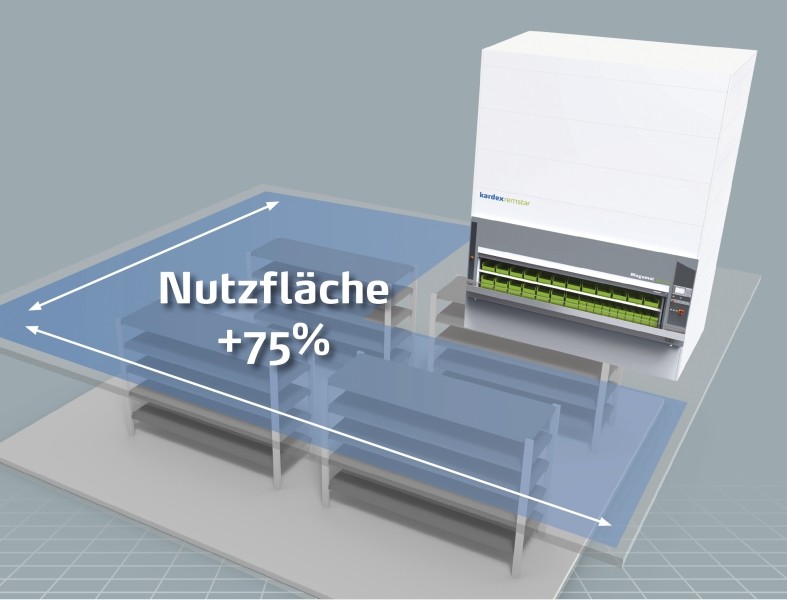
And this is exactly what retailers need: precise and fast order processing in order to live up to their own shipping promises and at the same time meet the high expectations of their customers.
Keep in touch










