
AI Mega Data Centers: A Global Survey of AI Infrastructure – Who Has the Most Computing Power, Who Is Falling Behind?
Xpert Pre-Release

Available in 27 languages 📢
Prefer Xpert.Digital on GoogleⓘPublished on: March 7, 2026 / Updated on: March 7, 2026 – Author: Konrad Wolfenstein
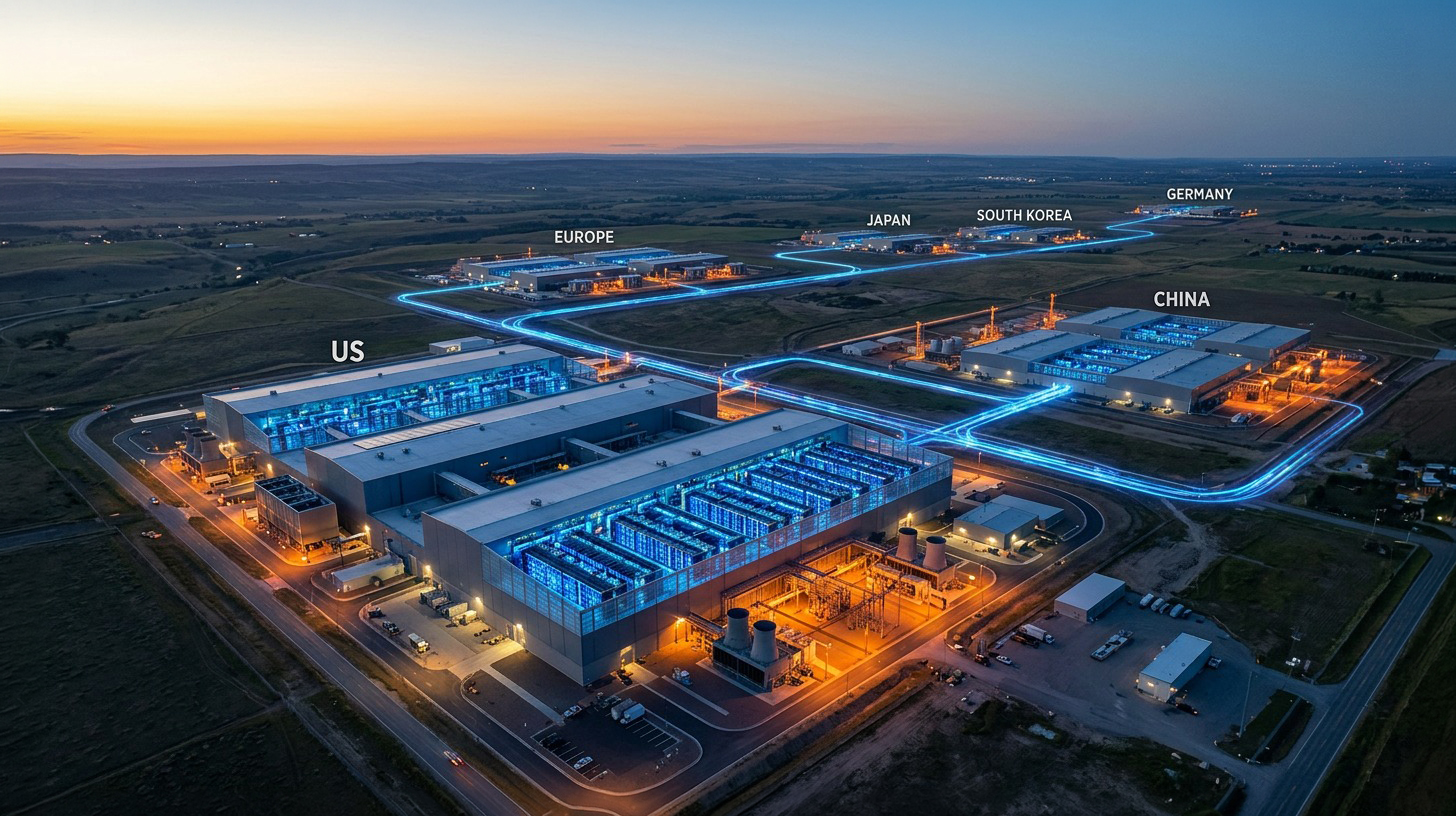
AI Mega Data Centers: A Global Survey of AI Infrastructure – Who Has the Most Computing Power, Who Is Falling Behind? – Image: Xpert.Digital
The billion-dollar leap by Japan and others: How Asia and the USA are overtaking us in AI
The battle for computing power: The real factories of the future are not in Europe
Artificial intelligence is considered the ultimate economic engine of the 21st century – but the key to its success is sheer computing power. Without the gigantic infrastructures of modern AI data centers, even the best algorithms remain useless. A recent inventory of global capacities paints a stark picture of the global power distribution: While the USA relentlessly expands its undisputed dominance with multi-billion-dollar mega-clusters, and Asian countries like Japan, China, and South Korea launch large-scale catch-up efforts, Europe risks falling behind technologically. Germany, of all places, is at the center of this crisis. Once celebrated as a high-tech hub, the raw figures for data centers and GPU capacities reveal an alarming lag. Is Germany on the verge of becoming a mere "data colony," or can the tide still be turned through the rapid reduction of bureaucracy and massive investments? This report sheds light on the global assessment of computing power and ruthlessly exposes who is building the true factories of the future in the AI age.
Germany is in danger of becoming a digital developing country, while the USA cements its dominance
The geopolitical distribution of power in the 21st century is no longer determined solely by military strength or raw material reserves, but increasingly by the availability of computing power. AI data centers are the factories of the digital economy, the blast furnaces of the fourth industrial revolution. Those who possess them determine the pace of innovation. Those who do not become mere spectators of a transformation that encompasses all industries. A detailed inventory of global AI data center capacities reveals a picture of dramatic asymmetries, in which Germany plays a particularly worrying role.
The global starting point: 30 gigawatts and growing
Total AI-related data center capacity reached approximately 30 gigawatts in the last quarter of 2025, an output equivalent to the peak electricity consumption of the entire state of New York and exceeding that of many developed countries. This figure is the result of an exponential expansion that began only a few years ago and is driven by the explosive demand for generative AI and agent-based AI.
The global IT power capacity of all data centers, not just those specifically dedicated to AI, already reached 122.2 gigawatts in the first quarter of 2025. North America leads with 42 percent of the total capacity and is projected to increase its share to 49 percent by 2035. AI workloads will overtake legacy workloads in the early 2030s and account for more than half of total data center capacity by 2031.
The United States: The undisputed hegemon
The US is dominating the global AI infrastructure race with a lead that is not shrinking, but widening. By 2026, the United States will have 8.2 gigawatts of dedicated AI data center capacity, representing 40 percent of the country's total installed capacity. In 2026 alone, 1.9 gigawatts of new AI capacity will be added, more than the total AI capacity of any other country in the world. By 2031, AI-driven capacity will grow to 26.4 gigawatts, representing 54 percent of total installed capacity.
The total capacity of all US data centers is 53.7 gigawatts, representing 44 percent of the global total capacity. The dominance is even more pronounced when it comes to AI-specific computing power. The US boasts 39.7 million H100 equivalents of AI computing power and a total power capacity of 19,800 megawatts. Approximately 75 percent of the world's GPU cluster power used for AI development and deployment is located in the United States. The US possesses 17 times the European AI supercomputing capacity.
These figures represent more than just hardware. They stand for a mutually reinforcing ecosystem of venture capital, technical talent, energy infrastructure, and regulatory flexibility. Mega-projects like OpenAI's announced $500 billion Stargate initiative demonstrate that this investment momentum shows no signs of slowing.
China: The strategic catch-up race under pressure from sanctions
China occupies a paradoxical position. The country boasts the most data center clusters worldwide, 230 in total, yet its AI-specific computing power lags significantly behind that of the US. AI-dedicated active data center capacity is projected to reach 3.1 gigawatts in 2026, representing 44 percent of total installed capacity. This is expected to grow to 10.3 gigawatts by 2031, with AI-driven capacity accounting for 67 percent of total capacity. In 2026 alone, 741 megawatts of new capacity will be added.
The decisive bottleneck for China is the US export controls on high-performance AI chips. With only 400,000 H100 equivalents of AI computing power, China lags significantly behind the US, India, and even the United Arab Emirates. Nevertheless, China partially compensates for this disadvantage through algorithmic efficiency, as the DeepSeek example impressively demonstrates. Chinese AI models remain, on average, about seven months behind leading US releases, but this gap has narrowed thanks to open-source strategies and efficient training methods.
China's total data center capacity is 19.6 gigawatts, 16 percent of the global total. The People's Republic plans a significant expansion by 2030, driven by the new five-year plan, which envisions the creation of hyperscale computing clusters.
A new dimension of digital transformation with 'Managed AI' (Artificial Intelligence) - Platform & B2B solution | Xpert Consulting

A new dimension of digital transformation with 'Managed AI' (Artificial Intelligence) – Platform & B2B solution | Xpert Consulting - Image: Xpert.Digital
Here you will learn how your company can implement customized AI solutions quickly, securely and without high entry barriers.
A managed AI platform is your all-inclusive, worry-free solution for artificial intelligence. Instead of dealing with complex technology, expensive infrastructure, and lengthy development processes, you receive a ready-made solution tailored to your needs from a specialized partner – often within just a few days.
The key advantages at a glance:
⚡ Rapid implementation: From idea to ready-to-use application in days, not months. We deliver practical solutions that create immediate added value.
🔒 Maximum data security: Your sensitive data stays with you. We guarantee secure and compliant processing without sharing data with third parties.
💸 No financial risk: You only pay for results. High upfront investments in hardware, software, or personnel are completely eliminated.
🎯 Focus on your core business: Concentrate on what you do best. We take care of the entire technical implementation, operation, and maintenance of your AI solution.
📈 Future-proof & scalable: Your AI grows with you. We ensure continuous optimization and scalability, and flexibly adapt the models to new requirements.
More information here:
The global AI ranking: One number reveals Germany's dramatic lag
Japan: The $135 billion jump
Japan has recognized the strategic importance of AI infrastructure and is responding with an unprecedented investment drive. AI-dedicated data center capacity is projected to reach approximately 1 gigawatt in 2026 and grow to 2.6 gigawatts by 2031. The country also has a pipeline of over 2.1 gigawatts of data center capacity under development.
The investment sums are enormous. The Japanese government is allocating 10 trillion yen, equivalent to approximately 135 billion dollars, for AI infrastructure. International hyperscalers have pledged an additional more than 28 billion dollars for Japanese AI infrastructure: AWS alone 15.24 billion dollars, Oracle 8 billion, and Microsoft 2.9 billion, the company's largest investment in Japan in 46 years. The planned data center in Nanto, Toyama Prefecture, is slated to become Japan's third and largest data center cluster, with a capacity of 3.1 gigawatts.
However, Japan is struggling with a structural bottleneck: In Tokyo, the waiting time for electricity connections is 5 to 10 years. The electricity demand of data centers is expected to more than triple from 19 terawatt-hours to 66 terawatt-hours by 2034, which corresponds to the consumption of 15 to 18 million households.
South Korea: Semiconductor superpower builds AI fortress
South Korea is pursuing a strategy that consistently transfers its strengths in semiconductor manufacturing to the AI infrastructure sector. The country has committed $65 billion in investments by 2027, led by Samsung and SK Hynix, which together control 90 percent of the global high-bandwidth memory market. Three gigawatts of new data center capacity are planned by 2030.
The National AI Computing Center will provide one exaflop of computing power, distributed across multiple locations, with full operation expected by 2027. Located in Jeollanam-do province, the world's largest planned AI computing center, with a capacity of 3 gigawatts, is under construction at a cost of $35 billion and will potentially house 200,000 GPUs. OpenAI is partnering with Samsung and SK Hynix to build two AI computing centers with an initial capacity of 20 megawatts. Construction costs, at $10 to $11 million per megawatt, are lower than those in other Asia-Pacific countries. The South Korean data center market is projected to grow from $5.04 billion in 2025 to $16.23 billion by 2031.
Europe: The fragmented continent
Europe will have 3.5 gigawatts of dedicated AI data center capacity in 2026, representing 37 percent of the continent's total installed capacity. This figure is projected to grow to 9.7 gigawatts by 2031. The total capacity of all European data centers is 20.8 gigawatts, 17 percent of the global total. A 70 percent increase to a total of 28 gigawatts is forecast by 2030.
The European Union has announced a €20 billion initiative to establish AI gigafactories. With JUPITER, the first European exascale supercomputer launched in Germany in September 2025, Europe boasts three systems in the global top ten. Nevertheless, the gap with the US remains enormous. Only three of the 40 most significant AI models of 2024 originated in Europe, all of them from France.
Germany: Europe's problem child
The figures for Germany are particularly sobering. The country currently operates around 2,000 data centers with a total capacity of just under 3,000 megawatts. Of this, only 530 megawatts are dedicated to AI data centers, representing about 15 percent of the total capacity. By 2030, AI capacity is projected to quadruple to 2,020 megawatts, and total capacity is expected to exceed 5,000 megawatts.
| Key figure | USA | China | Japan | South Korea | Europe | Germany |
|---|---|---|---|---|---|---|
| AI data center capacity 2026 | 8,200 MW | 3,100 MW | 1,000 MW | ~500 MW | 3,500 MW | 530 MW |
| Forecast 2031 | 26,400 MW | 10,300 MW | 2,600 MW | 3,000 MW | 9,700 MW | 2,020 MW |
| Total data center capacity | 53,700 MW | 19,600 MW | ~5,000 MW | ~3,000 MW | 20,800 MW | 3,000 MW |
| AI computing power (H100 equivalents) | 39.7 million. | 400.000 | ~210.000 | 5.1 million. | ~2.5 million. | 51.000 |
| AI power capacity (MW) | 19.800 | 289 | ~1.000 | 3.000 | ~2.000 | 25 |
The discrepancy is staggering: Germany's AI-specific computing power of 51,000 H100 equivalents with a power capacity of only 25 megawatts represents only a fraction of the American capacity. The USA already has ten times the data center capacity that Germany plans to build by 2030, and is adding more than four times the total German capacity annually.
Regional imbalances in Germany
Within Germany, computing power is heavily concentrated in a few locations. The greater Frankfurt area, with over 1,100 megawatts, accounts for more than a third of all German capacity. It is followed at a considerable distance by Bavaria with 420 megawatts, North Rhine-Westphalia with 378 megawatts, Baden-Württemberg with 233 megawatts, and Berlin with 146 megawatts. The lowest capacities are found in Mecklenburg-Western Pomerania with 20 megawatts, Bremen with 19 megawatts, and Saarland with 17 megawatts.
The cloud's share of total capacity rose from 29 percent in 2019 to the current 49 percent, while traditional data centers are shrinking. The electricity consumption of German data centers is estimated at 21.3 billion kilowatt-hours in 2025, compared to 12 billion in 2015. The industry is investing record sums: 12 billion euros in IT hardware and a further 3.5 billion euros in buildings and infrastructure.
What Germany lacks and what is at stake
Mega data centers specifically for AI applications, like those that exist in the US and China, are completely absent in Germany. Bernhard Rohleder, CEO of Bitkom, stated the consequence unequivocally: AI will be a decisive factor for the competitiveness of business and public administration. It will determine whether Germany becomes a data colony or remains a sovereign state in the digital age. Investment barriers, particularly lengthy approval processes and the reliable supply of affordable electricity, must be urgently removed.
The global distribution of AI computing power is not just a technical statistic. It is an early indicator of where economic value creation will take place in the coming decades. Every AI model that is trained and every intelligent application that goes into operation requires this infrastructure. Those who lack it will have to import the technology, along with the dependency that comes with it.
Your global marketing and business development partner
☑️ Our business language is English or German
☑️ NEW: Correspondence in your native language!

Konrad Wolfenstein
I and my team are happy to be available to you as your personal advisor.
You can contact me by filling out the contact form here or simply call me at +49 7348 4088 965. My email address is: [email protected]
I'm looking forward to our joint project.
☑️ SME support in strategy, consulting, planning and implementation
☑️ Creation or realignment of the digital strategy and digitization
☑️ Expansion and optimization of international sales processes
☑️ Global & Digital B2B trading platforms
☑️ Pioneer Business Development / Marketing / PR / Trade Fairs
🎯🎯🎯 Benefit from Xpert.Digital's extensive, five-fold expertise in one comprehensive service package | BD, R&D, XR, PR & Digital Visibility Optimization

Benefit from Xpert.Digital's extensive, five-fold expertise in a comprehensive service package | R&D, XR, PR & Digital Visibility Optimization - Image: Xpert.Digital
Xpert.Digital possesses in-depth knowledge across various industries. This allows us to develop tailored strategies precisely aligned with the requirements and challenges of your specific market segment. By continuously analyzing market trends and monitoring industry developments, we can act proactively and offer innovative solutions. The combination of experience and expertise generates added value and provides our clients with a decisive competitive advantage.
More information here:









