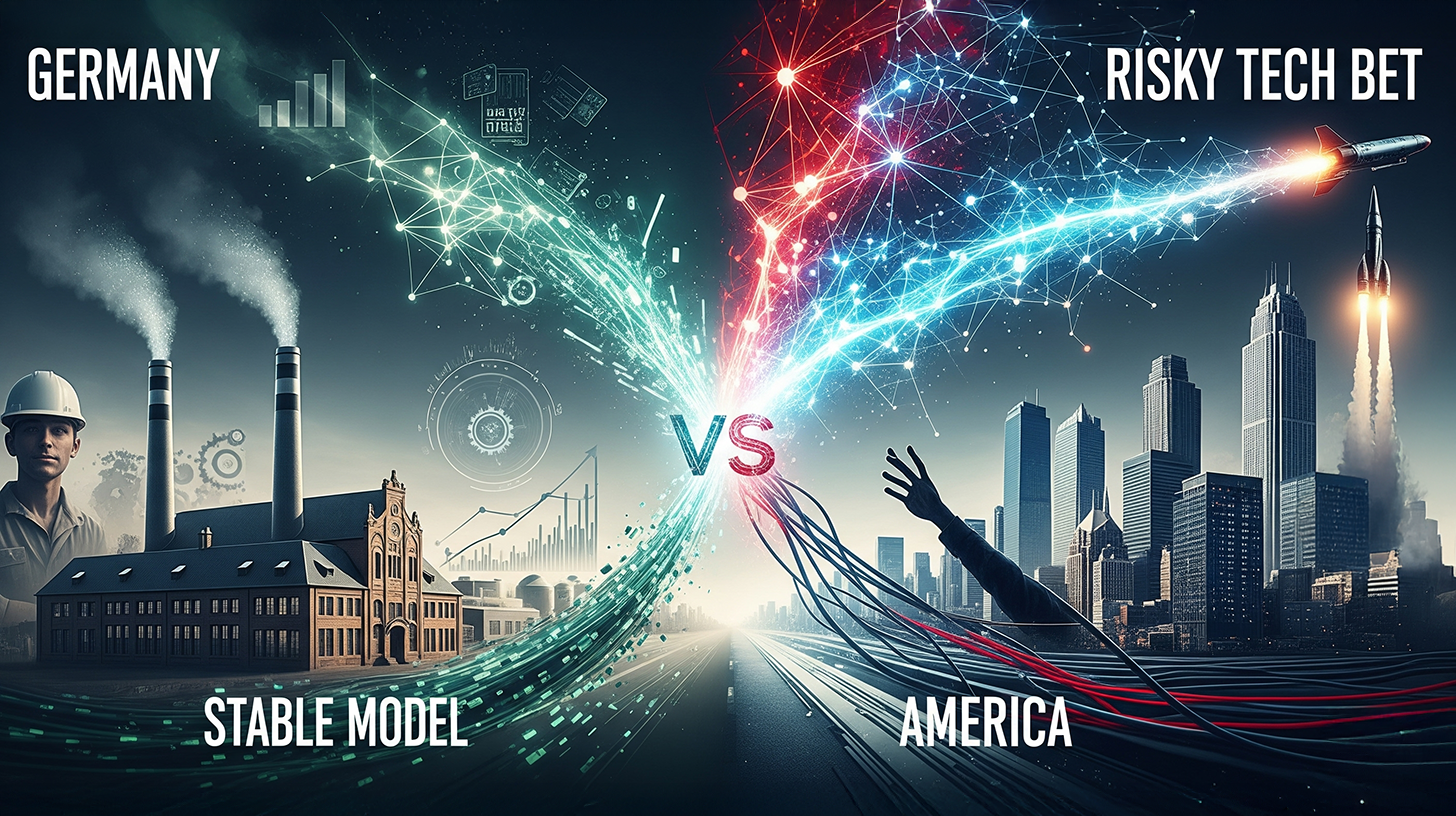
The dirty truth behind the AI battle of the economic giants: Germany's stable model versus America's risky tech gamble – Image: Xpert.Digital
The Achilles' heel of the tech giants: Why the Silicon Valley model is surprisingly fragile
Digital Dominance versus Industrial Resilience: A Comparative Analysis of Global Economic Models in the Age of AI
The battle for interpretive authority and market positioning
The global economic landscape is at a crossroads, where the struggle for supremacy is no longer decided solely by traditional indicators such as production volume or trade balances. Instead, a more subtle, yet all the more crucial, competition has emerged: the battle for interpretive dominance, the power to define what creates value in the 21st-century economy and which economic models are sustainable. It is a struggle for narrative control and strategic market positioning, the outcome of which is far from certain. On one side is the Silicon Valley narrative, which preaches an unstoppable digital transformation, spearheaded by a small group of technology giants whose innovations are portrayed as inevitable and indispensable. On the other side is the often overlooked but enduring resilience of industrialized nations, whose strength lies in physical production, engineering, and long-established value chains.
This report addresses the central questions arising from this tension. Is the digital economy, as promoted by the US, a self-sustaining force, or is it rather a complex superstructure resting on a foundation of physical matter, energy, and global supply chains? What are the real costs and dependencies of this digital infrastructure, often portrayed as intangible and "clean"? And which economic model is ultimately better equipped for long-term, stable, and sustainable prosperity: the US's speed- and risk-oriented, digitally focused approach, or the stability- and consistency-oriented, industrially driven model of Germany and Europe?
An examination of these questions reveals that the current economic competition between the major economic blocs—the US, the EU, and China—is increasingly being waged on a meta-level. It is no longer just about the direct competition of products and services, but about the strategic shaping of global narratives about what constitutes "innovation" and "value." The media dominance of the so-called "Magnificent Seven" and their relentless promotion of "irreplaceable AI" is not accidental, but a deliberate strategy to equate their digital products with progress itself and to make any alternative appear backward. The battle is being fought for the perception of one's own indispensability. The economic model that prevails in this narrative struggle will not only gain market share, but will also attract global capital, the most talented workforce, and favorable regulation. It is about defining the blueprint for the future.
Related to this:

The anatomy of two economic models: USA/California vs. EU/Germany
What characterizes Silicon Valley's speed- and risk-oriented economic model?
The economic model, which originated and has its epicenter in Silicon Valley, can aptly be described as "fast and risky." It is based on a culture that prioritizes exponential growth and rapid scaling above all else, viewing failure not as a flaw but as a necessary learning step on the path to success. The primary goal is often not to build a stable company for generations to come, but rather a quick, profitable "exit" through an IPO or sale, which brings immense returns to the founders and early investors.
The fuel for this model is a highly developed and massive venture capital (VC) ecosystem. The US VC market is orders of magnitude ahead of the European one. In 2022, venture capital investments in Europe totaled around €77 billion, while in the US they amounted to €188 billion – roughly two and a half times as much. Per capita, this gap is even greater. This enormous financial firepower makes it possible to invest in high-risk, visionary ideas and scale companies at a speed that is hardly replicable in Europe's more risk-averse financial culture. This culture of high risk appetite permeates the entire system, from investors and founders to employees and regulators.
A direct consequence of this model is an extreme concentration of market power. The technology companies known as the "Magnificent Seven"—Apple, Microsoft, Nvidia, Amazon, Alphabet, Meta, and Tesla—now account for over a third of the total value of the S&P 500 index. This concentration is both a source of strength, as these few companies drive market returns, and a source of fragility, as it makes the entire market vulnerable to the performance of a handful of players.
The labor market also reflects this model. It is characterized by high flexibility and less stringent dismissal protection laws. This facilitates the rapid hiring and firing cycles typical of startups, but stands in sharp contrast to the German model, which emphasizes job security and stability.
What are the strengths of the German and European economies based on stability and long-term perspective?
Unlike the American model, the German and, to a large extent, the European economy is based on the principles of stability, long-term sustainability, and substantial value creation. The backbone of this economic structure is the Mittelstand (small and medium-sized enterprises). More than 99 percent of all companies in Germany are SMEs, employing almost 60 percent of the workforce and responsible for 82 percent of vocational training positions. These companies are often family-owned for generations, prioritize long-term stability over short-term profit maximization, and are deeply rooted in their local and regional communities.
A particular strength within the German Mittelstand (SMEs) lies in the so-called "hidden champions." These are highly specialized companies, often unknown to the general public, that are world market leaders in their respective niche markets within the business-to-business sector. It is estimated that there are around 1,600 such companies in Germany alone. They contribute significantly to Germany's enormous export strength by focusing on quality, technological leadership, and innovation, rather than competing on price.
The German innovation model differs fundamentally from that of Silicon Valley. It relies on continuous, incremental improvements based on in-depth engineering expertise and a close integration of research, development, and production. A crucial success factor here is the dual vocational training system, which produces a highly qualified workforce essential for implementing complex manufacturing processes.
The prevailing corporate culture is characterized by a certain risk aversion and a strong need for security. This manifests itself in a cautious approach to financing – many medium-sized companies shy away from external capital – and a business strategy focused on continuity. While this attitude can be a weakness in fast-paced digital markets, it proves to be a remarkable strength in times of economic uncertainty and global crises, ensuring stability and resilience.
How do these differences manifest themselves in the fundamental economic data?
The fundamental differences between the Californian and German economic models are clearly reflected in the macroeconomic data. While California, as the world's fifth-largest economy, is often compared to Germany, a closer look at the sectoral composition of their gross domestic products (GDP) reveals a profound divergence.
California's economy, with a GDP of approximately $4.1 trillion in 2024, is dominated by services and the technology sector. The largest contributors to GDP are the "Professional and Business Services" ($548.9 billion), "Information" ($475.7 billion), and "Real Estate" ($446.3 billion) sectors. The manufacturing sector accounts for only about 11 percent. In contrast, Germany, whose GDP is projected to reach around $4.7 trillion in 2025, has a significantly stronger industrial base. The industrial sector there contributes approximately 28.1 percent to GDP, with the share of pure manufacturing, at nearly 20 percent, almost twice as high as in California.
These structural differences extend to research and development (R&D) spending. Germany invests 3.1 percent of its GDP in R&D, a leading figure internationally. These investments are heavily concentrated in core industries: the automotive industry alone invested almost €30 billion in 2022, followed by mechanical engineering and the electronics industry. California's R&D landscape, on the other hand, is dominated by technology giants whose spending focuses primarily on software, artificial intelligence, and digital services, as demonstrated by the massive investments of the "Magnificent Seven" in AI chips and R&D.
The labor market also paints a clear picture of this divergence. In Germany, around 21.1 percent of the workforce is employed in the manufacturing sector, underscoring the central role of industry in employment. In California, on the other hand, the largest employers are the health and social services sectors, followed by retail and professional, scientific, and technical services, reflecting the service- and knowledge-based orientation of the local economy. The following table summarizes the key figures for comparison.
Labor market prospects: Industry-driven Germany versus knowledge-based California
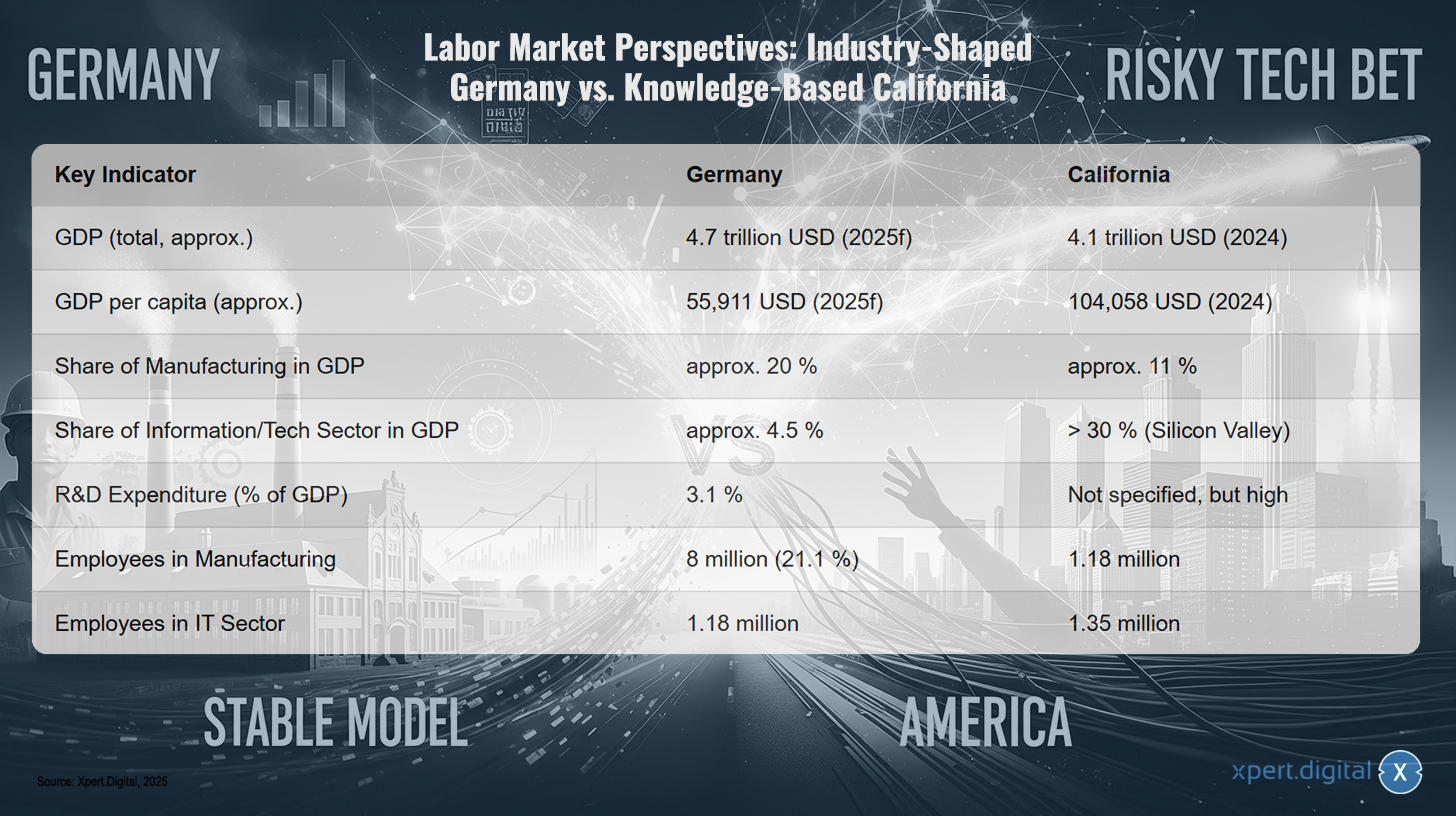
Labor market outlook: Industry-driven Germany versus knowledge-based California – Image: Xpert.Digital
The labor market outlook reveals a stark contrast between Germany, a country dominated by industry, and California, a knowledge-based economy. While Germany's gross domestic product (GDP) is projected to reach approximately $4.7 trillion in 2025, California's GDP is estimated at around $4.1 trillion in 2024. GDP per capita is significantly higher in California, at approximately $104,058, compared to Germany's $55,911. The manufacturing sector accounts for roughly 20% of GDP in Germany, but only about 11% in California. In contrast, the information and technology sector, driven primarily by Silicon Valley, contributes more than 30% to California's GDP, while this sector is considerably smaller in Germany, at around 4.5%. Research and development (R&D) expenditure in Germany is 3.1% of GDP, while in California it is high but not precisely specified. In terms of employment figures, approximately 8 million people work in the manufacturing sector in Germany, representing 21.1% of the workforce, while in California, around 1.18 million people work in this sector. The IT sector employs approximately 1.18 million people in Germany and about 1.35 million in California.
Analyzing these two economic models leads to a deeper understanding of their respective weaknesses. The US model, geared towards speed and risk, and the German model, which emphasizes stability and long-term perspectives, are not only different, they are evolving in path-dependent ways that create critical, mutually exclusive vulnerabilities. The US model's focus on software and digital services makes it highly efficient in a stable world, but extremely vulnerable to disruptions in the physical world, such as supply chains or energy resources. Its hardware value chain is globalized and exposed; the entire model relies on a stable physical world that it does not control. The strength of the German model, on the other hand, lies in its control over high-value physical production. Its weakness is a cultural and structural aversion to the high-risk, rapid digital innovation that is now reshaping manufacturing itself, as exemplified by the concept of Industry 4.0. This creates a higher-order risk: the core strength of one model is the critical weakness of the other. The US lacks industrial resilience; Germany lacks digital agility. In a future characterized by both geopolitical instability that disrupts physical supply chains and rapid technological change that revolutionizes industrial processes, neither model is optimally positioned. The winner will be the economy that can best synthesize both approaches – a challenge that lies at the heart of Germany's "Industry 4.0" initiative.
🎯🎯🎯 Benefit from Xpert.Digital's extensive, five-fold expertise in one comprehensive service package | BD, R&D, XR, PR & Digital Visibility Optimization

Benefit from Xpert.Digital's extensive, five-fold expertise in a comprehensive service package | R&D, XR, PR & Digital Visibility Optimization - Image: Xpert.Digital
Xpert.Digital possesses in-depth knowledge across various industries. This allows us to develop tailored strategies precisely aligned with the requirements and challenges of your specific market segment. By continuously analyzing market trends and monitoring industry developments, we can act proactively and offer innovative solutions. The combination of experience and expertise generates added value and provides our clients with a decisive competitive advantage.
More information here:
Lobbying and Narratives – The Power of the “Magnificent Seven”: How Big Tech Controls Public Opinion and Politics
The invisible hand of influence: actors and their interests
What influence do the “Magnificent Seven” have on public perception and political decision-making?
The influence of the "Magnificent Seven"—Apple, Microsoft, Nvidia, Amazon, Alphabet, Meta, and Tesla—extends far beyond their economic market power. They actively shape public perception and political decisions through a combination of media dominance, targeted lobbying, and strategic control of the narrative surrounding technology and progress.
Their omnipresence in financial and technology media creates a self-reinforcing hype cycle. Every product announcement, every quarterly report is intensely analyzed and disseminated, fostering a climate of inevitability regarding their technological leadership. This narrative positions artificial intelligence as an unstoppable and indispensable force, and its developers as the sole pioneers of this progress. Interestingly, public trust in the technology sector as a whole, at 76 percent, is significantly higher than trust in AI technology itself, which is welcomed by only 30 percent of people and rejected by 35 percent. Companies exploit this trust gap to build acceptance for their new AI products based on their established reputations.
Behind the scenes, they reinforce this narrative influence with massive financial power in the political arena. The technology sector is now the sector with the highest lobbying expenditures in the European Union, spending over €97 million annually. A third of this sum, around €32 million, is attributable to just ten companies, including Google, Amazon, Apple, Microsoft, and Meta. This immense financial power grants them privileged access to political decision-makers. For example, during the drafting of the EU Digital Services Act, 75 percent of the European Commission's high-level meetings took place with industry lobbyists.
This lobbying effort aims not only to prevent regulation but also to actively shape it in their own interest. Leaked documents have revealed strategies designed to sow conflict within the European Commission in order to weaken legislation. Big Tech publicly advocates for "soft rules" that they themselves help to create, while portraying stricter regulations as a threat to small and medium-sized enterprises (SMEs) and consumers. This influence is exemplified by the weakening of the EU AI Act's Code of Conduct. In the US, lobbying expenditures are far greater; total spending in 2022 exceeded $4.1 billion, compared to around $110 million in the EU, illustrating the scale of this political influence.


What role do management consultants and bureaucracy play as systemic brakes on efficiency?
Besides the direct influence of technology companies, there are two other systemic forces that act as brakes on efficiency and innovation, particularly in the German and European context: the management consulting industry and the deeply entrenched bureaucracy.
The business model of management consultancies is fundamentally based on making themselves indispensable to their clients. Critics argue that this is often achieved not through the sustainable solution of problems, but by creating new levels of complexity that ensure a continuous demand for consulting services. Often, standardized products and methods are sold that lack in-depth local or industry-specific knowledge, creating a dependency that weakens the internal capabilities of the client organization and effectively infantilizes governments.
Consultants are frequently employed, particularly in the public sector, to lend external legitimacy to politically unpopular decisions such as staff reductions or privatizations, or to serve as scapegoats should these measures fail. Their track record is questionable. A quantitative study of the British National Health Service (NHS) found a significant positive correlation between spending on consulting services and organizational inefficiency. Although the use of consultants in the German public sector, at 9 percent of revenue, is lower than in the UK at 22 percent, the same fundamental dynamics apply.
At the same time, German bureaucracy acts as a significant impediment to growth. An overwhelming majority of 92 percent of German companies report having perceived an increase in the bureaucratic burden over the past five years. This has concrete consequences: 58 percent of companies plan to avoid future investments in Germany due to bureaucracy. This burden results from the sheer volume of laws—the scope of federal legislation has grown by 60 percent in 15 years—as well as from lengthy approval processes, which, for example, can take four to five years for renewable energy projects, and a significant backlog in digitalization within public administration. This creates a risk-averse environment that stifles the agility necessary for innovation. Recent reforms, such as the Fourth Bureaucracy Relief Act, are intended to remedy this by digitizing contracts and shortening retention periods. However, companies remain skeptical: only 10 percent expect any noticeable relief, suggesting that the problem is deeply rooted in the administrative culture.
These two phenomena – the business model of consultants and the nature of bureaucracy – are in a pernicious interplay. Bureaucracy, through its complex processes and regulatory labyrinths, creates the very problems for which consultants are hired. These consultants are commissioned by both the private sector to navigate the bureaucracy and the public sector to "reform" it. However, the "solutions" implemented by the consultants often consist of new frameworks, key performance indicators, and process models that add an additional layer of complexity instead of addressing the root cause. This creates a self-reinforcing cycle: bureaucracy generates a demand for consultants, whose solutions, in turn, feed the bureaucratic machine. The result is a state of permanent, costly "transformation" without any fundamental simplification. This dynamic actively counteracts the "fast and risky" innovation model and cements the "slow and stable" – or even stagnant – status quo.
Related to this:

The physical reality of the digital world: dependencies and costs
Why is the digital economy fundamentally dependent on physical production?
The idea of an immaterial, weightless digital economy is one of the most powerful fictions of the 21st century. In reality, the digital economy is inextricably linked to the physical world and fundamentally dependent on material production. A data center without a productive economy whose processes it can optimize is economically meaningless. Its value arises only from the application of its computing power to real-world processes in manufacturing, logistics, trade, or services. A factory could and theoretically can exist without a cloud connection; however, a data center cannot monetize its value without a factory, logistics company, or retailer to serve. Digitization is therefore not a replacement for physical value creation, but rather a multiplier for it.
This dependency is most clearly manifested in the physical infrastructure upon which the entire digital world is built. Every email, every stream, every AI algorithm is processed on physical hardware: on servers, routers, and switches housed in data centers, and on end devices such as smartphones and laptops. The rise of artificial intelligence, in particular, is driving a massive expansion of this physical infrastructure, as AI models require immense computing power.
A critical tension arises from the differing speeds at which digital and physical infrastructures can be built. A modular data center can be erected in just two to three months, while constructing a modern factory takes several years. This asymmetry carries the risk of misinvestments and market cannibalization. If digital capacity grows faster than the physical economy's ability to utilize and pay for that capacity, overcapacity and unprofitable digital infrastructures will result. The digital and physical economies must grow in tandem to ensure a stable system.
What material resources and global supply chains underpin the digital infrastructure?
The physical basis of digital infrastructure is itself the result of complex, global and resource-intensive supply chains, which are characterized by significant geopolitical risks.
The core component of every digital hardware device is the semiconductor. Its production is a highly complex process relying on a global supply chain for raw materials, including a variety of rare earth elements such as gallium, germanium, neodymium, and cerium. These elements are essential for the specific electrical and magnetic properties of microchips.
The rare earth supply chain, however, is a geopolitical bottleneck. China dominates this market to an overwhelming degree. The country accounts for roughly 60 percent of global production but also for about 90 percent of the processing of these critical minerals. This dominance gives Beijing considerable geopolitical leverage, as demonstrated by the imposition of export restrictions on gallium and germanium. The US and its allies, such as Australia and Brazil, are working intensively to build alternative supply chains, but this is a lengthy and capital-intensive process that will take years, if not decades.
The end products of these supply chains, such as a smartphone, are masterpieces of global logistics. An iPhone, for example, consists of components sourced from all over the world: displays from South Korea, memory chips from Japan, processors designed in the USA but manufactured in Taiwan, and final assembly often taking place in China or Vietnam. This highly efficient, yet extremely fragile system is vulnerable to disruptions caused by geopolitical tensions, natural disasters, or trade conflicts, as recent years have vividly demonstrated. The digital world thus relies on a stable network of physical goods flows, which can break down at any time.
What are the environmental costs of digitalization?
The narrative of a "clean" digital economy obscures the enormous and ever-increasing environmental costs associated with its physical infrastructure. Digitalization has a massive material footprint that extends across its entire life cycle – from raw material extraction through production and operation to disposal.
Data centers, often euphemistically referred to as "the cloud," are among the most energy-intensive buildings in the world, consuming 10 to 50 times more energy than a typical office building. In 2023, they accounted for 4.4 percent of total electricity consumption in the US. Driven by the insatiable energy demands of AI applications, this share is projected to rise to 9 to 12 percent by 2030. At the same time, they are immense water consumers. A single large data center can require up to 5 million gallons (approximately 19 million liters) of water per day for its cooling systems, severely straining water resources in already arid regions.
Semiconductor manufacturing is also an environmentally problematic process. Chip fabrication is extremely resource-intensive and responsible for a significant portion of the electronics industry's greenhouse gas emissions. A single plant can consume up to 10 million gallons (approximately 38 million liters) of highly purified water daily, using a variety of hazardous chemicals in the process. These include fluorinated gases with high global warming potential and so-called "perpetual chemicals" (PFAS), which can permanently contaminate water sources. Silicon Valley itself is now home to numerous "superfund sites"—highly contaminated areas resulting from the legacy of the semiconductor industry.
At the end of their life cycle, digital hardware becomes electronic waste (e-waste), the fastest-growing solid waste stream in the world. In 2022, 62 million tons of e-waste were generated globally. Less than a quarter of this is properly recycled. The rest ends up in landfills, is incinerated, or illegally exported to developing countries. There, valuable metals are often recovered under the most primitive conditions, such as burning cables in the open air or using acid baths. This releases highly toxic substances like lead, mercury, and dioxins, which cause serious and lasting damage to human health and the environment.
Ecological costs of digitalization
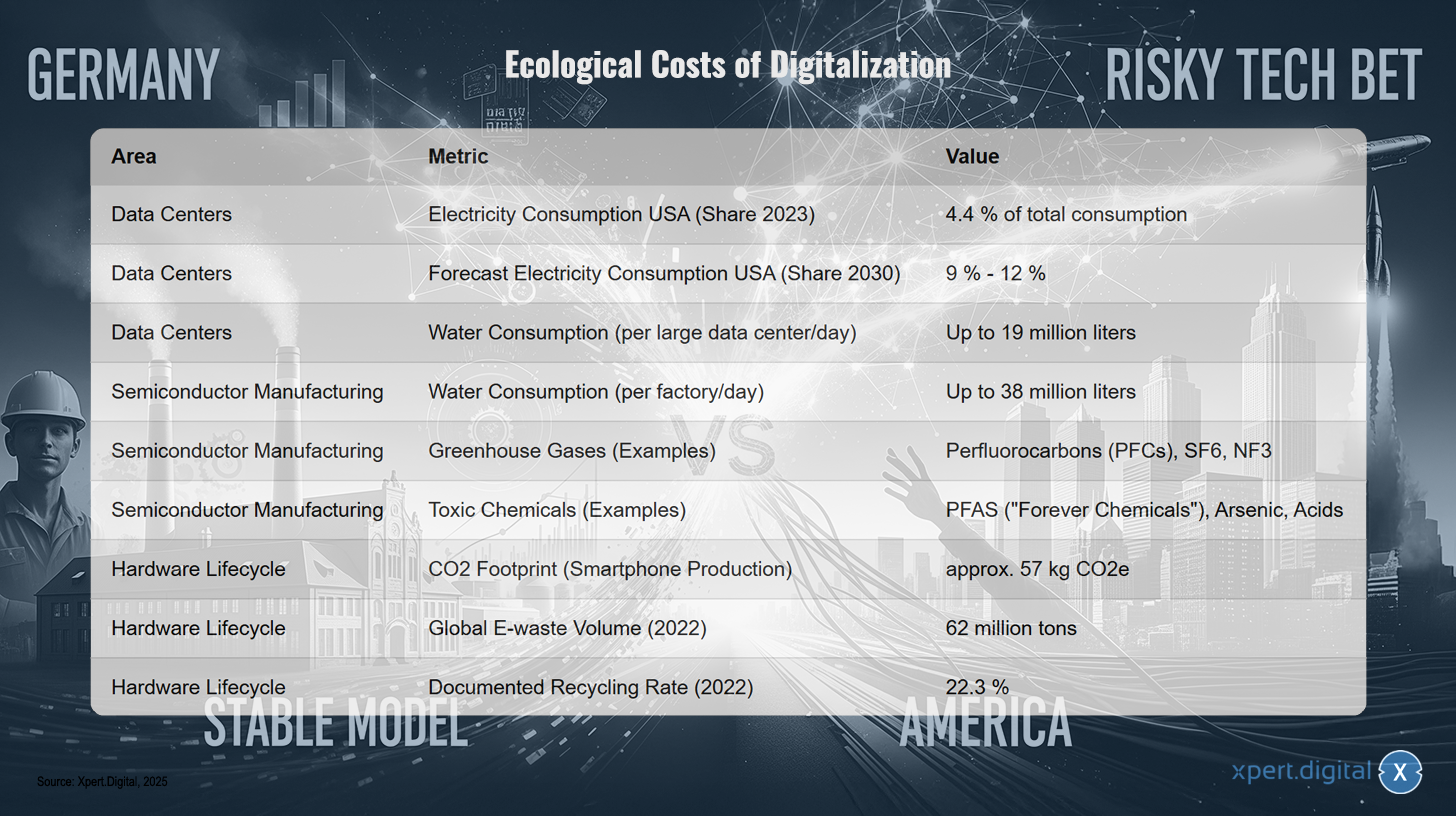
Ecological costs of digitalization – Image: Xpert.Digital
The environmental costs of digitalization are manifold. In the US, data centers accounted for 4.4% of total electricity consumption in 2023, with a projected increase to 9 to 12% by 2030. A large data center can consume up to 19 million liters of water per day. Semiconductor manufacturing uses up to 38 million liters of water per factory daily. Furthermore, these factories generate greenhouse gases such as perfluorocarbons (PFCs), SF6, and NF3, as well as toxic chemicals like PFAS, arsenic, and acids. The carbon footprint of smartphone production is approximately 57 kilograms of CO2 equivalent. In 2022, 62 million tons of electronic waste were generated worldwide, of which only 22.3% was documented as being recycled.
The prevailing narrative of a “clean” or “dematerialized” digital economy, upon closer examination, proves to be a dangerous miscalculation. The digital world has a massive and rapidly growing physical and ecological footprint. This is largely externalized, however—both geographically, by shifting dirty production and disposal processes to other parts of the world, and temporally, by passing the costs of waste removal and climate change mitigation onto future generations. The term “the cloud” itself is a marketing ploy that obscures the reality of massive, energy- and water-hungry industrial facilities. The true costs of the digital revolution are not fully reflected in the balance sheets of tech companies. This “ecological debt” represents a hidden subsidy for the digital economy, paid for by communities near mines, factories, and e-waste dumps, as well as by the global climate.
🔄📈 B2B trading platform support – Strategic planning and support for export and the global economy with Xpert.Digital 💡


B2B trading platforms - Strategic planning and support with Xpert.Digital - Image: Xpert.Digital
Business-to-business (B2B) trading platforms have become a critical component of global trade dynamics and thus a driving force for exports and global economic development. These platforms offer significant advantages to companies of all sizes, especially SMEs—small and medium-sized enterprises—which are often considered the backbone of the German economy. In a world where digital technologies are increasingly prominent, the ability to adapt and integrate is crucial for success in global competition.
More information here:
Between Silicon Valley and SMEs: Europe's opportunities in techno-industrialism
The future of value creation
Is the Silicon Valley model overrated and Europe's industrial strength underrated?
The preceding analysis suggests that the prevailing narrative has overstated the strengths of the Silicon Valley model and understated those of European, and particularly German, industrialization. The undeniable strength of the American model lies in its capacity for rapid, disruptive innovation and exponential scaling. However, this strength comes at the cost of significant, often overlooked weaknesses: a fundamental dependence on fragile global supply chains for physical hardware, an enormous and growing environmental footprint, and the creation of extreme market concentration, which carries systemic risks.
In contrast, Europe's industrial base offers remarkable resilience. The close link between research, development, and high-quality production, an excellently trained skilled workforce, and a corporate culture geared toward long-term stability are valuable assets in an increasingly uncertain and volatile world. Furthermore, the decentralized structure of Germany's small and medium-sized enterprises (SMEs) promotes a broader regional distribution of wealth and prevents the extreme geographical concentration of wealth characteristic of Silicon Valley.
However, the verdict is not final, and no model is inherently superior to another. The crucial insight is that the debate has been dominated for too long by a one-sided fascination with the purely digital, while neglecting the importance of material value creation. The future likely belongs neither to one extreme nor the other, but rather to a hybrid model that can combine the speed of innovation offered by digital technology with the resilience, quality, and sustainability of advanced manufacturing.
Related to this:

What opportunities does the synthesis of AI and mechanical engineering offer for Germany as an industrial location (Industry 4.0)?
Germany's strategic response to the challenges of digitalization is the concept of "Industry 4.0." It describes the vision of an intelligent factory ("Smart Factory") in which machines, products, and IT systems are networked in real time. This enables highly individualized production at the cost of mass production, predictive maintenance to prevent breakdowns, and resource-efficient, flexible logistics.
This vision is no longer a distant dream. Leading German industrial companies are already implementing AI solutions in their manufacturing processes. Siemens, for example, uses AI to optimize its supply chains, for quality control, and for predictive maintenance of its equipment, reporting significant efficiency gains and a reduction in downtime. BMW uses AI in vehicle design and to control robots on the assembly line to increase precision and efficiency.
A key advantage for Germany is the close collaboration between industry and excellent research institutions like the Fraunhofer Society. These collaborations ensure the rapid transfer of fundamental AI research into practical applications for production. Studies by the Fraunhofer Institute show that AI adoption in German industry is progressing – around 16 percent of industrial companies already use AI – but is currently still concentrated on large corporations and specific sectors such as the automotive industry.
The greatest challenge and, at the same time, the greatest opportunity lies in the widespread implementation of Industry 4.0 in German SMEs. These companies often face significant hurdles, including a lack of expertise, difficulties integrating new technologies into existing legacy systems, data protection concerns, high investment costs, and the absence of a clear digitalization strategy. If these hurdles can be overcome, Germany could create a unique economic model that combines the strengths of its industrial base with the advantages of digital transformation.
Related to this:
What strategic decisions need to be made for a sustainable and stable market economy?
In order to create a sustainable and stable market economy, both economic models must address their respective systemic weaknesses and make strategic decisions.
For Germany and the EU, the primary challenge lies in overcoming structural inertia. This requires a concerted effort to reduce bureaucracy in order to accelerate approval processes and facilitate investment. It necessitates fostering a more risk-tolerant innovation culture and improving access to growth capital to close the gap with the US venture capital market. Above all, the digitalization of small and medium-sized enterprises (SMEs) must be accelerated through targeted funding programs, the expansion of digital infrastructure, and the strengthening of digital skills. The goal should not be to copy Silicon Valley, but to create an independent "Made in Digital Germany" model that leverages existing industrial strengths as its foundation.
For the US and Silicon Valley, the challenge lies in recognizing and addressing the inherent fragility and externalized costs of their model. Specifically, this means increasing the resilience of supply chains through reshoring or nearshoring of critical hardware manufacturing. It requires massive investment in a circular economy for electronics to tackle the growing e-waste crisis and recover valuable raw materials. And it demands that tech giants take greater responsibility for the massive energy and environmental impact of their digital infrastructure and stop passing these costs on to society as hidden expenses.
On a global level, the imperative is to recognize the inevitable symbiosis between the digital and physical worlds. A sustainable future requires a balanced approach that equally values bits and atoms, innovation and resilience, rapid growth and long-term stability. The decisive competitive advantage of the future will not lie in prioritizing one over the other, but in mastering their intelligent and responsible integration.
The simultaneous crises of geopolitical instability, climate change, and technological disruption are rendering both the purely digital and the traditional industrial models obsolete in their current form. Geopolitical tensions, particularly with China, are exposing the fragility of the US model's globalized hardware supply chains. The climate crisis and resource scarcity, especially water and energy, are revealing the enormous, unsustainable footprint of the digital economy and challenging its "clean" image. At the same time, the rapid advancement of AI threatens to render the German industrial model uncompetitive if it does not adapt quickly enough due to cultural and bureaucratic inertia. None of the existing models is robust enough to withstand all these pressures simultaneously. A purely digital economy is neither resilient nor sustainable. A purely industrial economy that does not digitize is not competitive. This convergence of crises is forcing an evolution toward a new economic paradigm: a "resilient, sustainable techno-industrialism." This new model must prioritize resilience through diversified, more localized supply chains; sustainability through a circular economy and low-carbon energy for digital and physical production; and deep techno-industrial integration through the embedding of AI and digital tools directly into advanced manufacturing, as envisioned by Industry 4.0. This is the strategic endpoint toward which the entire analysis points.
Your global marketing and business development partner
☑️ Our business language is English or German
☑️ NEW: Correspondence in your native language!

Konrad Wolfenstein
I and my team are happy to be available to you as your personal advisor.
You can contact me by filling out the contact form here wolfenstein@xpert.digital:or simply call me at +49 7348 4088 965. My email address is
I'm looking forward to our joint project.