
Agri-photovoltaics / AgriPV: Suitable for smaller systems - EEG amendment - Stronger support for agriphotovoltaics

Available in 27 languages 📢
Prefer Xpert.Digital on GoogleⓘPublished on: October 17, 2022 / update from: August 6, 2023 - Author: Konrad Wolfenstein
Agri-photovoltaics: opportunities for smaller systems and high-mounted systems – Image: Xpert.Digital / Max kegfire|Shutterstock.com
Agri-photovoltaics as an opportunity
Agri-photovoltaics or AgriPV is the name for photovoltaic systems that are built on agricultural land. Electricity generation from AgriPV systems can make a significant contribution to the energy transition and reduce CO2 emissions.
However, the current support for photovoltaics through the Renewable Energy Sources Act (EEG) is not sufficient to accelerate the further expansion of photovoltaics.
In order to further accelerate the expansion of photovoltaics, the federal government has presented an amendment to the EEG, which will significantly increase support for photovoltaics. In addition, funding should be linked more closely to the overall expansion of renewable energies in the future.
Germany as a photovoltaic location benefits from the use of agricultural land for the construction of solar systems. The most recent change to the Renewable Energy Act (EEG) strengthens the economic viability of AgriPV systems by lowering the thresholds for funding. Together with rising electricity prices, consumers' high demands for sustainable energy production and positive experiences from other countries, this presents an interesting investment opportunity for agricultural businesses in Germany.
Agri-photovoltaics: better opportunities for smaller systems and high-mounted systems
Against the background of the EEG amendment coming into force in 2023, the German Farmers' Association (DBV), the Fraunhofer Institute for Solar Energy Systems ISE and the Kehl University of Public Administration welcome greater support for agri-photovoltaics - or agri-PV for short - in a joint position paper – in the Renewable Energy Sources Act (EEG). The amendment to the law will make it possible in the future to receive a feed-in tariff for electricity from PV systems on agricultural land as part of the standard EEG tenders. In order to help the still young technology achieve a breakthrough, more targeted support for high-mounted agri-PV and simplification of the approval procedures for the construction of agri-PV systems are still necessary.
The potential of the technology is great: If half of the 80,000 hectares of open-space systems planned in Germany by 2030 were built as high-mounted agri-PV, an average of around 30,000 terawatt hours of electricity could be generated annually. »Agri-PV can certainly become an important building block for the energy transition in the future. Many farmers see Agri-PV as a good opportunity to combine renewable energies with agriculture," says Udo Hemmerling, deputy secretary general of the DBV. Politicians must create framework conditions that make smaller agri-PV systems economically attractive and enable farms to operate them themselves.
The DBV, Fraunhofer ISE and Kehl University therefore recommend that high-mounted agri-PV systems that are not subject to tendering under the EEG can also receive a technology bonus. Systems with less than one megawatt of nominal output are generally exempt from the obligation to tender; in the case of community energy companies, the limit is even 6 megawatts of nominal output.
Small systems in particular enable agricultural businesses to own and operate the systems themselves. They can make the necessary investments more easily.
Another obstacle to exploiting the full potential of Agri-PV is the unclear legal situation with regard to the approval procedures. »Since Agri-PV systems are built outdoors, it is usually necessary for the local municipality to draw up a development plan. The land use plan often has to be changed first. These processes take an enormous amount of time and thus delay the market ramp-up of Agri-PV," says Prof. Dr. Michael Frey, Professor of Law and Municipal Sciences at Kehl University. In order to advance the expansion of renewable energies, the DBV, Fraunhofer ISE and Kehl University of Applied Sciences recommend prioritizing smaller systems that have a spatial-functional connection to the agricultural business or serve horticultural production. This type of system is attractive for a large number of agricultural businesses to quickly get started with Agri-PV
For large, high-mounted agri-PV systems, in the future, as part of the standard EEG tenders, there will be an additional entitlement to a premium of 1.2 cents per kilowatt hour in order to take into account the additional costs for the more complex substructure. “We welcome special funding for high-elevation systems because they promise special synergies, such as protection against hail, heavy rain or too much sun,” says Max Trommsdorff, group leader for agri-photovoltaics at Fraunhofer ISE. However, there are doubts about the efficiency and accuracy of a fixed premium. »The currently highly fluctuating steel prices make it practically impossible to accurately predict the additional costs for the substructure of high-elevation systems. In our opinion, our own award volumes for high-mounted agri-PV would therefore be more suitable than a fixed premium as part of the EEG tenders.” This could avoid over-funding and ensure a significant expansion of high-mounted agri-PV systems.
The amendment to the EEG, which will come into force in January 2023, has already introduced important framework conditions for the future market ramp-up of agricultural photovoltaics in Germany. In the future, it will be possible to receive a feed-in tariff for electricity from PV systems on agricultural land as part of the standard EEG tenders. At the same time, with regard to EU direct payments, there should be a legal right to 85 percent of the area-related payments from 2023.

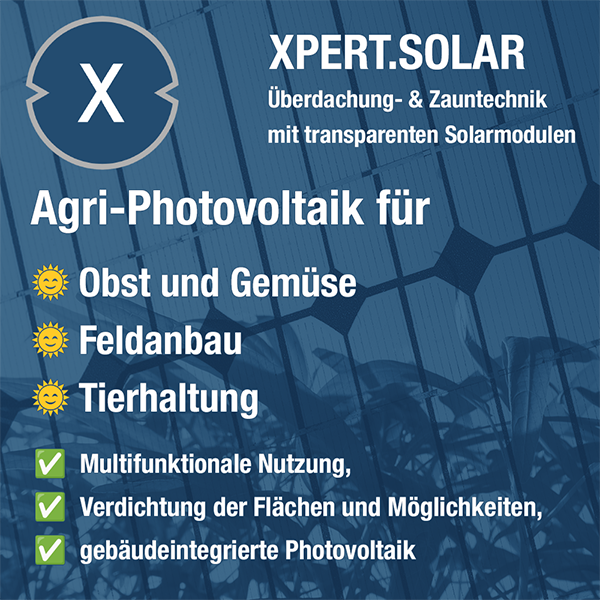
Partially transparent solar modules for Agri-PV are already in use
Partially transparent solar modules are already being used in a research facility in the “Model Region Agri-Photovoltaics Baden Württemberg”.
More about it here:
Plan your solar system for the most common applications conveniently online with our solar system planner!
With our user-friendly solar system planner you can plan your individual solar system online. Whether you need a solar system for your home, your business or for agricultural purposes, our planner offers you the opportunity to take your specific requirements into account and develop a tailor-made solution.
The planning process is simple and intuitive. You simply enter relevant information. Our planner takes this information into account and creates a tailor-made solar system that meets your needs. You can try out different options and configurations to find the optimal solar system for your application.
Additionally, you can save your plan to review later or share with others. Our customer service team is also available to answer your questions and provide support to ensure your solar system is optimally planned.
Use our solar system planner to plan your individual solar system for the most common applications and advance the transition to clean energy. Start now and take an important step towards sustainability and energy independence!

The solar system planner for the most common applications: Plan the solar system online here - Image: Xpert.Digital
More about it here:
📣 Energy-related renovation and new construction, consulting, planning and implementation for industry, retail and municipalities
Our experienced team will support you in optimizing your buildings to reduce energy consumption and promote sustainable energy use with photovoltaics. We analyze your individual needs and create tailor-made concepts that make sense both economically and ecologically. Regardless of whether it is about the energy-efficient renovation of existing buildings or the construction of new energy-efficient structures, we are at your side. Industrial facilities, retail buildings and municipal facilities can reduce their energy costs and reduce environmental impact while improving the comfort and efficiency of their buildings through our tailored solutions.
👨🏻 👩🏻 👴🏻 👵🏻 Energy-saving renovation and new construction, advice, planning and implementation for private households
We offer comprehensive support for private households in the energy-efficient renovation and construction of new buildings with photovoltaics. Our experienced team is at your side to help you advise, plan and implement your sustainable energy solutions. We analyze your energy consumption, identify savings potential and develop tailor-made concepts to improve your energy efficiency. From improving building insulation to installing energy-efficient windows and doors to installing photovoltaic and solar systems - we accompany you step by step to make your home more energy efficient and environmentally friendly. Trust in our expertise and benefit from the numerous advantages that energy renovation and the use of renewable energies offer you. Together we will create a sustainable future for your home.
Position paper, October 2022 - DBV, Fraunhofer ISE and Kehl University of Applied Sciences
1. Important steps have been taken
The goal of achieving greenhouse gas neutrality in 2045 requires a rapid and massive expansion of renewable energies in Germany. At the same time, the need to protect agricultural crops from increasing extreme weather events such as hail, dry spells and excessively high temperatures is increasing. One possibility of meeting these challenges is the dual use of land areas through high-mounted agri-photovoltaics (agri-PV). With such management of the area under the PV modules, the agricultural use of the area can be maintained and at the same time the PV could be used -Performance in Germany will be significantly expanded. Ground-level agri-PV, which allows cultivation between modules, also improves land use efficiency.
The most recent amendment to the Renewable Energy Sources Act (EEG 2023) has already put important framework conditions in place for a market ramp-up of agricultural photovoltaics in Germany. In the future, it will be possible to receive financial support for electricity from PV systems on agricultural land as part of the standard tenders of the EEG, as long as the agricultural use of the area is not significantly restricted by the system. For high-elevation systems with management under the PV modules, there is an additional entitlement to a premium to take into account the additional costs for the more complex substructure. With regard to EU direct payments, there should be a legal entitlement to 85 percent of area-related payments from 2023.
The new regulation of the tax treatment of Agri-PV should also be mentioned. The German Farmers' Association (DBV), the Fraunhofer Institute for Solar Energy Systems ISE, and the Kehl University of Applied Sciences expressly welcome the fact that the representatives of the highest federal and state financial authorities have now decided to equip the property with photovoltaic systems that meet the requirements of DIN SPEC 91434 as Agri-PV of category I or II, to be attributed to agricultural assets. The decree of July 15, 2022 (BStBl. 1 2022, p.1226) increases acceptance among farmers, which simplifies land acquisition and advances the energy transition.
Despite the fact that the course has been set so far to expand agri-PV in Germany, all three institutions still see an urgent need for correction and action in order to quickly leverage the high potential of agri-PV and prevent undesirable developments. This essentially concerns the promotion of high-mounted agri-PV in the EEG and the simplification of the approval procedures for the construction of agri-PV systems.
2. Need for correction in the EEG 2023 when promoting high-mounted agri-PV
According to the DBV, Fraunhofer ISE and Kehl University of Applied Sciences, an important achievement is the distinction between high-elevation and ground-level agri-PV systems in the new EEG, as both the costs and the synergy potential and areas of application of the two systems differ significantly. With the introduction of the technology bonus in the EEG of 1.2 cents per kilowatt hour, the additional costs and the special synergy potential of highly elevated systems are now generally taken into account.
However, there are considerable doubts on the part of the DBV, Fraunhofer ISE and Kehl University of Applied Sciences as to whether the amount of the technology bonus is sufficient for a significant expansion of high-elevation systems. If cost pressure is too high, innovation and diversity can be prevented when the market ramps up and agricultural production can be lost sight of. In particular, sharp increases in steel prices have increased the costs of the uprising in recent years.
From the perspective of the DBV, Fraunhofer ISE and Kehl University of Applied Sciences, the introduction of a dedicated segment for high-elevation systems would be more effective than a rigid premium in the standard EEG tenders. This could ensure that a significant expansion of high-mounted agri-PV systems actually takes place.
3. Enable EEG funding for small systems too
Currently, the EEG 2023 only provides for special funding for high-mounted agri-PV as part of the standard tenders.
However, systems not subject to tendering under an MWP only receive the standard rate of the statutory feed-in tariff, which is currently even below the average surcharges for large systems that are subject to tendering. In most cases, this set of rules will not be sufficient for the construction of tall systems. It is unclear whether the same applies to system combinations within the scope of the EEG's innovation tenders. Legal certainty should be created here as soon as possible.
In order to maintain social acceptance in the expansion of renewable energies, the participation of the local population plays an important role. This also includes giving agricultural businesses the opportunity to become owners and operators of Agri PV systems themselves. However, it seems much more likely that local farms will be able to make the necessary investments in small systems (in the range of a few 100 kWp) than in the case of large systems (1 MWp and more). By supporting even smaller agri-PV systems, local acceptance can be increased and the hurdles to entry into agri-PV can be reduced.
In the opinion of the DBV, Fraunhofer ISE and Kehl University of Applied Sciences, high-elevation systems should have the prospect of appropriate funding both in the statutory feed-in tariff and within the framework of the EEG's standard tenders. This could be implemented either through a separate quota or through an adequate technology bonus.
4. Simplification of approval procedures
Another obstacle to exploiting the full potential of Agri-PV is the current legal situation with regard to the approval procedures. From the perspective of the DBV, Fraunhofer ISE and Kehl University of Applied Sciences, it is important to reduce these hurdles for the construction of Agri-PV systems .
Typically, agri-PV systems are located outdoors. In principle, only privileged projects are permitted there, provided that public interests do not conflict with them and development is secured. Unlike all other renewable energy sources and systems for the disposal of radioactive waste, in many cases it is currently not possible to provide outdoor privileges for Agri-PV systems.
Therefore, it is generally necessary for the local municipality to draw up a (project-related) development plan. The land use plan often has to be changed first. These procedures usually take a lot of time and thus delay the market ramp-up of Agri-PV.
Therefore, the DBV, the Fraunhofer ISE and the Kehl University of Applied Sciences recommend that smaller systems of up to 1 hectare or 1 megawatt of nominal output, which have a spatial-functional connection to the agricultural operation or serve horticultural production, should be privileged in accordance with Section 35 of the BauGB. In addition, further measures to simplify the approval procedures appear to make sense, such as digitalizing the approval processes and expanding the specialist skills in the local approval authorities.
☀️🌾🌽🥕🍅🥒 Agri-PV for farmers and municipalities
Everything from a single source, specially designed for solar solutions for large agri-PV systems. You refinance or counterfinance into the future with your own electricity generation.
☀️🍅 For solar engineers
Advice and planning including a non-binding cost estimate. We bring you together with strong photovoltaic partners.
☀️🥒👨🏻 👩🏻 👴🏻 👵🏻 For private households
We are positioned across regions in German-speaking countries. We have reliable partners who advise you and implement your wishes.

- Warehouses, production halls and industrial halls with their own power source from a photovoltaic roof system - Image: NavinTar|Shutterstock.com

- Industrial plant with its own power source from an outdoor photovoltaic system - Image: Peteri|Shutterstock.com

- Plan solar systems with photovoltaic solutions for freight forwarding and contract logistics

- B2B solar systems and photovoltaic solutions & advice
- Plan photovoltaics for warehouses, commercial halls and industrial halls
- Industrial plant: Plan a photovoltaic open-air system or open-space system
- Plan solar systems with photovoltaic solutions for freight forwarding and contract logistics
- B2B solar systems and photovoltaic solutions & advice
Agri-photovoltaics: With Xpert.Solar Agri-PV – your individual strategic advice, planning and implementation

Konrad Wolfenstein
I would be happy to serve as your personal advisor.
You can contact me by filling out the contact form below or simply call me on +49 7348 4088 965 (Munich) .
I'm looking forward to our joint project.
Write to me

Xpert.Digital – Konrad Wolfenstein
Xpert.Digital is a hub for industry with a focus on digitalization, mechanical engineering, logistics/intralogistics and photovoltaics.
With our 360° business development solution, we support well-known companies from new business to after sales.
Market intelligence, smarketing, marketing automation, content development, PR, mail campaigns, personalized social media and lead nurturing are part of our digital tools.
You can find out more at: www.xpert.digital – www.xpert.solar – www.xpert.plus
Keep in touch








