
Agency closures, AI disruption, and the end of the hourly rate model
Xpert Pre-Release

Language selection 📢
Published on: April 3, 2026 / Updated on: April 3, 2026 – Author: Konrad Wolfenstein
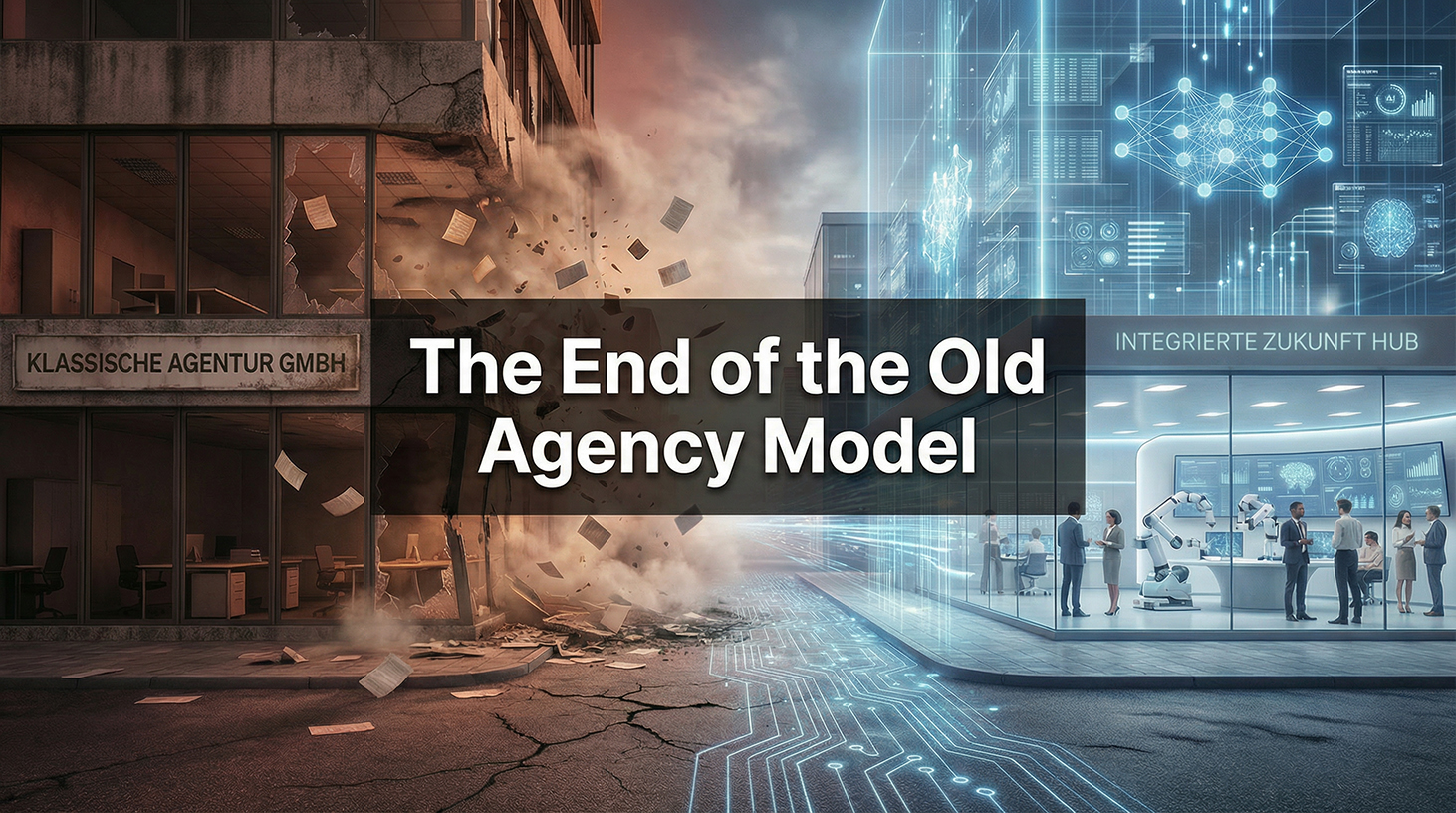
Agency closures, AI disruption and the end of the hourly rate model – Image: Xpert.Digital
Why 198 bankruptcies are just the tip of the iceberg – and which alternative model hits the nail on the head
The "parking meter mentality" is dead: Why full-service agencies are currently rationalizing themselves out of existence
AI delivers 80% quality at 20% of the cost: Why the advertising industry is facing a historic turning point
The advertising industry isn't simply facing a cyclical downturn; it's teetering on the brink of a historic systemic shift: Exploding bankruptcies and significantly declining fee revenues mark the end of the traditional full-service agency. The primary driver of this watershed isn't just the economic climate, but the clash between outdated business models and the disruptive power of artificial intelligence. When AI systems deliver standard services in a fraction of the time and at a fifth of the cost, the traditional "time for money" logic becomes obsolete, rendering the classic hourly rate model obsolete. Simultaneously, customer expectations are changing radically: What's needed are not mere implementers, but strategic partners who provide guidance, integrate AI into business processes, and deliver measurable impact.
This tension reveals a vast market gap between overburdened internal in-house teams and traditional agencies, which often lack entrepreneurial depth. The following text ruthlessly analyzes the industry's systemic weaknesses and demonstrates why hybrid approaches—such as Xpert.Digital's "quasi-in-house model," combined with smart content and Generative Engine Optimization (GEO)—not only survive the agency crisis but also represent a future-oriented and crucial solution. Those who fail to transform now will be swept away by the market.
The numbers behind the system failure
The advertising industry isn't experiencing a temporary downturn. It's undergoing a watershed moment, reflected in figures that, objectively speaking, are alarming. According to an analysis of the German insolvency register by iBusiness, exactly 198 agencies filed for bankruptcy in 2025 – twice as many as the previous year, when the number was 89. The first quarter of 2026 seamlessly continued this trend, already exceeding the figures for the same quarter of 2025 by over 60 percent. These numbers aren't mere statistical noise. They mark the end of an era.
When viewed within the context of the overall economic situation, the agency data fits into a larger picture: In 2025, German district courts registered 24,064 corporate insolvency applications – the highest figure in 20 years, representing an increase of 10.3 percent compared to the previous year. This followed double-digit growth rates in 2024 (+22.4 percent) and 2023 (+22.1 percent). In Baden-Württemberg alone, 2,706 corporate insolvency applications were filed, an increase of 10.7 percent. The advertising industry is part of a systemic crisis – but it is particularly affected because its structural vulnerabilities run deeper than in other sectors.
German full-service digital agencies reported combined fee revenue of €2.355 billion for 2025 – a decrease of 5.2 percent compared to the previous year. At the same time, the number of employees in the 137 ranked agencies fell by 3.5 percent. And a detailed projection by iBusiness publisher Joachim Graf reveals the true extent of the problem: 80 percent of total German agency revenue is potentially threatened by AI. The currently measurable average revenue decline due to AI is 33.6 percent. This figure is no longer a forecast – it's a reality.
The double threat: the economy and AI as a cumulative crisis
Those who attribute the agency closures solely to the weak German economy are missing the point. The economic component is real – shrinking budgets, hesitant investments, and the ongoing pressure on marketing budgets. The German Association for Industrial Communication (BVIK) recorded declining marketing budgets in industry in 2025 for the first time in five years, averaging 3.1 percent – while at the same time 87 percent of respondents reported external price increases of around 17 percent. The purchasing power of these budgets is therefore shrinking in two ways: nominally due to budget cuts, and in real terms due to inflation in service prices.
But the real, deeper force is structural in nature. Artificial intelligence is rapidly devaluing precisely those services on which the classic agency business model was built. Copywriting, image production, campaign logic, performance optimization, social media content – all of this falls under what iBusiness classifies as "potentially threatened by AI." In 2025, a freelance copywriter actually had to file for bankruptcy; his insolvency petition stated verbatim: massive revenue losses as a result of the increased use of AI in the industry. What was once a worst-case scenario is now a reality documented in insolvency proceedings.
Expert Timo Springer's striking assessment, based on his observations in over 80 AI workshops with agencies, precisely captures the dynamic: AI delivers 80 percent of the quality, at 20 percent of the cost, in 5 percent of the time – thus rendering traditional hourly billing obsolete. The economy can recover. This leap in quality brought about by AI systems is irreversible.
The business model as the real enemy
The harshest truth isn't the market situation. It's the business model itself. The classic agency model is based on a simple logic: time for money. You bill for working hours. The more hours, the more revenue. The more employees, the more billable time. This "parking meter mentality," as the Munich Chamber of Industry and Commerce calls it, works as long as the services provided during those hours are difficult to substitute.
This very substitutability has now occurred – and it's happening in two directions. First, through AI: Automated workflows now accomplish in hours what used to take weeks. Second, through in-housing: According to the Association of National Advertisers, 82 percent of the large companies surveyed now operate their own in-house agencies. The BVIK report shows the same trend in German industry: declining budgets for external contracts, increasing demands for measurability and direct business contribution. Only 27 percent of the companies surveyed expect budgets for external service providers to increase – an unmistakable signal.
The resulting efficiency paradox is brutal: agencies that successfully implement AI are rationalizing themselves out of existence. Less effort means fewer billable hours. Clients see the reduced effort and ask why they should pay the same prices when "AI is doing it now." The value of the idea remains, but the billable effort decreases. The business model is destroying itself.
Four systemic weaknesses of the classic digital agency
iBusiness publisher Joachim Graf, after speaking with agency executives, has identified four core problem areas that together are eroding the foundation of the classic model:
The first problem is the AI problem itself: agencies whose business model is based on hiring out employees face structural difficulties when a technology streamlines and devalues precisely this work. AI produces excellent average results – and for many standard services that agencies used to bill, this average is now sufficient. The "it'll do" factor is the invisible revenue killer.
The second problem is the temporary staffing problem: The strategic way out of the hourly rate dilemma—towards results-oriented consulting, towards access to the board, towards genuine responsibility for business results—requires an intimate understanding of the client's business model, an understanding of the processes, mastery of platform technologies, and credibility with management. This is a transformation, not an optimization. Many workbench agencies are simply unprepared for it.
The third problem is technological overload: AI agents, multi-agent systems, domain-specific language models, 6G connectivity, preventative cybersecurity – technological change is accelerating, while at the same time the ability of smaller agencies to manage training costs and hire experts is limited. The result: Many agencies are transforming into "workbenches on speed" – they are buying AI tools to reduce individual fees, but simultaneously increasing their AI licensing costs.
The fourth problem is the staffing problem: In a labor market that is structurally shrinking – fewer births, less immigration, more retirements – the costs for qualified specialists rise automatically. Only companies that can scale exponentially rather than linearly can afford the necessary quality premium. Agencies with a linear hourly rate model find themselves caught in a cost bind.
What customers really want: The shift from implementation to guidance
Parallel to the erosion of supply, the demand side is also changing – fundamentally. A recent agency survey by teambox shows that 87 percent of companies confirm that customers now expect more performance, even though budgets are stagnating or decreasing. What has changed is not just the price, but the type of service desired.
Today, clients need less implementation and more guidance. They no longer primarily need someone to build websites, write newsletters, or produce social media posts on demand. They need someone to tell them what they should actually be doing – what the right strategy is, which channels are effective in their industry, how AI can be integrated into their own processes, and how their brand should be positioned in a world where algorithms make the initial selection. The 2025 CMO study, conducted with 548 marketing managers from Germany, Austria, and Switzerland, shows that external partners are increasingly sought as strategic collaborators rather than mere implementers.
This means that the focus is shifting vertically. Away from production, towards interpretation. Away from output, towards guidance. And this is precisely where the core problem lies: Many agencies are neither structurally nor culturally equipped for this new role. They have spent decades optimizing the "how" – and are suddenly being asked to answer the "what".
The new gap in the market: Between in-housing and genuine consulting
The market is splitting into two movements that appear contradictory at first glance, but stem from the same root cause. On the one hand, companies are bringing marketing services back in-house – in-housing. On the other hand, the need for external strategic expertise is growing. Both movements reflect the same underlying concern: the traditional agency model no longer fully meets either requirement.
In-house marketing has its limitations: While the Association of National Advertisers and other studies show that over 80 percent of large companies now operate their own marketing teams, internal teams are encountering structural limitations. In-house burnout, a lack of industry breadth, technological overload, and the inability to view the company from an external perspective are real problems. Analysts estimate the annual fixed costs for a fully developed in-house marketing team at between €250,000 and over €500,000 – a fixed cost that becomes a burden in economically volatile times.
The gap that opens up is therefore twofold: On the one hand, internal teams lack the necessary external perspective, depth, and flexibility. On the other hand, traditional agencies are not structurally equipped to meet the new requirements – strategic, data-driven, AI-integrated, and manageable. This gap represents the real market opportunity of the coming years.
🎯🎯🎯 Data-driven B2B industry hub as a quasi-in-house solution

The quasi-in-house solution: How Xpert.Digital closes operational gaps in B2B marketing and sales – Smart Content-Driven Business - Image: Xpert.Digital
Xpert.Digital is a data-driven B2B industry hub led by Konrad Wolfenstein . The company acts as an external, quasi-in-house solution for industrial partners, closing operational gaps in marketing, content, and sales – without requiring additional resources on the client side.
More information here:
Visibility as a systemic issue: Why deep content becomes a competitive advantage
The Xpert.Digital model: Why this approach hits the nail on the head
Against this backdrop, it becomes clear why the Xpert.Digital concept is not a niche solution, but a structural answer to a structural crisis. The model explicitly positions itself as a "quasi-in-house solution"—and this term precisely describes what the market needs but can scarcely find.
What does "quasi-in-house" actually mean? It means the operational proximity, process understanding, and confidentiality of an internal marketing department – without the fixed costs, hiring risks, and structural inertia of a true in-house team. Xpert.Digital supports companies flexibly and efficiently, ideally suited for business development, marketing, and PR strategies, data-driven and across all industries. It's not about selling hours – it's about closing operational gaps without requiring the client to build additional infrastructure.
This model precisely addresses the needs identified by market research: B2B companies report that their primary obstacle is not financial, but rather a lack of time. Eighty-five percent cite time constraints as the main impediment to regular, high-quality content creation. The need is undeniable – it's well-documented. The question is whether the service provider is structurally calibrating the response correctly.
Smart content as a strategic lever: data instead of decoration
The term "Smart Content-Driven Business" describes a paradigm shift in the understanding of B2B marketing. In this model, content is not a decorative element, busywork for creative teams, or a mandatory exercise for a company's public image. Content is a sales tool, a positioning vehicle, a visibility engine, and a quality signal all in one.
What makes this approach such an economic advantage in the current climate? The German advertising market invests €30.9 billion annually in digital marketing, and the industry employs around 268,000 people. At the same time, research shows that AI agents are increasingly conducting procurement research – not only for private consumers but also in B2B procurement. When algorithms and AI agents make the initial selection for purchasing decisions, structured discoverability becomes a critical priority. Brands that are not visible in this filtering process are ignored – regardless of their quality.
Xpert.Digital addresses precisely this point. The platform, with over 2,500 expert articles in 18 languages and over 400 PDF documents, is not a showcase website, but rather a systematically built visibility asset. In an era where Generative Engine Optimization (GEO) – optimization for AI-powered search systems – is becoming the next stage after traditional SEO, this depth and structural breadth of content represents a defensible competitive advantage.
The compensation model of the future: From hour to impact
The Munich Chamber of Industry and Commerce (IHK München) succinctly summarizes the transformation of the agency business model: away from the "parking meter mentality" and towards value-based, results-oriented compensation. Clients want to know what they're getting for their money – and they expect measurable success. This expectation is legitimate, and in a world where AI standardizes production output, it's no longer negotiable.
Timo Springer identifies specific new monetization models currently being discussed in the industry: performance-based billing according to measurable KPIs, licensing models for proprietary AI tools and workflows, subscription models for ongoing services, and hybrid models combining base retainers and success-based components. These models share the common feature of focusing on output—the result—rather than input. For customers, this increases predictability and trust. For service providers, it requires a willingness to take responsibility for results.
The quasi-in-house model is structurally ideal for precisely this type of billing. Those who are operationally integrated into the client's processes, understand the business model, and view sales and marketing as an integrated function can also be held accountable for results. Conversely, those who deliver one-off campaign packages on demand lack leverage for sustainable impact – and therefore no basis for results-based compensation.
AI integration as an enabler, not a threat
A fundamental error in the debate about AI and agencies lies in treating AI either as a pure threat or a pure opportunity. The reality is more precise: AI is a threat to business models based on substitutable production services. It is an enabler for models that rely on guidance, strategy, and integration.
In industries with strong AI adoption, productivity has grown almost four times faster since 2022 than in industries without AI. Employees with AI expertise—machine learning, prompt engineering, workflow automation—earn on average up to 56 percent more than their AI-inexperienced colleagues. And while the total number of job postings shrank by 11.3 percent, jobs requiring AI increased by 7.5 percent. The message is clear: those who master AI will not be replaced; they will be valued more highly.
For a model like Xpert.Digital, this means: AI is not the enemy of the consulting approach, but rather its multiplier. When AI takes over the production tasks, time is freed up for what AI cannot do: industry understanding, relationship building, strategic assessment, and translating market data into concrete recommendations for action. AI handles the execution – the service provider delivers the interpretation. This is precisely the division of labor model that describes the future of consulting services.
Disorientation as a market opportunity: The strategic opportunity in the crisis
It would be too simplistic to view the decline of agencies merely as a loser's story. Behind every structural change of this magnitude lies a market gap – and this gap is substantial. The German consulting market has surpassed the 50 billion euro mark, with growth concentrated in one specific segment: AI integrators and strategic implementation partners. Companies are no longer just demanding strategic PowerPoint slides, but functional, scalable solutions that are directly integrated into their business processes.
Market research by teambox shows that 87 percent of companies expect more performance – with the same or a decreasing budget. This is not a contradiction, but a mandate: efficiency through integration. More output not through more hours, but through better processes, a clearer strategy, and smarter tools. The companies that accept and fulfill this mandate will be the winners of the market consolidation.
The fact that the German advertising market is simultaneously experiencing overall growth – with digital formats driving record growth according to iBusiness – demonstrates that the demand for communication services is not disappearing. It is simply being redistributed: away from production agencies and towards strategic partners, data analysts, and AI integrators. Those who are correctly positioned today can achieve disproportionate growth in this environment.
Branding in the algorithm age: Why visibility is becoming a systemic issue
One of the less discussed, but strategically most significant consequences of AI penetration is the altered logic of visibility. When AI agents take over preliminary research in the B2B procurement process—and this is a development that is already measurable—then a company's structured, machine-readable online presence determines whether it even makes the shortlist. Brands that are not anchored in the training data, indices, and knowledge graphs of AI systems will simply not be recommended.
This fundamentally shifts the logic of marketing. Traditional SEO optimizes for search engine algorithms. Generative Engine Optimization (GEO) optimizes for AI systems that synthesize rather than index. Structured content that demonstrates depth, authority, and relevance becomes the entry ticket to the selection lists of the next generation of procurement systems. Through the systematic development of high-quality specialist content in 18 languages over the years, Xpert.Digital has built an asset that represents a strategic advantage in this new logic of visibility.
For medium-sized B2B industrial companies – Xpert.Digital's core target group – this dimension is often not yet on their radar. They struggle with day-to-day operations, have no time for strategic content planning, and don't always immediately recognize the connection between content depth and business success. This is precisely where the consulting expertise lies: not answering the question of what text to publish today, but rather what visibility architecture a company will need in the next three to five years.
The courage to transform: What really needs to be rethought
The forecast is clear: In 24 months, there will be two types of agencies – those that have radically transformed their business model and those that no longer exist. This forecast also applies to every other consulting service provider. Transformation doesn't mean optimization. It means a fundamental realignment of what you sell, how you sell it, and for whom you do it.
Market trends clearly indicate the right direction. Budgets are shifting from media production to data and AI. 71 percent of the GWA members surveyed attribute their clients' increasing cost-cutting measures to more efficient use of AI. At the same time, 67 percent rate their own AI knowledge as good to very good – a self-assessment that is often more favorable than reality, but also demonstrates the strategic will to adapt.
What agencies and consultancies need now is no longer the courage to make minor adjustments, but the willingness to fundamentally question their own business model. From hourly rates to impact. From the workbench to strategy. From campaign production to long-term operational partnerships. Those who take this step – structurally, culturally, and commercially – will not only survive, but will benefit disproportionately in a significantly consolidated market.
The Xpert.Digital model demonstrates that this step is possible and what it can look like: as a data-driven, content-driven, operationally flexible quasi-in-house partner that offers medium-sized B2B companies precisely what the market demands but traditional structures can no longer provide. The market is being consolidated. The only question is, which side will you be on afterward?.
Your global marketing and business development partner
☑️ Our business language is English or German
☑️ NEW: Correspondence in your native language!

Konrad Wolfenstein
I and my team are happy to be available to you as your personal advisor.
You can contact me by filling out the contact form here or simply call me at +49 7348 4088 965. My email address is : [email protected]
I'm looking forward to our joint project.
☑️ SME support in strategy, consulting, planning and implementation
☑️ Creation or realignment of the digital strategy and digitization
☑️ Expansion and optimization of international sales processes
☑️ Global & Digital B2B trading platforms
☑️ Pioneer Business Development / Marketing / PR / Trade Fairs
📈🔵 Ambidexterity or doom: The only management concept that still works in the triple crisis💡

When proven strategies fail: Organizational adaptability in the digital transformation of ambidexterity - Image: Xpert.Digital
We are currently experiencing a period of economic turmoil that differs fundamentally from previous recessions. A deceptive silence prevails in the boardrooms of European and international companies – broken only by the sound of failing strategies that were considered a guarantee of success just yesterday. This is not merely a cyclical downturn, but a profound structural break. The tools with which companies achieved growth for over two decades simply no longer work.
More information here:
📈🔵 Market knowledge vs. marketing knowledge: Why SMEs block their own growth 💡

Market vs. Marketing Knowledge: Why SMEs Block Their Own Growth - Image: Xpert.Digital
A persistent, pragmatic misconception exists among small and medium-sized enterprises (SMEs): that those who know their customers and the market also know how marketing works. However, this very equation is increasingly becoming a strategic trap for many SMEs.
The following article analyzes the often overlooked tension between operational market knowledge (looking in the rearview mirror) and strategic marketing knowledge (the high beam for future market share). Learn why a sole focus on sales targets leads to interchangeability in the long run and how SMEs can mature from "short-distance runners" to distinctive brands by consciously separating and realigning these two disciplines. Because those who understand marketing merely as "colorful pictures for sales" surrender 95 percent of tomorrow's potential customers to the competition without a fight.
More information here:










