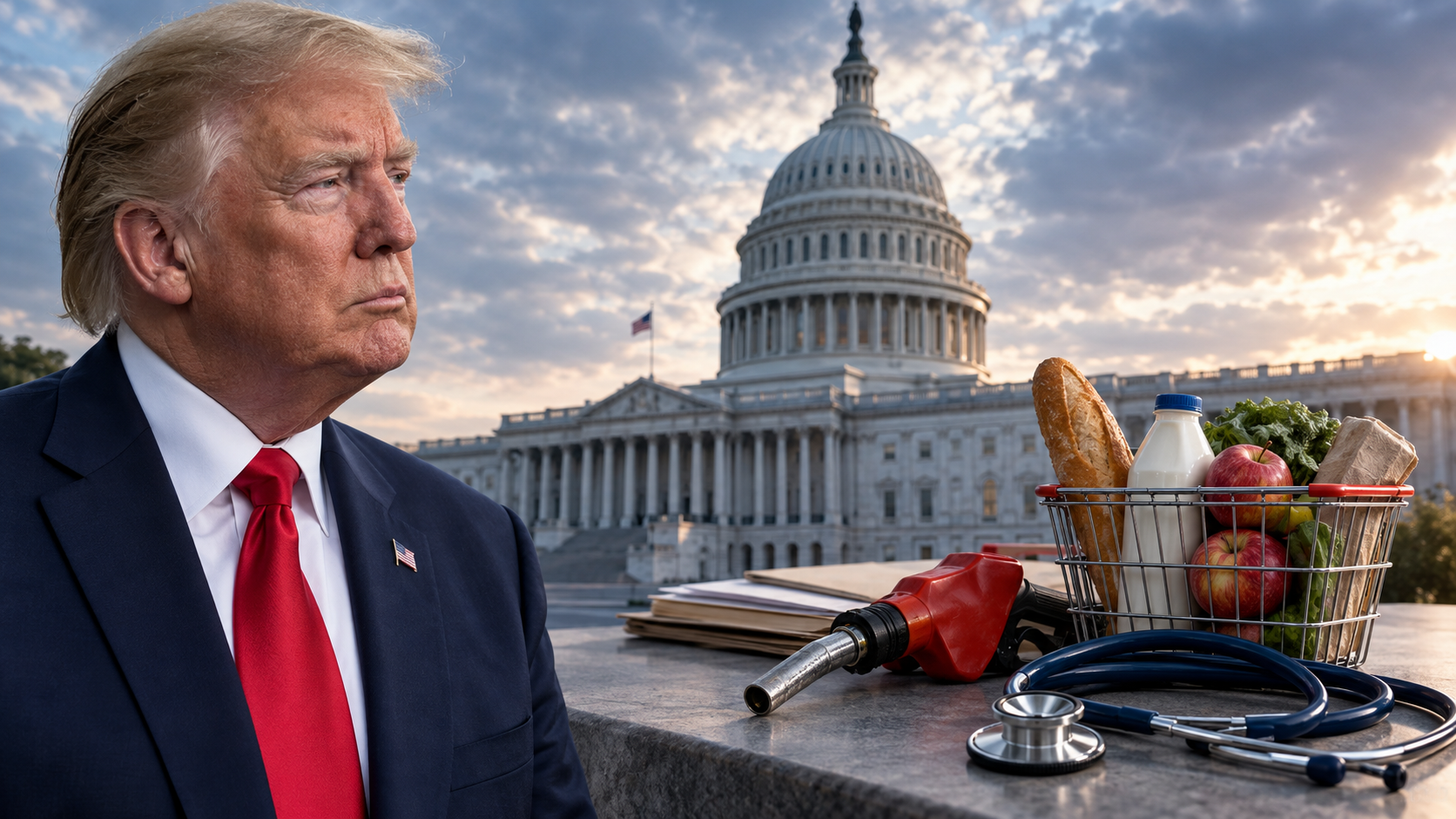
After the US midterms: Democrats versus Trump – a new majority caught between political reckoning and economic responsibility – creative image on the topic, created with AI: Xpert.Digital
Gasoline, food, health insurance: Can Congress really lower costs?
Trump under pressure, households under strain: The economic reckoning of the new majority
Democrats' 100-day plan: What could change for American families
Democrats intend to use their new majority in the US Congress to exert greater control over Donald Trump and his administration – while simultaneously reducing the economic burden on many households. A 100-day program is planned to address issues such as gasoline, food, and healthcare. Democrats also plan to reverse changes to the Affordable Care Act and cuts to Medicaid. Leading party representatives have not ruled out another impeachment trial.
However, political oversight does not automatically lower prices. Investigations can uncover potential conflicts of interest, prosecute misconduct, and strengthen trust in government institutions. The cost of living, on the other hand, depends on complex factors: from international markets and supply chains to competition, insurance coverage, and government funding. Even well-intentioned measures can also create new costs or simply shift burdens from one group to another.
Therefore, what matters is not just how many investigations the Democrats launch or how sharply they criticize the administration. What counts is whether their political majority leads to comprehensible and sustainable improvements – and whether they disclose who will pay for the planned tax relief. This new position of power thus gives the Democrats not only additional oversight but also greater responsibility for the economic consequences of their decisions.
Washington's change of power and the bill for America: What the Democratic offensive against Trump means economically
More control, lower costs? The difficult task facing Democrats in Congress
The Democrats are linking their new majority in the US House of Representatives to a two-pronged promise: They want to tighten oversight of Donald Trump's administration while simultaneously reducing the economic burden on the population. Investigations into the president, other members of the administration, and potentially corporations are intended to establish political accountability. In parallel, a 100-day program is meant to lower the costs of gasoline, food, and healthcare. Changes to the Affordable Care Act and cuts to Medicaid are also to be reversed. Leading Democrats are not ruling out another impeachment trial.
This creates a political constellation whose economic significance extends far beyond individual parliamentary inquiries. It concerns the distribution of public funds, the reliability of economic policy rules, the relationship between businesses and the government, and the question of how much power a parliamentary majority actually possesses vis-à-vis a president from the opposing party.
The central economic challenge lies in reconciling two distinct tasks. Political oversight can uncover abuses, correct perverse incentives, and strengthen trust in state institutions. However, it does not automatically lower prices at the gas station, in the supermarket, or at the doctor's office. Conversely, short-term tax relief measures may be popular without addressing the structural causes of high living costs.
The success of the democratic strategy will therefore not depend solely on how many investigations are launched or how sharply the government is criticized. What is crucial is whether verifiable improvements emerge from parliamentary power: more reliable rules, economically sustainable tax relief, and responsible management of public finances. The new majority thus assumes not only additional oversight powers but also a greater share of the political responsibility for what happens next.
The election victory changes the distribution of power, but not immediately the government
The new majority is initially a parliamentary, not a presidential, shift in power. According to current election projections, the Democrats will not only regain control of the House of Representatives but also a majority in the Senate. The final strength of individual majorities must be distinguished from the further vote count. Equally important is the timeline: The newly elected representatives and senators will not assume their duties until the new Congress takes office in January 2027. The election outcome therefore already alters expectations, but not immediately all legal options.
This distinction is crucial for economic analysis. Businesses and investors often react to anticipated political changes. However, actual legislative changes require parliamentary procedures, viable majorities, and, potentially, presidential approval. Therefore, significant political and administrative hurdles can exist between an announcement in November and effective tax relief the following year.
The House of Representatives has 435 voting seats; 218 are needed for an absolute majority. Such a majority allows a party to significantly determine the parliamentary agenda and shape the work of committees. This results in a different power position, particularly during investigations, compared to the opposition. Hakeem Jeffries from New York and Robert Garcia from California, with their announcements, therefore represent a shift from predominantly public criticism to institutionally supported oversight.
A majority in Congress does not, however, grant unlimited legislative power. In the Senate, many regular bills require 60 votes to end a deadlock. This threshold is higher than a simple majority. Consequently, a party can control both chambers and still face difficulties in passing sweeping economic or social policy reforms.
From an economic perspective, this creates a system of shared power. The Democrats can shift priorities, demand information, and increase political pressure. Trump, meanwhile, remains president. Anyone wishing to assess the economic consequences must therefore distinguish between investigative capacity, negotiating power, and actual implementation.
Why the cost of living dominates the political conflict
The announced relief program targets expenditures that households experience most directly. Groceries are purchased regularly, gasoline prices are publicly visible, and healthcare costs can significantly burden even high-income families. These areas therefore combine economic importance with high political scrutiny.
Price trends explain why a falling inflation rate alone does not end the dissatisfaction of many people. In December 2025, overall American consumer prices were 2.7 percent higher than the previous year. Food prices rose by 3.1 percent, food for home consumption by 2.4 percent, and food eaten out by 4.1 percent. Significant price increases had already occurred in the preceding years. The lower inflation rate thus meant a slower rise in prices, not a return to previous levels.
The most recent available data also underscore the need for a differentiated analysis. In September 2026, general consumer price inflation was 3.7 percent compared to the previous year. Food prices were 2.5 percent higher and food for household consumption 1.8 percent higher than their respective levels of the previous year. The price increases thus differed significantly between the expenditure categories.
This poses a problem for democratic communication. The promise of lower costs can refer to at least three different goals: genuinely lower market prices, reduced internal burdens through government support, or a slower increase in expenditures. These goals are not identical and require different instruments.
A subsidy can ease the burden on the household budget even if the market price remains unchanged. Increased competition can lower prices, but often takes time. Higher productivity can curb costs in the long term, but is rarely achieved within a few weeks. A sound economic policy program must therefore clearly state what form of relief it intends to achieve and within what timeframe.
The crucial distinction between price level and purchasing power
Political debate often conflates prices, inflation, and purchasing power. For a reliable assessment, these factors must be separated. The price level describes how expensive goods and services are. The inflation rate measures how quickly this level rises. Purchasing power also depends on how incomes, taxes, transfers, and unavoidable expenses develop.
A purely illustrative example clarifies the difference: If the price of a basket of goods first rises from 100 to 120 and then to 123, the second price increase is only 2.5 percent. The basket of goods still remains 23 percent more expensive than at the beginning. A significantly lower inflation rate can therefore coincide with sustained financial pressure.
For households, it is also crucial to know which expenses are rising most sharply. Those who need a large portion of their income for food, transportation, and medical care have fewer options for avoiding these increases. Average inflation rates therefore only provide a limited picture of individual circumstances.
This leads to a key requirement for the announced policy: it should not be measured solely by a general inflation figure. A more meaningful approach would be a combination of available income, necessary household expenditures, and financial risks. In the healthcare sector, for example, this includes not only insurance premiums but also deductibles, co-payments, and the question of whether treatment is even accessible.
An economically convincing program would be one that improves real financial freedom without negating its effect through additional burdens elsewhere. The political challenge lies in explaining such outcomes in an understandable way, even though they are more complex than the promise to lower all prices.
Petrol prices can be influenced politically, but not set by parliament
The line between political responsibility and economic control is particularly clear when it comes to fuels. A relief program must take into account that the final price is composed of several elements: the raw material, its processing, transport and distribution, as well as government levies. In addition, international developments can alter supply and expectations.
This presents a fundamental problem for every government and every congressional majority. A national measure can influence individual cost components, but it does not automatically control the entire market. Even if a political intervention is successful, opposing developments can override its effect.
Temporary tax relief would initially shift the burden between private households and public revenue. While it could provide short-term relief, it would raise the question of how to replace the missing funds. Furthermore, it would be necessary to examine what proportion of the relief actually reaches consumers. Full pass-through should not simply be assumed.
Interventions in supply and infrastructure must also be assessed according to their time horizon. Measures that facilitate investment or reduce bottlenecks can be economically sound. However, they are different from an immediate reduction in prices. Between a political decision and the availability of additional usable capacity, there are regularly further implementation steps.
A balanced strategy would therefore have to distinguish between short-term relief measures and long-term security of supply. Its success should not be measured by individual, particularly low fuel prices, but by whether mobility becomes more affordable and less vulnerable to crises. A 100-day program can provide a framework for this. However, it should not suggest complete control over a complex market.
Our US expertise in business development, sales and marketing


Our US expertise in business development, sales and marketing - Image: Xpert.Digital
Industry focus areas: B2B, digitalization (from AI to XR), mechanical engineering, logistics, renewable energies and industry
More information here:
A thematic hub offering insights and expertise:
- Knowledge platform covering global and regional economies, innovation and industry-specific trends
- A collection of analyses, insights, and background information from our key areas of focus
- A place for expertise and information on current developments in business and technology
- A hub for companies seeking information on markets, digitalization, and industry innovations
The challenges facing Democrats in Congress
Food prices demand more than the blanket accusation of excessive profits
The economic impact chain is even broader for food products. Agricultural production, processing, packaging, refrigeration, transport, and trade each contribute to cost formation. Therefore, an analysis must distinguish whether price increases arise primarily from higher input costs, lower available quantities, productivity problems, or limited competition.
The data already reveal significant differences within the food sector. In 2025, the prices of meat, poultry, fish, and eggs combined increased by 3.9 percent. Fruits and vegetables, on the other hand, rose by 0.5 percent, while dairy products and related goods became 0.9 percent cheaper. Given such differences, a single explanation for all food prices would be too simplistic.
Investigations against companies can be economically worthwhile if there is concrete evidence of illegal agreements, deception, or other violations. However, the mere observation of high prices is not sufficient to prove wrongdoing. Likewise, increased corporate profits alone do not prove that a price was set unfairly.
Conversely, the complexity of supply chains should not serve as a blanket excuse for actual abuse of power. The relevant questions are at what point in the value chain a burden arises, how it is passed on, and whether companies or consumers have realistic alternatives.
A robust program would therefore have to combine competition policy, security of supply, and social relief. Various approaches are conceivable, the benefits of each of which would need to be examined: fewer unnecessary barriers to market entry, more efficient logistics, improved transparency, and targeted support for particularly burdened households. The decisive factor would not be the political harshness of a measure, but its demonstrable impact on costs, availability, and competition.
The healthcare system is the biggest structural lever for the relief agenda
Healthcare occupies a special position within the announced program. This is not just about individual consumer prices, but about a very large sector of the economy and the protection against existential risks.
American healthcare spending reached approximately $5.3 trillion in 2024. This equated to $15,474 per capita and 18.0 percent of the gross domestic product. Compared to the previous year, spending increased by 7.2 percent. This magnitude illustrates that even relatively small changes in the financing system can have significant macroeconomic effects.
At the same time, the debate about insurance coverage must not be equated with a debate about all healthcare costs. The Affordable Care Act and Medicaid serve different functions. The announced reversal of changes in both areas must therefore be considered separately: Which people gain access to which coverage, who finances this coverage, and how do the actual out-of-pocket costs change?
Reversing a cut can increase the financial security of affected households without immediately reducing the underlying treatment costs. This would not automatically be a failure. Insurance companies are specifically designed to spread large risks across multiple parties. However, it would be misleading to simply present a change in financing as a reduction in overall economic costs.
A comprehensive reform would have to address both levels. It would have to guarantee access to care and simultaneously investigate why providing medical services is so expensive. Only by considering financing and service delivery together can it be assessed whether relief is sustainable in the long term or merely shifts the burden between households, employers, and the state.
Medicaid and the Affordable Care Act: The distribution question behind the billions
The potential impact of legislative changes is illustrated by estimates related to the 2025 Budget Act. These estimates suggest that the number of people without health insurance could be ten million higher in 2034 than previously projected. According to the underlying calculations, 7.5 million of these increases are attributable to changes in Medicaid, 2.1 million to the Affordable Care Act's insurance markets, and another 400,000 to other regulations and interactions.
These figures must be interpreted carefully. They represent a forecast against a benchmark scenario, not an actual loss of insurance coverage. Furthermore, the figure does not imply that all affected individuals will lose their coverage on the same day. Effective dates, individual circumstances, and other political decisions will influence the actual outcome.
For economic evaluation, the distributional effect is crucial. A government saving does not automatically translate into an equally large saving for the economy as a whole. If a publicly financed risk is increasingly borne by the private sector in the future, the allocation of the burden initially changes. Whether genuine efficiency gains also result must be demonstrated separately.
The democratic demand to reverse the changes should therefore be assessed based on several questions. How many additional people would be covered? What individual burdens would decrease? What additional public spending would be required? And what measures could prevent increased funding from simply being absorbed by further price increases?
Conversely, proponents of cuts must explain how the claimed savings will be achieved. Will inefficient expenditures be eliminated, or will services and access be restricted? Both approaches can relieve the burden on the state budget, but they have very different consequences for the population and economic performance.
The long-term health bill remains even after a change in political course
A return to previous rules would not resolve the structural financing issue. Official projections anticipate that American healthcare spending could rise from $5.3 trillion in 2024 to approximately $9 trillion in 2034. Its share of economic output would increase from 18.0 percent to 20.6 percent. For the period from 2025 to 2034, average annual growth in healthcare spending of 5.4 percent is assumed, compared to 4.1 percent for nominal GDP. These are also projections and not definitive results.
The economic policy significance lies in the relationship between the two sectors. If one sector grows consistently faster than the overall economy, it demands an increasing share of available resources. This creates conflicting objectives: More funding for healthcare can limit the scope for other private or public spending, unless it results in additional productivity or higher incomes.
A responsible democratic strategy must therefore go beyond simply reversing Republican decisions. It must explain how better security can be combined with sustainable spending. A lasting program requires more than additional funding; it requires a vision of which services generate which benefits and where avoidable costs arise.
A blanket approach to cuts would be just as inadequate as assuming that every additional expenditure automatically improves care. What matters is the relationship between costs, access, quality, and health outcomes. This consideration is politically challenging because savings in one area often affect the revenue of another.
That's precisely why the healthcare system is a litmus test for the seriousness of the relief agenda. Those who only promise short-term subsidies fail to address the long-term financing question. Those who only reduce public spending don't necessarily answer the question of the overall societal costs.
Investigations can protect competition – or create new uncertainty
The announced investigations against parts of the government and the business sector have an independent economic dimension. Government decisions influence companies through regulations, subsidies, permits, and market design. Where political ties confer economic advantages, oversight can therefore be more than just a partisan conflict.
From an economic perspective, an investigation would be particularly valuable if it demonstrably clarifies whether public decisions were made according to objective criteria. Disclosing conflicts of interest and correcting abusive advantages can strengthen competition. Companies would then have less reason to expect that political connections would be more important than quality, price, or innovation.
This potential benefit, however, presupposes due process. Political suspicion must not replace proof. The announced tough approach by Jeffries and Garcia initially reflects an intention to exert control, not an established guilt on the part of the individuals or companies involved.
Even the mere risk of an investigation can create potential costs for companies. Documentation, internal audits, and legal advice tie up resources. This effort can be justified if it serves to clarify specific facts. It would become problematic, however, if unclear standards or shifting political motives created persistent uncertainty.
The economic quality of the investigative agenda therefore depends on its discipline. Specific questions, transparent responsibilities, and a clear separation between public scrutiny and judicial decision-making would be more important than the most spectacular hearings possible. A credible majority would have to adhere to these standards even if thorough investigations generate less media attention than harsh accusations.
Why impeachment proceedings are not a shortcut to an economic policy solution
A potential renewed impeachment trial must be distinguished from ordinary investigations. The House of Representatives can pass articles of impeachment by a simple majority. The trial then takes place in the Senate. A two-thirds majority of the senators present is required for a conviction; the immediate consequence of a conviction is removal from office.
This requires distinguishing between two often conflated processes: the initiation of proceedings and the actual removal from office. A majority in the House of Representatives facilitates the first step. It does not guarantee the second. Even a simple majority in the Senate is not sufficient for a conviction.
Economically, such a procedure would be relevant primarily through expectations, political attention, and potential delays. However, no reliable, general forecast for stock prices, investments, or growth can be derived from this. The impact would depend on the specific allegations made, their validity, and how other institutions react.
For Democrats, a significant strategic risk would arise if impeachment proceedings were perceived as a substitute for achieving economic policy results. Such proceedings may be constitutionally mandated if the necessary conditions are met. However, they are not a tool for directly lowering food prices or insurance premiums.
A convincing political approach would therefore have to explicitly distinguish between these two issues. Any potential misconduct in office would have to be decided based on facts and constitutional standards. The discharge agenda would have to be judged based on its financing, feasibility, and effectiveness. The credibility of both tasks would suffer if they merely served as mutual justification.
The first 100 days are an organizational test, not an economic miracle window
A 100-day program creates a clear political timeframe. It consolidates priorities and makes early decisions visible. From an economic perspective, however, this period is primarily a test of preparedness and operational capability.
Within a few months, studies can be structured, legislative proposals introduced, and negotiations initiated. Whether this results in lower ongoing costs depends on the specific instrument. Immediate financial support follows a different timeline than a reform of competition or a change in healthcare structures.
A meaningful evaluation should therefore distinguish between political decision, administrative implementation, and economic outcome. A passed law can be significant even if its effects only materialize later. Conversely, a publicly announced measure is not yet a proven success.
Furthermore, there is the danger of jumping to conclusions. If a price falls during the first 100 days, this is not necessarily a result of the new program. Conversely, if it rises, this does not automatically prove its ineffectiveness. Economic changes can have multiple causes that coincide over time.
A more convincing method for monitoring success would therefore link concrete measures with appropriate key performance indicators. For example, in the case of insurance reform, these would include access to insurance and out-of-pocket expenses. For competition policy measures, market conditions and price trends would need to be examined. For government aid, disbursement, targeting accuracy, and financing would have to be considered. Such an approach would be less sensational than a blanket promise of success, but analytically far more robust.
Relief is only sustainable if its financing remains transparent
Every relief agenda requires a clear answer to the question of who will bear the costs. If public subsidies are increased or revenues are reduced, this must be reflected elsewhere in the budget or in borrowing. If businesses face heavier burdens, it must be examined whether and how they will react. If spending is cut, the question arises as to which services and recipients will be affected.
It is useful to distinguish between three processes. A genuine improvement in efficiency enables the same or better performance with fewer resources. Redistribution changes who pays. A deferral provides relief today and shifts burdens into the future. All three can be politically justified, but should not be lumped together under the same term.
Additional public spending cannot be assessed independently of the economic environment. Its impact depends, among other things, on whether it primarily alleviates financial constraints on households or addresses existing ones
🎯🎯🎯 Data-driven B2B industry hub as a quasi-in-house solution


The quasi-in-house solution: How Xpert.Digital closes operational gaps in B2B marketing and sales – Smart Content-Driven Business - Image: Xpert.Digital
Xpert.Digital is a data-driven B2B industry hub led by Konrad Wolfenstein . The company acts as an external, quasi-in-house solution for industrial partners, closing operational gaps in marketing, content, and sales – without requiring additional resources on the client side.
More information here:
Your global marketing and business development partner
☑️ Our business language is English or German
☑️ NEW: Correspondence in your native language!

Konrad Wolfenstein
I and my team are happy to be available to you as your personal advisor.
You can contact me by filling out the contact form here wolfenstein@xpert.digital:or simply call me at +49 7348 4088 965. My email address is
I'm looking forward to our joint project.