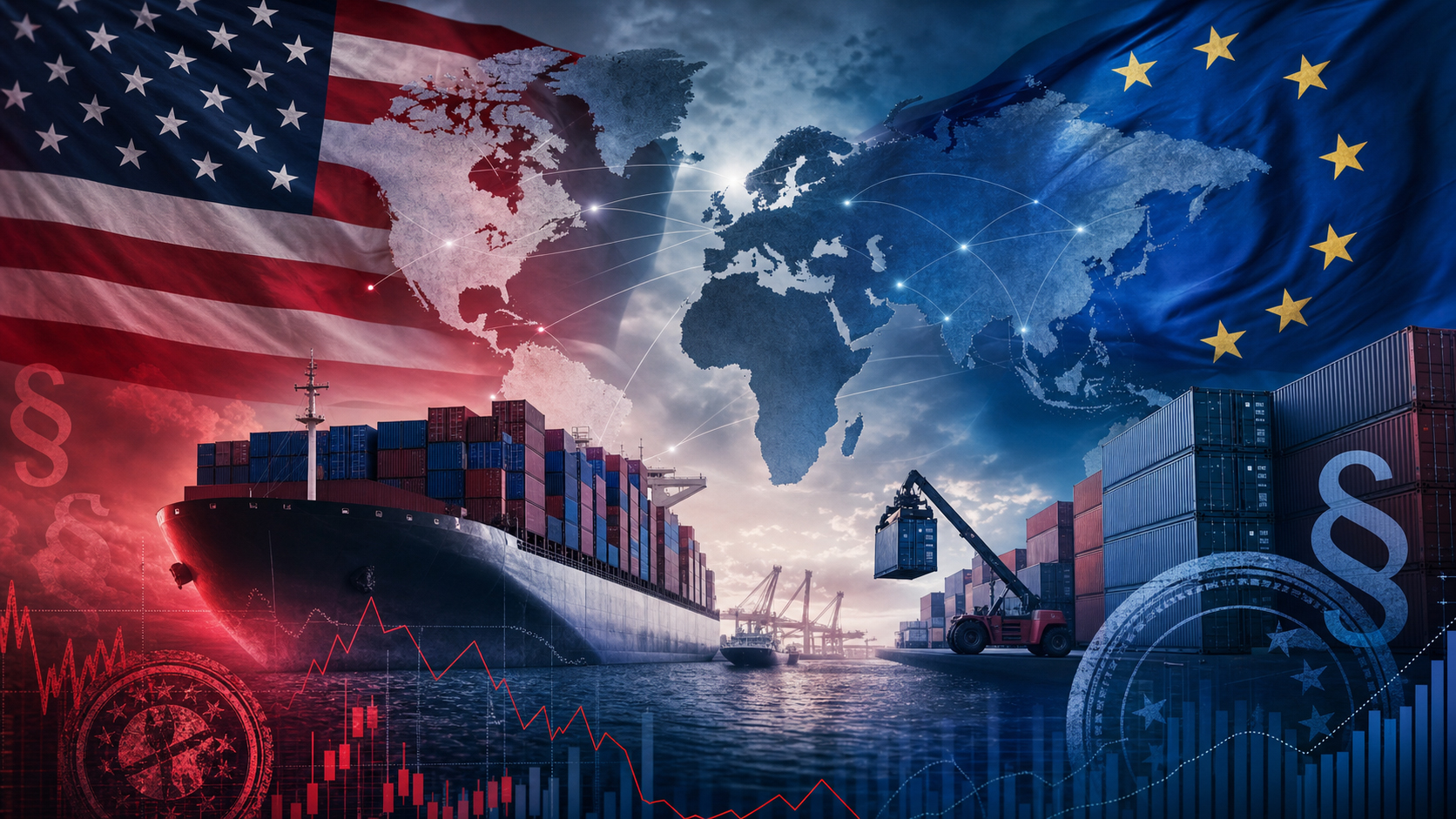
The new US tariff war: A tariff policy in a permanent state of improvisation – This time forced labor as justification – Image: Xpert.Digital
After court defeat, new US tariff shock: How Trump is undermining world trade with a legal trick
Forced labor as a pretext? The real reasons for the new American tariff war
Europe's economy is in turmoil: Why the Turnberry agreement is suddenly on the brink
The global trade war is entering its next, decisive phase: After the US Supreme Court struck down the Trump administration's emergency tariffs, Washington is now responding with a sophisticated legal maneuver. Under the guise of combating forced labor worldwide, new, far-reaching tariffs of up to 12.5 percent came into effect on July 24, 2026, without any transition period. Sixty trading partners are affected – impacting virtually all US imports. For the European Union, this suddenly puts the Turnberry Agreement, painstakingly negotiated just this past spring, back in jeopardy. But this controversial measure not only threatens the already fragile transatlantic relations, it could also drastically accelerate the radical restructuring of the global economy. An analysis of political improvisation, multi-billion-dollar legal tricks, and the potentially disastrous economic consequences.
Forced labor as justification, geopolitical redistribution as a consequence
When a Cold War law becomes a weapon of the 21st century
On Friday, July 24, 2026, the US government imposed tariffs of 10 to 12.5 percent on imports from 60 trading partners, thus opening the next round of a global trade conflict that has been simmering for years. The European Union is once again affected, with its goods now subject to tariffs under a new legal framework officially justified by the fight against forced labor, but in reality primarily serving as a replacement for tariffs that were previously overturned in court.
This development marks a remarkable turning point in American trade policy. After the United States Supreme Court ruled in February 2026 that the previous reciprocal tariffs, based on emergency legislation, were illegal, the Trump administration wasted no time in finding a new legal basis. The result is a tariff policy that, while formally based on a different section of the law, produces economically similar effects to the measures previously deemed unlawful.
The backstory of a legal defeat with billions in consequences
To understand the current situation, one must take a step back. Following his inauguration in the spring of 2025, Trump imposed tariffs on dozens of trading partners worldwide, invoking the International Emergency Economic Powers Act (IEEPA). These so-called reciprocal tariffs were intended to address alleged trade imbalances and were declared by the administration as a national emergency measure. In February 2026, the Supreme Court ruled by a clear majority that the president had exceeded his constitutional authority with this measure, as the emergency law was never designed for the routine imposition of import tariffs. Consequently, the US government must now reimburse billions of dollars in tariffs to the affected importers, representing a significant financial burden on the American budget and severely damaging the president's political authority in trade policy.
Just one day after the ruling, the White House responded with a temporary solution. On February 24, 2026, a global surcharge of 10 percent went into effect under Section 122 of the 1974 Trade Act. This provision allows the president to impose a surcharge of up to 15 percent for a maximum of 150 days in cases of balance of payments problems, without requiring congressional approval. This time limit was known from the outset and expired precisely on July 24, 2026, at 6:01 a.m. Central European Time, without Congress having granted an extension. At the exact moment the temporary measure was expiring, the administration implemented its next step, ensuring virtually no gap existed between the old and new tariff regulations.
Forced labor as a pretext or a genuine concern?
As early as March 2026, while the Section 122 tariffs were still in effect, the Office of U.S. Trade Representative Jamieson Greer launched investigations under Section 301 of the 1974 Trade Act against 59 countries and the European Union. Section 301 allows the U.S. government to take action against trading partners whose practices are deemed unjustified, unreasonable, or discriminatory against American companies. Historically, this instrument was used during the first Trump administration and under the Biden administration to justify tariffs against China. It is therefore not an entirely new tool, but a proven, legally more robust alternative to the failed emergency approach.
On June 2, 2026, the USTR (United States Trade Representative) announced the results of its investigation: all 60 economies examined had failed to establish or enforce an effective ban on the import of products made with forced labor. The US government argued that the United States was the only country in the world that actually enforced such a ban effectively, while other countries, although they had formal laws, did not consistently apply them. Trade Representative Greer put it this way: this failure forced American workers to compete under unequal conditions, and this inequality would no longer be tolerated.
Numerous trade experts and affected governments, however, view this justification with skepticism. The European Commission explicitly rejected the accusations, stating that it has its own effective regulations against the import of products manufactured using forced labor and that it considers the EU's involvement in this investigation unjustified. Chinese government representatives also criticized the measure as a unilateral, restrictive trade policy disguised as humanitarian concerns. Trade law experts like Caitlin Chalecki of the Atlantic Council point out that the true purpose of switching to Section 301 lies less in combating forced labor than in finding a legally sound, permanent legal basis for the government's customs policy. Because this instrument, unlike the emergency law, requires proper investigative procedures, public consultations, and formal findings, it is significantly more difficult to challenge legally.
How the new tariffs are specifically structured
The regulation, which came into effect on July 24, 2026, distinguishes between two tariff rates. Trading partners that could demonstrate at least partial safeguards against the import of forced labor goods are subject to a tariff of 10 percent. Countries that were certified as having no or only insufficient measures must accept a higher rate of 12.5 percent. According to the USTR, this measure affects the 60 largest trading partners of the United States, which together account for approximately 99.4 percent of total US imports, thus illustrating the enormous scope of this decision.
Certain product categories are exempt from the additional duties, including informational materials, donations, and personal luggage, as well as all goods already subject to separate tariffs under Section 232, which impose national security tariffs on steel and aluminum, for example. Also exempt are certain raw materials whose increased prices could lead to supply shortages in the US, and products that cannot be grown or produced in sufficient quantities in the United States. These exemptions demonstrate that the US government is indeed attempting to mitigate overly obvious repercussions for its own economy and consumer prices, which can also be interpreted as an indirect admission that the tariffs incur significant economic costs.
The special position of the European Union
For the European Union, the situation is more complicated than for many other affected countries because, in addition to the new Section 301 tariffs, the Turnberry Agreement, negotiated in the summer of 2025 between Trump and then-Commission President Ursula von der Leyen, exists. This agreement sets a tariff ceiling of 15 percent for most European exports to the US and was formally implemented by both sides in early summer 2026, after the European Parliament adopted the corresponding accompanying regulations by clear majorities. In return, the EU committed to far-reaching concessions, including the reduction of tariffs on numerous American industrial goods and a pledge to purchase $750 billion worth of American energy by 2028, primarily liquefied natural gas, oil, and nuclear energy.
The crucial open question now is how the new tariffs under Section 301 can be reconciled with the contractually agreed-upon 15 percent cap. The US government continues to point to a general tariff rate of 10 percent for the EU, as well as possible surcharges of up to 12.5 percent for certain product categories, but has not yet publicly clarified whether these new duties are added to the existing Turnberry cap or offset against it. This ambiguity is by no means insignificant, as the EU explicitly secured a safety net within the framework of the agreement: Should the United States deviate from the agreed-upon tariff rates, Brussels can reverse its own concessions, particularly the elimination of tariffs on American industrial goods. Thus, the EU possesses, at least theoretically, effective leverage, although its actual political applicability remains questionable given the economic interdependence and the already fragile transatlantic relationship.
It is also noteworthy that the EU's ratification of the Turnberry Agreement was conditional. The EU Council had made final implementation contingent, among other things, on Washington correcting its tariffs on steel and aluminum by December 31, 2026. This demonstrates that, even from a European perspective, the agreement is considered fragile and open to renegotiation. Against this backdrop, the announcement of the new compulsory labor tariffs appears as a further stress test for a treaty that had only been painstakingly finalized a few weeks earlier.
Our US expertise in business development, sales and marketing


Our US expertise in business development, sales and marketing - Image: Xpert.Digital
Industry focus areas: B2B, digitalization (from AI to XR), mechanical engineering, logistics, renewable energies and industry
More information here:
A thematic hub offering insights and expertise:
- Knowledge platform covering global and regional economies, innovation and industry-specific trends
- A collection of analyses, insights, and background information from our key areas of focus
- A place for expertise and information on current developments in business and technology
- A hub for companies seeking information on markets, digitalization, and industry innovations
Trump's new round of tariffs: Why American consumers will ultimately foot the bill
The economic mechanisms behind customs policy
From an economic perspective, import tariffs primarily function as a consumption tax, initially borne by importing companies but, in practice, largely passed on to end consumers if demand for the goods in question is not sufficiently elastic. For the US economy, this means that the introduction of additional tariffs of 10 to 12.5 percent on imports from virtually all relevant trading partners raises the price level for imported consumer goods, intermediate products, and raw materials. Trade experts like Ajay Srivastava of the Global Trade Research Initiative in India point out that higher tariffs generally lead to increased import costs, greater uncertainty for companies and supply chains, and ultimately, higher prices for American consumers and manufacturers. This is noteworthy because tariff policy is officially justified as a means of protecting American workers, but in reality, it disproportionately burdens those segments of the population who rely most heavily on inexpensive imported consumer goods.
At the same time, there is a risk that this new round of tariffs will further fuel the already strained inflation dynamics in the United States. Tariffs have an economic effect similar to an exogenous supply shock, increasing production costs along global supply chains without a corresponding increase in productivity. Should the US Federal Reserve have to respond to renewed inflation with a more restrictive monetary policy, this could in turn dampen economic growth and increase financing costs for businesses and consumers. This interplay between trade policy and monetary policy is among the least discussed, yet most economically significant, side effects of the current strategy.
The geopolitical dimension of a changing global economy
The deeper economic significance of this development lies less in the immediate price effects than in the accelerated transformation of global trade structures triggered by such a broad-based tariff measure. Trade law experts from various affected countries agree that recurring American tariffs are prompting many states to increasingly conclude trade agreements with each other, instead of continuing to rely primarily on the American market. Specific examples cited include the free trade agreement between the EU and the Mercosur countries of Argentina, Brazil, Paraguay, and Uruguay, which entered into force in May 2026, and the comprehensive agreement between the EU and India, signed in January 2026, which creates a common economic area of approximately two billion people.
This development can be interpreted as a structural reorientation of global trade, in which the United States, despite its continued preeminent economic importance, is increasingly perceived as an unreliable and unpredictable partner. When even close allies like the United Kingdom, Canada, Japan, and New Zealand are affected by changing tariff regimes within a few months, long-term investment decisions based on stable market access to the US become significantly less predictable. This encourages companies worldwide to diversify their supply chains, expand regional trade relationships, and reduce their dependence on a single, politically volatile sales market. While these adjustments do not happen overnight, with each new round of tariffs, the cost-benefit analysis for multinational companies shifts further toward diversification beyond the US market.
The legal stability of the new customs structure
A key difference between the current tariff policy and the previously failed one lies in the legal robustness of the chosen legal basis. While the Emergency Measures Act (IEEPA) granted the president sweeping powers to act quickly and without comprehensive procedural requirements, ultimately leading to its judicial annulment, Section 301 requires an orderly process with formal investigations, public hearings, and documented findings. These very higher procedural hurdles, which were criticized beforehand as a delaying tactic, are now proving to be a strength, as they lend the measure significantly greater legal certainty. Trade lawyers like Singh and Naik, who operate in India, assume that, given established precedents and the discretion granted to the Trade Representative by Congress, the risk of legal challenges to the new tariffs is considerably lower than for the previous emergency tariffs.
At the same time, this same procedural constraint means that future adjustments to tariffs will be considerably more difficult to implement. A repeal, increase, or suspension of tariffs can no longer be carried out overnight by presidential decree, as was possible under the emergency law, but instead requires a formal procedure involving legal justification, public consultation, and official confirmation. This inertia can have both positive and negative consequences: it protects tariff measures from short-term political arbitrariness, but simultaneously hinders a swift de-escalation should, for example, an agreement be in the making during ongoing negotiations with individual countries.
The role of individual affected economies
Within the group of 60 affected trading partners, there are significant differences in their respective negotiating positions and response strategies. Argentina, Cambodia, Ecuador, El Salvador, Guatemala, Malaysia, Mexico, Taiwan, and the United Kingdom are among the countries that have been certified as having at least partially effective safeguards against forced labor imports and are therefore subject to the lower tariff rate of 10 percent. For approximately 45 other economies examined, including China, India, Japan, South Korea, Vietnam, and New Zealand, the higher surcharge of 12.5 percent was imposed.
India occupies a remarkable intermediate position, as it is working on a framework agreement with the US, announced in February 2026, despite ongoing Section 301 proceedings, and publicly emphasizes its commitment to maintaining constructive dialogue with Washington. This dual strategy illustrates that, despite all criticism of the American approach, many countries ultimately rely on pragmatic negotiated solutions rather than risk open escalation, which in turn underscores the structural negotiating power of the United States despite all legal setbacks.
A customs policy in a permanent state of improvisation
The new round of tariffs on July 24, 2026, exemplifies how American trade policy under the Trump administration is in a continuous process of legal adaptation. Individual instruments are replaced as soon as they fail in court, while the fundamental goal of an aggressive, protectionist tariff strategy remains unchanged. The invocation of forced labor as justification may be factually sound in individual cases, but its blanket application to 60 highly diverse economies primarily serves as a legally robust substitute for a previously failed, far more overtly protectionist policy.
For Europe, and especially for export-oriented economies like Germany, this means continued uncertainty about the actual tariff burden, while at the same time the Turnberry Agreement functions as a fragile, but so far not completely undermined, protective instrument. In the long term, the repeated application of such tariff instruments is likely to further reinforce the already observable trend toward the diversification of global trade relationships outside the United States, thus paradoxically promoting precisely the economic isolation that protectionist policies are supposed to prevent.
Your global marketing and business development partner
☑️ Our business language is English or German
☑️ NEW: Correspondence in your native language!

Konrad Wolfenstein
I and my team are happy to be available to you as your personal advisor.
You can contact me by filling out the contact form here wolfenstein@xpert.digital:or simply call me at +49 7348 4088 965. My email address is
I'm looking forward to our joint project.
☑️ SME support in strategy, consulting, planning and implementation
☑️ Creation or realignment of the digital strategy and digitization
☑️ Expansion and optimization of international sales processes
☑️ Global & Digital B2B trading platforms
☑️ Pioneer Business Development / Marketing / PR / Trade Fairs
📈🚀 From visibility to trust 👀🤝 Your scalable path with Xpert.Digital


From visibility to trust: Your scalable path with Xpert.Digital - Image: Xpert.Digital
In industrial B2B, sustainable business relationships rarely emerge overnight. They develop step by step – through visibility, professional relevance, recurring touchpoints, and growing trust. Xpert.Digital's 4-stage model addresses precisely this: It offers a structured path that begins with a manageable entry point and can evolve into deeper collaboration in business development if needed.
Instead of relying on loud marketing promises, this model puts the relationship at the forefront. Companies start with clearly defined, easily calculable measures and then decide, based on their own experience, how far they want to expand the collaboration. A key factor for this undisturbed trust-building process: The platform completely avoids annoying advertising ads, so the editorial focus remains solely on the companies' expertise.
More information here: