
Market opportunities for the AR workstation: Sightful Spacetop for Windows offers a 100-inch display work space for laptops with AR glasses.
Xpert pre-release

Available in 27 languages 📢
Prefer Xpert.Digital on GoogleⓘPublished on: April 25, 2025 / update from: April 25, 2025 - Author: Konrad Wolfenstein

Market opportunities for AR workstation: Sightful Spacetop for Windows with AR glasses offers 100-inch display work space for laptops-Image: Xpert.digital
Comprehensive market analysis for Sightful Spacetop for Windows-opportunities in the B2B market for AR productivity solutions (reading time: 28 min / no advertising / no paywall)
Deutsche Telekom and Sightful: Partnership for AR-based company solutions
Sightful's introduction of "Spacetop for Windows" marks a strategic attempt to establish augmented reality (AR) for mobile productivity in the corporate environment. By converting compatible Windows laptops with artificial intelligence (AI) into immersive 100-inch working areas using AR glasses, the software solution addresses core needs of mobile specialists: an extended work area and increased privacy. The strategic swivel from a proprietary hardware solution towards software for existing laptops positions SightSful to benefit from the forecast growth of the market for AI-enabled PCs.
The central market opportunities for spacetop lie in the operation of a niche of B2B customers, for which visual privacy and a large, portable work area are crucial, especially for activities with sensitive data in public or flexible work environments. The partnership with Deutsche Telekom for German market entry is a significant advantage that creates credibility and enables access to a broad B2B customer tribe.
However, Sightful faces significant challenges. The dependence on specific high-end hardware (Intel Core Ultra processors with NPU, Xreal Air 2 Ultra glasses) initially limits the addressable market and leads to high total costs for the user. Potential concerns regarding the user-friendliness and the comfort of AR glasses in the event of long use as well as the intensive competition by established technologies such as Apple and META that build their own spatial computing ecosystems are risks.
For sustainable success, Sightful has to quickly expand the hardware compatibility, clearly quantify the Return on Investment (ROI) for B2B customers, continuously optimize the user experience and use its strategic partnerships at the maximum. While Spacetop could be a pioneer for AR-based Windows productivity, his long-term success depends on overcoming the current restrictions and the ability to assert itself in a dynamic market against powerful competitors.
Suitable for:

The emergence of AR-supported work environments
The evolution of personal computing is increasingly moving beyond the borders of traditional laptops. Driven by trends such as remote work, increased mobility and the growing need for increased productivity and privacy, the concept of spatial computing comes into focus as the next level of development. This development promises a more seamless fusion of the digital and physical world to enable new forms of interaction and information.
A crucial catalyst for this development is the advent of AI-capable PCs. This new generation of laptops, equipped with dedicated neural processing units (NPUS) in addition to powerful CPUs and GPUs, enables computing -intensive applications that were previously hardly feasible on mobile devices. Advanced AR working environments are among the most promising applications of this new hardware architecture. Market forecasts indicate rapid growth of this segment; According to Canalys, around 20% of the PCs delivered should be relevant in 2024, with an expected increase to over 60% by 2027. This development creates a growing installation basis for software that uses these new skills.
In this context, the start-up Sightful positions itself with its "Spacetop for Windows" solution. After an initial focus on your own hardware platform, Sightful is now focusing on offering software that transforms compatible Windows Ki laptops into immersive work environments. The core promise is the provision of a virtual 100-inch display that is privately, portable and flexible. Sightful is trying to use the convergence of AI PCs and AR software in order to create concrete added value for mobile productivity. Instead of developing a closed ecosystem, the company relies on providing a software level that expands the skills of new third -party hardware. This approach is closely linked to the successful market penetration of AI PCs, which is both an opportunity and a risk.
Sightful Spacetop for Windows: Product analysis
Core functionality and privacy
The heart of Spacetop for Windows is the ability to transform the screen of a compatible Windows laptop into a virtual 100-inch working area by connecting an AR glasses. This extensive virtual canvas enables users to arrange several application windows freely in the room-for example, messaging apps on the side, large spreadsheet centrally and vertically stretched. The software offers intuitive control options via keyboard commands to move windows, change or rotate in size, similar to a multi-monitor setup, but without its physical restrictions.
A central and strongly advertised feature is the inherent privacy of the system. Since the screen content is only visible to the carrier of the AR glasses, sensitive information remains protected from the eyes of third parties. This "for your eye only" principle is particularly relevant for working in public environments such as trains, cafes or aircraft, where protection of confidential data is crucial.
Technology stack and hardware requirements
Sightful positions Spacetop for Windows as a pure software solution that runs on existing, compatible hardware. However, this compatibility is severely restricted and places specific requirements:
- Ki-PC / NPU dependency: The software is specially optimized for Windows laptops, which are equipped with Intel Core Ultra processors of the 7 Series or 9 series (Meteor Lake Architecture or Neuer). These processors have dedicated NPUs, which are essential for the continuous AI processing of the AR interface, says Sightful. Intel chips without NPU and AI CPUs from AMD or Qualcomm are not supported at the start time. This close attachment to Intel results from cooperation to optimize the software on its platform.
- AR glasses: The standard package contains the XReal Air 2 Ultra AR glasses. This underlines that despite the software focus, specific AR hardware is still required.
User experience (UX) and ergonomics
Sightful promises a high -quality visual experience with a light, clear display that adapts to different lighting conditions. In addition, ergonomic advantages are emphasized how improved posture by positioning the virtual display at eye level, which is supposed to prevent neck tension.
However, the actual user experience depends largely on the performance and the comfort of the included XReal Air 2 Ultra glasses. User reports on previous XReal models (Air 2) indicate mixed experiences: On the one hand, the comfort is often rated as good for longer meetings. On the other hand, there are reports of problems that could affect productivity, such as screen jitter (especially when using the Nebula software that replaces spacetop), glare effects on the edges of the lenses and potential blurring, which can be disturbing, especially with text-intensive tasks. It is crucial that the spacetop software compensates for or bypassing these potential hardware weaknesses. The 6-Dof (Degrees of Freedom) Tracking capability of the Air 2 Ultra is positive, which is essential for a stable anchoring of the virtual work area in the room and allows the user to be freer. The low weight of the glasses (83g) also contributes to comfort.
The Spacetop software itself aims to offer a “natural OS experience” that feels familiar, but at the same time opens up the possibilities of spatial computing-more than just a simple screen expansion. The quality of this integration and the stability of the software under real working conditions will be crucial for acceptance.
Suitable for:

Pricing and bundle
Spacetop for Windows is offered in a bundle for $ 899 (as of April 2025). This package includes:
- The XReal Air 2 Ultra AR glasses (retail price approx. $ 699).
- A 12-month subscription to the spacetop software (value $ 200).
After the first year, the software subscription is automatically extended for $ 200 a year. For users who need a visual correction, optional lens inserts are available: $ 50 for one-off glasses and $ 150 for varifocal glasses, with a dioptry range from +6.00 to -9.00 supporting.
The need for a specific, tendency to be high-priced AI laptops (such as Dell XPS, Lenovo Yoga Slim etc. [German article]) In addition to the $ 899 bundle, Spacetop clearly positions the premium segment for professional users and companies. The total costs for commissioning are considerable. The subscription model ensures Sightful recurring income, but also represents an ongoing financial obligation for the users.
Spacetop for Windows - key specifications, requirements and prices
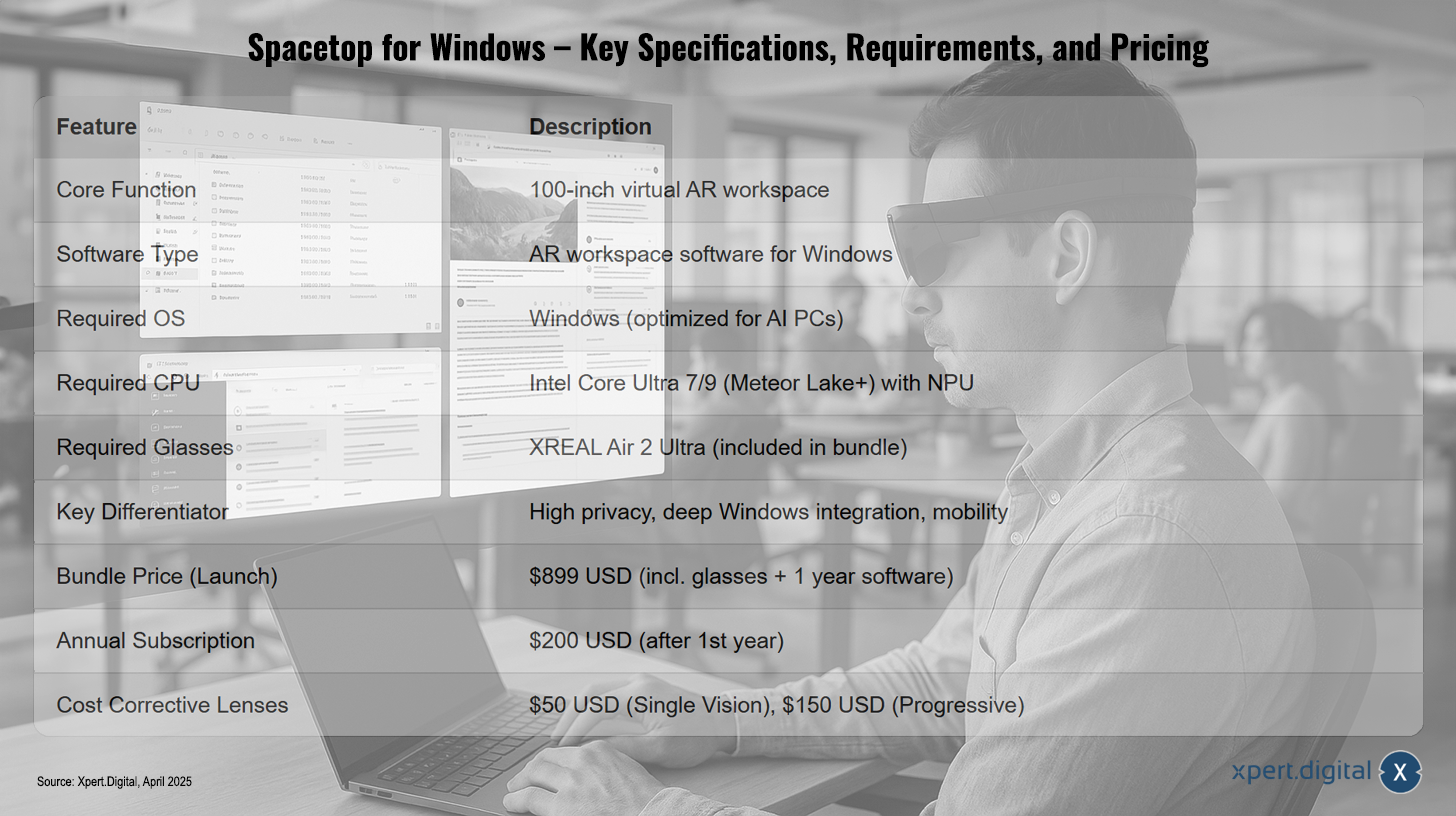
Spacetop for Windows - key specifications, requirements and prices - Image: Xpert.digital
This table summarizes the essential features and costs and illustrates the technical and financial entry hurdles for potential users.
Spacetop for Windows offers a 100-inch virtual AR work area, which is provided by specialized AR workpace software and is optimized for Windows. A Windows operating system and an Intel Core Ultra 7 or 9 processor (Meteor Lake+) with integrated NPU are required for use. The AR glasses XReal Air 2 Ultra, which is included in the bundle, is also required. Particularly noteworthy are the high privacy, deep integration in Windows and the mobility of the system. The bundle that includes the glasses and a one-year software subscription is available at the start price of $ 899. After the first year, the annual subscription costs $ 200. Additional correction lenses are available for $ 50 or $ 150.
Sightfuls strategic realignment
The introduction of Spacetop for Windows represents a fundamental change of strategy for Sightful. The company, founded in 2020 by former Magic Leap executives [German article], originally started with the aim of developing a fully integrated AR laptop solution. The result was the "Spacetop G1", a screenless laptop with its own operating system (SpaceOS, based on Android), which was offered for $ 1,900. However, this hardware apparently found only limited resonance in the market, as later reports on the setting of the product indicate.
With Spacetop for Windows, Sightful is now taking the transition to a pure software provider that is on the hardware of third parties. This swivel was significantly advanced by two factors: First, the market launch of AI PCs with powerful NPUs, which provide the necessary computing power for demanding AR applications on standard laptops. Second, the repeated demand of users and companies for a Windows-compatible solution ("When will it be available for Windows?") [German article]. Sightful sees the ideal platform in the AI PCs to open up the potential of AR working environments in combination with AI performance and accelerate its mission.
This strategic realignment had significant organizational consequences. Sightful separated from his hardware team, which led to a reduction in the workforce of originally 60 employees in 2024. Despite this reduction and change of the business model, the company was able to secure impressive $ 61 million to risk capital. This indicates that investors have confidence in the new, software -centered strategy and the long -term vision of the company.
Sightful's vision remains ambitious: The company is convinced that augmented reality is the future of personal computing, and deliberately positions itself in the environment of industry giants such as Apple, Meta and Google. In contrast to possibly more visionary, but less immediately applicable approaches, Sightful focuses on already delivering a specific added value for productivity. Future plans include the expansion of platform support, whereby a Mac version is mentioned as a goal, but without a specific schedule [German article].
The transition to the software model is a calculated risk. Sightful bets that the market for AI PCs is developing quickly enough and that its software on hardware from third-party providers can offer a convincing AR experience that stands out from simple screen mirroring or integrated solutions from competitors. The significant financing supports this vision and indicates that investors assess the potential of a (future) platform -tagnostic software approach than the original, capital -intensive hardware business. The reduction of the workforce underlines the complexity and the costs of hardware development in the AR area. Sightful's new strategy reduces its own investment costs, but increases the dependence on partners such as Intel and Xreal as well as on the market acceptance of specific technologies such as NPUs.
🎯🎯🎯 Benefit from Xpert.Digital's extensive, fivefold expertise in a comprehensive service package | R&D, XR, PR & SEM

AI & XR 3D Rendering Machine: Fivefold expertise from Xpert.Digital in a comprehensive service package, R&D XR, PR & SEM - Image: Xpert.Digital
Xpert.Digital has in-depth knowledge of various industries. This allows us to develop tailor-made strategies that are tailored precisely to the requirements and challenges of your specific market segment. By continually analyzing market trends and following industry developments, we can act with foresight and offer innovative solutions. Through the combination of experience and knowledge, we generate added value and give our customers a decisive competitive advantage.
More about it here:
AR-Buero | Market forecasts and trends: How KI, AR and Spatial Computing transform productivity
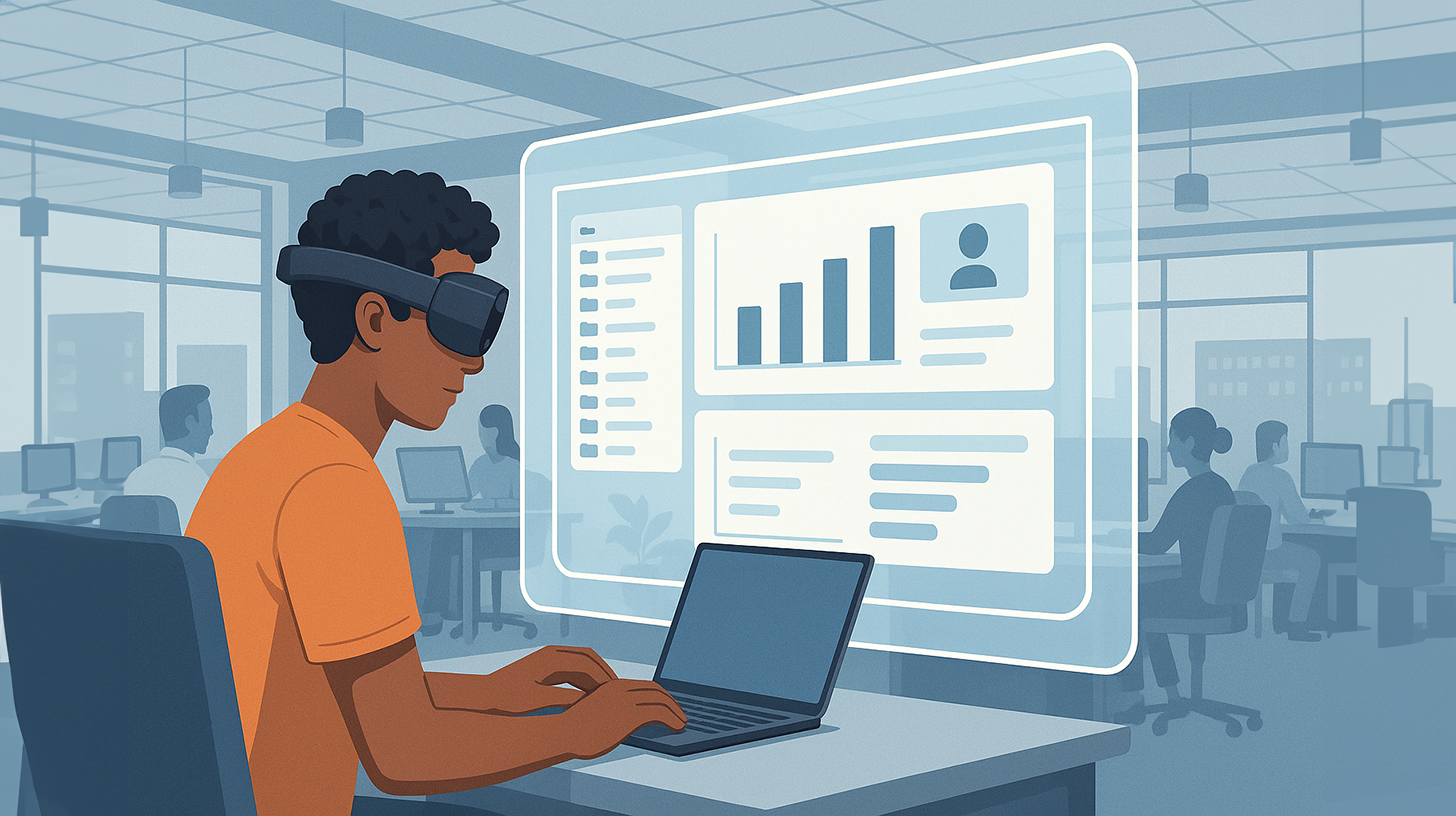
AR-Buero | Market forecasts and trends: How KI, AR and Spatial Computing transform productivity - Image: Xpert.digital
Market landscape: the convergence of AI, AR and productivity
Sightful operates at the interface of several dynamic and rapidly growing technology markets. Understanding these trends is crucial for the evaluation of the market opportunities of Spacetop for Windows.
Growth of the AI PC market
As already mentioned, Canalys predicts that the proportion of AI-enabled PCs at the global deliveries from almost 20% will increase to over 60% by 2027 in 2024. HP expects similar installments. This development creates an exponentially growing basis of potential users for software solutions such as Spacetop, which rely on the specific skills (especially NPUS) of these new devices.
Trajectorie of the Augmented Reality (AR) market
The global AR market is estimated at $ 83.65 billion in 2024 and, according to Grand View Research, is to grow from 37.9% to $ 599.59 billion by 2030 with an impressive annual growth rate (CAGR). This growth drivers are technological progress in hardware and software, increasing acceptance in corporate applications (industry, manufacturing, healthcare, logistics, training), but also in areas such as gaming, retail and education. In particular, the software segment, in which Sightful is now active, is expected to be the fastest growth, driven by the demand for AR applications to improve user experience and optimize work processes. North America is currently the largest market, while the Asia-Pacific region has the highest growth rate.
Growth of Spatial Computing Market
Spatial computing, as a superordinate concept that includes AR, VR and MR, also shows strong growth forecasts, even if the exact numbers vary depending on the source. Imarc Group estimates the market at $ 141.51 billion in 2024 and predicts growth to $ 945.81 billion by $ 2033 (CAGR 21.7%). The Business Research Company (TBRC) assumes $ 155.31 billion in 2024 and $ 418.49 billion by 2029 (CAGR 22.2%). Verified Market Research is conservative with $ 49.28 billion in 2024 and $ 122 billion by $ 2032 (CAGR 12%). Despite the differences, all forecasts show significant growth. Important drivers are the spread of AR/VR technologies, the use of digital twins, the increase in remote work and applications in sectors such as healthcare, production and gaming. North America also dominates the market here. However, the different forecasts also illustrate the challenge of precisely define and quantify this emerging market.
Matches:

Context of the digital transformation
AR and Spatial Computing are part of the overarching trend of digital transformation in companies. The global expenditure for digital transformation is expected to increase to $ 3.4 trillion by 2026. Companies invest massively in technologies to optimize processes, improve cooperation and to open up new business models. AR/VR is considered one of the technologies with the highest growth potential within this trend.
Meaning of the cloud infrastructure
Advanced AR- and Spatial Computing experiences often require considerable computing power and data storage, which are increasingly provided by cloud infrastructures. The growth of the cloud market (public cloud expenses of almost $ 600 billion in 2023) also indirectly also supports the development of solutions such as Spacetop.
In summary, it can be said that Sightful is entering a market that is characterized by the meeting of several rapidly growing technology trends (AI PCs, AR, Spatial Computing) and supported by overarching corporate initiatives (digital transformation, remote work). The general market potential is immense. However, the success of Spacetop depends on whether it is successful in successfully filling a specific niche within this market-AR productivity software for AI PCs-and convincing users that the needed added value justifies the investment and change of work habits. The quick growth of the AI PC base is the most direct positive indicator of the addressable market potential of spacetop.
Market forecasts-AI PCs, AR, Spatial Computing
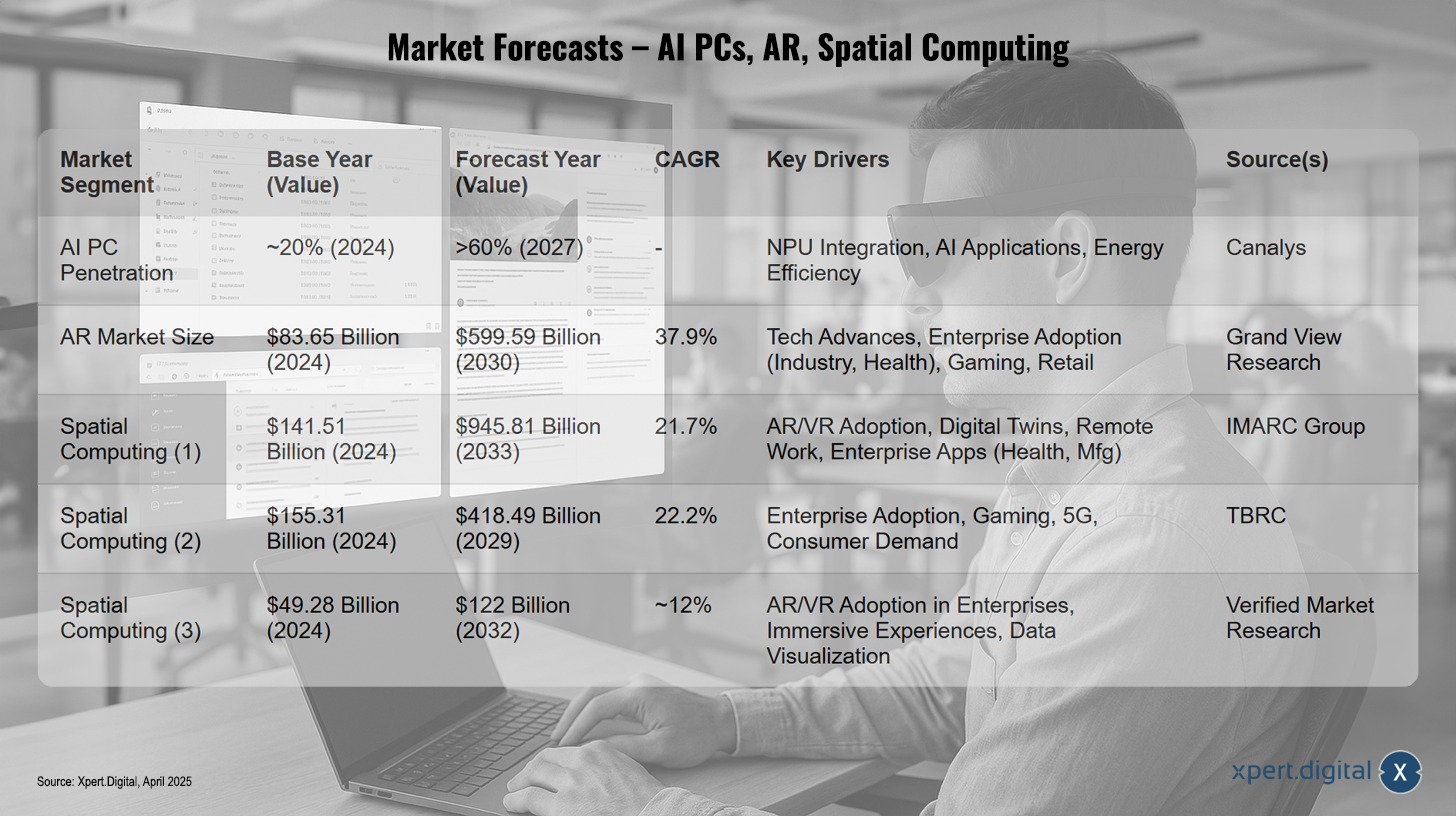
Market forecasts-AI PCs, AR, Spatial Computing-Image: Xpert.digital
This table quantifies the growth potential of the relevant markets and underlines the cheap macrouumbic field for Sightful, but also shows the uncertainties in the forecast for the still young spatial computing market.
Market forecasts show important developments in the areas of AI PCs, AR and Spatial Computing. According to Canalys, the penetration of Ki-PCs from around 20 % in 2024 will increase to over 60 % by 2027, driven by the integration of NPUs, AI applications and energy efficiency. The Augmented Reality (AR) market is expected to grow from USD 83.65 billion to an impressive $ 599.59 billion by 2030, with a CAGR of 37.9 %. The main factors are technological advances, the takeover by companies in industries such as industry and health, gaming and retail, says Grand View Research. Spatial computing also experiences strong growth: According to Imarc Group, the market should increase from $ 945.81 billion in 2033, with a CAGR of 21.7 %. Drivers are the distribution of AR/VR, digital twins, remote work and corporate applications. Further forecasts show different approaches: TBRC expects growth of $ 155.31 billion (2024) to $ 418.49 billion (2029) (CAGR 22.2 %), while Verified Market Research predicts a volume of $ 122 billion, based on $ 49.28 billion in 2024 and one CAGR of about 12 %. Factors as immersive experiences, AR/VR use in companies, data visualization, gaming, 5g and consumer demand play central roles.
Analysis of the competitive environment
With Spacetop for Windows, Sightful enters a complex competitive environment that includes both direct and indirect competitors.
Direct AR workpace competitor
There are other companies that focus on AR productivity solutions, even if details on their specific offers are limited compared to Spacetop's Windows-integrated approach. Databases such as CB Insights Lists Lists such as Sphere (XR for Enterprise Productivity), Third Aurora (AR/AI), Red 6 AR (AR for Training), Pretia (AR Cloud), Scope AR (Enterprise AR for Industry) and HoloLight (XR for Engineering) as players in the broader AR/XR sector. Sightful himself was led to “Multinarity” as a competitor. At the moment, however, none of these companies seems to offer a directly comparable solution that focuses a deep integration of a large, private AR work area into the native Windows ecosystem on AI PCs.
Indirect competition: large platform providers
The biggest challenge for Sightful is based on the technology gends who develop comprehensive spatial computing platforms:
- Apple Vision Pro: positioned as a high-end spatial computer (from $ 3,500).
- Strengths: very high resolution (more than 4K per eye), seamless integration into the Apple ecosystem (in particular Mac virtual display is praised by users), strong focus on enterprise applications with partners such as SAP and Microsoft, a variety of applications from collaboration to training and long-distance maintenance.
- Weaknesses: extremely high price, potentially lower wearing comfort with long sessions, closed ecosystem, no native Windows support (although there are PC screen apps).
- Relevance for Spacetop: Defines the upper end of the market for immersive productivity, shows the potential of spatial computing in the enterprise area, but competes in another price segment and ecosystem.
- Meta Quest platform (Quest 3/3S + Horizon Managed Solutions): Positioned as more accessible, primarily wireless VR/MR hardware platform with increasing enterprise focus.
- Strengthening: significantly cheaper hardware price, high market share in the VR/AR market (> 70% in 2024), standalone operation without PC compulsory, established management tools for companies (Meta Horizon Managed Solutions with device management, app management, MDM integrations), growing ecosystem to productivity and collaboration apps (e.g. HORIZON Workrooms).
- Weaknesses: Traditionally more focused on VR than on transparent AR (although MR skills increase), possibly lower visual sharpness for text-heavy productivity tasks compared to high-end-out or monitors (sightful highlights the readability of text on spacetop compared to the quest per), additional costs by enterprise subscriptions (approx. 180 USD/year or in Bundles).
- Relevance for Spacetop: offers a cheaper alternative for immersive work and training, but rather competes in the VR/MR area and may not offer the same seamless integration into the Windows desketop as Spacetop.
- Google: acts primarily as a platform and ecosystem provider via Arcore for mobile AR experiences and Android. The focus is more on mobile applications and specific industrial applications (e.g. manufacturing, service) than on a comprehensive AR desktop replacement. The Google Workspace productivity tools remain largely traditional. There are development activities in the AR sector, but no direct competitor to Spacetop for Windows is known.
Hardware addiction: The role of AR glasses (XReal)
Spacetop is not an integrated solution, but dependent on AR glasses of third-party providers, currently the XReal Air 2 Ultra. The quality of these glasses is therefore crucial for the overall experience. As mentioned, xreal glasses offer advantages such as low weight and good wearing comfort, but also potential disadvantages such as jitter or glare effects that could affect productivity. The 6th capacity of the Air 2 Ultra is an important plus compared to simpler 3dof glasses. This dependence on external hardware differentiates spacetop from integrated systems such as the Vision Pro and makes it susceptible to the quality and development cycles of the glasses manufacturers. Other actors such as Rokid are also pushing into the AR glasses market.
Suitable for:

Differentiation factors for spacetop
SPACETOP tries to withdraw from the following points against the competition:
- Native Windows integration: The core of the offer is the deep integration into the Windows ecosystem on AI PCs, which goes beyond simple screen mirroring and is intended to offer a spatially optimized OS experience.
- Focus on privacy: The argument of visual privacy is strongly emphasized and positioned as a central benefit for mobile professionals.
- Software-centered model: By using existing or newly purchased AI laptops by users, SightSful reduces your own development and production complexity compared to manufacturers of complete hardware solutions.
- Pragmatic productivity focus: The goal is to solve real problems of mobile knowledge workers today (large screen, privacy, mobility) instead of relying on a distant vision of the future.
The competitive position of Spacetop is therefore clearly defined, but also challenging. The main advantage lies in the potentially seamless integration into the dominant Windows company world over the new generation of Ki-PCs. However, this ties the fate of the product closely to specific hardware (Intel NPUS, XREAL glasses) and makes it susceptible to Microsoft platform updates or progress among competitors. The strong focus on privacy is a clear distinguishing feature compared to working on the open laptop screen, but less compared to other AR/VR headsets, which are also private.
Competitive landscape - comparison of AR/Spatial computing productivity solutions
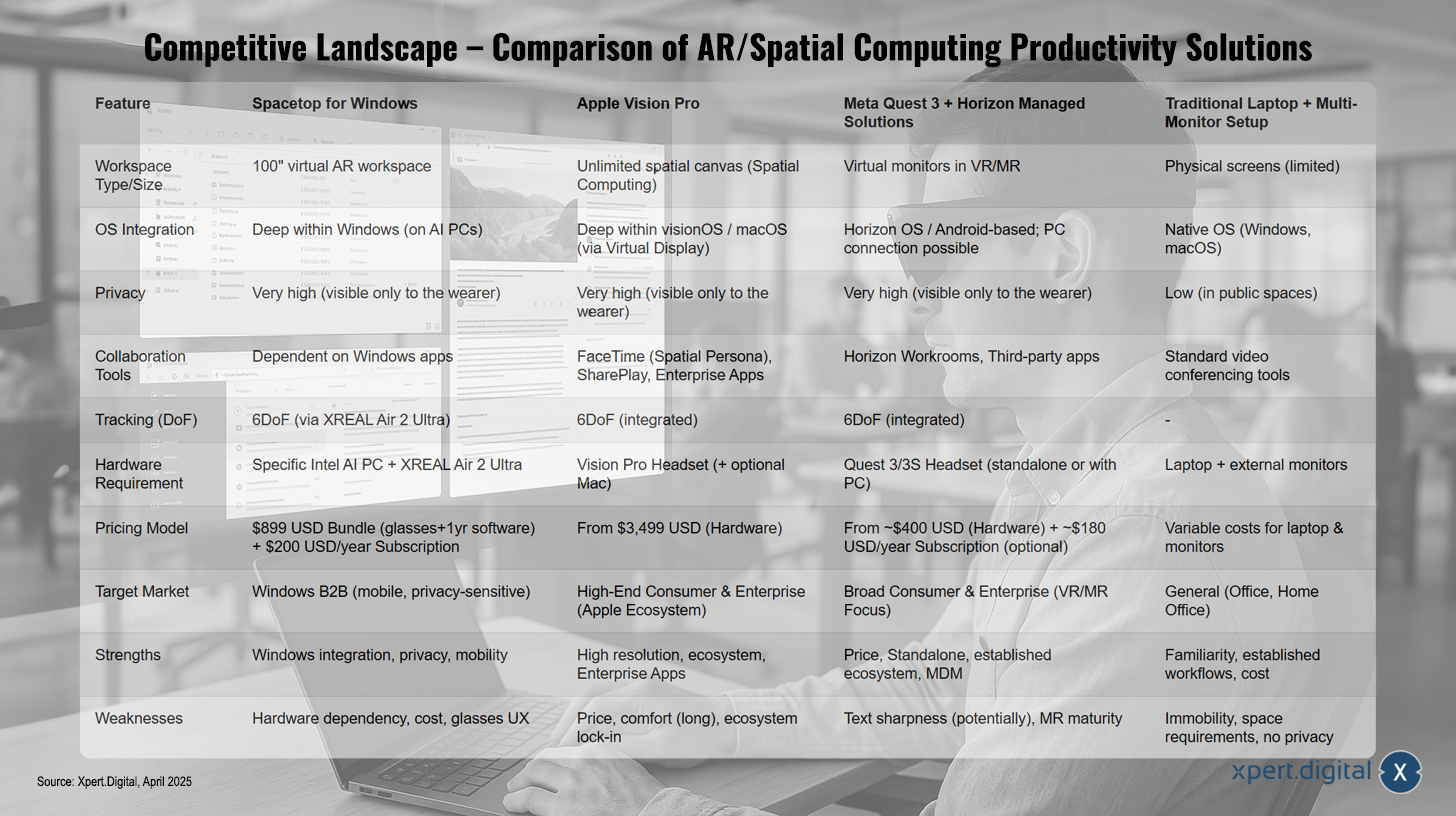
Competitive landscape - comparison of AR/Spatial computing productivity solutions - Image: Xpert.digital
This table illustrates spacetops positioning as a niche solution for Windows users who are looking for a mobile, private alternative to traditional setups, but are not ready or unable to invest in the expensive, closed ecosystems of Apple or META.
The competitive landscape in the field of AR and spatial computing productivity solutions shows a variety of options with different features and target groups. Spacetop for Windows offers a 100 ”virtual AR work space, deep integration into Windows on AI PCs and a very high privacy, since the content is only visible to the carrier. The collaboration tools depend on Windows apps, and the system requires specialized hardware, including an Intel Ai PC and the XReal Air 2 ultra glasses. 899 USD for the bundle plus $ 200 for the software, which focuses primarily on the mobile, privacy-sensitive Windows B2B market.
The Apple Vision Pro Headset offers unlimited spatial canvas and deep integration in visionos and macOS, including via virtual displays. The content is also only visible to the carrier, and the collaboration is optimized with features such as FaceTime, SharePlay and Enterprise apps. The hardware request includes the vision per headset, optionally supplemented by a Mac, whereby the entry price is $ 3,499. The target market includes high-end customers and companies in the Apple ecosystem. Apple convinces with high resolution, strong integration into the ecosystem and specialized enterprise apps, while disadvantages are especially at a high price, comfort with longer use and the ecosystem bond.
Meta Quest 3 combines virtual and mixed reality monitors and offers an independent headset based on Horizon OS/Android and the option of pairing it with a PC. Here, too, content is only visible to the carrier, and collaboration takes place via Horizon Workrooms and third-party apps. The hardware is available comparatively cheaply from around $ 400, supplemented by an optional subscription for approx. $ 180/year. This solution aims at a wide consumer and corporate base with VR/MR focus. The strengths lie in the price, the stand-alone ability and an established ecosystem with MDM, whereas weaknesses are in the potential text blur and the development of the MR functionalities.
The traditional laptop and multi-monitor setup, on the other hand, relies on physical screens with limited workspace, native operating systems such as Windows or MacOS and standard video conference tools for collaboration. Privacy is low in public spaces, and the hardware request varies depending on the laptop and monitor. The central target group is the general market in the office and home office area. Strengths are familiarity, established workflows and comparatively low costs. Weaknesses are the lack of mobility, space requirement and lack of privacy.
🎯📊 Integration of an independent and cross-data source-wide AI platform 🤖🌐 for all company matters

Integration of an independent and cross-data source-wide AI platform for all company matters-Image: Xpert.digital
Ki-Gamechanger: The most flexible AI platform-tailor-made solutions that reduce costs, improve their decisions and increase efficiency
Independent AI platform: Integrates all relevant company data sources
- This AI platform interacts with all specific data sources
- From SAP, Microsoft, Jira, Confluence, Salesforce, Zoom, Dropbox and many other data management systems
- Fast AI integration: tailor-made AI solutions for companies in hours or days instead of months
- Flexible infrastructure: cloud-based or hosting in your own data center (Germany, Europe, free choice of location)
- Highest data security: Use in law firms is the safe evidence
- Use across a wide variety of company data sources
- Choice of your own or various AI models (DE, EU, USA, CN)
Challenges that our AI platform solves
- A lack of accuracy of conventional AI solutions
- Data protection and secure management of sensitive data
- High costs and complexity of individual AI development
- Lack of qualified AI
- Integration of AI into existing IT systems
More about it here:
Spacetop AR and the hardware revolution: opportunities for mobile work
Target market and application viaility
Primary target group
Sightful and his partner Deutsche Telekom are clearly align spacetop for Windows to business customers (B2B) and mobile specialists. The core target group are users who work frequently on the go, need a large work area, value privacy and are already anchored in the Windows ecosystem. These typically include:
- Viel travelers: consultants, sales staff, manager.
- Specialists with sensitive data: employees in finance, lawyers, human resources, management.
- Remote/hybrid worker: People who switch between home office, office and other places and need a consistent working environment.
- Users in open office environments or public spaces: where visual privacy is decisive.
- Technology-affine Early Adopters: Companies and individuals who are willing to invest in new productivity tools.
Core applications
The applications communicated by Sightful and Deutsche Telekom underline the focus on flexibility and privacy:
- In the Home Office: Spacetop, a maximum virtual work area enables even with limited physical space. According to the provider, it is particularly suitable for data -intensive tasks such as the display of dashboards, safety monitoring or service applications.
- On the way (train, plane, café): Here Spacetop plays its strength of privacy. Users can work comfortably on confidential documents or data without being able to read the neighbor (“Shoulder Surfing” problem is solved).
- In the office: The virtual desktop is always there and enables users to move freely and use their personal setup in different locations in the office. The solution should be able to be flexibly adapted to different activities.
A user cited by Sightful confirms the benefits for frequent travelers who typically open several applications at the same time.
Accessory drivers
Several factors could promote the acceptance of Spacetop for Windows:
- Increasing productivity: The potential to work more efficiently through a larger virtual work area and improved multitasking is a main argument.
- Privacy and security: For certain industries and roles, the protection of visual information is a critical factor that addresses the spacetop directly.
- Mobility and flexibility: The solution fits well with the requirements of modern, mobile and hybrid working models.
- Ergonomics: The potentially better posture compared to the stuffed work on the laptop could be another advantage.
Barriers for acceptance
Despite the potential advantages, there are considerable hurdles:
- High total costs (TCO): The need for a specific, expensive AI laptop in addition to the $ 899 bundle and the annual $ 200 subscription is a significant financial hurdle.
- Hardware dependency and compatibility: The initial limitation to certain intel processors and the XReal glasses severely restricts the potential user group and creates friction losses in the introduction.
- Concerns regarding user-friendliness and comfort: Potential problems with AR glasses such as jitter, glare effects or discomfort with long wearing time could reduce productivity and inhibit acceptance. The social acceptance of wearing AR glasses in the professional environment has not yet been fully clarified.
- Technological maturity: AR for general productivity tasks is still in its infancy. The detection of a clear ROI compared to established methods (laptop, external monitors) is crucial but may be difficult to provide.
- Competition and inertia: Strong alternatives from established providers and the habit of users to existing working methods represent high change hurdles.
The target group for spacetop is therefore clearly outlined, but initially probably limited to a niche. It is above all those professional users and companies for which the combination of mobile, large work area and high privacy is so important that they are willing to bear the significant costs and accept the technological restrictions. In view of the current hurdles, a wider market acceptance appears far away and depends heavily on the further development of the technology and the reduction of the costs. The success will depend on whether Sightful can convincingly demonstrate the promised added value-in particular quantifiable productivity increases and security advantages-in order to justify the investment for B2B customers.
Suitable for:

German market entry strategy: The partnership with Deutsche Telekom
The decision to choose Germany as the first international market for Spacetop for Windows underlines the strategic importance of the German market for Sightful. This step is largely made possible by a strategic partnership with Deutsche Telekom (DT).
The role of Deutsche Telekom is of crucial importance. As one of the leading telecommunications providers in Europe with an established and extensive B2B customer trunk, the DT Sightful offers access to a market that would be difficult to open up for a start-up alone. The DT has the necessary sales channels, brand awareness and trust in the German corporate sector. Public support from high-ranking DT representatives, such as Dr. Maximilian Ahrens (Senior Vice President, T Digital), which referred to Spacetop as a redefinition of mobile productivity, gives the solution considerable credibility and validation in the target market.
The B2B portfolio of Deutsche Telekom includes digital solutions, connectivity, cloud services and security services, which is a good strategic agreement with the target market of Spacetop. The experience of the DT in the introduction of complex B2B products and the management of large IT system landscapes can be of great value for Sightful.
This partnership has the potential to significantly accelerate the acceptance of spacetop in Germany. It not only offers a sales channel, but also a platform for valuable market feedback from a demanding B2B environment. The success of this cooperation in Germany could serve as a blueprint for the further international expansion of Sightful, possibly through similar partnerships with leading telecommunications providers or IT service providers in other countries.
For Sightful, the partnership with Deutsche Telekom is a strategic stroke of luck that significantly reduces the considerable challenges of market entry as a relatively small, unknown company in a complex B2B market like Germany. It signals trust in the product potential on the part of an established industry leader and significantly reduces the risk of Sightful. The success of this partnership will be a critical indicator for the wider international perspectives of Spacetop.
Market opportunities and challenges (SWOT analysis)
A SWOT analysis summarizes the internal strengths and weaknesses of Sightful and Spacetop for Windows as well as the external opportunities and risks in the market:
SWOT analysis-Sightful Spacetop for Windows
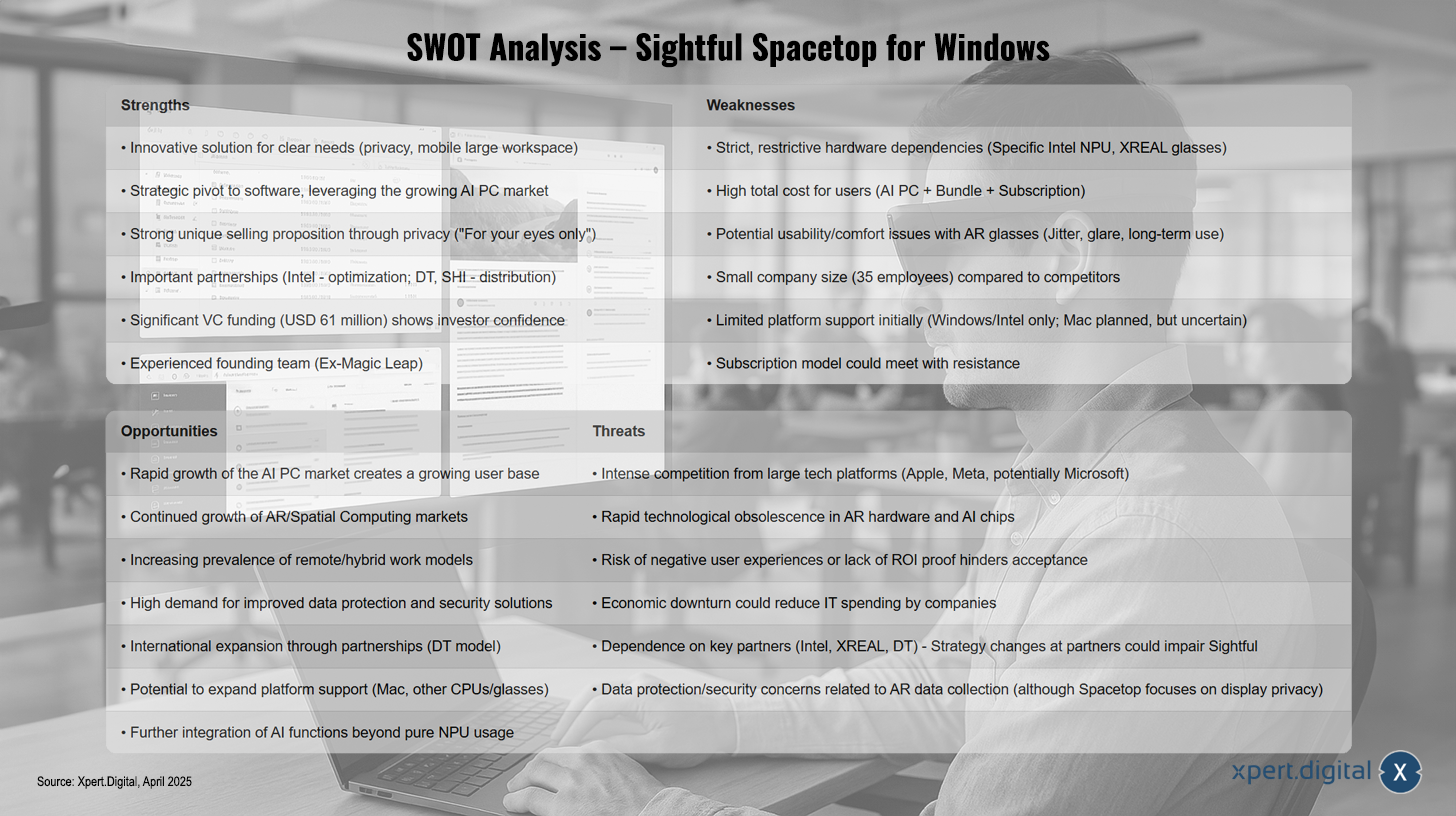
SWOT analysis-Sightful Spacetop for Windows-Image: Xpert.digital
The analysis shows that Sightful's success depends on using its strengths (privacy, partnerships, software focus) in order to take the market opportunities (AI PC growth, remote work), while at the same time it carefully manages its weaknesses (hardware dependency, costs) and asserts itself against significant competitive threats. The partnership with Deutsche Telekom is a crucial lever for European expansion. The greatest risk is to be overtaken by larger competitors that integrate similar functionalities into wider platforms.
The SWOT analysis for the Sightful Spacetop for Windows shows both advantages and challenges. The strengths include the innovative solution for clear needs such as privacy and a mobile large workspace as well as strategic turning towards software in the growing AI PC market. The unique selling point of the privacy "For Your Eyes Only", important partnerships-such as Intel for optimization and DT and SHI in sales-as well as a significant VC financing of 61 million USD and an experienced start-up team with ex-Magic Leap members underline the potential of the company. However, there are weaknesses such as the strict hardware addiction, high total costs for users, potential usability problems in AR glasses such as jitter and long-term use problems, the limited platform support, the small company size with only 35 employees and possible reservations about the subscription model. The rapid growth of the AI PC market and the AR- and Spatial Computing industry offers opportunities, as well as the increasing demand for remote and hybrid working models and for better data protection solutions. International expansion by partners such as DT, the expansion of platform support and the integration of additional AI functions are also promising. However, there are risks in intensive competition through large technology platforms such as Apple and Meta as well as fast technological outdoor age in AR hardware and AI chips. Negative user experiences or a lack of proof of the ROI could inhibit acceptance, and economic swings could reduce IT editions. In addition, the dependence on key partners such as Intel and XReal as well as data protection concerns in the argument in the AR data recording poses potential challenges.
Strategic recommendations
Overall rating of market opportunities
Sightfuls Spacetop for Windows addresses a valid market niche with significant potential. The combination of a large, mobile work area and high visual privacy meets the needs of B2B customers in an increasingly mobile and safety-conscious world of work. The strategic focus on software that uses the skills of the emerging AI PCs positions the company potentially advantageously in order to benefit from this growing hardware market. The partnership with Deutsche Telekom for German market entry is a strong signal and an important success factor.
However, the hurdles are considerable. The strict dependence on specific high-end hardware limits the addressable market considerably and drives up the total costs for the user. Potential deficiencies in user-friendliness and in the comfort of the necessary AR glasses could restrict acceptance with longer use. In addition, the competition from financially strong technology groups with its own, comprehensive spatial computing ecosystems is intensive.
In summary, it can be said that the market opportunities for Spacetop for Windows are real but challenging. Success is not guaranteed, but especially in specific B2B segments about strong partnerships. The product is an early indicator of the future of AR productivity, but not yet a solution to the mass market.
Strategic recommendations for sightful
In order to maximize the market opportunities and minimize the risks, the following strategic measures should be prioritized:
- Extension of compatibility: The highest priority should be on the expansion of hardware support. This includes the development of versions for MAC computers (as already indicated) as well as the support of AI processors from AMD and Qualcomm and potentially other AR glasses. This is crucial to expand the addressable market beyond the initial Intel/Xreal niche.
- Clear benefit promises and ROI quantification: For B2B customers, proof of a clear return on investment is essential. Sightful must convincingly explain how Spacetop increases productivity quantifiable and what specific security advantages it offers to justify the high costs and overcome the application for compensation. Meaningful case studies are essential for this.
- Optimization of the user experience (UX): Continuous software updates to improve stability and performance are necessary. Close cooperation with hardware partners such as XReal is just as important to address and minimize potential usability problems such as screen jitter or glare effects. A smooth and comfortable user experience is a basic requirement for productive work.
- Maximum use of partnerships: Relationships with Deutsche Telekom, Shi and Intel must be maintained and deepened. These partnerships are not only sales channels, but also sources for market feedback and co-development opportunities. Similar strategic alliances should be sought for expansion to other markets.
- Development of an ecosystem: In the long term, Sightful should check the integration with other important company software and possibly offer APIs (programming interfaces) to enable third -party providers to develop additional tools. This could increase the attractiveness of the platform.
- Differentiated offers: It should be checked whether, in addition to the current bundle, other price or offer models also make sense. A pure software license for users who already have compatible glasses (as mentioned in 7 as a possibility in direct contact), or staggered subscriptions could lower the entry hurdle and address different budgets.
The future of work: Ar as the key to more flexible and more productive jobs
Spacetop for Windows is an example of the beginning change towards immense and more flexible computer workstations. It shows how AR can solve concrete productivity problems, especially with regard to mobility and privacy. However, the broad acceptance of such solutions will depend on further progress in AR hardware (performance, comfort, price), a significant reduction in total costs and the clear evidence of advantages over traditional working methods. The progressive convergence of AR, AI and Spatial Computing will continue to make this area dynamically. Sightful has the chance to play an important role as a pioneer in the Windows world, but has to remain agile and continuously adapt its strategy to the rapid market development. Success depends on whether it is possible to defend the niche and at the same time lay the basis for future growth.
We are there for you - advice - planning - implementation - project management
Xpert.Digital - Pioneer Business Development
Smart Glasses & KI - XR/AR/VR/MR industry expert
Consumer metaverse or meta -verse in general
If you have any questions, further information and advice, please feel free to contact me at any time.

Konrad Wolfenstein
I would be happy to serve as your personal advisor.
You can contact me by filling out the contact form below or simply call me on +49 7348 4088 965 (Munich) .
I'm looking forward to our joint project.
Write to me

Xpert.Digital - Konrad Wolfenstein
Xpert.Digital is a hub for industry with a focus on digitalization, mechanical engineering, logistics/intralogistics and photovoltaics.
With our 360° business development solution, we support well-known companies from new business to after sales.
Market intelligence, smarketing, marketing automation, content development, PR, mail campaigns, personalized social media and lead nurturing are part of our digital tools.
You can find out more at: www.xpert.digital - www.xpert.solar - www.xpert.plus
Keep in touch










