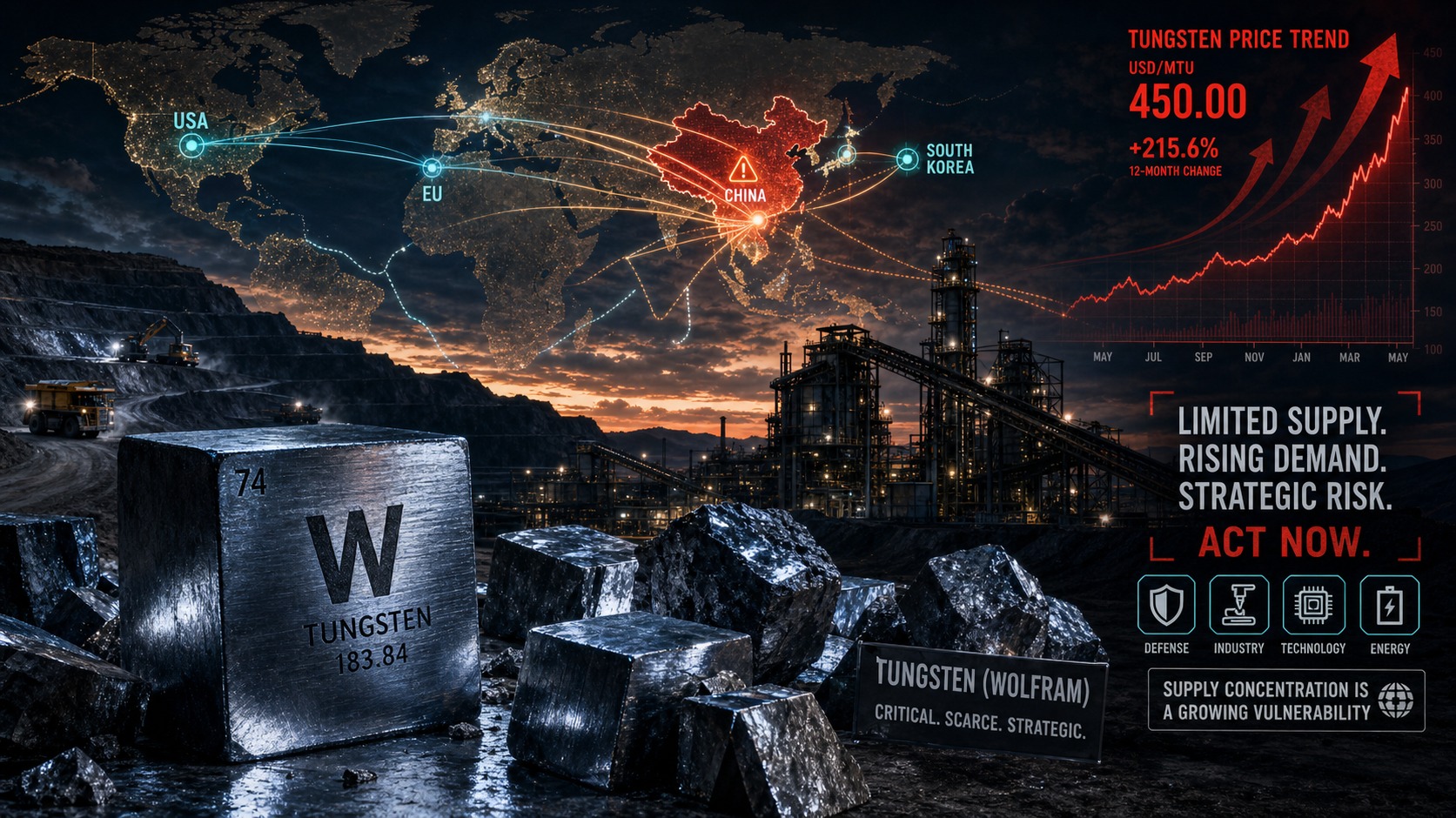
Tungsten Shock 2026: Why Almonty Industries and American Tungsten & Antimony are suddenly at the center of the commodities market – Image: Xpert.Digital
Price explosion of 550%: Why the West is now frantically searching for this secret metal
Forget gold and crypto: This unassuming metal will determine the new world order
China's raw materials trap snaps shut: These two stocks are now profiting from the global tungsten boom
An unprecedented price shock is rocking global commodity markets: In just over a year, the price of tungsten has exploded by a staggering 550 percent. This rare, extremely heat-resistant metal, absolutely essential for the modern defense industry, semiconductor production, and the booming AI sector, has been neglected by the West for decades. While Europe and the US relied on cheap imports from China, Beijing strategically exploited its market dominance and imposed drastic export controls. Now, with supply chains breaking down and Western industry desperately searching for domestic alternatives, companies promising a way out of this dangerous dependency are coming into focus. This comprehensive analysis explores how the geopolitics of commodities is radically changing in 2026, why the market faces a structural deficit, and how players like Almonty Industries and American Tungsten & Antimony are suddenly being catapulted into the center of a completely new commodity supercycle.
The silent metal that is taking control of the world – and why the West has looked away for decades
The price explosion of tungsten is fundamentally changing the perspective on critical raw materials. While gold, silver, and cryptocurrencies vie for attention, producers and developers of strategic metals are moving into the focus of Western industrial and defense policy. Two companies exemplify the structural change taking place in the global raw materials landscape: Almonty Industries Inc. and American Tungsten & Antimony Ltd.
A historic price rally without precedent
The global commodities market will be dominated in 2026 by a metal long known only to specialists: tungsten. The price of ammonium paratungstate (APT), the metal's most important trading form, has soared to a level that has surprised even seasoned market observers over the past twelve months. According to the industry service Fastmarkets, APT prices rose from USD 900–940 per metric unit (MTU) WO₃ in January 2026 to USD 1,650–1,900 by mid-February 2026. Prior to this, the price had already tripled from the end of September 2025 to the end of the year, resulting in a cumulative price increase of more than 550% since February 2025.
For comparison: Ferrotungsten, another key commodity, is currently trading at USD 200–210 per kilogram of tungsten – a year ago it was only USD 45–46. By mid-May 2026, tungsten concentrates will have risen to around USD 22,000–24,000 per MTU. This price dynamic is not a short-term market anomaly. It is the result of a structural imbalance that has been building up for years and is now hitting Western supply chains with full force.
The figures speak for themselves: The global tungsten market had a volume of over US$5.26 billion in 2025 and is projected to grow to more than US$11.25 billion by 2035, with an average annual growth rate of over 7.9%. Other market studies estimate the market volume at US$5.78 billion for 2026 and expect it to reach US$9.19 billion by 2034. This divergence in estimates illustrates how dynamic and difficult to predict the market has become – and how significantly recent price movements have altered the landscape for analysts.
The anatomy of a geopolitical commodity shock
The current situation is not triggered by a single crisis, but rather by a combination of structural supply shortages, geopolitically motivated export restrictions, and years of growing demand from the defense and high-tech industries. Understanding these three driving forces is crucial to grasping the depth of the shock.
China's overwhelming market power and the strategic use of export controls
China still controls around 80% of global tungsten production. Vietnam and Russia follow, while in the West only Canada, Austria, and the USA possess significant deposits. This concentration is the result of decades of Western industrial policy that relied on inexpensive imports instead of developing domestic supply capacities.
On February 4, 2025, the situation escalated significantly: In response to new US tariffs, China introduced export controls on five critical raw materials, including tungsten, tellurium, bismuth, indium, and molybdenum. Unlike previous restrictions on gallium and germanium, which involved a transition period, the tungsten controls took effect immediately without any prior notice. Since then, Chinese exporters have been required to apply for a license for each export, which necessitates detailed contract documentation, technical descriptions, and an end-user certificate. Experience has shown that processing such applications takes six weeks or more—in the past, the export volume of affected raw materials has temporarily plummeted to almost zero during such periods.
The export controls are not an isolated reaction. They are embedded in a strategy that has been escalating gradually since July 2023: Gallium and germanium in the summer of 2023 were followed by graphite in December 2023, then antimony in September 2024, and finally tungsten in February 2025. China is thus systematically using critical raw materials as a geopolitical instrument and officially classifying them as dual-use goods of security importance. This strategy is effective: Each new embargo has caught Western industries unprepared.
An especially worrying development is emerging: Market reports indicate that China is depleting its own tungsten reserves and increasingly becoming a net importer. Should this trend continue, the global supply situation would worsen further – with corresponding consequences for prices.
The nature of the metal: Why tungsten is irreplaceable
To fully grasp the strategic dimension of the tungsten shock, one must understand the metal's physicochemical properties. With a melting point of 3,422 degrees Celsius, tungsten is the metal with the highest known melting point. It possesses exceptional hardness, low electrical resistance, and high thermal stability. These properties make it simply indispensable in a range of applications.
In the defense industry, tungsten is used for kinetic penetrators, warhead materials, and artillery ammunition—areas for which no adequate alternatives exist. NATO's total annual tungsten requirement is estimated at around 2,500 tons. In the semiconductor industry, tungsten is indispensable as a barrier metal in chip manufacturing: without tungsten, modern processors, AI chips, and the necessary data centers would simply be impossible. Additional applications include aerospace engineering, machine tools, medical technology, and specialty alloys. This wide range of applications explains why both the US and the European Union classify tungsten as a critical raw material.
The EU has enshrined the strategic importance of tungsten in the Critical Raw Materials Act (CRMA), which entered into force on May 23, 2024. The legislation sets concrete targets for 2030: at least 10% of the EU's annual demand for raw materials should come from domestic production, and 40% of processing should take place within the EU. The EU is also currently examining the establishment of strategic raw material reserves specifically for tungsten, gallium, rare earth elements, magnesium, germanium, and graphite. State Secretary for Energy Elisabeth Zehetner succinctly summarized the situation: without tungsten, gallium, and rare earth elements, there is no modern industry, no semiconductors, no energy transition, and no strong defense industry.
Almonty Industries: The Tungsten Dominator of the West
Against this backdrop, Almonty Industries Inc. (ISIN: CA0203987072) is developing into one of the most important Western tungsten producers and a strategic partner of Western governments and industrial corporations. The Toronto-based company, now listed on the Nasdaq, has a portfolio that is unique in its entirety outside of China.
The centerpiece: The Sangdong mine in South Korea
The flagship project is the Sangdong mine in South Korea, which officially resumed production on March 17, 2026 – after a hiatus of approximately 30 years. With the commissioning of the Phase 1 plant, Sangdong processes 640,000 tons of ore annually, delivering around 2,300 tons of tungsten concentrate per year. What makes these figures particularly remarkable is the ore's tungsten trioxide content of approximately 0.51% – three times higher than the global average. This makes Sangdong one of the highest-grade and therefore most economically viable tungsten deposits in the world.
Phase 2 expansion is already planned for 2027, which will double processing capacity to 1.2 million tons of ore. At full capacity, Sangdong is expected to meet 40% of global tungsten demand outside of China. The mine's expected lifespan exceeds 45 years. In short, this is a mine that can deliver for generations to come, located in a country that is among the closest allies of the Western world.
Almonty's strategic integration into Western supply structures is particularly noteworthy. The company has signed a 15-year contract with the US defense industry, guaranteeing a minimum of 40 tons of tungsten oxide per month for use in missiles, drones, and munitions. CEO Lewis Black stated at the start of production that this was a significant milestone in the efforts of the US and its allies to diversify supply chains for critical minerals away from China. A legal regulation will take effect on January 1, 2027, requiring US defense contractors to source tungsten only from outside Chinese supply chains—a requirement that directly benefits Almonty as virtually the only Western producer of a relevant scale.
Furthermore, the company signed a long-term supply contract in early 2026 with the South Korean SeAH Group, which, among other things, supplies SpaceX. The contract stipulates annual molybdenum deliveries of 5,600 tons starting in 2026 at a guaranteed minimum price of USD 19 per pound – this deal alone generates guaranteed annual revenue of at least USD 234 million.
The portfolio is complemented by the Panasqueira mine in Portugal, where annual production is to be increased from the current 58,000 MTU to 124,000 MTU by 2027, as well as by new acquisitions in the USA and the relocation of the company headquarters from Canada to the USA. The latter is a deliberate strategic step to solidify access to US funding instruments and strengthen its role as a reliable partner for US defense projects.
Ratings and analyst opinions
Almonty Industries' market valuation reflects the new reality. The stock (Nasdaq: ALM) is currently trading at around $17.59, representing a year-to-date performance of over 90%. Its market capitalization is estimated at between €4.28 and €5.0 billion. Three analysts currently rate the stock as a "Strong Buy." The projected price-to-earnings ratio (P/E ratio) for 2026 is 46.3x, while for 2027 it drops to a significantly more attractive 13.9x – a reflection of the anticipated production ramp-up and the associated profit increases.
The stock's short-term volatility—the price has fallen by around 24% in the past 30 days—should not obscure the structurally bullish picture. It reflects typical consolidation phases after steep price gains and is an indication of the speculative demand that has accumulated in the tungsten sector. The 52-week low of $2.52 compared to a high of $24.41 demonstrates the significant revaluation the company has undergone.
American Tungsten & Antimony: The US answer to China's resource power
Parallel to Almonty, American Tungsten & Antimony Ltd. (ASX: AT4; OTCQB: ATALF) is positioning itself as an emerging North American player in a market seeking domestic alternatives. The company is pursuing a two-pronged strategy: establishing a tungsten supply chain in the US and tapping into the strategically important antimony market.
The Dutch Mountain Mill: Infrastructure as a crucial competitive advantage
On January 30, 2026, American Tungsten & Antimony announced that it had entered into binding agreements to acquire a 100% interest in the Dutch Mountain Processing Facility in Tooele County, Utah. The significance of this transaction lies not primarily in the ore deposits themselves, but in a factor rare in U.S. mining: a fully permitted, proven processing facility that was last in operation in 2017.
In a regulatory environment where developing a new mill on federal land typically triggers the NEPA (National Environmental Policy Act) permitting process, resulting in years of delays, an existing, permitted facility on private land is of inestimable strategic value. Managing Director Andre Booyzen aptly stated, "In the competition for critical minerals, time is the most valuable asset." The facility has a nominal capacity of 400 tonnes per day, with the potential to expand to 850 tonnes per day.
In March 2026, remediation work began at the Dutch Mountain Mill with a budget of $400,000, aiming to resume tungsten processing within approximately six months. The initial ore supply will come from the historic Fraction Lode Mine, which last delivered ore to the plant in 2017 – and is considered the last actively producing tungsten mine in the US. With this project, American Tungsten & Antimony is addressing precisely the gap that the US raw materials sector is feeling most acutely: a lack of domestic processing capacity.
Antimony Canyon: A strategic twin metal with growth potential
American Tungsten & Antimony's tungsten story is complemented by drilling programs at the Antimony Canyon Project in Utah, which is proving to be a strategic resource in its own right. Antimony was first subject to export restrictions by China in September 2024 and is considered one of the most sought-after critical raw materials of our time – essential for flame retardants, military technology, solar energy, and energy storage.
The initial drilling programs yielded exceptionally compelling results: Drill hole ACP26DD010 intersected 11.03 meters at 3.1% antimony from a depth of 25.91 meters, including 2.62 meters at 12.54% antimony from 29.2 meters. Another drill hole returned 8.47 meters at 2.67% antimony from 31.15 meters, including 2.2 meters at 9.69% antimony. These grades are significantly higher than those found in many classic Western antimony vein systems and are reminiscent in their geometry of the stratiform Xikuangshan system in China – the world's largest antimony district.
The geological exploration target currently comprises 6.1 to 6.9 million tonnes at 1.4 to 2.3% antimony. These are still conceptual targets without an official resource classification; however, early drilling results indicate a hydrothermal system of considerable size. Furthermore, the mineralization extends across several historical mining areas within the patented claim block, highlighting the district-level potential.
The company completed a financing round of 10 million AUD in May 2026 and is working towards a possible listing on the US Nasdaq.
🎯🎯🎯 Global Sourcing & Commodity Trading with integrated logistics


Raw materials, global procurement & trade - Image: Xpert.Digital
State-of-the-art cargo planes, optimized transport routes, and multimodal logistics chains are interchangeable—they can be bought, leased, or outsourced. What money can't buy are direct contacts with producers in Peruvian mines, reliable supply relationships in the CIS countries, and years of built-up trust in markets that are unfamiliar to outsiders. The decisive competitive advantage in global commodity trading lies not in transporting the good from A to B, but in knowing where the good comes from, who produces it, and how to gain access before others even know the market exists. Whoever owns the network sets the price. Everyone else pays it.
More information here:
Supply chains in transition: How sourcing intelligence protects against raw material shortages
The structural context: How a naively pursued raw materials policy drove the West into dependency
Today's crisis is the result of decades of structural neglect of raw material security in the West. The mantra of free trade and the premise of comparative cost advantages led Europe and the US to gradually abandon their own mining capacities and rely on cheap Chinese imports. When China imposed export controls on antimony in August 2024 and tungsten in February 2025, the West lacked the means to respond – simply because it had failed for years to develop alternatives.
These shortcomings are reflected in the supply chain situation of NATO countries. Until recently, NATO's entire annual tungsten requirement of an estimated 2,500 tons was largely met by Chinese and Russian sources. As of January 1, 2027, a legal ban on US defense contractors sourcing tungsten from these sources will take effect. The time to establish alternative supply chains was correspondingly short – which explains why projects like Sangdong and the Dutch Mountain Mill received so much political support in such a short time.
The tungsten shock reveals another, often overlooked dimension: technological dependence. In semiconductor production, tungsten is used as an interconnect metal that connects the transistor layers of modern chips. Without this raw material, the ongoing AI revolution would be impossible—neither the data centers that enable the training of large language models, nor the end devices that use these models. The AI boom and the geopolitical arms race converge in the tungsten market and reinforce each other.
Macroeconomic classification: Tungsten in the context of the global raw materials transition
The price dynamics of tungsten are not an isolated phenomenon. They are representative of a structural paradigm shift that has affected the entire raw materials sector. For decades, the principle held that a global market for critical materials was sufficiently resilient. This assumption was definitively refuted in 2026.
The market volume of the tungsten sector is projected to reach between US$9.19 and US$11.25 billion by 2033/2035, according to various estimates. This growth is driven by three structurally stable demand drivers: the ongoing arms build-up in Western democracies as a result of the war in Ukraine and tightened NATO commitments; the exploding demand for AI infrastructure, which relies on tungsten-containing chips; and the industrial transformation towards precision tools and specialty alloys for the green transition. This demand is countered by a structurally tight supply: known Western deposits are limited, permitting processes typically take one to two decades, and investments in mining have been held back for years.
Added to this is the dimension of the recycling industry as a potential structural counterforce. A recent study by the BDI (Federation of German Industries) and the Boston Consulting Group estimates that the circular economy and recycling could replace between 20 and 40% of strategic raw material imports in Germany by 2045. Circular gross value added could more than double from the current 60 billion euros to as much as 125 billion euros in 2045. Tungsten is particularly recyclable: In the hard metal industry, high proportions of tungsten carbide tools are already being recovered. Nevertheless, the timeframe remains critical – recycling capacities cannot compensate for the structural supply bottleneck in the short term.
The macroeconomic analysis also requires an examination of price rationality. Increases of 550% within 14 months not only reflect fundamental scarcity but also incorporate speculative premiums. Commodity markets with thin trading liquidity—and the physical tungsten market is highly illiquid compared to gold or copper—react disproportionately to supply shocks. When warehouses are emptied and buyers compete for the remaining material, fundamental bottlenecks are amplified into extreme price swings. This does not mean that prices are unsustainable, but it does mean that some consolidation is likely once initial Western production volumes reach the market.
Risk profile and critical analysis: What investors and industry leaders need to know
A differentiated analysis would be incomplete without a sober consideration of the risks that accompany both companies and the entire sector.
Execution risks during production start-up
Mining projects have a pronounced tendency to be delayed and costly compared to initial plans. While Sangdong is now active in Phase 1 of Almonty Industries' operations, the ramp-up to full commercial capacity in the second quarter of 2026 is still underway. The first concrete production figures, expected in the next quarterly report, will be crucial in determining whether the company's market valuation is fundamentally justified. Any delay or shortfall in production forecasts would put significant pressure on the stock.
At American Tungsten & Antimony, the execution risks are even higher, as the company is still in the exploration phase. The remediation work at the Dutch Mountain Mill, with a budget of only US$400,000, appears modest in light of the projected market volume and suggests moderate initial production. Drill results from Antimony Canyon are promising but still far from a bankable resource classification.
Geopolitical risks beyond China
It would be a mistake to assume that geopolitical risks will end with the reduction of dependence on China. Almonty concentrates the majority of its production volume in South Korea, which is geographically in close proximity to North Korea and operates within the geopolitical tension zone of the Korean Peninsula. An escalation on the Korean Peninsula would directly affect Sangdong. Similarly, regulatory changes in South Korea or Portugal could alter Almonty's operating conditions.
Price volatility as a double-edged sword
The same thing that drove tungsten stocks up could also drive them down. Should China pragmatically normalize its export restrictions—whether as part of a broader trade or geopolitical agreement with the US—tungsten prices could fall rapidly. Both companies, Almonty and American Tungsten & Antimony, have planned their business models at historically high price levels. While fixed cost structures and offtake agreements offer some buffer, a price drop to pre-2025 levels would severely impact profitability.
Long-term offtake agreements, such as Almonty's 15-year deal with the US defense industry, significantly mitigate this risk. Nevertheless, the ability to manage production costs and employ hedging strategies remains a key differentiator between robust and fragile business models in the sector.
The Xpert.Digital perspective: Sourcing Intelligence as a strategic response
Given the dynamics described, industrial decision-makers face a practical question: How can they make well-founded procurement decisions in such an opaque and fast-paced market without relying on one-sided information from companies with a direct self-interest?
The answer lies in independent sourcing intelligence. Xpert.Digital, as a platform for global procurement analytics and market intelligence, offers an approach based on data-driven, politically independent analysis. In a market environment where information is increasingly dominated by PR-driven corporate communications and interest-driven analyses from the capital markets sector, the value of independent, in-depth procurement analytics is hard to overstate.
The market for strategic metals is characterized by several structural features that underscore the need for robust sourcing intelligence. First, information asymmetry is extremely pronounced: mining companies have a natural incentive to present their deposits and production prospects in a positive light. Capital market-oriented analyst firms, on the other hand, are subject to commercial conflicts of interest. Neutral, methodologically sound assessments are rare. Second, market liquidity is low: the physical tungsten market is dominated by a few, well-connected participants who possess considerable pricing power. Third, regulatory frameworks change very rapidly: what is valid today may be obsolete tomorrow due to new export controls, amended production guidelines, or bilateral agreements.
Industrial buyers who need to make strategic procurement decisions for tungsten-containing raw materials or products face the challenge of not only understanding current price levels but also assessing structural trends, political risks, and supply chain alternatives. A platform that systematically integrates these dimensions and processes them independently of the self-interest of market participants offers a clear competitive advantage over those who rely on isolated sources or sporadic market reports.
Small and medium-sized enterprises (SMEs) face particularly significant challenges in this context: While large corporations maintain their own raw material procurement teams and direct mining contracts, SMEs often rely on multi-tiered supply chains that lack transparency and resilience. Structured sourcing intelligence can bridge this gap.
One metal is changing the world order
The price explosion in tungsten is not a temporary market spike. It is the visible symptom of a deeper realignment of global raw material and supply chain structures, driven by geopolitical rivalries, technological megatrends, and decades of Western negligence.
Almonty Industries and American Tungsten & Antimony represent a sector that long remained in the shadow of traditional precious metals but has now moved to the forefront of industrial and defense policy priorities. Both companies address genuine structural bottlenecks in Western supply chains – with proven resources, existing or readily available infrastructure, and a market environment that is increasingly shifting in their favor, both politically and economically.
At the same time, it would be analytically short-sighted to ignore the risks described. Valuations in the sector include significant premiums for political favoritism and price optimism, which could dissipate once the market environment normalizes. Investors and industry leaders operating in this sector don't need euphoria – they need precise, independent information.
Wolfram has significantly outperformed precious metals and cryptocurrencies over the past twelve months. However, far more important than the price performance of individual stocks is the strategic realization this shock has forced: the new geopolitics of the 21st century will be decided in commodity markets. Those who are not positioned there – as nations, companies, or investors – will feel the consequences for decades to come.
Your contact for raw materials ⛏️ Global sourcing 🚢🌐 & trading 📦

Dmitry Kovalenko
I would be happy to serve as your personal advisor.
Dmitry Kovalenko
Tel: +49 7348 4088 961
Your contact for raw materials ⛏️ Global sourcing 🚢🌐 & trading 📦

Konrad Wolfenstein
I would be happy to serve as your personal advisor.
Konrad Wolfenstein
Email: wolfenstein@xpert.Digital
Our global industry and economic expertise in business development, sales and marketing

Our global industry and economic expertise in business development, sales and marketing - Image: Xpert.Digital
Industry focus areas: B2B, digitalization (from AI to XR), mechanical engineering, logistics, renewable energies and industry
More information here:
A thematic hub offering insights and expertise:
- Knowledge platform covering global and regional economies, innovation and industry-specific trends
- A collection of analyses, insights, and background information from our key areas of focus
- A place for expertise and information on current developments in business and technology
- A hub for companies seeking information on markets, digitalization, and industry innovations