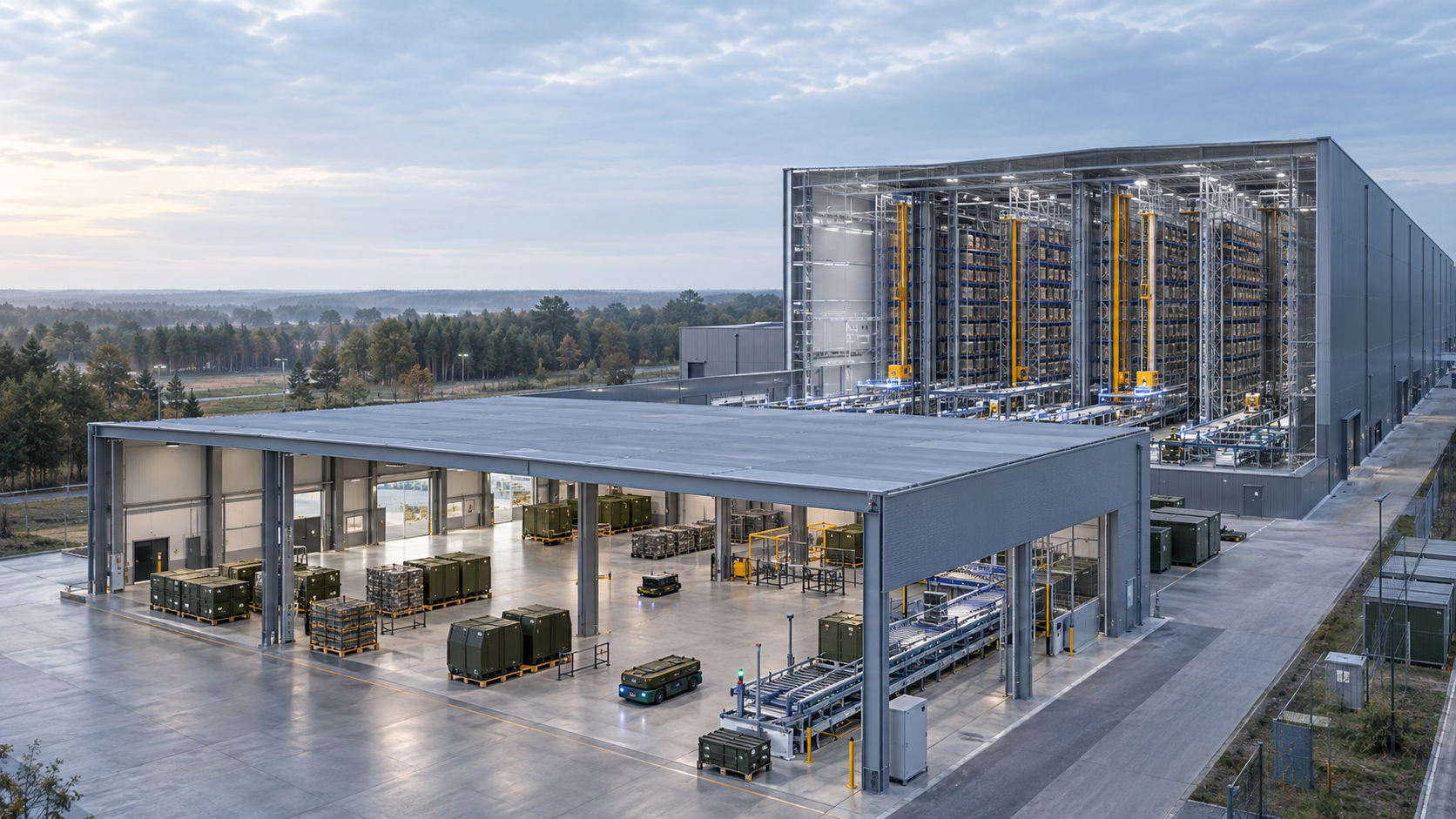
Military Logistics 4.0: Why Germany's defense will begin in high-bay warehouses in the future – Creative image on the topic, with AI: Xpert.Digital
German Armed Forces' multi-billion euro project: The risky high-tech undertaking on the Altmark training area
More than just a construction contract: Why this mega-project in Saxony-Anhalt is becoming a litmus test
The underestimated economics of the troops: The hidden hurdles of the new Bundeswehr camp
A groundbreaking project is underway at the Altmark training area, the army's central training facility: a fully automated high-bay warehouse complete with a scaffolding hall. What initially appears in the public tenders to be a conventional construction project, upon closer inspection reveals itself to be a highly complex systems project intended to revolutionize the military value chain. It's about far more than steel, concrete, and storage space. The German Armed Forces are adopting state-of-the-art principles of "Industry 4.0," where Building Information Modeling (BIM), cybersecurity, automated conveyor technology, and precise data flows are interwoven. However, the path to networked military logistics is fraught with economic and planning hurdles. Automation brings efficiency but simultaneously demands maximum resilience for emergencies. This article examines why the project in Saxony-Anhalt is not only a gigantic economic lever for planners and the construction industry but will also become a crucial test case for the new, accelerated federal military construction program.
The Altmark region is automating its military logistics
Germany's defense capability is determined not only by its weapons system, but also by its stockpile
The tender for the construction of a new automated high-bay warehouse with a scaffolding hall at the Altmark training area appears at first glance to be a typical public planning contract. From an economic perspective, however, it represents a fundamental shift: military capability is increasingly understood as the result of a seamless industrial value and logistics chain. It is not just the number of available vehicles, equipment, or spare parts that is crucial, but rather the ability to reliably store materials, manage them digitally, assemble them according to demand, and provide them under tight time constraints.
The project encompasses general planning services for an automated high-bay warehouse, a scaffolding hall, and a staff building. Plans include functional preliminary design, BIM-based system planning, the creation of a functional specification, and support during the subsequent tendering process to a general contractor. Construction supervision and quality assurance are also included. This project thus goes far beyond the planning of a simple warehouse. It integrates architecture, structural engineering, building services engineering, fire protection, automation, information technology, material flow planning, and future operational processes into a cohesive system.
It is precisely this connection that makes the project economically attractive. The actual building merely forms the outer shell. The strategic value arises from the material availability organized within it. An automated warehouse can consolidate space, make inventory more transparent, shorten access times, and reduce routine personnel tasks. However, whether these advantages are actually realized depends less on the height of the shelves than on the quality of the process planning, the database, and the technical interfaces.
From construction contract to logistics system project
The official classification as a service provided by architectural firms only describes part of the economic scope. In reality, it is a complex systems project in which traditional building design and automated intralogistics are interdependent. Even minor changes to the load carrier, the dimensions of the goods to be stored, or the required throughput can affect racking geometry, conveyor technology, the floor slab, fire protection, energy supply, and software architecture. These interdependencies increase the planning effort and, at the same time, the value of a high-performance, comprehensive plan.
In a conventional warehouse, the building can initially be designed largely independently of its later operation. This approach would be risky for an automated high-bay warehouse. The structure must be tailored to dynamic loads, defined tolerances, and precise movement sequences. Storage and retrieval machines, conveyor lines, transfer points, and control systems require precisely defined interfaces. Maintenance routes, evacuation, fire suppression concepts, and emergency operation procedures must not be added later but integrated into the overall design from the outset.
The assembly hall expands the warehouse's function by adding a crucial process step. There, materials are not only moved, but also assembled, inspected, replenished, and handed over according to specific operational or training needs. From an economic perspective, it forms the link between inventory and usage. A high degree of automation in the warehouse loses its benefit if picking, inspection, or handover processes are subsequently hampered by unclear procedures. Therefore, planning must consider the entire process chain and not focus solely on maximizing storage capacity.
A key location for mission preparation
The location lends the project additional significance. The Army Combat Training Center in the Altmark region is the Army's central training facility for realistic operational and combat training. The training area covers approximately 23,000 hectares and allows for exercises involving large units and various branches of the armed forces. The infrastructure there therefore not only serves the daily operations of the barracks but also supports complex training exercises with considerable material requirements.
At such a location, delays in material supply can have far-reaching consequences. If equipment, spare parts, or pre-prepared material packages are missing, not only are individual working hours lost, but in the worst-case scenario, this results in downtime for vehicles, training personnel, and entire training units. The economic damage caused by a logistical bottleneck can therefore significantly exceed the immediate value of the missing item. Consequently, a warehouse project must be evaluated based on the system costs it avoids and the availability it enables.
The modernization also fits into a longer-term development plan for the site. The combat training center already utilizes extensive simulation and digitalization technology. An automated high-bay warehouse extends this modernization approach to material supply. While simulation, training, and logistics will not become a single technical system, they will follow the same economic logic: processes should be measurable, reproducible, and manageable even as complexity increases.
The underestimated economics of military camps
Military warehousing differs significantly from a typical commercial warehouse. E-commerce is usually characterized by high throughput, short delivery times, and a large number of standardized orders. Military stockpiles, on the other hand, can vary considerably in size, weight, turnover rate, and security requirements. Some goods are moved regularly, while others must remain available for extended periods. Additionally, documentation requirements, special access rights, and stricter redundancy standards may apply.
Automation is therefore not an end in itself. It is particularly worthwhile where standardizable loading units, recurring movements, and sufficiently predictable processes exist. If unsuitable or highly heterogeneous goods are forced into an overly rigid automation concept, special cases, manual detours, and disruptions can negate the expected efficiency gains. A sound economic analysis must therefore differentiate between various storage zones and levels of automation, instead of aiming for a completely unmanned facility across the board.
The economic benefits arise from several components. Compact storage reduces the space required per storage location. Automated transport minimizes search, travel, and waiting times. Continuous inventory management can reduce incorrect bookings, unnecessary safety stock, and unplanned replenishment. Ergonomically challenging or monotonous tasks can be partially automated. However, this also increases capital commitment, technological dependency, and the need for qualified maintenance and software support. The crucial question, therefore, is not whether automation is inherently modern, but whether the costs avoided and performance improvements over the product lifecycle outweigh the investment and operational risks.
Planning becomes the most valuable project phase
For complex logistics facilities, the overall costs are particularly strongly influenced in the early planning phases. Once the supporting structure, hall dimensions, fire protection compartments, material flow, and technical connections are defined, fundamental errors can only be corrected with considerable effort. Therefore, the comprehensive planning contract has a greater economic impact than its share of the total subsequent investment volume would suggest.
For public contracting authorities, the key task is to formulate requirements precisely enough without unnecessarily narrowing the scope of possible solutions. A purely technical specification of details can stifle competition and innovation if specific systems are defined too early. Conversely, an overly general functional description shifts ambiguities to the bidding and construction phases. There, they often lead to risk premiums, change orders, or disputes regarding the scope of services owed.
The quality of preliminary planning can therefore be measured by how well it combines requirements, performance, and verifiable criteria. These include, for example, required storage capacities, peak loads, availability targets, restart times, acceptable downtime risks, expansion possibilities, and maintenance windows. The expected development of the site should also be considered. A warehouse that is optimally utilized on the day of handover can quickly become a bottleneck if operations grow later. Conversely, an oversized facility ties up capital and generates unnecessary operating costs on a permanent basis.
BIM as an economic management model
The planned BIM-based system planning for this project is more than just a digital representation of the building. Building Information Modeling can combine geometries, technical specifications, costs, schedules, and operational information into a coordinated data model. This is particularly relevant for an automated high-bay warehouse because building construction, building services, and intralogistics must be closely aligned.
The greatest short-term benefit lies in collision detection. Pipes, sprinklers, cable trays, maintenance areas, and conveyor systems compete for limited space. If conflicts are only discovered on the construction site, downtime, replanning, and change orders result. A coordinated digital model can identify such problems earlier. However, it doesn't eliminate them automatically. The benefits depend on uniform data standards, clear responsibilities, and consistent model verification.
In the long term, BIM can also support operations. If components, maintenance intervals, spare parts data, and technical documentation are transferred in a structured manner, the operator gains a digital starting point for plant management. However, without binding requirements for data quality and updates, there is a risk of creating a complex model that will not be used after the handover. Therefore, BIM is only economically viable if it is clear before planning begins which information will later be used by whom and for what purpose.
The general contractor as an accelerator with risks
The planned preparation for later implementation by a general contractor reflects the political and administrative desire for faster implementation. A general contractor typically assumes significant planning responsibilities as well as construction, consolidating numerous trades under a single contractual responsibility. For the client, this can reduce interfaces and simplify scheduling. This model offers potential advantages, particularly for projects that can be standardized or are highly integrated from a technical perspective.
The price of this bundling lies in a greater dependence on the quality of the functional performance specification. The less clearly the required function is defined, the greater the scope for interpretation during implementation. A general contractor focused on cost-effectiveness will either factor in unclear risks or attempt to implement the most cost-effective yet contractually compliant solution. Both can be detrimental to the client. Therefore, the general planning must precisely define those requirements that are essential for performance, safety, expandability, and life-cycle costs.
In addition, there is a question of market structure. Large, comprehensive contracts can accelerate projects, but often increase the requirements for revenue, references, liability, and coordination capabilities. This narrows the pool of potential main contractors. Small and medium-sized architecture, construction, or engineering firms remain involved as subcontractors, but have less direct access to the client. From an economic perspective, it is therefore necessary to weigh whether the gains in acceleration justify the reduced competitiveness and potential dependence on a few system integrators.
A contract for several industries
The initial planning commission is aimed at architectural and engineering firms, but the potential added value extends much further. Expertise is required in structural engineering, structural design, building services engineering, fire protection, geotechnical engineering, energy supply, IT, security technology, and intralogistics. Later implementation will add steel and plant construction, racking systems, conveyor technology, sensor technology, control software, construction execution, and technical maintenance.
This creates not just a typical individual market for suppliers, but a project ecosystem. Consortia or general planners with demonstrable experience in automated warehouses and complex public construction projects have particularly good opportunities. Pure architectural expertise will likely not suffice if material flow and automation are not considered from the outset. Conversely, a strong intralogistics provider needs partners who are proficient in public building law, procurement procedures, military requirements, and federal construction regulations.
The contract can also serve as a reference project. Military infrastructure in Germany will need to be modernized and expanded for many years to come. Successfully planning or implementing a technically demanding project under the conditions of federal public construction improves one's starting position for future contracts. However, this benchmark should not lead to aggressively low bids. Especially with long-term and security-relevant projects, unrealistically low planning fees can later result in quality problems, staff turnover, or additional claims.
Tailwind despite weak construction market
The project is encountering a contradictory market situation. Parts of the German construction industry are suffering from high financing costs, weak new housing construction, increased material prices, and uncertain private demand. At the same time, the government-driven need for defense, energy, transportation, and digital infrastructure is growing. For planning offices and construction companies, this is shifting demand from interest-rate-sensitive private projects to long-term financed public projects.
Intralogistics also faces a complex situation. German manufacturers possess high levels of technological expertise, but have recently had to contend with a weaker industrial economy and declining production volumes. Public and defense-related investments cannot fully compensate for this weakness, but they do provide comparatively stable demand in a demanding segment. Solutions that not only promise automation but also back it up with robust availability, service, and security concepts are particularly in demand.
The current situation does not automatically translate into lower bids. Specialized professionals, suitable system integrators, and experienced BIM planners remain scarce. Furthermore, safety requirements, documentation obligations, and long project durations lead to higher overhead costs. Public sector clients can benefit from broader interest in the construction industry, but should not assume that a weak market will solve all capacity problems.
Your intralogistics experts

Consulting, planning and implementation of complete solutions for high-bay warehouses and automated storage systems - Image: Xpert.Digital
More information here:
The German Armed Forces' infrastructure needs are growing rapidly
Billions in demand meet limited capacities
The German Armed Forces (Bundeswehr) face an exceptionally high infrastructure requirement. Around €1.06 billion was budgeted for new construction and replacement buildings in 2025, supplemented by approximately €270 million for renovations. Infrastructure needs projected up to 2035 amount to around €26 billion; by 2045, a total requirement of more than €100 billion is forecast. This scale demonstrates that the bottleneck is not solely a matter of financing.
Planning authorities, permitting agencies, building authorities, and companies are facing a significantly higher volume of projects. While funding can attract capacity, experienced engineers, project managers, and specialist planners cannot be multiplied overnight. When too many projects are launched simultaneously, prices, processing times, and quality risks increase. A single high-bay warehouse then competes not only with private logistics centers but also with barracks, depots, airfields, transportation projects, and energy facilities for the same skilled personnel and supply chains.
For public authorities, portfolio management is therefore becoming just as important as the management of individual projects. Projects with a high contribution to operational readiness should be prioritized and supported by realistic resource plans. Standardization, reusable planning modules, and bundled procurement can help, but must not ignore local requirements. The decisive productivity gain lies in reducing friction between the end user, the construction administration, planners, and contractors.
Acceleration changes the rules of the game
This project coincides with a period of profound reforms to military procurement and construction. In 2026, the legislature further facilitated accelerated planning and procurement for the German Armed Forces. Additionally, a draft law for accelerating the development of infrastructure for the German Armed Forces, including a separate law for military construction, is currently under consideration. The aim is to shorten planning and approval times, provide more flexible responsibilities, and enable faster implementation of military infrastructure.
Economically, such acceleration can bring significant advantages. Having a facility ready for deployment years earlier generates benefits that are not apparent in a purely cost-based calculation. Shorter processes also reduce the risk of price increases during lengthy planning phases. At the same time, speed should not be confused with abandoning reliable demand forecasting. A warehouse built quickly but incorrectly sized or technically inflexible will incur follow-up costs for decades.
The planned legal simplifications in environmental, nature conservation, and permitting law are also politically and legally controversial. Proponents see them as a necessary response to the infrastructure backlog and the worsening security situation. Critics warn against excessive restrictions on legal protection, environmental impact assessments, and established responsibilities. For the Altmark project, this has a clear consequence: the faster formal procedures become, the more important transparent technical decisions, thorough documentation, and the proactive involvement of affected parties become.
Regional opportunities for Saxony-Anhalt
The project generates direct and indirect economic benefits for Saxony-Anhalt. During the planning phase, specialized offices, consultants, and technical advisors will profit. Construction will generate contracts for building contractors, assembly companies, electrical firms, building services engineers, and logistics providers. Later, during operation, qualified personnel will be needed for plant operation, maintenance, software support, and technical inspections.
The regional share of the value creation, however, depends on the procurement structure. Highly specialized automation and high-bay racking systems are often supplied by companies operating across regions or internationally. Regional firms have better chances for earthworks, building construction, technical equipment, assembly support, and ongoing service. Effective integration of local suppliers requires that the main contractor defines suitable work packages and communicates safety and quality requirements early on.
The knowledge effect is also relevant. When regional companies gain experience with BIM, federal military construction projects, and automated intralogistics, they can later apply this expertise to other industrial and infrastructure projects. The same applies to universities and vocational training institutions. Therefore, the long-term regional benefit arises not only from temporary construction revenues, but also from additional technical capabilities and stable maintenance relationships.
The increase in personnel is real, but limited
Automation is often equated with staff reduction. This view is too simplistic. An automated high-bay warehouse primarily reduces manual driving and searching movements, as well as repetitive transport. At the same time, new tasks arise in the control room, data maintenance, troubleshooting, preventive maintenance, and system administration. The required skill set changes more significantly than the total number of employees inevitably decreases.
For the German Armed Forces, this transformation can nevertheless be economically attractive. Personnel are scarce and should ideally be deployed for tasks requiring military or technical decision-making expertise. Automating routine operations frees up working hours to focus on monitoring, preparation, and availability management. However, this benefit depends on having a sufficient number of trained operators and maintenance personnel. Without training and reliable technical support, a highly automated system can be down for longer than a conventional warehouse in the event of a malfunction.
When planning personnel, shift work and peak operations must also be taken into account. A system that functions with a small staff during normal daily operations must also remain operational during drills, short-notice needs, or exceptional workloads. Suitable backup models, documented emergency procedures, and regular training for manual or semi-automated backup operations are therefore essential for cost-effectiveness. Resilience is not a free add-on, but rather an operational service that requires funding.
Data quality as a hidden bottleneck
Even the most efficient high-bay warehouse can only operate as reliably as its data. Item master data, dimensions, weights, storage conditions, inventory levels, and access rights must be accurate and up-to-date. Inaccurate data leads to blocked storage locations, incorrect storage, increased search time, or security issues. This effort is often underestimated in automation projects because the focus is on visible technology.
Therefore, systematic data cleansing is required before commissioning. Existing inventory must be recorded, classified, and assigned to suitable load carriers. At the same time, interfaces to materials management, maintenance, and, where applicable, higher-level control systems must be defined. Media breaks between paper, spreadsheets, and specialized software would significantly reduce the benefits of automation.
Data quality is not a one-off project task. New items, modified packaging, and differing weights must be systematically integrated into the system. Responsibilities for master data maintenance are therefore just as important as the technical software. A robust organizational structure should define who is authorized to modify data, how changes are verified, and which key performance indicators (KPIs) should signal quality issues.
Cybersecurity is becoming part of building security
With the networking of warehouse management systems, material flow computers, sensors, and plant controls, the physical infrastructure merges with information technology. A failure can not only affect data but also halt actual material movements. This makes cybersecurity an integral part of logistical availability and not merely a task for office IT.
The security concept must balance various objectives. The system requires protected networks, controlled access, logging, secure remote maintenance, and robust recovery procedures. At the same time, an overly rigid security model must not render necessary maintenance and updates practically impossible. Dependencies on proprietary software or individual manufacturers are particularly critical. If only one vendor can implement changes, long-term cost and availability risks arise.
Therefore, clear requirements for interfaces, documentation, configuration rights, spare parts supply, and data export are economically sound. Restart and emergency operation procedures must also be tested. A backup is only valuable if its restoration works under realistic conditions. Public authorities should specify cybersecurity and technical resilience as measurable performance characteristics in their tenders, rather than treating them as general declarations of intent.
Energy, fire protection and operating costs
High-bay warehouses place special demands on fire protection and building services engineering. Great storage heights, dense storage, and limited accessibility can necessitate sophisticated fire suppression and detection concepts. The specific solution depends on the stored goods, load carriers, and structural conditions. Early coordination is crucial from an economic standpoint, as subsequent modifications to racking, sprinklers, or fire compartments can be particularly expensive.
Energy consumption also warrants a life-cycle assessment. Storage and retrieval machines may recover energy during deceleration, but along with conveyor technology, control systems, lighting, ventilation, and IT, they require a reliable power supply. Load management, energy-efficient drives, and demand-based lighting can reduce operating costs. A system designed for maximum peak performance is not automatically economical if it operates predominantly at partial load.
The decisive factor is the total cost of ownership, encompassing planning, construction, operation, maintenance, upgrades, and decommissioning. Low initial costs can be offset by expensive spare parts, short software lifecycles, or high energy consumption. Conversely, not every technically sophisticated system is economically justified. Therefore, the tender should include relevant operating costs and availability guarantees in its evaluation, insofar as this is legally and practically feasible.
Resilience instead of maximum efficiency
Private logistics often optimizes for cost, speed, and capacity utilization. Military logistics, however, must additionally cope with disruptions, peak loads, and limited external support. This requirement alters the optimal design. A system with the highest theoretical efficiency may be unsuitable if a single point of failure brings the entire operation to a standstill.
Resilience can be increased through redundant components, alternative routes, spare parts inventory, independent power supply, and manual emergency procedures. Each of these measures costs money and can increase technical complexity. Therefore, a risk-based approach is necessary. Not every process requires complete redundancy, but acceptable downtime and restart targets should be bindingly defined for critical material flows.
The right balance lies between an expensive, over-engineered safety concept and a minimal, failure-prone system. A transparent risk assessment should consider the probability of occurrence, the extent of damage, and the recovery time. Supply chain risks are also included. If key components have long lead times, a comparatively small spare parts inventory can generate significant economic benefits.
The risk of costly interface errors
The greatest project risk likely lies not in a single trade, but in the interfaces between them. Building structure and racking system, conveyor technology and fire protection, warehouse management and materials handling, as well as construction and subsequent maintenance, each follow different technical logics. Without clearly defined interfaces, each participant can formally fulfill their individual task, while the overall system still fails to function reliably.
The overall planning must therefore organize central integration responsibility. This includes coordinated data models, interface lists, release processes, and systematic testing. Before acceptance, not only should individual machines function, but complete operating scenarios should be demonstrated. These include normal operation, peak load, malfunctions, restarts, and, if necessary, emergency operation.
Another area of risk is phased handover. Buildings and technical systems are rarely fully completed simultaneously. If systems are being installed while other trades are still working, this creates risks for sensitive components and creates scheduling conflicts. A realistic commissioning concept must therefore integrate installation, software testing, trial operation, training, and data migration. The schedule should include sufficient buffers for troubleshooting, rather than equating formal completion with actual operational readiness.
No reliable valuation without financial volume
The publicly available announcement does not specify a reliable total investment volume for the subsequent construction project. This results in a significant analytical limitation. Neither the size of the warehouse, nor the degree of automation, nor the expected economic viability can be reliably quantified. Any concrete cost estimate would be speculative without information on floor space, number of storage spaces, throughput, technical specifications, and safety requirements.
Nevertheless, its economic significance can be qualitatively assessed. The combination of high-bay warehouse, scaffolding hall, staff facilities, BIM planning, functional specifications, general contractor award, and subsequent quality assurance points to a sophisticated infrastructure project with multiple technical system layers. The planning mandate lays the foundation for a significantly larger future investment and influences its costs throughout the entire life cycle.
For sound performance monitoring, key performance indicators (KPIs) should be published or internally defined as binding no later than the completion of the preliminary planning phase. These include planned capacity, throughput, availability, energy consumption, staffing requirements, investment costs, annual operating costs, and expected service life. Only these metrics allow for a comparison between automated and conventional solutions. Transparency is not only a matter of public accountability but also a tool to prevent gradual shifts in objectives.
What success must be measured by
Project success should not be reduced to adherence to construction costs and delivery dates. While these metrics are important, they reveal little about whether the facility fulfills its military-logistical purpose. What matters is operational performance after commissioning. A warehouse built on schedule but plagued by frequent malfunctions or insufficient throughput would not be an economic success.
Relevant performance indicators include inventory accuracy, average setup time, throughput during normal and peak loads, technical availability, number of critical malfunctions, restart time, and maintenance costs. Additionally, energy consumption per movement, space utilization, and personnel hours per job should be monitored. The quality of the setup processes is also measurable, for example, by identifying faulty configurations or delayed handovers.
Key performance indicators (KPIs) must be defined during the planning phase so that technical decisions can be aligned with them and acceptance tests can be derived from them. After commissioning, a stabilization phase should follow, during which operational experience is evaluated and processes are adjusted. Automation rarely reaches its full performance on the first day. What is economically crucial is how quickly the system achieves stable, regular operation and whether identified weaknesses are consistently addressed.
A test case for the new federal military building
The project in the Altmark region is more than just a single tender for planning services. It's a litmus test for whether Germany can translate its growing defense spending into functional infrastructure. Political willingness to invest more doesn't automatically solve the implementation problem. Only when needs assessment, planning, tendering, construction, digitization, and operation function as a cohesive process will military benefit be realized.
The chosen approach inherently possesses suitable elements. General planning can consolidate the multitude of technical disciplines. BIM can make interfaces visible earlier. A functional specification provides the general contractor with greater flexibility in finding solutions. Construction supervision and quality assurance can prevent acceleration from compromising functionality. However, each of these instruments only unfolds its full potential with clear responsibilities and technically sound requirements.
The rationale is therefore this: The new building can become a model for modern military logistics, but it is by no means automatically an efficiency project. Automation shifts costs and risks from manual labor to technology, data, and system integration. If this shift is consciously planned, the Altmark region can benefit from higher material availability, shorter deployment times, and better land use. Conversely, if only a modern building and impressive technology are procured without adequately preparing processes, data, and operations, the result is an expensive system with limited added value.
This is precisely where its macroeconomic relevance lies. Germany will have to implement many military construction projects simultaneously in the coming years. Successful projects can set standards, accelerate learning curves, and utilize scarce planning capacities more productively. Conversely, flawed projects would not only tie up budgetary resources but also consume personnel and political attention. The high-bay warehouse in the Altmark region is therefore small in relation to the overall infrastructure needs, but large enough to demonstrate whether the announced construction boom can actually be combined with industrial precision.
Your global marketing and business development partner
☑️ Our business language is English or German
☑️ NEW: Correspondence in your native language!

Konrad Wolfenstein
I and my team are happy to be available to you as your personal advisor.
You can contact me by filling out the contact form here wolfenstein@xpert.digital:or simply call me at +49 7348 4088 965. My email address is
I'm looking forward to our joint project.