
The Starlink conflict highlights Europe's digital risk: Whoever controls the infrastructure also has a say – Creative image on the topic, created with AI: Xpert.Digital
Europe's dependence on US technology: Why a functioning connection is not enough
Cloud, AI, satellites: How digital partnerships become strategic dependencies
Digital sovereignty: Why Europe needs more than European alternatives
Satellite connections in Ukraine are working again. But the restoration of Starlink and Starshield doesn't resolve the central question: Who can decide on critical digital infrastructure – and how quickly can users switch providers if conditions change? The conflict highlights that technical availability and actual control are not the same thing. What constitutes a security policy urgency in Ukraine is an economic warning for European companies and governments: Those who rely on essential services from a limited number of providers must also consider the dependencies and switching costs.
This does not mean distrusting American technology outright or questioning every international partnership. US providers deliver powerful services that create significant benefits for many companies. Rather, the crucial questions are how transparent the terms of service are, who decides on access in a crisis, and whether core functions can continue to operate even if political or commercial interests shift. These questions extend far beyond satellite communications, encompassing cloud services, AI systems, and the digital infrastructure of industry.
A look at the markets shows why this issue is gaining importance: A few providers dominate key digital platforms, while switching providers at short notice is often technically and economically complex. Europe therefore doesn't need the illusion of complete independence, but rather credible alternatives and verifiable capacity to act. The Starlink dispute is not proof that every dependency inevitably becomes a tool of power. However, it does show why companies and states need to know which services they actually control – and which alternative routes will actually work in a crisis.
America's Digital Power: When Partnership Becomes Dependency – Whoever Controls Access Rules with You
The restoration of satellite connections in Ukraine ends an acute disruption, but not the underlying problem: Critical infrastructure can be technically available yet remain outside of one's own political control. For European companies and governments, this is an economic warning, not a call for blanket distrust of American technology. The crucial factor is not whether a provider is US-based, but how interchangeable its services are, who decides on their use, and what the consequences of any restrictions would be. From this perspective, the conflict surrounding Starlink and Starshield connects three developments: the increasing intertwining of economic and security policy, the concentration of key digital markets, and the growing value of credible alternatives.
The legitimate core of the criticism of American power politics therefore does not lie in the assertion that partnership has always been nothing but a deception. It lies in a sober observation: A partnership becomes vulnerable when one side can change its commitments at short notice and the other side can hardly evade them. Under the current US President Donald Trump, this contradiction is particularly evident; at the same time, the documented problems with European replacements show that political outrage alone does not create the capacity for technical action.
The connection is established, but the uncertainty remains
On October 24, 2026, the Ukrainian leadership announced that the previously restricted use of Starlink and Starshield had been restored. The problems had disrupted military operations for more than a week, affecting communications and counter-drone missions, among other things. According to the Ukrainian Ministry of Defense, connections subsequently remained stable even at speeds exceeding 400 kilometers per hour.
This restoration is operationally significant, but not yet a long-term economic guarantee. When an essential service is functioning again, only its current state is clarified. It remains unclear whether the conditions for its use are sufficiently transparent, contractually sound, and enforceable in the event of a dispute. For a business, a restored cloud can be as reassuring as a reopened delivery route. However, a long-term investment decision also requires an assessment of how reliable this availability will be in the future.
Ukraine is an extreme case, and precisely for that reason, revealing. Its needs are existential, the time pressure exceptionally high, and the possibility of switching suppliers at short notice limited. This does not mean that European industrial customers will face the same constraints tomorrow. It does mean that technological capability and sovereign usability are two different things. An infrastructure can function perfectly well and still create strategic dependency.
Why kilometers per hour are crucial
The discussed limits of approximately 160 kilometers per hour referred to the speed of movement of the connected devices, not to an internet bandwidth of supposedly 160 or 400 megabits per second. This distinction is crucial: A satellite terminal can continue to transmit data while stationary, whereas its connection will be restricted on a fast-moving platform. Therefore, this was not simply a general slowdown of all Ukrainian internet connections.
Economically, this process illustrates how precisely digital infrastructure can be controlled. It's not only a complete shutdown that alters the usefulness of a system. Even restrictions on individual functions can render a particular application unusable, while other services continue to operate. The relevant dependency, therefore, often concerns less the ownership of a device than the continuous availability of its capabilities.
This raises a practical question for companies: Which functions are controlled locally and which depend on externally managed approval? With a networked machine, an AI application, or a logistics platform, a nominally available service can become economically worthless if the required function is unavailable. Owning hardware then does not automatically equate to controlling its productive use. This distinction must be considered in any serious analysis of digital operational security.
Jurisdiction is not a secondary matter
Starlink and Starshield should not be treated indiscriminately. Starlink is SpaceX's commercial offering; Starshield is aimed at governmental and security-related applications and leverages the company's underlying technology and launch capabilities. However, a shared technical foundation does not mean that terms of use, decision-making powers, and governmental influence options are identical.
On October 24, Elon Musk admitted that SpaceX had restricted commercial Starlink usage, citing allegedly impermissible offensive drone operations. Ukrainian representatives disagreed, pointing to existing speed and geographical limitations on the commercial service. Therefore, they argued, the claim of a proven Ukrainian contract violation would be unjustified.
Regarding Starshield, Musk pointed to the decision-making authority of the US government, while Trump and leading government officials denied any responsibility for the restrictions. The publicly discernible allocation of responsibility thus remains contradictory. Economically, this very ambiguity exacerbates the risk: A customer needs to know not only that a service is available again, but also which entity has the binding authority to decide on its continuation. Clear accountability is a prerequisite for reliable commitments, effective escalation channels, and predictable business relationships.
Not every disruption is power politics
A reliable assessment must distinguish between technical failures and deliberately imposed usage limits. On July 24, 2025, Starlink suffered a widespread international outage, which, according to the company, was due to the failure of key internal software services. The service was largely restored after approximately two and a half hours. This incident demonstrates a technical concentration risk, but not, in itself, a political intent.
The difference is significant for risk management. Different measures are needed to address a common software error than a legally or politically mandated restriction. The only commonality in both cases is that a central dependency can affect many users simultaneously. A large number of distributed satellites does not automatically eliminate every common point of failure in network operation. Conversely, the existence of such points of failure should not be misinterpreted as evidence of supposedly deliberate control of every disruption. Proper risk management investigates the cause, scope, and alternative solutions separately, instead of lumping all disruptions together into a single geopolitical narrative.
Hegemony was never selfless
America's leadership role after World War II combined its own interests with institutions that also benefited other nations. The Bretton Woods system, agreed upon in 1944, created a framework for monetary cooperation, reconstruction, and economic development through the International Monetary Fund and the World Bank. American influence and international cooperation were therefore not opposites, but rather integral components of the same system.
A dominant state can particularly benefit from an open and predictable system. It gains markets, political ties, and influence over regulations, while partners gain access to capital, technology, and more stable exchange relationships. This mutual benefit does not, however, create equality. It explains why partnership can be more than mere rhetoric and yet still contain power asymmetries.
Previous US administrations also used their economic power unilaterally. In 1971, President Richard Nixon ended the dollar's convertibility to gold and imposed an additional 10 percent import tariff; these measures were also intended to force international adjustments in favor of the US. The notion of a completely equitable past would therefore be just as simplistic as the idea that all previous partnerships were merely a facade. The analytically important difference lies in the relationship between long-term commitment to common rules and short-term use of one's own leverage.
Trump is changing the business model
Under Trump, technology policy was explicitly linked to the goal of consolidating American leadership internationally. The US strategy for AI exports encompasses not only individual products, but complete technology packages including hardware, data infrastructure, cloud services, models, security solutions, and applications. The global dissemination of American standards and governance models is identified as a strategic objective.
This differs from the concept of a politically neutral technology market. Those who provide a complete digital infrastructure influence not only the customer's purchasing decisions, but also their education, interfaces, investment cycles, and technological advancements. Economic cooperation can thus create closer, lasting relationships. These relationships are not inherently disadvantageous, but should be understood as an integral part of the business.
The more precise criticism, therefore, is not that Trump invented American self-interest. He makes the connection between technological market leadership, national advantage, and shaping foreign policy particularly explicit. However, this does not imply that every technological restriction is directly ordered by him or that every American company is an instrument of his administration. The Starshield controversy, in particular, demonstrates how crucial the distinction between documented action, alleged jurisdiction, and presumed political motive remains.
America's economy is growing, but unevenly
The claim that the US economy practically no longer functions outside of cloud computing and AI is not supported by the available data. In the second quarter of 2026, real gross domestic product (GDP) grew at an annualized rate of 2.2 percent; compared to the previous quarter, this corresponded to approximately 0.6 percent. Growth contributions came not only from the technology sector, but also from consumption, investment, and exports.
At the same time, labor market data do not point to a widespread employment boom. In September, the unemployment rate stood at 4.2 percent, and the number of people employed outside of agriculture increased by only 29,000. Over the previous twelve months, the average monthly increase in employment had been just 45,000. Consumer prices in September were 3.7 percent higher than the previous year, which further dampened real purchasing power.
The accurate picture, therefore, is of a growing but strained economy. Global economic growth of 3.1 percent was forecast in October for 2026, coupled with significant downside risks. AI investments are supporting demand, while energy prices, geopolitical uncertainty, and financial vulnerabilities are limiting the outlook. Against this backdrop, American technological strength appears particularly valuable, though it does not fully explain economic performance.
The cloud boom has a power structure
The global market for cloud infrastructure services reached $143.4 billion in the second quarter of 2026, according to a market estimate, a 43 percent increase year-over-year. This figure includes infrastructure and platform services as well as hosted private clouds, but not all software subscriptions or the entire AI market. Amazon held 28 percent, Microsoft 20 percent, and Google 15 percent; together, these three American providers accounted for 63 percent.
Concentration is economically more important than an isolated revenue record announcement. A rapidly growing market not only distributes additional revenue but also shapes the infrastructure of future business models. The more companies concentrate their data processing and applications on a few platforms, the more their technical and commercial decisions influence the rest of the economy. This isn't complete control, but it is a significant shift in bargaining power.
A market survey published in July 2025 reveals a similarly pronounced asymmetry for Europe: the three major US providers accounted for approximately 70 percent of the regional cloud infrastructure market, while European providers held around 15 percent. These figures reflect the data available at that time and should not be considered precise market shares for October 2026 without a new survey. Nevertheless, they demonstrate the extent of European dependence even before the recent satellite controversy.
Market leadership is achieved through scaling
The position of the major platforms cannot be explained solely by political support. Extensive upfront investments, broad product portfolios, and complex technical interconnections complicate market entry and switching between cloud providers. A high-performance, comprehensive offering can actually be more cost-effective and productive for customers than a multitude of self-organized, individual solutions. Dependence can therefore be the result of what initially appears to be a rational efficiency decision.
The problem develops over time. Employees acquire specialized knowledge, data structures are adapted, and applications are connected to provider-specific services. A subsequent switch then affects not only the transport of stored data but also programming, operational processes, and responsibilities. The UK Competition and Markets Authority (CMA) concluded in its final cloud investigation of July 2025 that technical hurdles and data outflow fees can impair effective freedom of choice.
This leads to a sober benchmark for the debate on digital sovereignty. Market leadership is not automatically an abuse, and standardization on a single provider is not automatically a mistake. The situation becomes problematic when customers underestimate the long-term switching costs or when high switching costs can later be used to justify unilateral deteriorations. The crucial economic question, therefore, is not just how cheap the initial entry is, but how costly a shift in interests could become.
🎯🎯🎯 Data-driven B2B industry hub as a quasi-in-house solution


The quasi-in-house solution: How Xpert.Digital closes operational gaps in B2B marketing and sales – Smart Content-Driven Business - Image: Xpert.Digital
Xpert.Digital is a data-driven B2B industry hub led by Konrad Wolfenstein . The company acts as an external, quasi-in-house solution for industrial partners, closing operational gaps in marketing, content, and sales – without requiring additional resources on the client side.
More information here:
Satellite communications: The challenges for Europe
Private operators, public consequences
The conflict surrounding satellite communications reveals an institutional tension: private companies develop and operate systems whose use for governmental tasks is becoming paramount. Under normal circumstances, this division of labor can accelerate innovation and facilitate access to high-performance technology. However, in times of crisis, different logics of responsibility clash: corporate control, contractual boundaries, national security, and the user's privacy interests.
A service provider is generally entitled to define terms of service and must comply with legal restrictions. Conversely, a state cannot accept that essential services depend on conditions that are persistently unclear or subject to short-term changes. Neither of these positions can be resolved by simply stating that it is either a private company or a state instrument of power. It is precisely this overlap that necessitates careful institutional safeguards.
SpaceX's contribution to Ukrainian connectivity since the Russian invasion should not be overlooked. A company can create significant security benefits while simultaneously generating a problematic dependency. Acknowledging both is not indecisiveness. Rather, it prevents the assessment from oscillating between uncritical gratitude and blanket demonization, while the fundamental question of lasting control remains unanswered.
Trust acts like invisible capital
Long-term infrastructure investments are based on expectations. A customer must be able to trust that key performance indicators will not be unexpectedly eliminated or altered for reasons they cannot influence or compensate for in a timely manner. If these expectations weaken, the economic value of additional safeguards increases. These include technical reserves, alternative operating routes, and contractually prepared transitions.
These costs are rarely fully reflected in price comparisons between two providers. A seemingly inexpensive service can become costly if it requires extensive maintenance. Conversely, a higher ongoing price can be economically sound if it offers a credible alternative. This doesn't require an impending shutdown. Even a change in the assessment of reliability can postpone the investment decision.
The Starlink issue illustrates this mechanism without proving a general unreliability of American technology. An additional warning signal can increase customer demand for alternatives, even if the specific disruption has since been resolved. This creates a conflict of objectives for the dominant provider: short-term control may promise an immediate advantage, while demonstrated dependence increases interest in competing solutions in the long run. Whether this effect will actually be significant enough to shift market share remains to be seen.
Dependence arises along entire chains
Digital sovereignty has several layers. A company might store its data in Europe, while core software, identity services, security updates, and operational tools depend on external providers. Having its own server room doesn't automatically eliminate these dependencies. Conversely, an external cloud can manage certain risks better than a poorly managed in-house solution. Therefore, a meaningful analysis begins with the functions actually needed, not with a geographical label.
In satellite communications, the chain is particularly evident: end device, network operator, authorized usage, capacity, and alternative connection must all be compatible. Switching to OneWeb would not only require a new contract but also the replacement of proprietary Starlink or Starshield terminals. The mere mention of a second provider in a presentation does not constitute operational redundancy.
The same basic principle applies to cloud computing and AI. Two service providers can rely on the same infrastructure, a locally offered service can be managed externally, and an exported file can be practically unusable without suitable software. The crucial factor is whether a switch works under realistic conditions. In this context, sovereignty does not mean the absence of all international dependencies, but rather the ability to continue performing essential tasks even under changing circumstances.
Data location is not subject to legal control
The CLOUD Act makes the distinction between location and legal obligation particularly clear. US law can compel providers, within the framework of permissible legal proceedings, to disclose data that is in their possession, custody, or control, even if that data is stored outside the US. This obligation is subject to legal requirements and is not a blanket license for arbitrary government access.
Likewise, the CLOUD Act is not a general legal basis for shutting down European cloud customers. It concerns cross-border data transfers and corresponding international agreements; issues of service interruption are distinct from this. Conflating the two overestimates a specific legal mechanism while simultaneously underestimating the diversity of actual dependencies.
A data center within the EU therefore only answers part of the security question. Companies must also examine who exercises administrative access, who controls the keys, which company is responsible for operations, and what technical services are permanently required from external providers. Such examinations are more demanding than simply checking the server location, but significantly more informative. A so-called sovereign offering is only reliable if its controllability and continuity can be verified under concrete conditions. The decisive test is not whether a provider promises independence, but rather what degree of autonomy the customer actually retains.
AI is shifting industrial value creation
The economic significance of American AI capabilities extends beyond the sale of individual models. The US export strategy explicitly combines computing hardware, data infrastructure, models, and industry-specific applications into complete offerings. This allows the same technological foundation to be used and further developed in software development, transportation, healthcare, or agriculture.
This presents a twofold challenge for European industrial companies. On the one hand, powerful AI systems can increase their own productivity and enable new services. On the other hand, comprehensive integration into external platforms can change the distribution of value creation. If production expertise remains local, but the central digital tools have to be purchased on an ongoing basis, this creates a persistent dependence on the prices, interfaces, and development decisions of other companies.
An economically sound response is not to reject every foreign AI solution. It is to treat company-specific knowledge, data access, and process expertise as proprietary assets. Models should remain interchangeable where feasible with reasonable effort. Particularly sensitive or time-critical functions can be secured differently than ordinary support tasks. The benchmark is long-term business benefit, taking dependencies into account, not the symbolic political value of a technological decision. Europe must be able to use AI without relinquishing control over all the conditions of its industrial application.
Without energy, there is no AI sovereignty
According to the latest energy analysis, global data center electricity consumption was projected to reach approximately 485 terawatt-hours in 2025. Central projections anticipate an increase to roughly 950 terawatt-hours by 2030; this is a projection and not based on actual measured consumption. The analysis also identifies bottlenecks in grid connections, power equipment, chips, and financing.
Digital infrastructure is thus directly linked to industrial and energy policy. Anyone wanting to expand computing capacity needs not only capital and servers, but also a reliably available electrical supply. A low average electricity price alone is insufficient if connections are lacking or actual operation cannot be adequately secured. Likewise, a fast building permit does not automatically create competitive computing power.
For Europe, this connection opens up opportunities beyond simply replicating American platforms. Network technology, cooling, automation, and energy-efficient operation are economically relevant components of AI expansion. However, this should not lead to an automatic expectation of success: even a large infrastructure requirement does not guarantee that every project will be profitable. High-performance locations must combine technical, energy-related, and economic prerequisites. A digital strategy that ignores the physical infrastructure remains incomplete; so too does an energy policy that plans new data centers without viable demand assumptions.
Europe's satellite gap cannot be ignored
OneWeb offers a European-focused alternative, but it does not represent an immediate and complete replacement for Starlink and Starshield. As of October 2026, the OneWeb constellation was described as having approximately 600 active satellites, compared to more than 10,000 for Starlink. The sheer number of satellites is not a complete measure of performance; in addition, the capacity, cost, weight, and energy consumption of the terminals limit the interchangeability of certain applications.
The European IRIS² program aims to close the structural gap. Following the expansion confirmed in August 2026, the planned main constellation will comprise 348 satellites, 330 in low Earth orbit and 18 in medium Earth orbit. Initial launches are scheduled for 2029; subsequently, European-controlled connectivity services will be made available gradually. This timeline represents a development path, not a currently operational replacement capacity.
The transition phase therefore demands pragmatism. Existing services should continue to be used while alternative transmission paths and European capacities are strategically expanded. Different applications require different solutions: A connection for a fixed location is not the same as a lightweight, mobile connection that can be used under difficult conditions. Anyone who conflates these requirements underestimates the industrial challenge. Strategic autonomy arises from operational systems and robust capacities, not from the mere announcement of a European alternative.
Multiple providers do not yet represent resilience
Even with cloud services, the frequently recommended multi-provider strategy is not a guaranteed success. A British competition investigation documented technical and commercial obstacles to both switching providers and using multiple clouds simultaneously. While additional providers can offer more choices, they also increase the effort required for integration, security, and operation. Therefore, greater diversity is not automatically more economical in every application.
The better question is which critical functions can actually continue to run independently. A company doesn't necessarily need a fully-fledged backup system for every application. It can be more important to be able to reliably export central data, restore identities, and operate essential processes in a limited capacity for a short time. A realistically tested fallback solution is often more meaningful than a theoretically comprehensive architecture that no one can master in practice.
The same applies to AI. The interchangeability of a model depends not only on an existing interface, but also on the quality of the results, its integration into processes, and the requirements of the specific task. An alternative does not have to be identical to offer economic benefits. However, it must be able to perform the most important functions under acceptable conditions. Resilience is therefore not merely a purchasing strategy, but a consciously designed operational capability. It must be regularly reviewed to ensure that a supposed alternative does not become a further problem in an emergency.
Companies must factor in exit costs
A sound cost-benefit analysis considers more than just usage fees, storage costs, and computing time. It also includes the effort required for future migration, the availability of qualified personnel, and the consequences of a temporary service outage. The more critical a service is to revenue, production, or security, the less sufficient a comparison of ongoing fees becomes. This does not mean, however, that every conceivable crisis should be hedged against with maximally expensive reserves.
A tiered approach is advisable. Standard communication and support tasks may have different requirements than production-related control, sensitive development data, or the handling of central supply processes. Crucial factors are acceptable downtime, possible alternative procedures, and whether a change can be realistically prepared in advance. Even a consciously accepted risk can be rational if it is transparently assessed and not taken unintentionally.
A provider's price-performance ratio doesn't automatically change to their disadvantage as a result. Large platforms can remain the most economically viable solution despite high customer retention rates. However, the decision should then be based on a comprehensive cost analysis. The real mistake lies in treating dependency as free. Knowing your alternatives not only allows you to better manage crises but also enables you to conduct commercial negotiations with greater clarity.
Europe needs demand, not labels
European providers more than tripled their regional cloud revenues between 2017 and 2024, while their market share in the rapidly growing overall market declined significantly. Growth alone is therefore insufficient to improve their relative market position. A European strategy must therefore go beyond general funding objectives and address which services are in demand in sufficient quality, scale, and reliability.
Regulation can reduce some of the barriers to switching providers. The Data Act, applicable since September 2025, contains provisions for switching data processing services; from January 12, 2027, the recorded switching fees may no longer be charged. However, this does not mean that all migration costs or all ongoing fees for parallel cloud usage disappear. Technical adjustments, internal work, and the creation of a functional target environment remain separate tasks.
The economic policy challenge lies in linking switching rights with genuine choice. Europe needs high-performing services, qualified operators, and customers that enable viable business models. A purely national coexistence of small, isolated solutions can be just as inadequate as continued dependence on a few global platforms. The sensible objective is not a European label on as many products as possible, but rather verifiable control over particularly important digital capabilities.
Technological strength does not protect against misallocation
The extraordinary dynamism of AI and cloud computing makes the corresponding investments economically attractive, but not automatically profitable. A reassessment of AI expectations is therefore a significant risk to the global outlook. High infrastructure spending can generate short-term demand, while long-term returns depend on whether companies actually develop enough productive applications and attract paying customers.
This is significant for the US because technological leadership and macroeconomic stability are not the same thing. An economy can possess world-leading platforms and still suffer from inflation, weak job growth, or unevenly distributed wealth gains. Similarly, a massive investment cycle can pave the way for later productivity gains or, in some cases, lead to overcapacity. Which combination will prevail remains to be seen.
Europe should therefore neither succumb to American apocalyptic expectations nor to an uncritical race to imitate. Not every large data center is a strategic success, and not every technological dependency is an economic disadvantage. The crucial question is whether investments generate tangible benefits and whether the remaining commitments are commensurate with the importance of the respective application. A dispassionate analysis must consider technological opportunities, capital risks, and political control issues simultaneously, rather than elevating any one of these factors to the sole explanation.
The next strength would be credible self-restraint
For American providers, maintaining their international base of trust represents a distinct economic advantage. Customer loyalty can be fostered through superior performance, seamless integration, and predictable terms, or through high exit costs. The first approach creates a more robust foundation for long-term partnerships. The second, while effective in the short term, intensifies the incentive to develop alternatives.
This presents the US with a strategic dilemma. The more explicitly technological dominance is declared a political goal, the more closely partners scrutinize the conditions of their dependence. Therefore, credible self-restraint in the use of existing leverage could be more economically valuable than its highly visible demonstration. Predictable usage rules, clearly assigned responsibilities, and practical transition pathways would combine efficiency and reliability.
For Europe, the decisive perspective is therefore neither complete decoupling nor unconditional trust. Transatlantic cooperation remains meaningful where it creates mutual benefits and appropriately limits key risks. In this understanding, complementary European capabilities are not a counter-project to the partnership, but rather its safeguard. Those who can continue essential functions, if necessary, either independently or with other partners, must treat political and commercial commitments less as a matter of faith. The most important lesson of the satellite conflict, therefore, lies not in the presumed intentions of individual actors, but in a verifiable capability: A partnership is more resilient when both sides remain capable of action even in the face of conflicting interests.
📈🚀 From visibility to trust 👀🤝 Your scalable path with Xpert.Digital

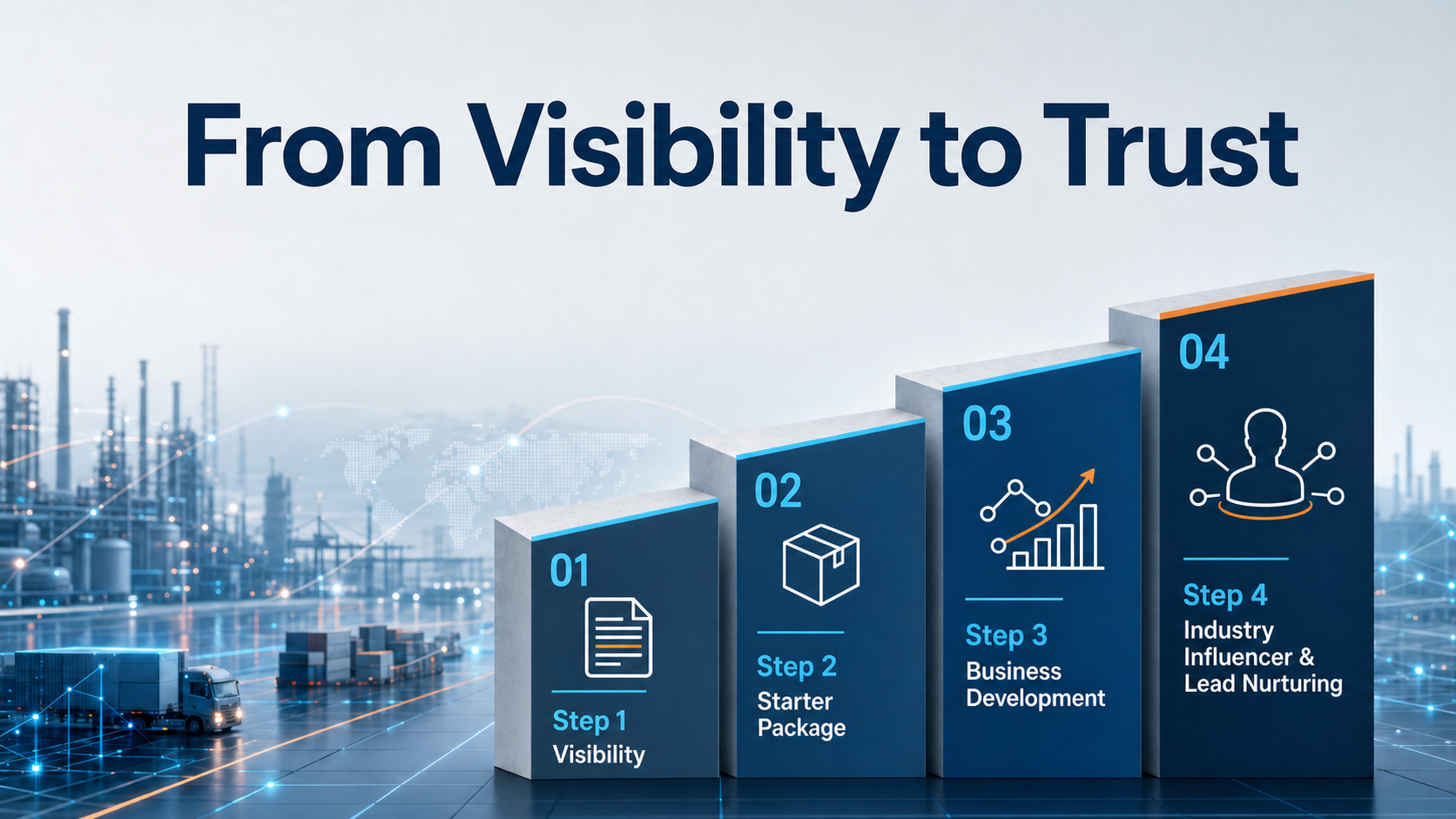
From visibility to trust: Your scalable path with Xpert.Digital - Image: Xpert.Digital
In industrial B2B, sustainable business relationships rarely emerge overnight. They develop step by step – through visibility, professional relevance, recurring touchpoints, and growing trust. Xpert.Digital's 4-stage model addresses precisely this: It offers a structured path that begins with a manageable entry point and can evolve into deeper collaboration in business development if needed.
Instead of relying on loud marketing promises, this model puts the relationship at the forefront. Companies start with clearly defined, easily calculable measures and then decide, based on their own experience, how far they want to expand the collaboration. A key factor for this undisturbed trust-building process: The platform completely avoids annoying advertising ads, so the editorial focus remains solely on the companies' expertise.
More information here:
Your global marketing and business development partner
☑️ Our business language is English or German
☑️ NEW: Correspondence in your native language!

Konrad Wolfenstein
I and my team are happy to be available to you as your personal advisor.
You can contact me by filling out the contact form here wolfenstein@xpert.digital:or simply call me at +49 7348 4088 965. My email address is
I'm looking forward to our joint project.