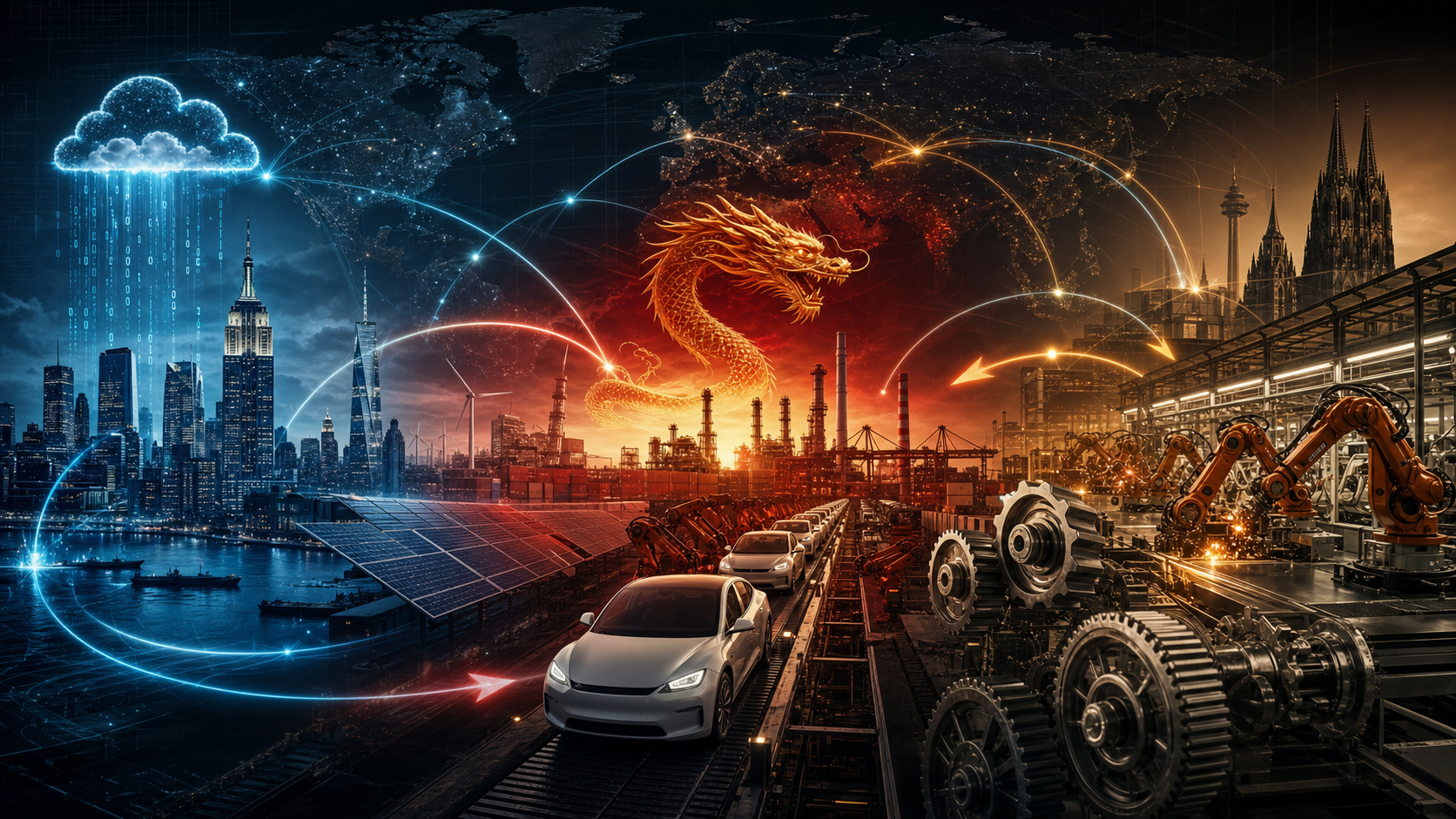
Stock market prices are deceptive: Who really keeps the global economy running – the medium-sized world market leaders and hidden champions – Image: Xpert.Digital
The blind spot of economists: Why we completely mismeasure the wealth of nations
The great caricature – Who really drives the global economy
USA, China, Europe: Who will really win the global economic battle?
Record stock market performance by American tech giants and massive government subsidies in Asia dominate the daily headlines. But this fascinated focus on share prices and simple growth rates often provides only a highly distorted picture of global power dynamics. The question of who will truly be viable in the geo-economic three-way battle between the US, China, and Europe is not decided on Wall Street, but rather in the deep structure of their respective economies. While the US neglects its industrial base in the pursuit of digital growth and China is trapped in a dangerous overproduction cycle without sufficient domestic consumption, Europe's true strength lies hidden. Underestimated, medium-sized global market leaders form an industrial foundation that is indispensable worldwide. This article looks behind the glittering facade of economic statistics and illuminates why one-sided dominance ultimately becomes the greatest weakness – and why, in the end, only a genuine balance of innovation, production, and consumption can secure true prosperity.
Related to this:


Stock market prices don't lie – but they don't tell the whole truth either
When economists, journalists, and investors compare the economic strength of nations, they tend to focus on the market capitalization of large corporations, GDP growth rates, and capital market indices. This perspective is understandable because it is tangible and measurable. However, it is also systematically distorted—because it overemphasizes global players on the stock markets and neglects those layers of the economy upon which genuine, sustainable prosperity is based. A geopolitical comparison of the three major economic regions—the US, China, and Europe—therefore requires more than a snapshot of market capitalization. It demands an examination of the deep structure of the respective economies.
The American promise and its structural limits
The United States presents itself to the world as an undisputed technological power. Indeed, a significant portion of its current economic strength rests on a handful of digital and technology corporations: the so-called Big Tech companies Microsoft, Amazon, Alphabet, Meta, Apple, and Nvidia. Their market capitalization has surpassed the size of entire economies like Germany or Japan. Cloud computing, artificial intelligence, and digital platforms have been the growth engines of the past decade – and this is no longer a fringe phenomenon, but rather a central component of the global economy.
But behind this gleaming facade lies a structural problem that is rarely discussed in the public sphere: the creeping erosion of the industrial foundation. In the first quarter of 2025, the manufacturing sector's share of American economic output fell to a historic low of 9.7 percent – down from 28 percent in the early 1950s and 18 percent in the late 1980s. In the fourth quarter of 2025, according to the Federal Reserve Bank of St. Louis, this share was exactly 9.4 percent. The US has thus become a country that exports digital services and intellectual property, but – measured against its economic size – hardly plays a significant role in manufacturing, mechanical engineering, and production technology.
This is neither a coincidence nor a failure, but rather the result of a long-term economic shift. Globalization, automation, and a structurally more favorable environment for services have led to a situation where, although the industrial sector has grown in absolute terms, its relative share of the overall economy has steadily declined. The McKinsey report on the geopolitics of world trade 2026 shows that the US attracted roughly half of the globally newly constructed capacity for AI infrastructure and data centers – a clear indication of where the American economic model places its priorities.
The problem isn't that cloud computing and AI are economically worthless. Quite the contrary: these sectors generate enormous profits, geopolitical control, and technological standards. But they are service sectors by nature—dependent on physical infrastructure, hardware, semiconductors, and manufacturing capacity, a significant portion of which is produced outside the US. AWS is growing at a double-digit rate, Microsoft's Azure surged 32 percent in the second quarter of 2025—but the servers, chips, cables, and equipment that make it all possible come from Taiwan, South Korea, Switzerland, Germany, and China. An economy that neglects its industrial foundation buys short-term profit maximization at the cost of long-term vulnerability.
The return of industrial policy under the banners of "reshoring" and "Made in America" demonstrates that Washington, too, has recognized this vulnerability. The Inflation Reduction Act and the CHIPS Act are expressions of this realization. However, industrial capacity that has been dismantled over decades cannot be rebuilt in just a few years—neither with subsidies nor with tariffs. The structural dependence on foreign manufacturing expertise remains one of the greatest strategic vulnerabilities of the American economy.
The silent winners: Europe's underestimated industrial depth
While the stock market world focuses on AI valuations and Big Tech's quarterly profits, something is happening in Europe that is almost lost in the media noise: thousands of medium-sized companies are dominating their respective global market niches with a consistency and depth that is hardly replicable outside of Europe. Germany alone boasts around 1,600 so-called Hidden Champions – global market leaders in specific niche markets that are unknown to the outside world but highly profitable and technologically leading internally. This represents about half of the estimated 3,400 Hidden Champions worldwide.
The term originates from the German economics professor Hermann Simon, who characterized these companies as the "spearhead of the German economy" as early as 1990. Hidden champions are, by definition, those companies that rank among the top three worldwide or number one in Europe in their market segment, generate annual revenue between ten million and five billion euros, and employ at least 50 people. They are typically owner-managed, not publicly traded, and invisible to the media – precisely for this reason, they remain systematically underestimated in the global economic discourse.
In 2024, the manufacturing sector contributed approximately 19.7 to 19.9 percent to Germany's gross value added – more than twice as much as in France (10.6 percent) and significantly more than in the USA. This share is not indicative of economic backwardness, but rather of a consciously cultivated industrial core. Mechanical engineering alone employs 1.3 million people in Germany, while the automotive, chemical, and electrical industries are global leaders. With 25,000 patents registered in 2024, Germany is the European champion of invention.
Of particular importance is the regional anchoring of these companies. A strikingly high proportion of hidden champions are not located in metropolitan areas, but rather in rural or small-town regions. This geographical distribution creates economic stability that extends far beyond the dynamics of the stock markets. A global market leader for specialty valves in the Black Forest or a manufacturer of industrial measurement technology in Thuringia may not appear in any global stock market index – but it contributes to export strength, tax revenue, apprenticeships, and regional resilience that is hardly visible in aggregate GDP growth.
The paradox of European economic strength is therefore this: Measured by stock market capitalization and AI investments, Europe appears weak. However, measured by industrial depth, technological specialization, and the ability to produce high-quality physical goods, Europe – and Germany above all – remains one of the pillars of the global industrial economy. Not as a global mega-player on the stock market, but as an indispensable supplier of precision machinery, drive components, specialty chemicals, and automation solutions.
The McKinsey 2026 report identifies a paradoxical weakness: When the US drastically reduced its imports from China, Europe could theoretically have stepped in as a replacement supplier – after all, the continent produces many of the affected goods. In practice, this hardly happened. After accounting for temporary pharmaceutical effects, the EU covered less than three percent of the diverted US demand. ASEAN countries and India reacted more quickly and flexibly. This demonstrates that industrial depth alone is not enough. Speed, scalability, and geopolitical responsiveness are equally important success factors.
China: Technological lead on shaky foundations
Over the past twenty years, China has undergone an economic transformation unparalleled in history. Driven by the state program "Made in China 2025," the People's Republic has strategically identified industries, developed them with massive subsidies, and propelled them to global leadership positions. The result is impressive: In the electric vehicle battery market, Chinese manufacturers CATL and BYD alone control over 55 percent of the global market – CATL holds almost the entire top spot with 39.2 percent. In the electric vehicle sector, around 13.7 million all-electric vehicles were sold worldwide in 2025, almost 9 million of them in or from China. China invested around US$800 billion in the energy transition in 2025 alone – equivalent to about 35 percent of all global spending in this area. In the field of industrial robotics, China increased its global share of installed robots from one-fifth to more than half of total global demand within ten years.
These figures are real and impressive. However, they mask a structural crisis that is increasingly putting pressure on China's economic model. Private consumption in China accounts for only around 40 percent of gross domestic product – a figure far below the global average and making the system vulnerable. By comparison, in mature economies, this share typically ranges between 55 and 70 percent. Beijing itself acknowledges this imbalance – the new five-year plan sets strengthening private consumption as its first major objective. Government officials spoke of "significantly" increasing the share of consumption in GDP by 2025, without specifying concrete targets.
The core structural problem is this: While China's industrial policy has built up technological strength, it has simultaneously created an overcapacity crisis that is now being transferred to export markets. Factories are producing more than the domestic market can absorb and are therefore pushing into the global market with aggressive pricing. The trade surplus reached a record high of $1.2 trillion in 2025 – larger than the economic output of many G20 countries. At the same time, total fixed asset investment in China collapsed for the first time since data collection began in 1996, with real estate investment falling by 17.2 percent.
Stanford economists show that publicly listed Chinese industrial companies that received government subsidies under "Made in China 2025" did not increase their productivity more than unsubsidized companies—a shocking result for a program that has mobilized trillions of dollars in public funds. The International Monetary Fund estimates that China's industrial policy is reducing overall productivity growth by more than one percentage point. The government-directed subsidies tend to flow to companies with below-average productivity levels, resulting in a systematic misallocation of capital.
The situation is exacerbated by geopolitical feedback loops: China's exports to the US fell by around 20 percent in 2025 as a result of US tariff policy. China reacted by opening up new markets in Europe, Latin America, and Asia – thereby displacing domestic suppliers, which in turn provoked further punitive tariffs and trade conflicts. The EU has already imposed countermeasures on Chinese electric vehicles, and the German Economic Institute (IW) explicitly warns that the China shock hit German foreign trade hard in the first five months of 2025: German exports to China plummeted by 14.2 percent, while imports rose sharply.
Our global industry and economic expertise in business development, sales and marketing


Our global industry and economic expertise in business development, sales and marketing - Image: Xpert.Digital
Industry focus areas: B2B, digitalization (from AI to XR), mechanical engineering, logistics, renewable energies and industry
More information here:
A thematic hub offering insights and expertise:
- Knowledge platform covering global and regional economies, innovation and industry-specific trends
- A collection of analyses, insights, and background information from our key areas of focus
- A place for expertise and information on current developments in business and technology
- A hub for companies seeking information on markets, digitalization, and industry innovations
Small and medium-sized enterprises as an anchor of stability: Why Europe's future lies beneath the surface
The dilemma of one-sided strength: When excellence becomes a trap
The central economic insight from this three-way comparison is not immediately obvious: economic strength is not an absolute measure, but rather a systemic equilibrium problem. Each of the three economies has developed a specific characteristic that, on the one hand, gives it relative strengths – but these strengths increasingly become a structural trap if they are not balanced by corresponding counterweights.
For the US, this means that digital platforms and AI infrastructure generate enormous value transfers and global network effects. But they are ultimately second-order services—they can only exist because a physical world of manufacturing underpins them. The AI data centers that drove roughly a third of global trade growth in 2025 require servers, chips, and network technology primarily sourced from Taiwan, South Korea, and parts of Asia. If these supply chains are disrupted geopolitically—as in the Taiwan scenario—the US's digital strengths are suddenly exposed. An economic model based on digital services while neglecting the industrial foundation accumulates systemic risks that are not reflected in stock market valuations.
For China, the problem is reversed: technological capacity without sufficient domestic demand is a trap of overproduction. The Chinese economy produces electric cars, solar panels, and battery storage in quantities that far exceed its own market – and is therefore structurally dependent on export markets, which are increasingly showing signs of resistance. McKinsey describes China in 2026 as the "factory of factories" – the country is increasingly exporting not consumer goods, but machinery, components, and industrial equipment, thus assuming a role traditionally held by Germany. This is a remarkable technological achievement – but also a sign that China must increasingly base its economic success on external demand because domestic demand has not kept pace.
The economist Dan Wang, one of the most astute analysts of the Sino-American economic rivalry, characterizes China as an "engineering state" that boasts an efficient industrial ecosystem and fierce competition – but simultaneously struggles with a weak economy, while the US faces rising inflation and the curse of haphazard trade policy. Both countries, according to Wang, overestimate their respective strengths.
This three-way comparison reveals a peculiar position for Europe and Germany: deeply rooted in industry, globally indispensable in specific niches, but increasingly caught between two millstones. Germany's trade surplus shrank by 14 percent in 2025 – and by around 60 percent if only trade outside the EU is considered. For the first time, Germany imported more cars from China than it exported there. At the same time, exports to the USA collapsed by six percent, primarily for vehicles and machinery. China overtook the USA as Germany's most important trading partner outside the EU, with a foreign trade volume of over 251 billion euros.
Related to this:


Balance as an economic law: The long-term cost of imbalances
Behind the individual economic weaknesses of the three superpowers lies an overarching economic principle that is often neglected in current analyses: Sustainable economic strength requires a systemic balance between technological innovation, industrial production base, a functioning domestic market, and export performance. If one of these components is permanently overemphasized, a fragility arises that ultimately works against the system itself.
A complete economic system needs all its components in a balanced relationship. This doesn't mean that all sectors must be equally large. It means that no single component should become so dominant that the others are relegated to mere appendages. The US, with its focus on digital services and AI, has created an extraordinary concentration of value creation in a sector that cannot function without a physical foundation. China, with its state-directed industrial policy, has built technological sectors that are not self-sustaining without sufficient domestic demand. Europe has preserved its industrial base but has been too hesitant in terms of speed, scalability, and geopolitical responsiveness.
The model that works most effectively in the long run is the one that doesn't sacrifice any of its essential components. The Chinese say that when it comes to economic patience, they think in centuries, while others think in decades. This perspective is insightful – it explains the willingness to accept short-term losses for the sake of strategic positioning. But even a long-term strategy can fail due to internal imbalances if it systematically neglects the fundamental needs of its own population – purchasing power, consumption, and standard of living.
For the Chinese leadership, the current model is risky insofar as export success depends on factors beyond Beijing's control: the willingness of trading partners to import, reactions to dumping accusations, the tariff policies of the US and the EU, and the willingness of global buyers to remain permanently dependent on Chinese suppliers. If exports do not achieve the necessary success at the required level—and this success must be substantial given the massive subsidies, state loans, and industrial investments—then the structural imbalance between production capacity and domestic demand will become a systemic problem. Overcapacity cannot be permanently offset by export subsidies if the other side is no longer willing to participate.
Geopolitics as an economic factor: The new systemic competition and its consequences
The three economic regions no longer compete merely as trading partners, but as systemic rivals with competing visions of order. The German Economic Council describes this systemic competition as a fundamental challenge to the global order: The geopolitical fragmentation of world trade continues and is accelerating – countries with similar geopolitical positions are increasingly trading with each other, while trade relations between geopolitically distant economies are shrinking. What was once considered a temporary disruption has been evident in the data for almost a decade and intensified significantly in 2025.
This systemic competition sheds new light on what economic "strength" actually means. China is using rare earths and battery raw materials as strategic trade weapons – the export controls imposed by Beijing on rare earths and batteries demonstrate that the Chinese government is prepared to inflict massive damage on the West to achieve its strategic goals. The US is using AI, cloud infrastructure, and chip controls as geostrategic levers. Europe still lacks a clear strategic position in this power game.
Despite all the challenges, the McKinsey 2026 report also reveals opportunities for Germany and Europe: German companies expanded their trade with other EU countries by nine percent, and demand for German machinery, rail vehicles, and pharmaceutical products is growing in emerging markets – by over ten percent each in the Middle East and Africa, and by six percent in Latin America. This demonstrates that Europe's industrial depth is not worthless – it simply needs to be combined with geopolitical awareness and strategic agility.
The Economic Council rightly warns that Chinese exports are increasingly being diverted towards the EU as a result of US import tariffs. Rising export surpluses and additional price pressure could lead to significant market distortions. Europe is therefore faced with the task of protecting its markets against dumped imports without falling into the same trap as China – namely, creating a closed economy that no longer sharpens its strengths through genuine competition.
The underestimated power of regional SMEs
In the global economic policy debate, corporations, stock market indices, and national growth rates dominate the narrative. What is systematically underestimated is the economic importance of unlisted medium-sized businesses – particularly in Germany and other European countries. Ninety-nine percent of Germany's approximately 1,600 hidden champions are owner-managed and not part of the public discourse surrounding global economic debates. They generate export revenues, pay taxes, provide training, and create regional economic structures whose stability far surpasses the stock market fluctuations of technology companies.
What distinguishes these companies is a combination of technological specialization, a long-term investment commitment, and close integration with the dual vocational training system – a model considered exemplary worldwide that produces highly skilled, flexible workers. This institutional depth is difficult to replicate. It is the result of decades of co-evolutionary growth between companies, training systems, research institutions, and regional authorities.
This is precisely where the blind spot lies in geopolitical economic comparisons: those who only look at publicly traded corporations are comparing the visible tips of the icebergs – and overlooking the fact that the stability and sustainability of an economy depend on what lies beneath the surface. In the US, this foundation has thinned in recent decades. In China, it is technologically impressive in some sectors, but structurally dependent on state subsidies and not sufficiently supported by the domestic market. In Germany and Europe – despite the current economic weakness and GDP growth of only 0.2 percent in 2025 – it remains more substantial than in the vast majority of other economies worldwide.
Where the journey is headed: Scenarios for the next decade
The question of which of the three economic regions will dominate the next decade cannot be answered simply by referring to current strengths. It depends on which of the described imbalances can be corrected – and which will deepen.
For the US, the crucial variable is whether it succeeds in strengthening its industrial base through targeted reindustrialization policies without damaging its strengths in the technology and service sectors. AI investments, which reached 2.1 to 2.2 percent of US GDP in 2025, demonstrate that the sector has achieved macroeconomic significance. However, whether it can support an economy that is experiencing structural decline in manufacturing remains an open question.
For China, domestic demand is the key variable. As long as private consumption is not sustainably strengthened and its share of GDP, currently around 40 percent, does not approach the international average of 55 to 65 percent, the export-driven economy will remain structurally fragile. The government's announcement of a "significant" increase in the share of consumption is a first step – but the mechanisms by which this is to be achieved sustainably in a state-controlled economy without destabilizing the growth model have not yet been convincingly defined.
For Europe, the crucial question is whether its existing industrial base can be mobilized geopolitically. The potential is there: machinery, rail vehicles, pharmaceuticals, and specialized technology from Europe are in demand worldwide – and emerging economies are growing. However, the ability to react quickly to geopolitical trade diversions and to act as a reliable alternative supplier is still insufficiently developed. Only three percent of the import demand diverted from China by the US was met by European suppliers – a structural warning that must be taken seriously.
A system needs all its parts
A geopolitical comparison of the three major economic blocs leads to a sobering but productive realization: Currently, no single economy fulfills all dimensions of sustainable economic success simultaneously. The US leads in digital services and AI infrastructure but has neglected its industrial base. China has built impressive technological capacity but based its growth model on a structural imbalance between production and domestic consumption. Europe—and Germany in particular—possesses industrial depth and technological specialization on a unique scale but struggles with geopolitical inertia and cyclical weakness.
Technological innovations, industrial infrastructure, and a robust domestic market must be balanced with exports. This balance can only function sustainably if all participants derive genuine economic benefits from the system – and not just individual actors who appropriate structural advantages at the expense of others. An export model based on state-subsidized overcapacity and suppressed domestic demand is not a sustainable growth model – no matter how impressive the technological products it generates.
Without a solid systemic foundation—that is, without a balance between production, innovation, consumption, and exports—technological advantages are not sustainable in the long run. When a system becomes one-sided, other players catch up. They learn from the leader's strengths, build their own capacities, and ultimately offer better solutions—solutions that may not only be technically superior but also more systemically stable because they rest on a balanced foundation. This is not a pessimistic prediction, but rather the fundamental historical principle of economic evolution: One-sided strength creates vulnerabilities. Balanced strength ensures longevity.
Your global marketing and business development partner
☑️ Our business language is English or German
☑️ NEW: Correspondence in your native language!

Konrad Wolfenstein
I and my team are happy to be available to you as your personal advisor.
You can contact me by filling out the contact form here wolfenstein@xpert.digital:or simply call me at +49 7348 4088 965. My email address is
I'm looking forward to our joint project.
☑️ SME support in strategy, consulting, planning and implementation
☑️ Creation or realignment of the digital strategy and digitization
☑️ Expansion and optimization of international sales processes
☑️ Global & Digital B2B trading platforms
☑️ Pioneer Business Development / Marketing / PR / Trade Fairs
🎯🎯🎯 Data-driven B2B industry hub as a quasi-in-house solution


The quasi-in-house solution: How Xpert.Digital closes operational gaps in B2B marketing and sales – Smart Content-Driven Business - Image: Xpert.Digital
Xpert.Digital is a data-driven B2B industry hub led by Konrad Wolfenstein . The company acts as an external, quasi-in-house solution for industrial partners, closing operational gaps in marketing, content, and sales – without requiring additional resources on the client side.
More information here: