The divided republic: What do voters in Germany read? How do they inform themselves? – Image: Xpert.Digital
From Tagesschau to Telegram: These are the true "house media" of the German political parties
Algorithms in election campaigns: Who wins on social media – and who remains invisible
The German media landscape is undergoing profound change and showing clear cracks. Increasingly, the political parties voters in Germany choose also determine the information environment they inhabit. Current surveys – from the Media Authorities' Info-Monitor 2025 to YouGov and INSA data, and the journalism study by TU Dortmund – demonstrate a drastic fragmentation. Instead of a single, leading media outlet reaching the entire society, parallel media realities now exist.
This polarization is particularly pronounced at opposite ends of the political spectrum: While supporters of the Green Party and the Social Democratic Party (SPD) place almost unconditional trust in public broadcasting and established mainstream media, AfD voters are turning away from these sources. They are forming their own ecosystem, shaped by social networks (especially TikTok, Telegram, and YouTube) and "alternative," right-wing platforms. Caught in between are the voters of the Christian Democratic Union (CDU/CSU) and the Free Democratic Party (FDP), who, while exhibiting a high level of trust in traditional media, have a significantly stronger affinity for center-right publications. This divide is exacerbated by the algorithms of social networks, which deliberately prioritize specific party-political content during election campaigns.
The following article breaks down in detail which party supporters consume their news where, what the state of trust in journalism is, and which sources politicians themselves most frequently share.
Overall classification: Fragmented media landscape according to party affiliations
The German media landscape is highly fragmented politically; there is no unified "voter media landscape," but rather two to three parallel information spaces. This is particularly evident between the Greens and the SPD on the one hand, and the AfD on the other, while the CDU/CSU, FDP, and Left Party lie in between, each with its own priorities. These patterns are primarily derived from the Media Authorities' 2025 Info-Monitor, YouGov data on the 2025 election campaign, INSA surveys, the TU Dortmund Journalism Study, and analyses of shared media by members of parliament. They describe supporters or potential voters, not every individual party member.
Election profiles and key issues of the camps
| party | Typical voter profile | Key themes |
|---|---|---|
| Greens | Younger to middle-aged, urban, formally educated, West, above-average number of women | Climate, social liberalism, Europe |
| SPD | Older, public servants, trade union milieu, somewhat more Western | Welfare state, work, stability |
| CDU | Older, suburban/rural, middle class, religiously influenced | Economy, security, order |
| CSU | Like the CDU, but specifically Bavarian, somewhat more conservative | Bavarian identity + Union issues |
| left | East Germany + urban left, younger protest voters, left-leaning academic milieu | Social justice, peace, rents |
| FDP | Higher income, self-employed, economically liberal | Taxes, reducing bureaucracy, market |
| AfD | Disproportionately East German, male, middle education, protest | Migration, “system criticism”, security |
The big picture: Public broadcasters vs. platforms vs. “alternative” media
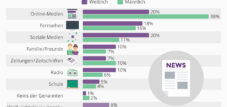
Three findings are consistent across almost all studies: Public broadcasters (Tagesschau, ZDF heute, DLF) remain the primary source of information for the center and left, with trust ratings of 99% for Greens, 93% for SPD, 96% for CDU/CSU, but only 28% for AfD. AfD-sympathizing individuals specifically use search engines, YouTube, Telegram, X, TikTok, and alternative media such as Nius, Tichys Einblick, Junge Freiheit, and Reitschuster. Trust in alternative media is at 48% for AfD supporters, compared to only 4% for Greens and 7% for CDU/CSU. Traditional quality newspapers like the Süddeutsche Zeitung, Frankfurter Allgemeine Zeitung, Die Zeit, and Der Spiegel remain relevant but are biased along party lines, while tabloids (Bild) and Springer publications (Die Welt) are more prevalent among CDU/CSU and AfD supporters than among Greens.
An INSA survey vividly confirms this picture: 67% of Green Party voters primarily get their information from public broadcasting, while 0% use alternative media. For AfD voters, social or alternative media are the main source for 49%, compared to only 27% for public broadcasting. YouGov data from the 2025 election campaign shows a similar pattern regarding TV usage as a political source: SPD 82%, CDU/CSU 76%, Greens 61%, AfD only 48%. In terms of social media, the AfD leads with 44%, followed by the Greens with 38%, while the CDU/CSU (23%) and SPD (20%) lag significantly behind. X, TikTok, and Telegram are clearly overrepresented among AfD voters, while they are almost invisible among the other political camps.
A journalism study by TU Dortmund (in cooperation with Forsa) further supports this finding: While a high percentage of people close to the SPD, CDU, and Greens use public broadcasting, the proportion of AfD supporters who use alternative news sites and messenger group chats is particularly high. According to a follow-up survey, 40% of AfD supporters use "alternative news sites outside the mainstream"—significantly more than any other group. Only 7% of AfD supporters consider journalism in Germany to be generally credible, compared to 80% of Green Party supporters. The perceived political bias is also interesting: Almost half of AfD supporters (47%) see journalism as being close to the Greens (compared to 25% of respondents close to the CDU), while Green Party and SPD supporters, conversely, tend to perceive journalism as more conservative and close to the CDU.
Party by party: Top online sources in detail
Greens
The core media outlets are Tagesschau/tagesschau.de, Spiegel, Zeit, Süddeutsche Zeitung, Tagesspiegel, and Deutschlandfunk. The taz is a clear core of the left-wing/green milieu; surveys of taz readers have shown for years that around two-thirds of regular readers vote Green. Online, there is a very high affinity for Instagram, LinkedIn, Signal, and Spotify, but little for Facebook and TikTok. Green Party members of parliament disproportionately share Spiegel, Zeit, Tagesspiegel, and Tagesschau, while alternative right-wing media play virtually no role.
SPD
The core media outlets are Tagesschau (Germany's main evening news program), regional daily newspapers, Spiegel magazine, and ARD television programs; according to YouGov, television remains the most important source of political information at 82%. Online, news websites and apps rank ahead of social networks. Facebook is used somewhat more than by the Green Party, but lags far behind the AfD (Alternative for Germany); the use of alternative media is below 10%.
CDU
The core media outlets are regional newspapers, FAZ, Welt, Bild, and ZDF/ARD. There is significantly more trust in established brands than among AfD supporters, but greater openness to Springer publications than among the Social Democrats and Greens. Members of the Bundestag from the CDU/CSU frequently share Bild and Welt. Facebook is more relevant than for the Greens/Left Party, while alternative right-wing portals remain a fringe phenomenon.
CSU
Similar to the CDU, but with a Bavarian influence. The Süddeutsche Zeitung is read, but often viewed critically; local titles like Merkur and AZ, as well as Bild/Welt, are present. Overall, information consumption remains close to the CDU/CSU alliance, relying on public broadcasting plus regional and Springer media.
left
The core media outlets are taz, junge Welt, nd (Neues Deutschland), Spiegel, and, to some extent, NachDenkSeiten. Public broadcasting is still used, but alternative left-wing sites are used more frequently than by the SPD/Greens. Online, there is a greater affinity for Instagram than for Facebook; TikTok is used by some of the younger supporters (similar to the AfD, but with different content). X is generally avoided, and Telegram is used less than by the AfD.
FDP
The core media outlets are FAZ, Handelsblatt, Welt, ntv, and, to some extent, Bild. X is used above average (the FDP, along with the AfD, is the political camp that uses X most extensively), supplemented by LinkedIn and business-related portals. FDP members of parliament disproportionately share Handelsblatt and FAZ.
AfD
Core media outlets include Nius, Tichys Einblick, Junge Freiheit, Compact (where accessible), relevant YouTube channels, Telegram channels, and X. The biggest difference from all other camps lies in the targeted dissemination of information via YouTube, WhatsApp, Facebook, X, Telegram, and TikTok, coupled with extremely low public broadcasting usage and correspondingly low trust. AfD members of parliament disproportionately link to Nius and Junge Freiheit—often more frequently than traditional mainstream media—while Bild and Welt are shared, Spiegel and Zeit are hardly mentioned.
Bild, Welt, taz, Spiegel compared: Strengths and trust by political affiliation
| medium | Strongest camp | weakest camp | role |
|---|---|---|---|
| Tagesschau/ARD | Greens, SPD, CDU/CSU | AfD | The most widely used and trusted offer overall |
| Mirror | Greens, SPD, Left Party | AfD, parts of the CDU/CSU | A classic red-green leading medium, most shared by SPD/Green Party MPs |
| taz | Greens, Left | Union, FDP, AfD | A niche publication, not a mass-market paper, with a clearly green-left readership |
| Time/SZ | Greens, SPD, academic center | AfD | Quality and debate media of the urban left-liberals |
| FAZ / Handelsblatt | CDU, FDP | Greens, Left | Bourgeois-economic liberal |
| World | CDU, FDP, AfD | Greens | Conservative-liberal Springer title |
| Picture | CDU/CSU, AfD, parts of the SPD | Greens, Left | Reach king, agenda setter, but low trust among leftists/Greens |
| Nius/Tichy/JF | AfD | All other | Alternative right-wing online ecosystem |
It's important to note that reach and trustworthiness often diverge. Bild has an enormous reach and is frequently quoted, but is considered disreputable in left-wing and Green circles, while Tagesschau combines both qualities with almost all political camps except the AfD. Studies on linking by politicians (not by voters themselves) confirm this pattern: the Greens and the SPD primarily link to Spiegel, Zeit, and Tagesschau; the CDU/CSU, FDP, and AfD tend to link to Bild and Welt; the AfD also links to Nius and Junge Freiheit.
Social media as a dividing line between the camps
| platform | Overrepresented at | Underrepresented in |
|---|---|---|
| YouTube | AfD | Greens |
| Telegram | AfD | Greens, SPD |
| X (Twitter) | AfD, FDP | Greens, SPD, Left Party |
| TikTok | AfD, parts of the Left (young) | Union, SPD |
| AfD, older Union | Greens, Left | |
| Greens, younger left/SPD | AfD (relatively) | |
| Bluesky / Signal | Greens, Left | AfD |
Algorithms further amplify this effect: Analyses of the 2025 election campaign showed that AfD and Left Party content was disproportionately displayed on TikTok, X and YouTube, while SPD and CDU/CSU lost significant visibility in the feeds.
Summary classification
There is no longer a single, unified "leading German media outlet" for all voters. The Tagesschau comes closest, but falls short due to the AfD electorate. Bild and Welt are not Green or SPD media outlets, but rather affiliated media for the CDU/CSU and AfD, while taz is not a mass medium of the SPD, but the core media outlet for the Greens and the Left Party. Der Spiegel remains the most important national online leading medium for the center-left. The sharpest divide today is not between the CDU and SPD, but between those who trust public broadcasting (Greens, SPD, large parts of the CDU/CSU) and those who reject it (AfD, parts of the BSW) – with overall trust in established media at 85% for the Greens, 78% for the SPD, 68% for the CDU/CSU, but only 16% for the AfD.
It should be noted that almost all figures measure party affiliation or voting intention, not the daily reading time of each individual, and there are overlaps within each party. However, the dominance of the sources and, above all, the level of trust shown differ very clearly between the two camps.
What voters in Germany choose
In a federal election, eligible voters cast a first vote (for a direct candidate) and a second vote (for a party list); the latter determines the distribution of seats in the Bundestag. The relevant parties can be politically categorized as follows: the Greens and The Left are left of center (ecological and socialist, respectively), the SPD stands for social democracy, the CDU/CSU for a Christian-conservative center-right policy, the FDP for economic liberalism, and the AfD for right-wing populist to right-wing nationalist positions.
Extended overview: Weekly usage of online news portals by party
The following table is based on the representative Reset/pollytix study (eligible internet users, weekly usage):
| Online source | All | SPD | CDU/CSU | Greens | FDP | AfD | left |
|---|---|---|---|---|---|---|---|
| tagesschau.de | 39 % | 45 % | 46 % | 54 % | 41 % | 28 % | 40 % |
| Spiegel Online | 22 % | 25 % | 19 % | 34 % | 31 % | 16 % | 27 % |
| Focus Online | 20 % | 20 % | 21 % | 19 % | 30 % | 21 % | 21 % |
| Bild.de | 19 % | 20 % | 20 % | 11 % | 23 % | 28 % | 14 % |
| World Online | 15 % | 15 % | 14 % | 15 % | 21 % | 18 % | 14 % |
| RT Deutsch | 4 % | 3 % | 2 % | 3 % | 3 % | 12 % | 4 % |
| Epoch Times | 1 % | 1 % | 1 % | 1 % | 2 % | 4 % | 1 % |
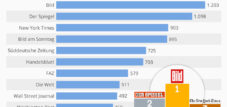
In addition, a domain-based tracking study (Stier et al., N=1,347, actual browser data) shows the most visited news domains overall: bild.de (513,434 sessions), zdf.de (151,890), spiegel.de (149,309), welt.de (93,384), focus.de (90,920), ardmediathek.de (68,061), ntv.de (58,528), express.de (55,875), stern.de (50,917) and daserste.de (39,850).
Nius, Bild, FAZ, Welt, Spiegel and Tagesschau: Who shares what?
An analysis of media links shared by members of the German Bundestag on X reveals that AfD MPs share no other media outlet as frequently as Nius – the right-wing conservative portal founded in 2023 by Julian Reichelt, boasting over 265 million YouTube views. CDU/CSU MPs share Bild most often, followed by FAZ and Welt; for the FDP, FAZ and Welt also lead the way. For the SPD and the Greens, Spiegel and tagesschau.de dominate. Nius features the Greens far more frequently than any other source (over 300 mentions; Robert Habeck alone is mentioned 198 times).
Zeit Online, Frankfurter Rundschau and other quality media
Zeit Online and Frankfurter Rundschau do not appear as a separate category in large quantitative mass surveys, but can be associated with target groups close to the Greens/SPD or left-liberal parties, respectively. Due to its limited overall reach, Frankfurter Rundschau does not achieve significant sample sizes in representative surveys, similar to taz.
Social media reach in the 2025 election campaign
Among young users (21–25 years old), the first AfD-related TikTok video appeared after just 11–12 minutes, while an SPD video only appeared after around 70 minutes. Of all party-political TikTok content, 50% was AfD-related, but only 15% was CDU/CSU-related. With 555 videos, the AfD posted the largest amount of content of all parties during the period under investigation before the federal election.
Trust, distrust and the "filter bubble" effect
Non-voters and AfD voters consume the fewest diverse news sources and exhibit the highest levels of authoritarian attitudes. Those who rely exclusively on online information are significantly more likely to vote for the AfD or abstain from voting altogether. Distrust of established media is particularly pronounced among AfD supporters and in eastern Germany.
Other right-wing / AfD-affiliated alternative media
Apollo News
Founded in 2018, Telegram is considered a growing competitor to Nius and, according to CeMAS, was at one time the most shared alternative media outlet on Telegram. Tichys Einblick and Achse des Guten are among its journalistic forerunners, while AUF1, Reitschuster.de, and Report24.news achieve enormous reach via Telegram. Established publications of the "New Right" such as Junge Freiheit, Compact, and Sezession are sometimes considered quasi-campaign organs of the AfD; Compact was temporarily banned in 2024. Other relevant platforms include Kontrafunk, Deutschlandkurier, Die Freie Welt, Journalistenwatch, Ansage.org, Unzensuriert.at, Wochenblick.at, NachDenkSeiten, Multipolar, Free21, and Exxpress.at.
Other left-wing/left-alternative media
Neues Deutschland (nd)
(A cooperative since 2022) has historical ties to the Left Party. Junge Welt is a Marxist-oriented daily newspaper to the left of the Left Party and celebrated its 70th anniversary in 2026. Der Freitag (owned by Jakob Augstein) and Jungle World complete this spectrum. Also included are Telepolis, Correctiv.org, Belltower News, Blätter für deutsche und internationale Politik, and the German edition of Jacobin.
Summary table: Top sources per party
| party | Top online news portals | Most shared medium (X/Twitter) | Preferred social media channels |
|---|---|---|---|
| Greens | tagesschau.de, Spiegel Online, Zeit Online, taz | Spiegel, tagesschau.de | LinkedIn, Instagram, Signal |
| SPD | tagesschau.de, Spiegel Online, Focus Online | Spiegel, tagesschau.de | WhatsApp, Facebook, Telegram |
| CDU | tagesschau.de, Focus Online, Bild.de, FAZ, Welt | Bild, FAZ, Welt | WhatsApp, Facebook, LinkedIn |
| CSU | Süddeutsche Zeitung, Merkur, AZ, Bild, Welt | Image, World | Facebook, WhatsApp |
| FDP | Spiegel Online, FAZ, Handelsblatt, Welt Online | FAZ, Welt | X, LinkedIn |
| left | tagesschau.de, taz, junge Welt, nd, Spiegel | Mirror | Instagram, TikTok |
| AfD | Bild.de, Nius, Tichys Einblick, Junge Freiheit | Nius, Junge Freiheit | Facebook, YouTube, Telegram, X, TikTok |
From tabloids to party affiliation: New patterns in the online media use of German voters
Bild.de remains a popular, classic online source among AfD voters, but Nius and Junge Freiheit have become key media outlets, particularly closely intertwined with the AfD's political agenda. Welt and FAZ are more prevalent among CDU/CSU and FDP voters; Zeit Online, Spiegel, and taz among SPD, Greens, and Left Party voters. Niche media outlets like the Frankfurter Rundschau, nd, and junge Welt remain statistically barely visible in large-scale audience surveys, despite their content relevance.