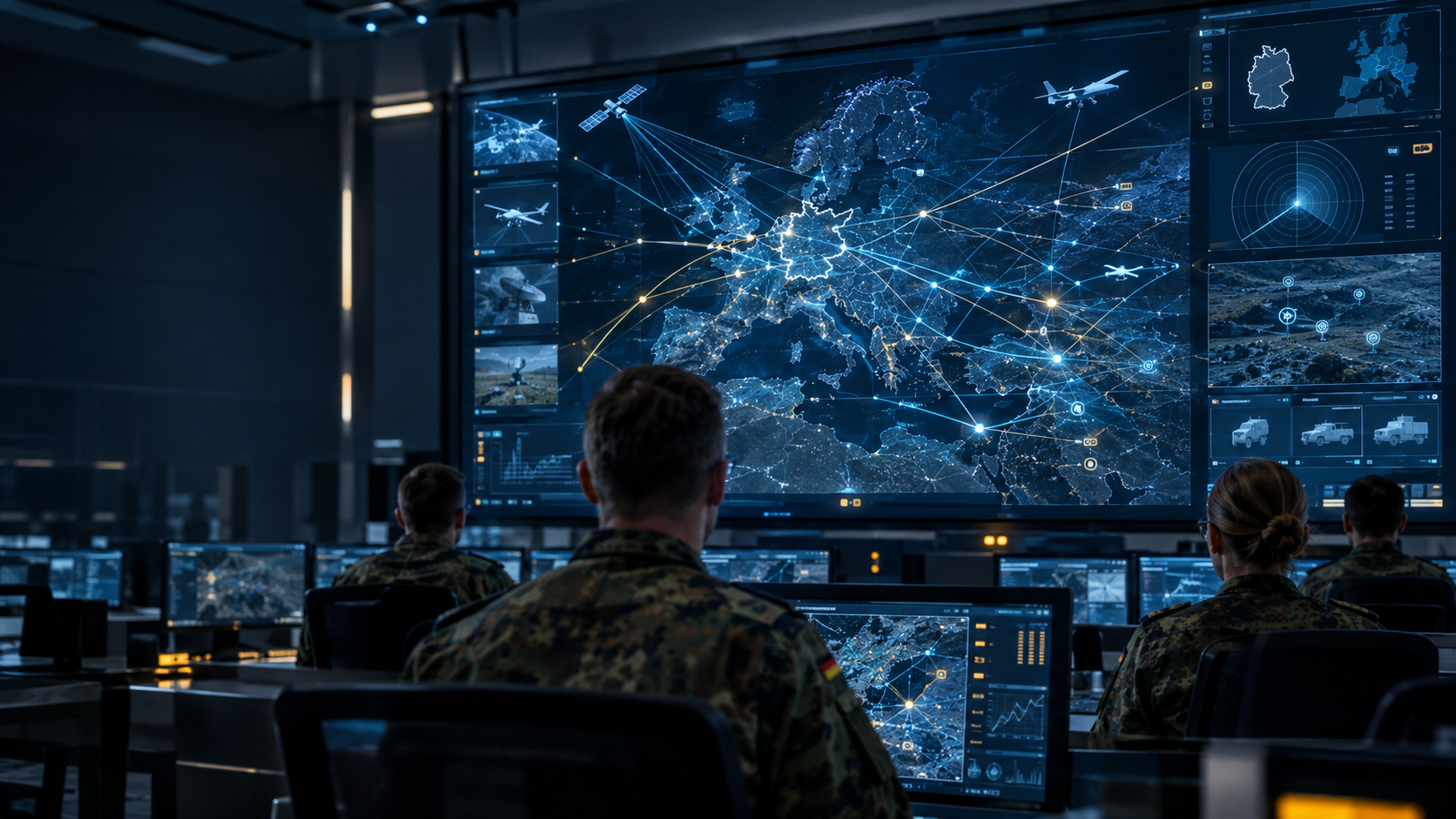
Uranos AI instead of US tech: Billion-dollar bet against Palantir – Why the German Armed Forces are relying on their own AI system – Creative image on the topic, with AI: Xpert.Digital
No US software for the troops: The German Armed Forces' risky path to digital sovereignty
Uranos AI instead of US tech: How Europe is building the digital battlefield of the future
Digital sovereignty at any price? The German Armed Forces' bold AI plan
The decision is a strategic bombshell: Instead of relying on the market-dominating US system from Palantir for evaluating military data, the German Armed Forces (Bundeswehr) are planning to build their own European platform. A first prototype is slated for completion by 2027 – an extremely ambitious timeline that entails immense technological and financial challenges. While this step is intended to protect against long-term dependencies and strengthen Europe's digital sovereignty, foregoing proven American technology also carries significant risks in terms of deadlines and development. The following analysis examines why the Bundeswehr is embarking on this multi-billion-euro venture, the crucial role that open architectures and consortia play, and why real combat data from Ukraine is becoming a key factor.
The German Armed Forces are building Europe's alternative to Palantir: Digital sovereignty is expensive – strategic dependence would be even more expensive
The German Armed Forces' decision not to use Palantir for a central platform for analyzing military data is far more than a simple software procurement. It touches upon the question of who, in a crisis, controls data, develops systems, and influences the speed of military decisions. Given growing threats, the lessons learned from the war in Ukraine, and a less secure transatlantic division of labor, Germany aims to establish a European alternative. A prototype is expected by the second quarter of 2027, with a fully functional solution targeted for mid-2028. This is ambitious, but strategically sound.
Economically, the project is a test case for Europe's ability not only to finance digital defense technology but also to rapidly transform it into operational products. The German armed forces now have considerably more money at their disposal than just a few years ago. For 2026, the regular defense budget allocates approximately €82.7 billion, with an additional €25.5 billion from special funds. The draft budget for 2027 anticipates a further significant increase. However, higher budgets do not automatically solve the core problem: modern warfare is not achieved solely through more tanks, missiles, or drones, but through the ability to aggregate data from numerous sources within seconds and derive sound decisions from it.
Software becomes military infrastructure
Palantir's Maven Smart System is emblematic of a profound shift in defense economics. Previously, military capabilities were primarily defined by individual weapon systems. Today, the digital connection between sensors, platforms, command centers, and weapons increasingly determines operational effectiveness. A reconnaissance drone only delivers significant military value if its data is rapidly classified, cross-referenced with radar, satellite, and intelligence information, and relayed to the appropriate recipient. Software is thus evolving from a supporting tool to critical infrastructure.
The economic value of such a platform does not primarily lie in individual algorithms. Crucially, it possesses the ability to integrate highly diverse data formats, control access rights, map relationships, and provide applications on a shared data foundation. The more sensors, users, and partners are connected, the greater the system's benefit. However, this network effect also leads to a strong dependency on the provider. Whoever controls data models, interfaces, workflows, and training holds a structural position of power that can only be dismantled later with considerable effort.
For the German Armed Forces, it's therefore not simply a matter of replacing an American user interface with a European one. What's needed is a robust architecture that processes data of varying security classifications, functions in isolated environments, supports NATO standards, and remains effective even when communication is disrupted. Added to this are requirements for traceability, cybersecurity, maintenance, model updates, and control over software updates. Only when these aspects work together will a genuine alternative emerge, and not merely a politically appealing prototype.
The rejection of Palantir comes at a price
Excluding Palantir from the outset reduces certain strategic risks, but increases costs and time pressure in the short term. NATO procured the Maven Smart System within just six months and introduced the platform for Allied Command Operations in 2025. This demonstrates the decisive advantage of an established provider: the product, integration expertise, references, and trained specialists are already available. Germany is deliberately foregoing this advantage and instead assuming the development, integration, and scheduling risks itself.
The decision to forgo a European solution can be seen economically as an insurance premium for freedom of action. A European solution initially costs more because development expenses cannot be spread across an already dominant global product. Furthermore, interfaces, security checks, and organizational processes must be rebuilt. However, these drawbacks are offset by long-term advantages: The state can contractually control access to source code, data storage, operating models, and further development, establish domestic providers, and retain a larger share of the value creation within Europe.
The central question, therefore, is not whether sovereignty comes free. It doesn't. The crucial question is whether the additional costs are less than the anticipated damage of future dependency. This damage could arise from rising licensing fees, limited adaptability, political conflicts, export controls, or a lack of control over particularly sensitive data. Because military command and control systems are used and continuously expanded over decades, an initially inexpensive external solution can lead to high switching costs in the long run.
Speed determines credibility
The planned prototype in the second quarter of 2027 is a sensible interim step, but it should not be confused with operational readiness. A prototype can connect selected data sources and demonstrate individual use cases. In real-world operation, however, the system must function under time pressure, with incomplete information, limited bandwidth, and targeted cyberattacks. It must communicate with existing management information systems, integrate users from different organizational units, and deliver reliable results without creating a false sense of security.
The timeline extending to mid-2028 is therefore both necessary and risky. It is necessary because Palantir and other suppliers are already marketing operational systems, and technological standards are rapidly becoming established. It is risky because European defense projects often suffer from complex responsibilities, lengthy tendering processes, and subsequent changes to requirements. The longer the development takes, the greater the pressure to resort to an available American product or to continue using an interim solution indefinitely.
The European strategy will only be credible if the German armed forces deliver readily usable partial capabilities early on. Instead of waiting until 2028 for a comprehensive system, development should proceed in clearly defined steps. Initially, this could involve data fusion for reconnaissance, followed by AI-supported situational awareness, and then more complex planning and decision-making functions. Short development cycles generate practical feedback, reduce the risk of a technically overloaded mega-project, and allow unsuitable components to be eliminated early.
Thirty providers are both an opportunity and a warning sign
BWI is reviewing programs from 30 companies, predominantly from Germany. This breadth demonstrates the growing market for defense software in Europe. Alongside established defense contractors, specialized software companies and startups combining AI, robotics, sensors, and data platforms are also competing. This presents governments with the opportunity to foster competition and avoid dependence on a single vendor.
A large number of candidates, however, is not proof of industrial maturity. Many companies can convincingly demonstrate individual modules, but few are capable of operating a highly available overall system for years. The real challenge lies not in the next analytics function, but in the secure integration of heterogeneous data, certification, operation at various security classification levels, and support for thousands of users. Start-ups, in particular, often have innovative products, but not yet the personnel and financial resources for decades-long military programs.
The selection should therefore not be based solely on technical performance. Equally important are open interfaces, economic stability, European ownership and control structures, verifiable supply chains, and a realistic operating model. The state must prevent the attempt to avoid Palantir from simply creating a new dependency on a European monopolist. Competition should not only exist before the contract is awarded, but should also be maintained during operation through interchangeable modules and clearly documented standards.
Consortia distribute risks and responsibilities
The German Armed Forces are increasingly relying on consortia for complex defense projects. In the Uranos AI project, Airbus and Quantum Systems, as well as Helsing and ARX Robotics, are collaborating in competing business alliances. The system is designed to monitor large areas on NATO's eastern flank using data from radar, drones, cameras, satellites, and other sensors. The initial contract volume of approximately €170 million could increase significantly after successful testing.
Consortia make economic sense because hardly any single company possesses all the necessary skills. A defense contractor understands certification processes and military integration, a software company is an expert in data architectures, a drone manufacturer provides sensor platforms, and a robotics specialist contributes experience with unmanned systems. This combination can shorten development times and distribute risks across multiple partners. It also strengthens medium-sized companies that would otherwise struggle to access large procurement programs.
Consortia, however, do not automatically solve the problem of responsibility. When data integration, user interface, sensor connectivity, and operation are distributed across multiple companies, gaps in responsibility can arise. Each partner then optimizes their own component, while no one assumes full responsibility for the operational readiness of the overall system. The German Armed Forces therefore need a clearly designated system owner, binding technical standards, and contracts that regulate not only the delivery of individual components but also the measurable performance of the entire operational chain.
Europe's alternative needs an open architecture
The most strategically important design principle is modularity. A sovereign system should not be built as a closed product from a single manufacturer, but rather as a platform with standardized interfaces. Sensors, analysis models, databases, and applications must be interchangeable without having to redesign the entire system. Only in this way can competition be maintained after the initial contract award, allowing the German Armed Forces to incorporate technological advancements from various providers.
An open architecture does not mean that security-critical source code must be publicly available. What is crucial are documented interfaces, transferable data models, and contractually secured access rights for the government. The federal government should also require that core components can be further developed by other European providers if necessary. This includes source code escrow models, comprehensive technical documentation, and rights to use already developed components should a supplier fail or be acquired.
From an economic perspective, modularity reduces switching costs and limits the pricing power of individual companies. It can initially lead to higher integration costs because standards must be defined and components thoroughly tested. In the long run, however, it enables a market where suppliers compete for individual modules. This increases the speed of innovation and reduces the risk of a single company remaining indispensable for decades.
The Franco-German backbone is politically logical
Germany and France agreed in July 2026 to examine the development of a sovereign European digital backbone. This will involve considering data-centric security concepts, artificial intelligence, and cloud solutions from both countries. Arcadia is mentioned as a potential French contribution, which could be integrated with comparable German solutions. Politically, this approach is consistent: a relevant European market can hardly be created without the two largest defense industries in the European Union.
Economically, cooperation can generate economies of scale. Development costs are spread across a larger number of users, common standards facilitate export and maintenance, and companies gain access to a larger domestic market. Especially with software, additional users are comparatively inexpensive to serve after development. A joint Franco-German core could therefore reduce unit costs and make it easier for other European countries to join.
At the same time, the bilateral structure carries known risks. Germany and France differ in their procurement culture, industrial division of labor, export policies, and military requirements. If each side seeks to protect national suppliers and secure central leadership roles, duplication of structures is likely. The digital backbone must therefore not be organized as a politically divided mega-project where workload allocation is more important than technical quality. A more promising approach would be a shared reference architecture with clearly defined interfaces that allow national solutions to interact.
Interoperability is more than compatibility
A German system must function within NATO, even though the alliance uses the Maven Smart System. This situation creates a conflict of objectives. On the one hand, Germany wants technological independence; on the other hand, the Bundeswehr (German Armed Forces) must not become a digital anomaly within the alliance. A national platform that only exchanges data with NATO systems in a cumbersome way would weaken military operational capability and could even be more dangerous in combat than dependence on foreign software.
Interoperability must therefore not be limited to the export of a few files. Common data standards, identity and access models, harmonized security classifications, and robust connections between command structures are needed. Information must be exchanged rapidly without relinquishing national control rights. The technical goal is a federated architecture: Each state retains control over sensitive data and services but can automatically integrate shared information into common situational awareness systems.
This capability has significant economic value. Whoever establishes a European interoperability standard creates a market for complementary applications, sensors, and services. If Germany and France succeed in developing a compelling architecture, it could become the basis for procurement by other European countries. If standardization fails, the market will remain fragmented, while an established provider like Palantir will benefit from the advantages of an already widespread system.
🤖🚀 Managed AI Platform: Faster, safer & smarter to AI solutions with UNFRAME.AI

Managed AI Platform - Image: Xpert.Digital
Here you will learn how your company can implement customized AI solutions quickly, securely and without high entry barriers.
A managed AI platform is your all-inclusive, worry-free solution for artificial intelligence. Instead of dealing with complex technology, expensive infrastructure, and lengthy development processes, you receive a ready-made solution tailored to your needs from a specialized partner – often within just a few days.
The key advantages at a glance:
⚡ Rapid implementation: From idea to ready-to-use application in days, not months. We deliver practical solutions that create immediate added value.
🔒 Maximum data security: Your sensitive data stays with you. We guarantee secure and compliant processing without sharing data with third parties.
💸 No financial risk: You only pay for results. High upfront investments in hardware, software, or personnel are completely eliminated.
🎯 Focus on your core business: Concentrate on what you do best. We take care of the entire technical implementation, operation, and maintenance of your AI solution.
📈 Future-proof & scalable: Your AI grows with you. We ensure continuous optimization and scalability, and flexibly adapt the models to new requirements.
More information here:
Digital sovereignty in defense: Why the German Armed Forces must forge their own path
Ukrainian combat data is changing the course of events
Cooperation with Ukraine is particularly valuable for European development. The Ukrainian Delta system combines information from sensors, drones, intelligence services, and other sources to create a real-time situational picture. Through an agreement, Germany has gained access to combat experience and selected data that can be used to analyze German systems and improve AI tools. This provides a raw material that cannot be fully replaced by war games or synthetic test data.
For AI systems, the quality of training and testing data is often more important than the sheer size of a model. Real combat data contains interference, deception, incomplete information, and unusual situations that are difficult to authentically replicate in exercises. This allows for testing recognition models under realistic conditions and a more precise understanding of error rates. As a result, Germany can skip developmental stages that could otherwise take years.
Access to such data, however, is not a free competitive advantage. Ukraine expects military support, industrial cooperation, and direct benefits from improved systems in return. Furthermore, data protection, military secrecy, rights to derived models, and the return of knowledge must be clearly regulated. The question of whether external companies may train models on Ukrainian data and who subsequently has control over these models is particularly sensitive.
Data is capital, but not an ordinary commodity
In the digital defense economy, data is often referred to as a strategic resource. This comparison is only partially accurate. While oil is consumed, data can be reused multiple times and enriched with additional information. Its value often increases when it is systematically linked. At the same time, once military data is disclosed, it cannot be retrieved. A data leak can reveal procedures, capabilities, and vulnerabilities for years.
The German Armed Forces therefore need a precise data economy. For each data class, it must be clear who creates it, who is allowed to use it, how long it is stored, and whether models trained from it may be shared. The distinction between raw data, metadata, derived insights, and model parameters is particularly important. Even if raw data does not leave Germany, trained models can contain sensitive patterns and allow inferences to be drawn about sources or operational procedures.
A sovereign operating model should log data access, version models, and make results traceable. The state must also ensure that data is not effectively locked away in proprietary formats. Economically, data portability is just as important as technical access: without the ability to transfer data and semantic models to another provider, switching suppliers remains theoretical.
Artificial intelligence does not replace responsibility
Military AI can pre-sort large amounts of data, recognize patterns, and display decision options. However, it cannot eliminate uncertainty. Sensors deliver conflicting signals, adversaries attempt to deliberately deceive systems, and models can fail in new situations. The faster the software produces results, the greater the risk that users will mistake seemingly precise output for established knowledge.
Economic evaluation should therefore not be based solely on speed. A system that accelerates decisions but frequently generates false alarms shifts costs to users and can waste operational resources. Key performance indicators (KPIs) for accuracy, robustness, explainability, and handling of uncertainty are required. Tests should not only simulate ideal conditions but also disrupted communication, manipulated data, and the failure of individual components.
Humans must remain involved in responsible decision-making. This doesn't mean manually confirming every automated step. Rather, it must be clearly defined which tasks the machine performs independently, when it makes a recommendation, and when human approval is mandatory. Good design reduces cognitive load; poor design simply overwhelms soldiers with more information, and faster.
The bottleneck is skilled workers
Even large budgets cannot quickly remedy the shortage of experienced software architects, data engineers, cybersecurity experts, and military users. The government is competing for these specialists with technology companies, consultancies, banks, and the growing European defense industry. Salary disparities, slow hiring processes, and security clearances further complicate recruitment.
For the German Armed Forces, simply purchasing software externally is insufficient. They require in-house expertise to define requirements, review results, and independently evaluate technical decisions. Without a strong public client, information asymmetry arises: the supplier knows more about architecture, costs, and risks than the client and can more easily assert their interests. Internal experts are therefore not an add-on, but a prerequisite for sovereignty.
A realistic personnel model should combine permanent government core teams with industry partners, reservists, and temporary experts. Career paths must allow for movement between the Bundeswehr (German Armed Forces), BWI (Federal Institute for Risk Assessment), research institutions, and companies without jeopardizing security interests. User training is also crucial. The best algorithm generates no added value if staff cannot adapt their processes or critically evaluate results.
Europe's capital market remains a competitive disadvantage
Palantir benefits not only from technology and government contracts, but also from a large American capital market. High valuations allow US companies to attract skilled workers, acquire other firms, and invest in product development for years. European defense startups now have significantly better access to capital, but still face fragmented markets, differing export regulations, and hesitant institutional investors.
Government contracts are therefore crucial for building a European software industry. They create references and recurring revenue, which companies can use to raise additional capital. However, procurement should not become a permanent subsidy for inefficient providers. Companies must be judged on measurable results, exportability, and reliable delivery. National origin alone is not a quality criterion.
The European Defence Fund and the Readiness 2030 program significantly expand the financial framework. However, billions in available funding will only translate into industrial strength when procurement is pooled, requirements are standardized, and products are actually ordered. Research projects without follow-up contracts generate knowledge, but not scalable businesses. For military software, predictable, multi-year contracts are more important than a large number of short-term funding projects.
The state must actively shape the market
In a strategic platform, the state cannot act like an ordinary buyer selecting a finished product at the lowest price. It shapes the market, defines technical standards, and decides which companies have access to sensitive data. This role requires a long-term industrial policy that balances competition and sovereignty.
It would be sensible to separate state-controlled core components from competitively procured applications. Identity management, security policies, central data models, and logging could be subject to special state control. Analysis tools, visualizations, and specialized AI models, on the other hand, could be developed by multiple vendors. This would keep the core stable while allowing for innovation at the application level.
Contracts should incentivize rapid delivery without circumventing security checks. Possible payment methods include payments based on achieved integration milestones, bonuses for proven interoperability, and deductions for missed performance targets. Crucially, payment should be based not on the number of delivered features, but on the actual usable capability. A less complex system that operates reliably under real-world conditions is more economically valuable than a feature-rich platform that only impresses in demonstrations.
The costs remain unclear for now
No reliable total price has yet been given for the planned Bundeswehr platform. This is not unusual in early market research, but it makes public evaluation more difficult. The pure development costs represent only a portion of the financial burden. Additional costs include data centers, secure networks, data processing, integration of existing systems, training, cybersecurity, maintenance, and ongoing model improvements.
With software, the cost structure is shifting from a one-time purchase to ongoing operation. AI models need to be monitored, tested with new data, and adapted to changing threats. Interfaces change, sensors are added, and security vulnerabilities must be patched quickly. A sound calculation should therefore consider the total costs over at least ten to fifteen years. Low initial costs can be misleading if subsequent licenses, consulting services, or computing resources become expensive.
At the same time, a direct price comparison with Palantir is difficult because the scope of services, operating model, and data rights can differ. A European solution may appear more expensive on paper, but it can generate additional economic benefits: tax revenue, highly skilled jobs, technology spin-offs, and reduced outflows of license payments. However, these benefits do not justify an unlimited price premium. Military benefits must always take precedence over industrial policy considerations.
Security policy becomes location policy
The development of a European data platform could have an impact beyond the German Armed Forces. Technologies for secure cloud infrastructures, data rooms, robotics, and robust AI are also relevant for critical infrastructure, disaster relief, and industrial applications. Companies that develop sophisticated military systems can transfer their expertise to civilian markets. Conversely, many key components originate from the civilian digital economy.
For Germany, this project offers the opportunity to combine its traditional strength in industrial systems with modern software. Sensor manufacturers, machine builders, vehicle producers, and robotics companies possess valuable domain expertise. If these companies collaborate with software providers using common data standards, a high-performance ecosystem can emerge. Conversely, if data and interfaces remain confined to separate projects, the potential economies of scale are lost.
Regional clusters can benefit from this. Munich, Berlin, Hamburg, Ulm, Stuttgart, and other locations connect the defense industry, research, software development, and industrial users. However, the crucial factor is not the number of funded centers, but their networking. Europe needs fewer demonstrators operating in parallel and more shared platforms, test environments, and procurement programs.
Sovereignty must not lead to isolation
Digital sovereignty is often confused with complete technological self-sufficiency. For Germany, this goal would be neither realistic nor economically viable. Semiconductors, cloud technologies, base models, network components, and development tools all originate from international supply chains. Attempting to produce every component domestically would scatter resources and delay implementation.
Sovereignty means, rather, understanding critical dependencies, maintaining alternatives, and being able to make essential decisions independently. International procurement can be efficient for interchangeable standard components. However, stronger European control is necessary for data models, access rights, security architecture, and operational management. The degree of autonomy should be determined by the potential damage of a failure or political conflict.
Cooperation with American partners remains indispensable. NATO interoperability, intelligence data, and joint operations require close technical links. A European platform should therefore be developed not against the US, but as a robust European contribution within the alliance. Greater autonomy can stabilize the transatlantic partnership because Europe assumes more responsibility and has alternatives without fundamentally calling cooperation into question.
Competition is decided by standards
In the platform business, the technically superior individual product doesn't necessarily win. Often, the system that quickly attracts a large number of users, data sources, and complementary providers prevails. Palantir has a significant advantage here. Maven is used by the United States and NATO, has practical references, and can build on existing integrations. Germany and Europe therefore need to not only catch up functionally but also quickly establish an attractive standard.
This requires binding procurement commitments from several states. If each country formulates its own requirements and develops separate platforms, European suppliers will remain small and their products expensive. A common core market, on the other hand, would allow for higher development investments and distribute costs among more users. Smaller NATO and EU states, in particular, could benefit from a European standard solution, provided it is affordable, interoperable, and politically reliable.
Export considerations must be integrated from the outset. A system developed solely for German specific regulations will hardly scale. At the same time, export goals must not compromise security requirements. A multi-tiered architecture with nationally controlled modules and an exportable common core could reconcile both interests.
Success requires clear benchmarks
By the time the prototype is ready in 2027, the German Armed Forces should not only demand a technical demonstration, but also publish verifiable performance data, insofar as this can be done without compromising security. This includes the number of integrated data sources, the time from data acquisition to display, availability under disrupted communication conditions, and the effort required to integrate a new sensor. Error rates and the effort required for human error correction must also be measured.
By 2028, it should be demonstrated that the platform functions in large-scale exercises, exchanges data with NATO systems, and is accepted by military users. Equally important is its economic viability: operating costs, personnel requirements, and dependencies on individual suppliers must be transparent. Formal acceptance without robust operation would merely postpone the problem to later years.
In the long term, what matters is whether the project gives rise to a European ecosystem. A successful system must be able to integrate additional states, providers, and applications without relinquishing national control. It should enable technological innovation instead of becoming an outdated system itself, difficult to change, after just a few years. Especially with AI, adaptability is a crucial aspect of its operational readiness.
Europe's digital defense is being put to the test
By excluding Palantir, the German Armed Forces are making a strategically justifiable, but challenging, decision. In the short term, purchasing an existing American platform would likely be faster and involve less development risk. In the long term, however, it could deepen a dependency that is particularly problematic with regard to data, software, and military decision-making processes. The European alternative is therefore not a luxury project, but an investment in freedom of choice.
This freedom of choice, however, does not arise from origin labels or political declarations. It requires usable software, open interfaces, verifiable data, qualified personnel, and procurement that combines speed with responsibility. Germany and France must limit national industrial interests and create an architecture in which other European states can genuinely participate. Ukraine provides valuable operational experience and data, but this does not replace the difficult work of integration and organization.
The economic benchmark is ultimately clear: Europe must use the additional billions invested in defense to build lasting technological capabilities. If this succeeds, the project will strengthen military capability, industrial value creation, and political independence simultaneously. If it fails due to slow procedures, unclear responsibilities, or national fragmentation, Palantir's lead will continue to grow. Then Europe will have spent a great deal of money without gaining the crucial resource: control over its own digital battlefield.
Consulting - Planning - Implementation

Konrad Wolfenstein
I would be happy to serve as your personal advisor.
You can contact me at wolfenstein∂xpert.digital or
Just call me on +49 7348 4088 965 .