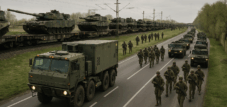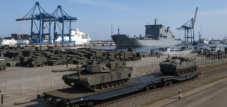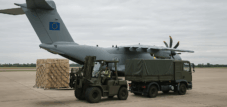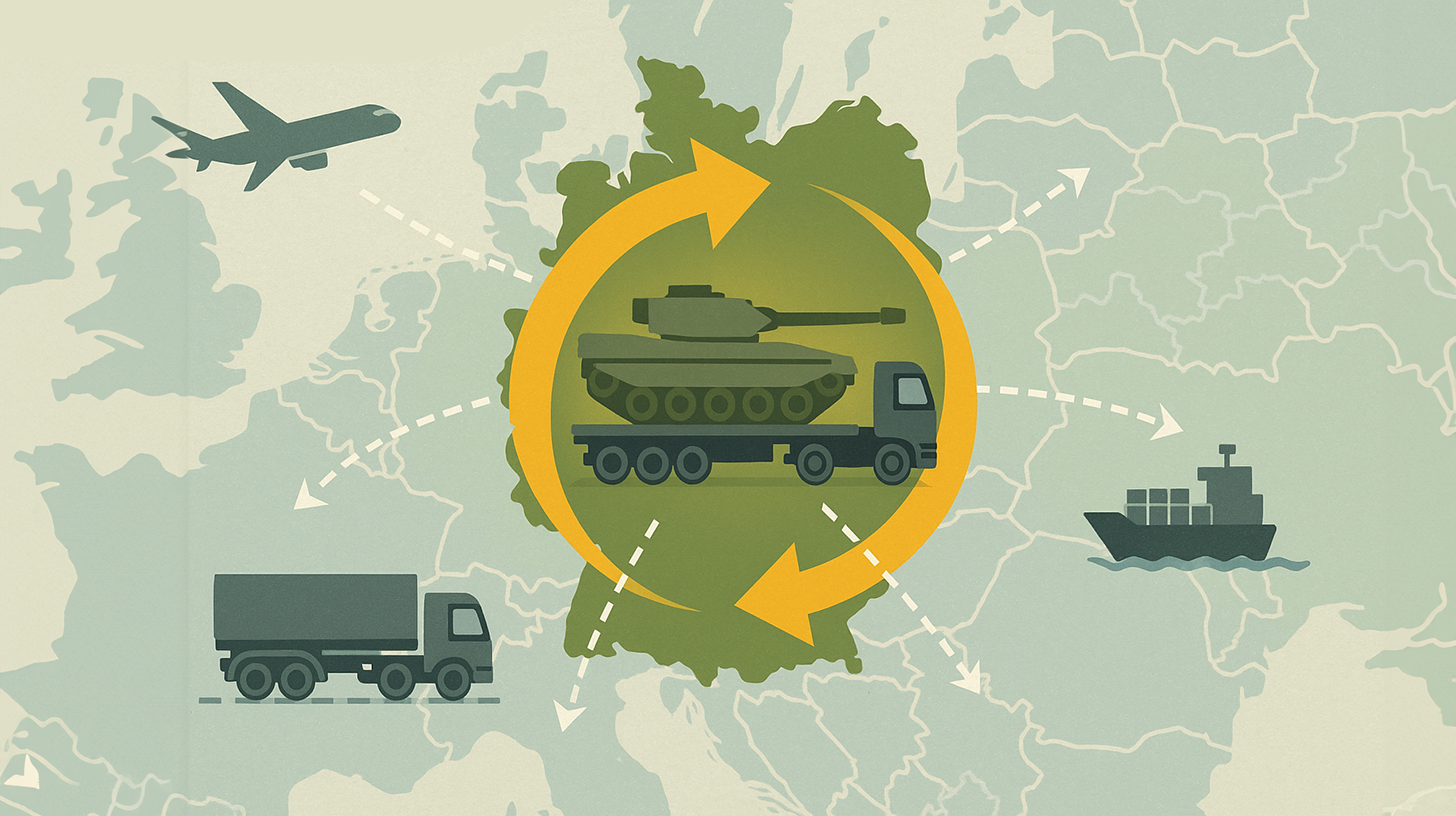
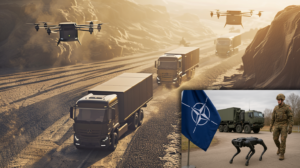
Germany as a hub: Logistical uniformity instead of a patchwork for military heavy transport – Image: Xpert.Digital
The German Armed Forces and Autobahn GmbH are creating uniform regulations for military transports
NATO transports on German highways: German Armed Forces secure privileged passage rights
In light of the changed security situation in Europe, the Federal Republic of Germany is undergoing a comprehensive realignment of its defense structures. A central role in this is played by Germany's strategic importance as a logistical hub for military movements within the NATO alliance. In this context, the agreement concluded in June 2025 between the German Armed Forces and Autobahn GmbH des Bundes (the Federal Autobahn Company) is to be considered a groundbreaking step, laying the foundation for more efficient and faster handling of military transports on German highways.
Related to this:

Paradigm shift in German defense strategy
Germany's strategic situation has fundamentally changed since the end of the Cold War. While Germany was considered a frontline state until reunification, it now lies at the center of an expanded NATO area. This geographical position makes Germany a logistical hub for troop movements and material transfers necessary to reinforce NATO's eastern flank. This paradigm shift from a potential battlefield to a central supply base requires a comprehensive redesign of military transport infrastructure and related procedures.
In response to the threat posed by Russia, NATO has reorganized and introduced the new NATO Force Model, which will replace the existing NATO Response Force from 2025. Germany is contributing approximately 35,000 troops and over 200 aircraft and ships to this new model – more than twice as many as in the previous NRF. This significant increase in German contributions to collective defense makes the need for a high-performance transport infrastructure all the more urgent.
The Operations Plan Germany as a strategic foundation
The Operations Plan Germany (OPLAN DEU) forms the strategic foundation for Germany's new role in collective defense. This classified plan encompasses all operational scenarios for the Bundeswehr in peacetime, crisis, and wartime, and defines the Federal Republic as a logistical hub for the deployment and supply of allied and German forces. A key aspect of OPLAN DEU is its comprehensive national approach, which integrates military and civilian actors into a coordinated system.
NATO plans stipulate that several hundred thousand soldiers will require continuous logistical and medical support. In the event of a potential Russian attack, up to 800,000 soldiers from NATO allies, along with their weapons, vehicles, and supplies, would have to be transported across Germany within 180 days. These dimensions illustrate the immense logistical challenge that Germany, as a transit nation, must overcome.
The new agreement: Uniformity instead of a patchwork
The agreement signed on June 30, 2025, between the German Armed Forces and Autobahn GmbH of the Federal Government represents a significant milestone in the modernization of German military logistics. The new regulation replaces the previously inconsistent agreements between the individual federal states and, for the first time, establishes clear, uniform framework conditions for military transport on the German motorway network.
Until then, a complex patchwork of different state-specific regulations existed for oversized and heavy transports by the German Armed Forces. The approval procedures for military transports varied considerably between the federal states, leading to time-consuming and inefficient processes. Saarland was the first federal state to conclude a corresponding agreement with the German Armed Forces in 2024, thus setting a precedent.
The nationwide agreement was signed by Dr. Michael Güntner, Chairman of the Management Board of Autobahn GmbH des Bundes, Lieutenant General André Bodemann, Deputy Commander of the Operational Command of the Bundeswehr, and Prof. Dr. Roland Börger, President of the Federal Office for Infrastructure, Environmental Protection and Services of the Bundeswehr.
Institutional structures and responsibilities
The agreement was drafted based on a proposal from the Federal Highway Authority and regulates road use in accordance with the Road Traffic Regulations. The Federal Highway Authority, established in 2018 as a higher federal authority within the portfolio of the Federal Ministry of Transport, exercises legal and technical supervision over the Autobahn GmbH des Bundes (Federal Autobahn Company).
The Autobahn GmbH des Bundes (Federal Autobahn Company) was founded in 2018 and assumed responsibility for the planning, construction, operation, maintenance, financing, and asset management of Germany's autobahns at the beginning of 2021. This comprehensive reform of the federal highway administration made it possible, for the first time, to manage the entire autobahn network from a single source and to establish uniform standards nationwide.
The Federal Office for Infrastructure, Environmental Protection and Services of the German Armed Forces (BAIUDBw) functions as one of the three resource agencies of the armed forces administration and is responsible for construction projects at home, abroad, and in operational areas. With approximately 3,000 employees in Germany and abroad, the BAIUDBw coordinates all support services for deployments abroad and, with around 29,000 positions, manages its own operations and those of subordinate agencies.
Host Nation Support as a central task
As a host nation, Germany plays a central role in supporting allied armed forces within the framework of Host Nation Support (HNS). This support encompasses a broad range of services, from providing infrastructure and logistical assistance to security measures. HNS is a nationwide task in which civilian authorities, emergency services, and commercial enterprises also participate.
The legal basis for HNS is the NATO Status of Forces Agreement and its supplementary agreements, as well as bilateral and multilateral agreements between the participating states. The German Armed Forces are authorized to use roads beyond their permitted capacity, provided corresponding agreements are in place. The new agreement with Autobahn GmbH represents an important component of this system, as it establishes the necessary legal framework for military transport.
Your dual-use logistics experts
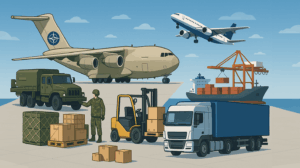
Dual-use logistics experts - Image: Xpert.Digital
The global economy is currently undergoing a fundamental transformation, a watershed moment that is shaking the foundations of global logistics. The era of hyper-globalization, characterized by the relentless pursuit of maximum efficiency and the "just-in-time" principle, is giving way to a new reality. This new reality is marked by profound structural breaks, geopolitical power shifts, and increasing fragmentation of economic policy. The once taken-for-granted predictability of international markets and supply chains is dissolving and being replaced by a period of growing uncertainty.
Related to this:
Germany as a NATO hub: Why the Bundeswehr's highway cooperation can only be the beginning
Civil-military cooperation in logistics
The effective implementation of Germany's role as a logistics hub requires close cooperation between military and civilian actors. The Bundeswehr Logistics Command initiated the "Future-Oriented Cooperation in Logistics" project to identify and utilize innovative approaches to collaboration with the private sector. These collaborations are essential because the Bundeswehr will require significantly greater secure logistics capacities in the future than are currently available or militarily feasible.
The integration of the private sector into the Bundeswehr's logistics system must be designed to be future-proof. Civilian service providers can play an important role in this; however, a right to refuse service still exists, which could become problematic in times of crisis. Therefore, new approaches to logistics processes, the accompanying framework conditions, and contractual agreements are needed.
Related to this:


Challenges of transport infrastructure
Germany's transport infrastructure faces significant challenges that impair military mobility. The country's dilapidated infrastructure, bureaucratic hurdles, capacity bottlenecks, and vulnerable communication systems severely hamper military mobility. This makes it difficult for Germany to fulfill its obligations under the new NATO Force Model.
Experts are calling for a special fund of €30 billion for the targeted modernization of military corridors. Many roads and railways cannot withstand the strain of heavy military vehicles, and numerous bridges need to be inspected and, if necessary, reinforced. The Berlin Ring Road is just one example of how important transport links can be temporarily closed to military traffic due to renovation work.
Related to this:
Dual-use logistics: The underestimated key to Germany's defense capabilities – criticism of the lack of a dual-use concept
A key criticism of the current approach is the insufficient consideration of the concept of dual-use logistics. While the new agreement between the German Armed Forces and Autobahn GmbH represents an important step, the strategic integration of civilian and military logistics systems remains incomplete. The concept of dual-use logistics refers to the strategic use of infrastructure, systems, and capacities for both civilian and military purposes.
Europe's modern logistics landscape faces the dual challenge of increasing the efficiency and sustainability of civilian supply chains while simultaneously meeting the growing demands of military mobility. A comprehensive dual-use logistics network would provide valuable capacity for both military and civilian emergencies. The potential synergies between civilian economic interests and military defense requirements are currently underutilized.
Here, intelligence in strategic contexts is particularly important. Integrating civilian systems into military logistics networks requires a comprehensive consideration of interoperability and cybersecurity. Military planning and resilience concepts can be transferred to civilian supply chains, while civilian technological innovations can enhance military capabilities. The practical implementation of expanded dual-use logistics would bring concrete operational benefits that go beyond theoretical concepts.
Related to this:
International dimension and EU cooperation
Military mobility is not only a national but also a European challenge. All EU and NATO member states have agreed to promote military mobility. A common goal is the expedited approval of entry and transit for armed forces, including oversized and heavy transport of military goods.
To reduce bureaucracy, it is recommended that the procedures for transporting military goods between German states be abolished and that cross-border permits and customs duties be harmonized at the EU level. Legal and regulatory harmonization is essential for the cross-border use of dual-use logistics systems and concerns both dual-use export controls and regulations for military transport.
Security aspects and cyber protection
The integration of civilian and military logistics systems also presents specific security challenges. Integrating civilian systems into military logistics networks increases the attack surface for cyber threats, especially given current hybrid threats from state actors. Robust cybersecurity measures must be implemented, requiring close cooperation between security authorities and private logistics providers.
For critical communications infrastructure in the transportation sector, it is recommended that no components from China be used and that, at the very least, the planned KRITIS law for the protection of critical infrastructure mandate the certification of critical components. Technical interoperability between different national and civil-military systems requires comprehensive standardization efforts.
Outlook and further developments
The new agreement between the German Armed Forces and Autobahn GmbH represents an important first step towards modernizing German military logistics. It lays the foundation for more efficient handling of military transports and strengthens Germany's role as a NATO logistics hub. The agreement applies to all motorways in Germany and also covers transports carried out by companies contracted by the German Armed Forces, provided they are acting on official orders.
However, the successful implementation of the hub function will require further efforts. The dilapidated transport infrastructure must be modernized, bureaucratic hurdles reduced, and cooperation between civilian and military actors further intensified. The comprehensive implementation of dual-use concepts is particularly important, as these enable optimal use of existing resources and create synergies between civilian and military requirements.
Geopolitical developments and the ongoing threat from Russia make it clear that Germany must continuously strengthen its defense and alliance capabilities. The new agreement with Autobahn GmbH is an important building block in this process, but it can only be the beginning of a more comprehensive transformation of German defense logistics. The challenges of the future require innovative solutions that combine military effectiveness with economic efficiency and public acceptance.
Only through a holistic approach that considers both military and civilian requirements and fully exploits the potential of dual-use logistics can Germany fulfill its responsibility as a central hub for NATO logistics. The strategic importance of this task for European security makes it clear that not only national, but also European and transatlantic interests are at stake.
Hub for Security and Defense - Advice and Information

Hub for Security and Defense - Image: Xpert.Digital
The Security and Defence Hub offers expert advice and up-to-date information to effectively support companies and organizations in strengthening their role in European security and defence policy. Working closely with the SME Connect Defence Working Group, it particularly promotes small and medium-sized enterprises (SMEs) that wish to further develop their innovative capacity and competitiveness in the defence sector. As a central point of contact, the Hub thus creates a crucial bridge between SMEs and European defence strategy.
Related to this:
Consulting - Planning - Implementation

Markus Becker
I would be happy to serve as your personal advisor.
Head of Business Development
Chairman SME Connect Defense Working Group
Consulting - Planning - Implementation
Konrad Wolfenstein
I would be happy to serve as your personal advisor.
You can contact me at wolfenstein∂xpert.digital or
Just call me on +49 7348 4088 965 .