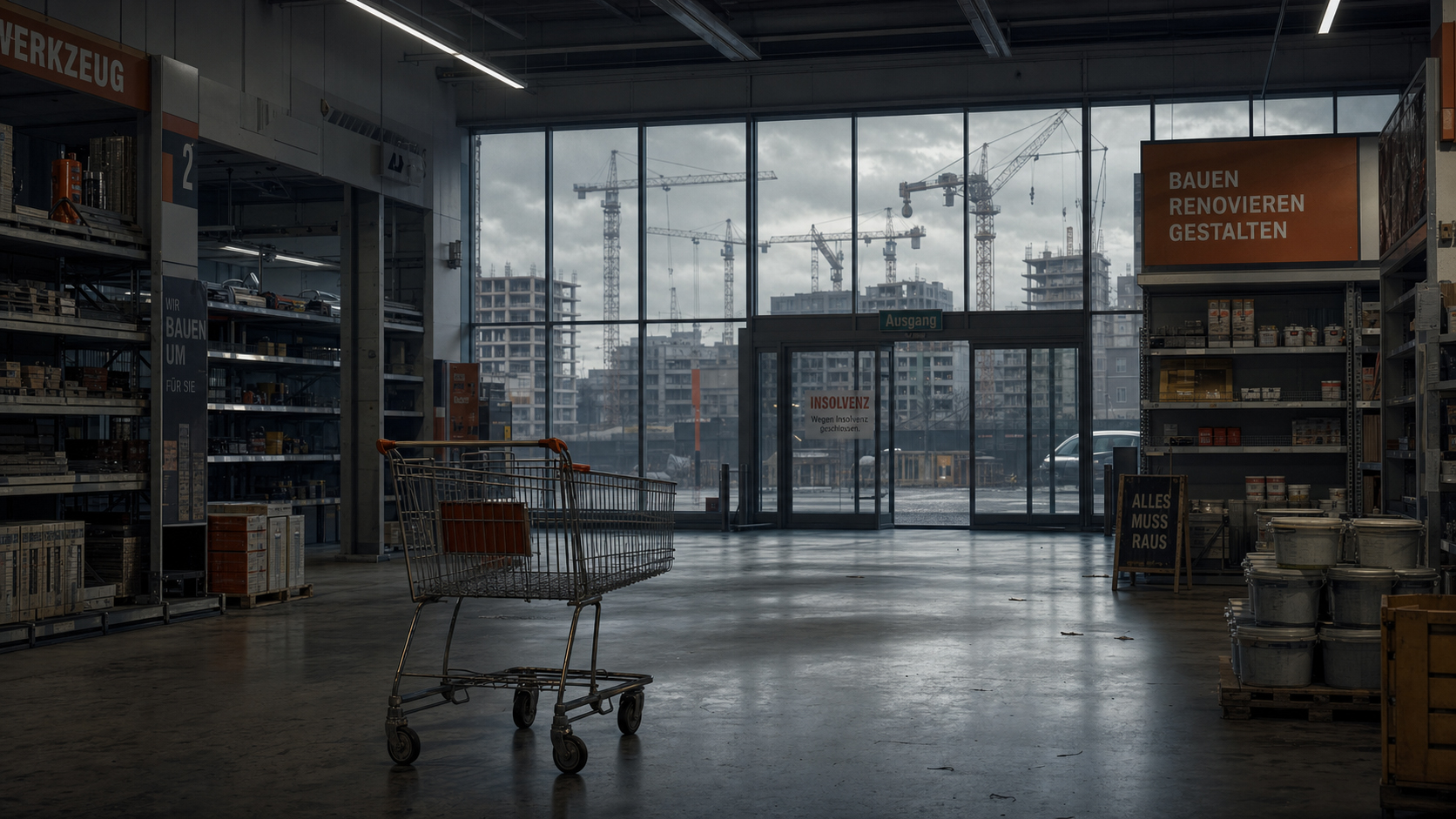
Traditional DIY stores on the verge of collapse: A wave of bankruptcies is sweeping through Germany – Image: Xpert.Digital
Amazon & Temu as gravediggers? That's why our local hardware stores are dying now
Hellweg, BayWa & Hammer in crisis: The bitter downfall of the DIY store giants
Some are growing, others are going bankrupt: The real problem of German DIY stores
The German DIY sector is experiencing an unprecedented upheaval: Former industry giants like Hellweg, BayWa Bau & Garten, and Hammer are filing for insolvency, putting thousands of jobs at risk. What initially appeared to be a normal decline in demand after the massive COVID-19 boom has long since escalated into an existential struggle for survival. A toxic mix of the historic construction crisis, exploding fixed costs across vast retail spaces, and the unstoppable advance of e-commerce giants like Amazon and discount retailers like Temu is forcing traditional retailers to their knees. However, the crisis is not affecting everyone equally: While medium-sized, nationally rooted chains are being forced to capitulate en masse, digitally advanced heavyweights like Hornbach and Bauhaus are further expanding their market power. The following article examines the multifaceted causes of the widespread demise of DIY stores, places the German predicament in an international context, and demonstrates how the DIY industry must radically reinvent itself to survive in the future.
The great DIY store extinction? Why Germany is losing its home improvement stores
Wave of bankruptcies in the midst of the booming sector: What's happening right now
In mid-June 2026, the Dortmund-based DIY chain Hellweg filed for insolvency proceedings under self-administration at the Essen District Court – and the application was immediately approved. This affects 68 branches nationwide, primarily in Berlin and the Rhine-Ruhr region, as well as approximately 2,900 employees, whose salaries are secured for three months through insolvency benefits from the Federal Employment Agency. Simultaneously, BayWa Bau- & Gartenmärkte GmbH & Co. KG, also part of the Hellweg Group, initiated insolvency proceedings under self-administration – affecting 46 locations in Bavaria and Baden-Württemberg and around 1,300 employees. This means that over 4,300 jobs are at risk within this group of companies alone.
This development is not an isolated case, but rather part of an accelerating structural transformation. The DIY and home furnishings chain Hammer already ran into crisis at the beginning of 2025 and filed for insolvency again at the Bielefeld District Court at the end of January 2026 – according to the company, due to massive start-up deficits following an acquisition, technical problems with the supply of goods, and resulting liquidity crises. More than 1,100 employees are once again worried about their jobs. Insolvency applications were also filed for individual Hagebau stores – including those in Mülheim an der Ruhr and Ratingen – in 2026, after the Langenfeld location had already run into difficulties in 2024.
| Chain | Status (2025/26) | Scope |
|---|---|---|
| Hellweg | Insolvency under self-administration (June 2026) | 68 markets, ~2,900 employees |
| BayWa Construction & Garden | Insolvency/restructuring associated with Hellweg | 46 stores in Bavaria/Baden-Württemberg, ~1,300 employees |
| hammer | Another bankruptcy (January 2026) | >1,100 employees |
| Hagebau (individual locations) | Individual locations insolvent | including Mülheim, Ratingen, Langenfeld |
The end of the Corona flash in the pan: Market data on revenue development
To understand the current crisis, one must broaden the timeframe somewhat. German DIY and home improvement markets benefited from an extraordinary consumer boom during the pandemic years of 2020 and 2021: Consumers, confined to their homes, renovated, remodeled, and discovered DIY as a leisure activity. Cash registers rang like never before, and the industry achieved record sales.
However, this exceptional boom was followed by the inevitable normalization. Sales in the core German DIY market – comprising home improvement stores, specialist retailers, and small businesses – peaked in 2022, before declining slightly to around €50.8 billion in 2023. By 2025, industry sales stood at approximately €49.10 billion, with total gross sales from pure home improvement stores in Germany amounting to €24.67 billion. This sounds like a stable figure, but it's deceptive: in real terms, adjusted for inflation, the market shrank for three consecutive years. The twenty largest German home improvement retailers recorded combined sales of €25.5 billion in 2023 – a decrease of 4.1 percent compared to the previous year.
The analysis of the top six retailers is particularly revealing. In 2024, they generated a combined revenue of €19.533 billion, representing an overall decline of 0.7 percent. However, the performance of these players varied considerably: While Hornbach increased its net revenue by 3.8 percent to €6.4 billion in the 2025/26 fiscal year and explicitly gained market share in Germany and Europe, OBI managed to keep its revenue in Germany almost stable at just under €4.19 billion. Bauhaus assumed domestic market leadership for the first time in 2024 with gross revenue of €8.3 billion (across Europe), narrowly surpassing OBI (€8.2 billion). On the other hand, there are chains like Hellweg, which can neither leverage the economies of scale of the market leaders nor are small enough to respond flexibly to customer demands – a structural dilemma that retail experts have been describing for years.
Construction crisis as an accelerant: The slump in the new construction segment
A key macroeconomic factor hitting the construction industry hard is the historic slump in German residential construction. The crisis began with the interest rate turnaround in 2022: Suddenly, borrowed capital for new construction projects cost four percent or more, rendering many projects unprofitable. The result was a dramatic decline in building permits – in 2024, only 215,900 residential building permits were issued in Germany, 16.8 percent fewer than the previous year and the lowest number since 2010.
For 2025, the German Institute for Economic Research (DIW Berlin) calculated a decline of 6.4 percent in actual residential construction completions, while the total actual construction volume fell by a further 1.2 percent. Although the figures from various institutes differ slightly in their forecasts, the trend is clear: in 2025, only around 206,600 apartments were completed in Germany – the lowest figure since 2012. A study by Bulwiengesa and the Federal Association of Independent Real Estate and Housing Companies (BFW) even calculated that the number of housing project starts plummeted by 77 percent between the end of 2022 and the end of 2025. JLL projects only about 211,000 completions for 2026 – with an annual deficit of around 80,000 units.
This slump in the new construction sector has direct material implications for the DIY and home improvement industry. New construction activities drive demand for building materials, tools, sanitary ware, flooring, and everything else related to a newly built or extensively renovated house. According to the IFH study from 2024, tradespeople and contractors are losing revenue, particularly in those trades directly related to new construction projects. This indirectly affects DIY and home improvement stores, which serve both professional and DIY customers. While the DIW Berlin forecasts real growth in total construction volume of 1.7 percent for 2026 – the first such growth in five years – residential and commercial construction will hardly benefit from this – the impetus comes almost exclusively from public construction, driven by infrastructure spending from special funds.
Digital disruption from within and without: Amazon, Temu and the missed transformation
In addition to macroeconomic pressures, there is structural competitive pressure that is effectively undermining weaker providers from the outside. Amazon has become the central hub for DIY product searches in Germany: Most consumers looking for a product from the hardware store range don't start their research on the chains' websites, but directly on Amazon – and they also make their purchases there. As early as 2024, the international credit insurer Atradius estimated that the entire DIY e-commerce market in Germany was worth around €2.77 billion, of which, according to expert estimates, around €1 billion was already attributable to Amazon's marketplace – with a strong upward trend. Traditional hardware and home improvement stores were only able to capture around €500 million, which corresponds to a market share of 17.5 percent in their own digital channel.
Industry analysts and time series analyses show that DIY store companies like Hornbach and OBI embraced digital transformation significantly earlier and more consistently than chains like Hellweg, which lagged behind in online sales. In 2012, 42 percent of all respondents already stated that they bought DIY products from online retailers other than the DIY stores themselves; by 2018, this figure had risen to 54 percent. The DIY stores' own online offerings consistently played a secondary role – although seven out of ten customers visited the DIY store websites, they did not make any purchases there.
Alongside Amazon, new players have entered the market since 2023 and 2024: Chinese platforms like Temu and Shein have massively expanded their product range to include DIY, tool, and home furnishing products, directly targeting the price-sensitive segments of the traditional hardware store customer base. In 2024 alone, an estimated 4.6 billion low-value shipments under €150 were delivered from China to the EU. The prices offered by these platforms systematically undercut brick-and-mortar retailers – which particularly affects medium-sized chains without a private-label strategy and without a strong service offering.
Added to this is the growing competition from the grocery retail sector: With €2.9 billion in sales in the DIY and garden sector, the grocery trade grew by 13 percent in the past five years, while DIY stores in the same categories only increased by 9 percent. Discount retailers such as Lidl, Aldi, and Norma, in particular, are using their own brands, such as Lidl's "Parkside" for power tools or seasonal gardening promotions, to target and attract frequent customers.
Structural cost trap: Rent, energy and the large-scale model
The business models of many medium-sized DIY store chains are based on a concept developed in the 1990s and early 2000s: large-scale locations on greenfield sites, favorable long-term leases, and a broad product range as the main differentiating factor. This model is becoming increasingly less effective in an environment of inflationary cost increases. In its insolvency press release, BayWa Bau- & Gartenmärkte explicitly cited rising rents and operating costs, as well as increased energy prices, as contributing factors to its impending insolvency.
The problem lies in the cost structure: Large sales areas mean high fixed costs – for rent, heating, lighting, and personnel – which continue even when customer traffic declines. Unlike an online retailer, a brick-and-mortar DIY store cannot reduce its capacity at short notice. The combination of weak post-pandemic demand and simultaneously increased energy costs as a result of the 2022/23 energy crisis has permanently pushed the margins of many locations below the break-even point. Industry insiders also report locations that were structurally disadvantaged – for example, due to construction sites in the immediate vicinity, poor transport connections, or weak demographic development in the catchment area.
Hellweg, founded in Dortmund in 1971, also found itself in a strategic middle ground: with 68 branches, it was too large for its regional niche, but too small to benefit from the economies of scale offered by market leaders Bauhaus, OBI, and Hornbach. The pressure on supply chains—and thus on purchasing conditions—affects smaller chains proportionally more. Added to this was a concrete external shock: BayWa AG, itself experiencing financial difficulties, had previously withdrawn millions in support from the Hellweg Group, and the trade credit insurer Allianz Trade immediately excluded deliveries to Hellweg from its insurance coverage, further jeopardizing the supply of goods.
Winners and losers: The two speeds of the industry
The current crisis shows with stark clarity that the German DIY market sector is splitting into two camps: on the one hand, high-performing, digitally well-positioned and internationally active corporations that are deliberately exploiting the weakness of the competition to gain market share; on the other hand, medium-sized, nationally rooted chains without sufficient strategic differentiation.
Hornbach is the most remarkable positive counter-example to the industry trend. In fiscal year 2025/26, the company increased its revenue by 3.8 percent to €6.4 billion despite a challenging consumer environment and explicitly gained market share in Germany and Europe. The key: a consistent pricing strategy, the early development of the interconnected retail concept – the seamless integration of online and brick-and-mortar stores – and a clear profile as a supplier for DIY enthusiasts and tradespeople with demanding projects. Bauhaus, now the largest DIY store chain in Europe by revenue with gross sales of €8.3 billion, benefits from its dual strategy as a supplier for both private consumers and commercial customers.
E-commerce growth within the sector is a key indicator of future viability. E-commerce sales of DIY products rose by approximately 4.8 percent to €2.9 billion in 2024. B&Q (Kingfisher) in the UK doubled its online marketplace to over two million products and achieved online growth of 17.2 percent in 2025. Chains that have ignored this shift are not only losing revenue but also customer loyalty, which is essential for brick-and-mortar stores.
Our EU and German expertise in business development, sales and marketing


Our EU and German expertise in business development, sales and marketing - Image: Xpert.Digital
Industry focus areas: B2B, digitalization (from AI to XR), mechanical engineering, logistics, renewable energies and industry
More information here:
A thematic hub offering insights and expertise:
- Knowledge platform covering global and regional economies, innovation and industry-specific trends
- A collection of analyses, insights, and background information from our key areas of focus
- A place for expertise and information on current developments in business and technology
- A hub for companies seeking information on markets, digitalization, and industry innovations
Germany's DIY market crisis in comparison: Why consolidation is unavoidable
International comparison: How Germany fares in a global context
What China, the USA and France can teach us: Strategies against the imbalance in the German construction market
The problem of DIY stores is not a purely German phenomenon – but the intensity and frequency of insolvencies give the situation here a special quality.
Globally, the worldwide home improvement market contracted by 1.9 percent in 2024. The main driver of this decline was not Europe, but China: the country experienced a market contraction of 15.4 percent in 2024, which dragged the entire Asia-Pacific region into negative territory. Without China's exceptional effect, the global market would actually have grown by 1.5 percent. By comparison, North America and Europe each grew by 1.0 percent in the nominal DIY market segment in 2024. China's slump can be explained by a combination of a housing crisis, subdued consumer sentiment, and the structural consequences of regulatory interventions in the housing market. Interestingly, China had prevented a more severe downturn in the global market in 2023, as it was the only major region to experience growth.
The situation in France is very similar to that in Germany. The French DIY market shrank by 4.3 to 6.4 percent in 2024 to around €22.1 to €22.8 billion. Market leader Leroy Merlin, which controls approximately 39 percent of the French market, launched a cost-cutting program. Kingfisher's Castorama and Brico Dépôt, which together hold around 25 percent of the French market, recorded a 5.9 percent decline in sales. The Kingfisher Group as a whole – with brands such as B&Q (UK), Screwfix (UK), Castorama, and Brico Dépôt (France) – also suffered a 1.5 percent drop in sales to £12.78 billion in the 2024/25 financial year. Pre-tax profit plummeted by 35 percent. Both Germany and France are thus experiencing a demand crisis characterized by a weak construction sector, high interest rates, and cautious consumers.
The situation in the US is fundamentally different. Home Depot and Lowe's dominate the North American market as a duopoly with combined sales of approximately $251 billion in fiscal year 2025: Home Depot alone generated $164.7 billion, and Lowe's $86.3 billion. The US market model differs structurally from that in Europe in several key aspects: The two chains serve a vast, unified domestic market, employ intensive cross-selling strategies between the retail and professional trades markets, and benefit from a housing market geared towards continuous renovation and remodeling. Furthermore, in the US, around 40 to 50 percent of sales come from professional construction companies – a significantly higher share than in the German market. Home Depot expects total sales growth of approximately 2.8 percent for fiscal year 2025, which underscores the structural stability advantage of this market model. There are no significant DIY chain bankruptcies of comparable size in the USA because the oligopolistic market structure with two dominant players has a stabilizing function.
Japan, in turn, represents a special case: The Japanese home improvement market is estimated at around €95 billion and is heavily concentrated in local, mid-sized chains such as Cainz, Kohnan, and Nafco, operating in a saturated, aging market. While DIY culture is deeply rooted in Japan, the renovation impulse is strongly influenced by demographic shifts and the high average age of homeowners. Bankruptcies of larger chains are less frequent there, due to the defensive, conservative expansion strategies employed by market participants. Finally, according to new calculations by Dähne Verlag, China has the world's largest national home improvement market, estimated at €612 billion – even ahead of the US (€426 billion). The challenge in the Chinese market, however, is that Western DIY concepts do not work structurally, as cheap labor has largely replaced home improvement as a mass preference; Western chains like B&Q have learned this the hard way.
Systemic stress: Why Germany is particularly hard hit
Despite the weakness of the sector across Europe, the concentration of insolvencies in Germany is strikingly high. There are several structural explanations for this that go beyond the general decline in demand.
First, the German DIY market is historically more fragmented than most comparable markets. Unlike in France, where Leroy Merlin alone holds almost 40 percent, and unlike in the US with its stable duopoly, Germany has over a dozen relevant chains competing for a market that is actually shrinking. The inevitable consolidation in a stagnant market inevitably hits the weakest links first.
Secondly, the regulatory and tax environment in Germany is particularly costly for brick-and-mortar retailers. High industry-wide collective bargaining agreements, minimum wage increases, and bureaucratic requirements raise the fixed cost base. At the same time, insolvency law, with its instrument of self-administration, offers a comparatively attractive rescue route for companies that are still operationally viable – which explains why Hellweg and BayWa Bau & Garten are choosing this path and not simply liquidating.
Thirdly, the specific link between the construction crisis and consumer restraint in Germany has a particular impact: While the construction crisis is suppressing professional demand, general economic uncertainty is causing DIY enthusiasts to postpone projects as well. A study by IFH Cologne and Klaus Peter Teipel Research & Consulting predicted a nominal market decline of around 1.9 percent for 2024; in real terms, given price increases, the losses were just under three percent.
Fourth, the comparison with successful chains reveals a management failure at the insolvent companies: Hellweg clearly missed the boat on digitalization. Competitors like Hornbach and OBI had expanded their online sales significantly earlier. In 2018, 54 percent of consumers were already buying DIY products from Amazon or other online retailers – those who hadn't yet implemented a robust omnichannel strategy at that time permanently lost market share with no real chance of regaining it.
Scenarios and solutions: What can be learned from the crisis?
The current consolidation phase will change the German DIY market sector in the long term. Five key strategic courses of action can be derived from insolvencies, international comparisons, and industry analyses:
First, consistent omnichannel integration: Today, customers expect a seamless connection between online research, digital purchasing, and in-store consultation or collection. Kingfisher has demonstrated how this can work with its marketplace model: B&Q now offers over two million products online, and Hornbach combines in-store expertise with high-performance e-commerce. The click-and-collect model bridges this gap, enhancing the physical store as a logistics hub. AI-powered product recommendations, like those Kingfisher already uses and which have generated over £100 million in additional revenue, are the next logical step.
Secondly, the shift towards becoming a service provider: Simply offering products is no longer a sufficient unique selling proposition when the same products can be obtained more cheaply through Amazon or Temu. Atradius expert Michael Karrenberg put it precisely: For many DIY stores, it would be beneficial to evolve from a pure product supplier to a provider of products and related services. Tool rental, tradesperson referrals, installation services, kitchen and bathroom design consultations, energy-efficient renovation advice – these services cannot be purchased from Amazon and create customer loyalty that extends beyond the transactional purchase.
Thirdly, portfolio optimization and space reduction: The era of megastores on greenfield sites is drawing to a close. Kingfisher has begun introducing smaller formats such as B&Q Local and Screwfix City and converting large stores into multifunctional spaces. In Germany, a similar strategy – downsizing large locations, combining them with craft centers or home studios, and subletting unused space to partners – would be a realistic way to reduce fixed costs.
Fourthly, professional customer segmentation: The trend of developing professional tradespeople as a distinct, high-yield customer segment has borne considerable fruit in Great Britain with Screwfix and the B&Q TradePoint concept – TradePoint grew by 6.4 percent in 2024/25 and already accounted for 23 percent of total B&Q sales. Comparable concepts are still underdeveloped in Germany. Tradespeople often purchase from building material suppliers or directly from wholesalers; a product range in DIY stores clearly geared towards this target group – with professional pricing, booking of installation appointments, and a warehouse collection concept – could unlock significant market potential.
Fifthly, capitalizing on the upswing in the renovation market: DIW Berlin expects real growth in construction volume in 2026 for the first time in five years, initially driven by public infrastructure, but with positive signals also for residential construction in 2027. The second half of the 2020s could be positive for the construction industry due to two strong structural trends: the energy transition in existing buildings (insulation, heat pumps, photovoltaics) and catching up on years of deferred maintenance. Chains that invest now in consulting expertise for energy-efficient renovations and integrate government funding programs into their offerings are positioning themselves for a surge in demand that will come with significant political and financial support.
Structural change without return: The new topography of the DIY market sector
The bankruptcies of Hellweg, BayWa Bau & Garten, Hammer, and individual Hagebau locations are not temporary aberrations, but rather accelerated symptoms of a structural change that has been visible for years. The post-pandemic decline in demand, the slump in new residential construction, the digital disruption caused by Amazon, Temu, and others, as well as the chronically high fixed cost base, have coalesced into a toxic mix that is pushing medium-sized, nationally operating chains without a clear differentiating profile to the brink of collapse.
The industry will emerge from this consolidation phase smaller but more resilient. The surviving chains – above all Hornbach, Bauhaus, and OBI – will gain market share and emerge stronger from the consolidation. The market itself will grow again in the medium term, once the construction crisis in Germany subsides and government renovation programs take effect. However, for the affected employees and local supply structures, particularly in regions with a previously high density of DIY stores, such as the Ruhr area or southern Bavaria, the current market shakeout initially means real hardship – and for many municipalities, the loss of an anchor tenant that occupied large commercial properties on greenfield sites, with an uncertain future use plan.
Internationally, comparisons show that there is no universal recipe for success in the home improvement market: While the US duopoly of Home Depot and Lowe's remains stable due to sheer market power, the Japanese market benefits from a conservative expansion strategy, and the French market, despite greater consolidation, is also suffering considerably. China demonstrates that Western home improvement models are structurally incompatible with markets that have cheap labor. Germany, on the other hand, must find its own path – moving beyond simply selling products in large stores and towards an integrated service model for 21st-century home improvement.
Your global marketing and business development partner
☑️ Our business language is English or German
☑️ NEW: Correspondence in your native language!

Konrad Wolfenstein
I and my team are happy to be available to you as your personal advisor.
You can contact me by filling out the contact form here wolfenstein@xpert.digital:or simply call me at +49 7348 4088 965. My email address is
I'm looking forward to our joint project.
☑️ SME support in strategy, consulting, planning and implementation
☑️ Creation or realignment of the digital strategy and digitization
☑️ Expansion and optimization of international sales processes
☑️ Global & Digital B2B trading platforms
☑️ Pioneer Business Development / Marketing / PR / Trade Fairs
🎯🎯🎯 Data-driven B2B industry hub as a quasi-in-house solution


The quasi-in-house solution: How Xpert.Digital closes operational gaps in B2B marketing and sales – Smart Content-Driven Business - Image: Xpert.Digital
Xpert.Digital is a data-driven B2B industry hub led by Konrad Wolfenstein . The company acts as an external, quasi-in-house solution for industrial partners, closing operational gaps in marketing, content, and sales – without requiring additional resources on the client side.
More information here: