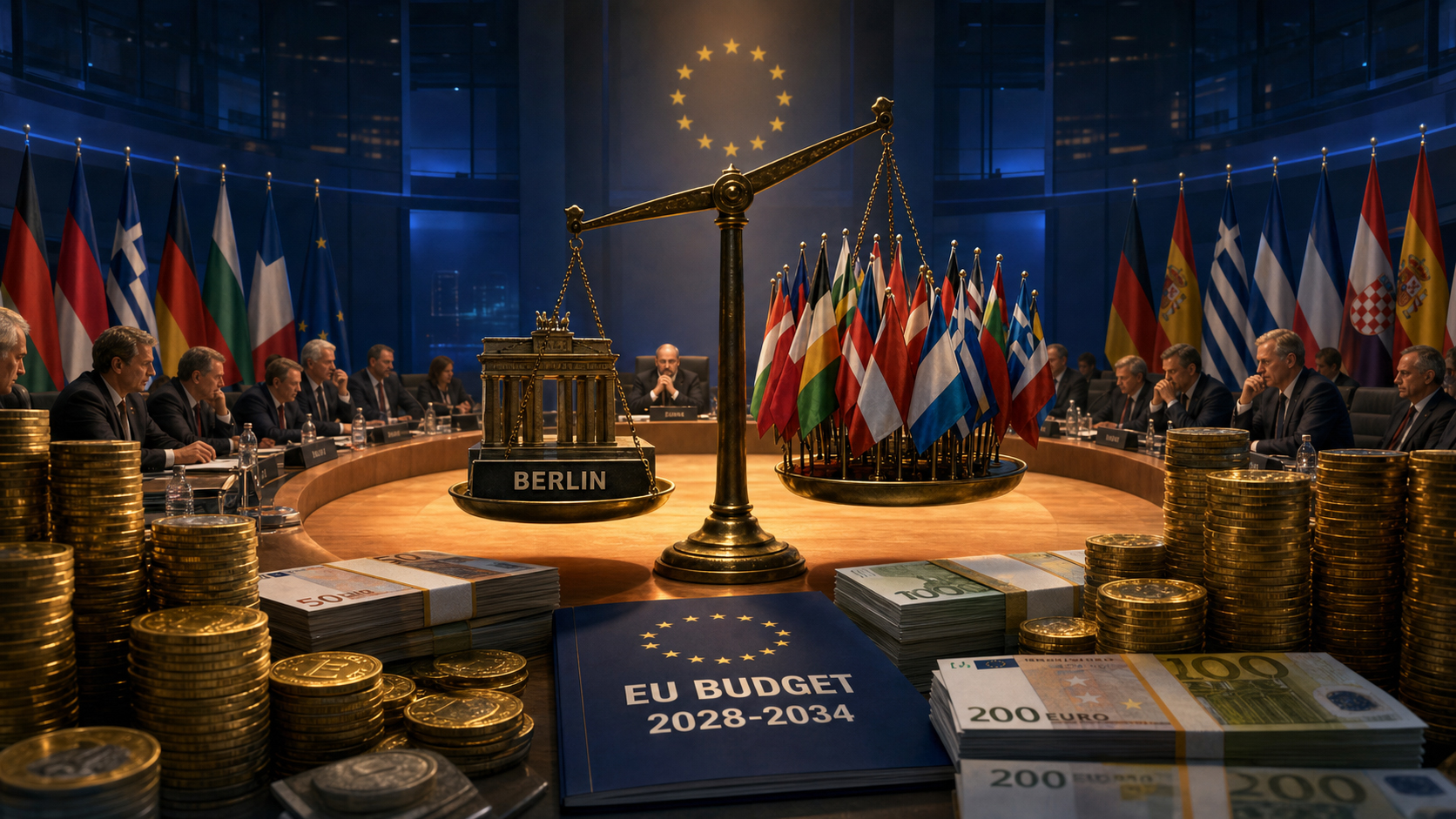
Billion-dollar shock: This is how expensive the new EU budget will really be for Germany – This EU plan is angering taxpayers – Image: Xpert.Digital
2,500 new civil servants in Brussels? Europe's 2 trillion euro plan: Who will foot the bill in the new budget dispute?
The bitter fight over our tax billions and the pension scandal in Spain: Are our European subsidies disappearing here?
The dispute over the new EU budget is escalating: For the years 2028 to 2034, the European Commission is planning expenditures of nearly two trillion euros – a historic increase that would place a massive burden on Germany, the Union's largest net contributor. While Chancellor Friedrich Merz is demanding substantial cuts and categorically rejects new joint debt, strong resistance is forming in Brussels. At least 16 member states are pushing for the continuation, or even expansion, of generous subsidies. Amid this fiscal power struggle, an unexpected demand from Italian Prime Minister Giorgia Meloni is causing coalition chaos, while reports of billions of euros in EU funds being misappropriated in Spain are inflaming the passions of the net contributors. This is a deep dive into the European negotiating poker game, where hundreds of billions of euros are at stake for German taxpayers – and nothing less than the future viability of the EU.
Editor's note: This article sheds light on the deep-seated conflicts and the situation before the EU summit.
Payers versus recipients: Germany's lonely fight for the EU budget
When one person pays for everyone – and everyone is against it: The arithmetic of imbalance
The European Council will meet in Brussels on June 18, 2026 – and the toughest debate will not be about war, climate, or competitiveness, but about money. Lots of money. In July 2025, the European Commission presented a Multiannual Financial Framework (MFF) for the years 2028 to 2034 with a volume of almost two trillion euros. This corresponds to an annual increase in the EU budget from around 199 billion euros to approximately 285 billion euros – a rise of 43 percent compared to the current financial framework. For Germany, as the largest net contributor to the Union, this means a potentially drastic increase in its financial burden.
Figures make the conflict tangible: Germany currently finances approximately 23.6 percent of the EU budget, which corresponds to an annual gross contribution of around 47 billion euros. Should this ratio be maintained, Germany's annual contribution would rise to approximately 67 billion euros – over a four-year legislative period, this would amount to a total burden of around 269 billion euros and an absolute additional burden of over 81 billion euros. According to calculations by the Frankfurter Allgemeine Zeitung (FAZ), Germany's total contribution for the entire Multiannual Financial Framework (MFF) period could even rise to between 420 and 450 billion euros, especially since the European Commission also intends to completely abolish Germany's contribution rebate.
The German Economic Institute (IW Cologne) confirms that in 2024, despite ongoing economic weakness, Germany paid €13.1 billion more into the EU budget than it received – the highest figure of all member states, both in absolute terms and per capita (€157 per inhabitant). While the net contribution has shrunk compared to the peak of €19.7 billion in 2022, a fact the German Institute for International and Security Affairs (SWP) attributes to the continuing economic slump in Germany, no other country recorded such high absolute and relative net contributions.
A chancellor facing headwinds – Merz against 16 member states
Chancellor Friedrich Merz has made his position in Brussels unequivocally clear: The current draft Multiannual Financial Framework (MFF) is "unaffordable," and Germany demands "significant cuts in spending across the board." New debt at the European level is out of the question for the Chancellor, as is the issuance of joint European bonds. In his government statement to the Bundestag, Merz put it bluntly: The challenges of the 21st century cannot be met with a 20th-century budget – but that means modernization and reallocation, not increased spending.
The Chancellor's core problem, however, is mathematical: he is entering the negotiations at a disadvantage. At least 16 of the 27 EU member states are fighting against his approach and want to maintain or even increase EU spending. The so-called "Friends of Cohesion"—Spain, Bulgaria, the Czech Republic, Croatia, Estonia, Greece, Hungary, Latvia, Lithuania, Malta, Poland, Portugal, Romania, Slovakia, and Slovenia—have demanded in a joint declaration that funding for agriculture and regional policy be increased. Even Italy, although itself a net contributor, effectively endorsed this demand under Prime Minister Giorgia Meloni, thus significantly complicating Berlin's coalition arithmetic.
Germany is supported by the Netherlands, Austria, Denmark, and Sweden – a classic coalition of fiscal conservatives that has already fought against excessive spending in previous MFF rounds. Sweden is going particularly far, demanding not the 2 percent cut offered by Cyprus as a compromise – which Michael Jäger of the European Taxpayers Federation described as a "bad joke" – but a 20 percent reduction compared to the Commission's proposal.
The Meloni Paradox: The ally as troublemaker
Italian Prime Minister Giorgia Meloni illustrates the complexity of European fiscal policy in a unique way. On the one hand, she governs with a declared austerity policy – the Italian 2026 budget was adopted with the aim of reducing new borrowing to below three percent of gross domestic product. On the other hand, she pursues a course in Brussels that significantly weakens Merz's alliance.
Meloni is demanding the abolition of existing contribution rebates for net contributors. If the anachronistic rebate system is maintained, Italy, as the EU's third-largest net contributor, should enjoy the same benefit. This demand turns the entire negotiating process on its head: The rebate issue is usually only addressed at the end of MFF negotiations, once the overall architecture is in place. Raising it at the outset makes a swift agreement less likely. Germany currently receives an annual rebate of €3.671 billion on its EU contribution – eliminating this would further exacerbate its already increasing financial burden.
At the same time, Meloni demands more investment in defense and competitiveness – but not at the expense of fishermen and farmers. This is precisely the opposite of what Merz and his alliance are aiming for: they want to dismantle old subsidy structures in the agricultural and cohesion sectors in favor of modern, future-oriented investments. The intra-European reform consensus is therefore more fragile than public rhetoric often suggests.
Cohesion policy between solidarity and self-serving
At the heart of the conflict is European cohesion policy – the system of regional and structural funds designed to reduce economic imbalances between EU member states. A total of €373 billion has been earmarked for this purpose in the current Multiannual Financial Framework (MFF) 2021–2027 – roughly one-third of the entire EU budget. This immense volume is the main reason why the poorer recipient countries are fighting so fiercely to maintain or expand it.
The scientific assessment of cohesion policy, however, is soberingly nuanced. Researchers at the ZEW Mannheim note that while the policy has measurable positive effects on growth and employment, these effects are often short-lived and diminish with increasing levels of funding. Particularly noteworthy is the finding that despite thirty years of cohesion policy, regional disparities in Southern Europe have barely decreased. There is a structural problem that more funding alone cannot remedy.
At the same time, net contributors indirectly benefit from the cohesion system: export-oriented economies like Germany or the Netherlands gain from better-equipped sales markets in Central and Eastern Europe. Older studies showed that cohesion spending can generate a long-term return of at least two percent of GDP for donor countries – through spillover effects on production and productivity. However, this economic justification loses its persuasiveness when subsidies are not used for productive investments but instead to cover structural budget deficits – as the current example of Spain dramatically illustrates.
The scandal surrounding Spain's pension billions
No single incident illustrates the weaknesses of the European budgetary system better than the Spanish scandal involving misappropriated COVID-19 recovery funds. Over ten billion euros from the NextGenerationEU program – intended for digital transformation and the green transition – ended up in the Spanish social security system: around 2.38 billion euros in 2024 flowed into the civil servants' pension fund and subsidies for minimum pensions, and at least another 8.5 billion euros are said to have flowed into the social security system in 2025. The Spanish Ministry of Finance confirmed the transaction.
The legal situation remains complex: A spokesperson for the European Commission explained that payments for current expenses are generally not eligible for funding from the Recovery and Resilience Fund (RRF) – but member states could temporarily use RRF liquidity to cover other budget expenditures. The European Commission ultimately sided with Spain, stating that there was no evidence of a rule violation. This outcome reveals a structural weakness: Controls are least effective where the political will to impose sanctions is lacking.
CDU budget expert Andreas Schwab described it as a trust-destroying process: if this practice becomes widespread, solidarity between member states will be over. This reveals a fundamental political-economic dilemma: the solidarity that underpins the EU redistribution system presupposes trust in the proper use of funds. Where this trust erodes, the political willingness of net contributors to continue paying into the system also diminishes.
Our EU and German expertise in business development, sales and marketing


Our EU and German expertise in business development, sales and marketing - Image: Xpert.Digital
Industry focus areas: B2B, digitalization (from AI to XR), mechanical engineering, logistics, renewable energies and industry
More information here:
A thematic hub offering insights and expertise:
- Knowledge platform covering global and regional economies, innovation and industry-specific trends
- A collection of analyses, insights, and background information from our key areas of focus
- A place for expertise and information on current developments in business and technology
- A hub for companies seeking information on markets, digitalization, and industry innovations
Austerity pact or structural reform? The decision that will shape the next Multiannual Financial Framework
Bureaucracy build-up in times of austerity pressure
Adding to the tensions between those advocating for austerity and those seeking to spend is another point of conflict, symptomatic of Brussels' institutional reflexes: While the Commission demands budgetary discipline from member states, it has registered a need for 2,500 new full-time positions in connection with the 2028–2034 Multiannual Financial Framework (MFF). The official justification cites new tasks in the areas of cybersecurity, AI, defense, and biotechnology.
The reaction from the net contributors was unanimously negative. Austria's Minister for Europe, Karoline Edtstadler (or rather, her acting representative), criticized the proposal, arguing that anyone demanding austerity from member states should start at home. The deputy chairman of the Budget Committee, CDU MEP Niclas Herbst, announced opposition, declaring that the plan would never pass the Council and Parliament in its current form. Even more explosive is a subsequent calculation: according to a Eurostat analysis, the 2,500 new positions would lead to additional pension expenditures of at least €1.026 billion by 2073 – meaning this short-term personnel decision perpetuates decades of financial obligations.
The European Taxpayers Federation, under its head Michael Jäger, advocates for the exact opposite: a staff reduction of ten to 25 percent, supported by the targeted use of AI. The picture Jäger paints – money squandered like water in a sauna – is populist and exaggerated, but it strikes a nerve: In a system that lacks genuine sanctions for inefficient use of funds and whose administration is constantly expanding, structural improvements are politically difficult to enforce.
Reform coalition and time pressure: The alliance of frugal countries
Germany is not alone, even though the number of opponents is impressive. The coalition of fiscal conservatives – Germany, the Netherlands, Austria, Sweden, and Denmark – has issued a joint statement against the Commission's proposal to increase staff and cohesion funds. Austria even wants to completely reject the plan for 2,500 new positions.
The institutional timetable gives this coalition at least some tactical power. The MFF must be adopted unanimously in the Council of the EU – each member state has a veto. However, past experience shows that negotiations on the Multiannual Financial Framework regularly end in compromises that are perceived as unsatisfactory by those who initially advocated for frugality: For the 2021–2027 MFF, Austria, Sweden, Denmark, and the Netherlands began negotiations under the banner of the "Frugal Four" (later joined by Germany) – and ultimately agreed to a framework that included significant increases in spending.
The target date for an agreement is the end of 2026, so that the new MFF can enter into force as planned on January 1, 2028. If no agreement is reached by then, a contingency plan with provisional twelfths will be implemented. This time pressure weakens the veto players in principle, because a failure of the negotiations would be costly for all sides – including the recipient countries, whose programs and payments would then not be able to start as planned.
Structural reform instead of volume dispute: What's really missing
The real strategic weakness of Merz's position lies not in the demand for austerity per se – which is fiscally legitimate and economically justifiable – but in the lack of a positive agenda so far. Germany has not yet specified any concrete upper limits at this summit. Sweden is bolder in this regard and has named a clear figure: a 20 percent cut instead of 2 percent. Without quantifiable counter-proposals, the "unaffordable" position remains a political gesture, not a negotiating offer.
What Europe truly needs is not merely a debate about budget size, but rather an efficiency and structural reform. In its position on the Multiannual Financial Framework (MFF), the European Parliament called for an increase in the budget of approximately 10 percent, with the additional funds specifically allocated to the most important EU programs – without providing more money for administration or agencies. This approach is conceptually closer to German modernization rhetoric than to the purely expenditure-driven logic of the cohesion coalition.
The German Institute for International and Security Affairs (SWP) proposes a hybrid reform model that adapts cohesion policy to changing circumstances without completely abandoning traditional principles. This could offer a way out of the negotiating impasse: instead of the either-or choice between volume and cuts, a reallocation of funds from blanket transfers to more targeted, conditional investments in competitiveness, decarbonization, and defense.
New sources of income: The silent taboo
A crucial parallel issue, often overlooked in public debate, concerns revenue. The European Commission has proposed new own resources in the MFF package – that is, EU revenues that would flow independently of national contributions. The "Friends of Cohesion" have explicitly stated in their declaration their openness to discussions about new sources of revenue.
France leads the way in viewing new joint debt as a legitimate financing instrument – a direct legacy of the NextGenerationEU logic, which gained traction during the pandemic. FDP MEP Moritz Körner rejects new EU taxes as "poison for the economy." Germany and Austria have also positioned themselves against joint bonds. The principle of budgetary discipline, institutionally enshrined in the German Basic Law with the debt brake, casts a long shadow over negotiations at the European level.
This stance has an economic logic: Mutualizing debt without simultaneously mutualizing fiscal and economic policy creates incentive problems. Those who do not bear the costs of a policy alone have less incentive to exercise discipline. Spain's pension scandal is therefore not an isolated incident, but a symptom of a deeper institutional problem.
The geopolitical dimension: Defense as a door opener
Beyond the budget figures, the summit has a broader agenda that places the fiscal dispute in a wider context. The question of support for Ukraine, the situation in the Middle East, and possible negotiations with Russia are also on the agenda. Chancellor Merz has positioned himself as a potential voice for Europe in a possible round of negotiations with Putin – a stance that strengthens his influence in Brussels but also raises expectations that extend beyond purely fiscal issues.
The defense dimension is not insignificant for the budget negotiations: Both Merz and Meloni want more EU investment in security and competitiveness. Merz explicitly advocates an EU budget that prioritizes joint investments in sovereignty, competitiveness, and defense. Herein lies a potential bridge: If the new priorities are clearly and verifiably defined, a reallocation of funds from old subsidy structures could be easier to justify politically – including to the cohesion countries, which also have an interest in a robust European security architecture.
The central question remains whether political actors are prepared to set aside their entrenched national interests in favor of a modernized European fiscal architecture. Negotiations for the 2021–2027 Multiannual Financial Framework (MFF) dragged on until the very last minute – and in the end, everyone agreed because the alternative of a failing Europe would have been more costly than the compromise. This logic will also apply in 2026. The only question is how expensive the compromise will be for Germany this time – and how much actual structural reform it will entail.