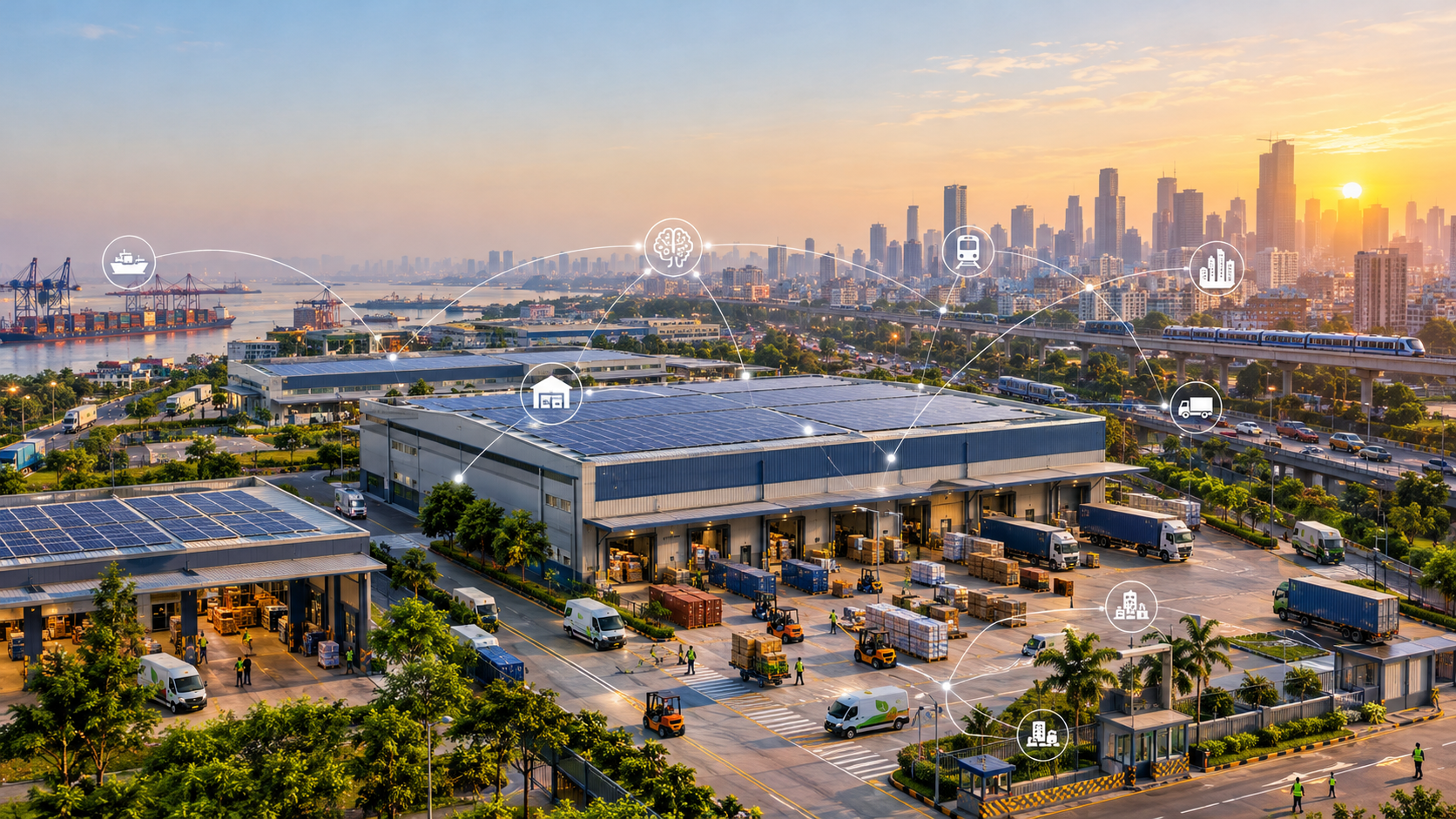
Not a modernization push, but a functional transformation: The warehouses of tomorrow – India's path to intelligent logistics – Creative image on the topic, with AI: Xpert.Digital
India's warehousing industry: From storage facility to innovation hub
E-commerce and warehouse logistics: India's new challenges for 2026
India's warehouse space: Growth and quality change in the logistics sector
India's warehousing industry is facing a fundamental transformation in 2026 that goes far beyond mere modernization. Warehouses, once passive storage facilities, are evolving into active control centers within complex supply chains. The focus is shifting from pure space utilization to efficiency, speed, and data integration. The demands on warehouse logistics are multifaceted and reflect India's diverse roles as a manufacturing hub, consumer market, and e-commerce center.
Artificial intelligence, automation, digital traceability, and a stronger focus on last-mile delivery are key elements of this transformation. Companies must adapt to remain competitive, as customer expectations for fast and reliable deliveries are constantly rising. The market is not only growing but also demanding higher quality and efficiency in warehousing. In this dynamic environment, traditional metrics such as stored volume are no longer sufficient. Instead, throughput per square meter and the ability to respond flexibly to market changes are becoming increasingly important.
Given these challenges, it is crucial that companies invest in the quality of their processes, the qualifications of their employees, and the energy efficiency of their facilities. Those who rely solely on automation or new space risk digitizing inefficiencies or clinging to outdated standards. The Indian warehousing sector is therefore not only growing but also becoming more demanding, and its success will depend on how effectively the various elements of modern warehouse logistics can be integrated.
Those who are still only renting out space in 2026 will lose out to data, speed, and intelligent networks
India's warehousing sector will not experience a typical modernization boost in 2026, but rather a profound functional transformation. The warehouse will evolve from a passive storage facility into an active control center of the supply chain. Performance will no longer be solely determined by available space, but by how quickly inventory levels are identified, orders prioritized, goods moved, errors avoided, and delivery commitments met. Artificial intelligence, selective automation, modern building technology, digital traceability, and a stronger focus on last-mile delivery will all work together to achieve this transformation.
This transformation is economically significant because India is simultaneously growing as a manufacturing hub, a consumer market, and an e-commerce ecosystem. These three roles generate different demands. Industry requires reliable supplies, sequencing, and high process stability. Retail needs frequent replenishment and a wider product range. E-commerce and quick commerce put warehouse operators under considerable time pressure because same-day or next-day delivery is no longer considered an additional service in many metropolitan areas, but rather the norm. As a result, the key performance indicator shifts from stored volume to throughput per square meter, per working hour, and per rupee invested.
The crucial point is therefore this: India's warehousing sector is not only growing, it is becoming more demanding. Additional warehouses alone will not solve inventory problems or urban supply bottlenecks. Capital must simultaneously be invested in property quality, processes, data, personnel qualifications, energy efficiency, and network connectivity. Those who rely solely on automation without structuring data and processes are simply digitizing inefficiencies. Conversely, those who merely build new space without designing it for high throughput, flexible product ranges, and networked systems are already creating the outdated infrastructure of tomorrow.
Storage space is being transformed into productive infrastructure
For a long time, Indian warehousing was characterized by small-scale, regionally fragmented, and sometimes tax-driven structures. With the unification of the single market, the expansion of national transport corridors, and the professionalization of logistics services, the logic of location has changed. Companies no longer need to primarily store goods where administrative boundaries dictate. They can design networks more according to demand, transit time, throughput, and total cost. This favors larger regional distribution centers connected to transshipment points near cities and micro-fulfillment sites.
This trend is clearly evident in the industrial space market. In the eight most important Indian industrial and warehouse locations, approximately 36.8 million square feet (3.4 million square meters) were transacted in the first half of 2026. This represented a 15 percent increase compared to the same period of the previous year. The total inventory in these markets reached approximately 584.9 million square feet (54.3 million square meters), exceeding the previous year's level by 14 percent. Simultaneously, the vacancy rate decreased from 12.1 to 11.4 percent. The combination of growing inventory and declining vacancy rates suggests that demand was able to absorb the additional space made available.
However, the dynamics are not evenly distributed. Mumbai accounted for roughly one-third of the inventory of the core markets under consideration in the first half of 2026 and achieved the highest transaction volume at 10.7 million square feet. The National Capital Region followed as the second-largest market. Bengaluru, Ahmedabad, and Kolkata also saw increases, while Pune, Chennai, and Hyderabad experienced declines in take-up. Such declines should not automatically be interpreted as weak demand. In markets with low availability, the lack of supply often limits the number of large deals. Conversely, high vacancy rates can indicate a mismatch between supply and demand, either in terms of timing or quality.
Rents are also rising. In the first half of 2026, average rents increased in all eight markets surveyed. The annual increases ranged from four to seven percent. Pune remained the most expensive market at 28.7 rupees per square foot per month, while Chennai recorded the strongest percentage increase. This trend is driven by a shortage of suitable land, higher construction and financing costs, and the growing demand for technically superior buildings. For users, this means that rent alone is becoming less of a deciding factor. The decisive factor is the total cost per completed order, per pallet, or per delivered unit.
Growth alone masks the quality gap
The Indian market features both modern logistics parks and existing buildings with limited technical capabilities. In older buildings, low ceilings, narrow column grids, weak floors, inadequate electrical systems, insufficient loading bays, and poor fire protection can hinder the implementation of modern racking systems and conveyor technology. While some existing buildings are several decades old, observations about buildings 50 years old or more should not be generalized to the entire Indian market. The decisive factor is not so much the year of construction, but rather whether the building's structure and technical equipment are adequate for today's goods flows.
Modern Grade A warehouses are therefore gaining in importance. They typically offer greater ceiling heights, more durable and level floors, larger loading zones, better maneuvering areas, efficient fire protection systems, and the technical prerequisites for warehouse management software, sensors, and automation. High ceilings create vertical capacity, but the economic benefits only materialize in combination with a suitable racking concept, standardized load carriers, sufficient floor load capacity, and safe conveyor technology. Wider column spacing, in turn, allows for more flexible travel and picking routes.
In the first half of 2026, 52 percent of the leased space consisted of Grade A properties. Their share of the total inventory in the eight core markets was 47 percent. Significant differences lie behind the national average: Chennai and Pune had particularly high Grade A proportions, while Mumbai and the National Capital Region remained considerably more dominated by older properties. It is noteworthy that the absolute Grade A lease volume declined in the first half of the year despite market growth, while Grade B space saw a significant increase. This does not necessarily rule out a shift in quality. A significant portion can be explained by the geographical shift in demand towards cities with a lower Grade A share and by the limited short-term availability of large, premium spaces.
The economic evaluation should therefore not stop at the classification of buildings. A cheaper warehouse can become expensive if low ceiling height, inefficient traffic routes, a lack of gates, or frequent operational interruptions limit throughput. Conversely, a more expensive property can offer lower unit costs despite higher rent per square meter. A sound location decision must therefore consider rent, space efficiency, personnel productivity, energy consumption, damage rate, transport connections, and delivery time together.
Artificial intelligence is becoming the decision-making layer
Digitization and automation are not the same. A digital warehouse electronically records inventory and orders. An automated warehouse has machines perform predefined tasks. An intelligent warehouse connects data, forecasts, and operational decisions in such a way that processes are continuously adapted to new conditions. It is precisely at this intersection that artificial intelligence gains importance.
A warehouse management system (WMS) first creates transparency. It documents which goods have arrived, where they are located, which orders are open, and which stocks need replenishing. Barcode scanners, RFID, cameras, and sensors improve data quality. Conveyor belts, sorting systems, automated storage and retrieval systems, and autonomous vehicles execute physical movements. AI builds on this infrastructure. Its purpose is not merely to display what has happened, but to predict what is likely to happen next and what the most economically sensible response will be.
Demand forecasting is particularly relevant. Historical sales, seasonality, holidays, promotions, regional patterns, and current order data can be combined to estimate future demand for each item and location. This allows for the derivation of inventory distribution, reorder points, and staffing levels. The economic benefit lies in reducing two opposing risks: stockouts cost revenue and customer loyalty, while excess inventory ties up capital and increases storage, depreciation, and spoilage costs.
Another area of focus is dynamic slotting, the ongoing allocation of items to storage locations. Frequently ordered products can be positioned closer together. Fast-moving items move to easily accessible zones, while slow-moving goods occupy less valuable space. With fluctuating product ranges, static placement quickly becomes outdated. AI-powered models can update recommendations more frequently, simultaneously considering size, weight, turnover rate, order relationships, and security requirements.
Personnel deployment planning is also changing. Instead of staffing shifts solely based on averages, expected order volumes, individual employee skills, zone load, and available technology can be compared. This can reduce downtime, identify bottlenecks earlier, and limit overtime during peak periods. However, the benefits depend on reliable data and realistic forecasts. An algorithm that doesn't account for short-term demand spikes, local conditions, or a lack of employee qualifications merely postpones the problem.
Selective automation beats technology at any cost
India remains a labor-intensive market with significant disparities in wages, skills, building quality, and order structure. Complete automation, as seen in some highly capitalized locations, is therefore neither economically nor technically viable everywhere. A more robust approach is selective automation: technology is deployed where volume, speed, repeatability, or the risk of failure justifies the capital investment.
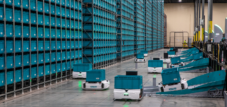
Conveyor belts and sorting systems are suitable for standardized, frequently recurring goods movements. Autonomous mobile vehicles can reduce long walking distances between storage zones. Automated storage and retrieval systems offer advantages with high space utilization and clearly defined load carriers. Robot arms are particularly useful where products and handling are sufficiently standardized. However, in highly variable product ranges, with sensitive goods, or with unpredictable packaging, human flexibility remains valuable.
The central investment question is therefore not how much technology a warehouse has, but whether it eliminates a measurable bottleneck. A conveyor system can increase throughput, but at the same time become a single point of failure. A robotics system can reduce personnel costs, but delivers a weak return on investment if utilization is too low. An autonomous vehicle can shorten routes, but requires safe driving zones, stable radio connections, maintenance, and trained personnel. The overall calculation must include acquisition, integration, training, energy, maintenance, spare parts, software licenses, and downtime risks.
A phased approach is particularly recommended for small and medium-sized operators. First, processes should be standardized and data reliably captured. This is followed by mobile scanners, digital work instructions, inventory control, and simple mechanization. Only on this foundation do complex optimization systems make sense. This approach limits wasted investments and makes the actual benefits of a technology transparent.
Automation doesn't simply replace people. It shifts tasks. Physically demanding, monotonous, and safety-critical jobs can decrease, while monitoring, maintenance, data analysis, and exception handling become more important. This creates a skills challenge: without further training, technological modernization can simultaneously increase productivity and exacerbate operational dependencies. Therefore, companies need not only engineers and software experts, but also shift supervisors and operators who understand processes, can classify malfunctions, and take responsibility for decisions.
Computer vision makes errors visible
Computer vision extends automation to include visual inspection. Camera systems can read barcodes, inspect packaging, detect damage, check completeness, and flag discrepancies between expected and actual contents. Combined with scales and order data, it's possible, for example, to identify whether a package was likely picked incorrectly. This allows a faulty shipment to be stopped before dispatch, instead of later being returned or returned as a complaint.
The economic impact extends beyond the mere error rate. Every avoided incorrect delivery saves not only the value of the goods, but also customer service, return shipping, re-picking, and potential price reductions. Returns can be particularly costly with cash-on-delivery orders or difficult-to-deliver addresses. Image-based packaging optimization can further help avoid oversized boxes, unnecessary filler material, and increased shipping weight.
However, visual AI is not a guaranteed success. Varying lighting conditions, reflective films, dirty labels, similar products, and changing packaging can all affect recognition rates. The models must be trained with representative data, regularly checked, and integrated into a clear review process. For safety-critical or regulated products, human approval often remains necessary. The benefit does not come from the camera image itself, but from the reliable integration of recognition, decision-making, and correction.
The last mile begins in the camp
The last mile is considered the most expensive and operationally challenging part of many supply chains. In the underlying industry analysis, more than 30 percent of total delivery costs are attributable to this segment, primarily due to labor, fuel, low shipment density, failed deliveries, and complex urban traffic. Depending on the definition and business model, this percentage can be significantly higher. The crucial factor is not the exact universal figure, but the magnitude: errors in the warehouse are particularly costly on the last mile.
Fast delivery doesn't begin with the courier. It begins with proper inventory positioning. If an item is available close to the customer, distance and transit time decrease. Conversely, if it has to be retrieved from a distant central warehouse, even an efficient delivery service can hardly compensate for the time loss. This explains the expansion of distributed fulfillment networks and urban micro-locations.
Same-day and next-day delivery models, however, increase inventory complexity. The more locations a retailer supplies, the more dispersed the inventory becomes. This increases the risk of individual items being in the wrong place. Network speed and capital commitment are in conflict. Excessive centralization reduces safety stock but lengthens delivery routes. Excessive decentralization improves proximity but can increase overstocking and write-offs. AI-powered inventory allocation is therefore not just an operational application, but a tool for solving an economic network problem.
The location of the warehouse remains fundamental. Proximity to highways, ring roads, bridges, railway junctions, ports, and major consumer centers influences its reach and reliability. In densely populated metropolitan areas, smaller transshipment points gain importance, while large regional centers ensure economies of scale in storage and sorting. A robust network connects both levels and simultaneously takes into account travel times, local access regulations, land costs, and available labor.
Quick commerce is changing urban logistics
Quick commerce intensifies the logic of the last mile. Sub-hour deliveries require small, demand-driven product ranges located in close proximity to customers. Forecasts predict that the gross merchandise value of the Indian quick commerce market could reach around two trillion rupees by 2028. Typical micro-fulfillment centers stock only a few thousand items, but must replenish them frequently and manage them with near-perfect accuracy.
The business model thrives on short distances and high inventory accuracy. An item visible in the system but physically missing immediately leads to alternative offers, cancellations, or delayed deliveries. Therefore, digital synchronization between the dark store, regional warehouse, and procurement is crucial. Small spaces are unforgiving of poor placement. Every extra step, every unclear shelf layout, and every delayed restock directly impacts delivery times.
Economically, quick commerce remains challenging. High order frequency does not automatically translate into high profitability. Small shopping carts, discounts, staffing needs, and expensive retail space near city centers all negatively impact the unit cost. Crucial factors include order density, repurchase rate, assortment management, and the ability to utilize existing capacity throughout the day. Warehouse technology can improve productivity, but it cannot cure a weak business model.
A two-tiered demand is emerging in the real estate market. Large, highly connected distribution centers handle procurement, consolidation, and regional supply. Smaller, urban locations serve as the rapid customer interface. Sorting and transshipment centers lie in between. This hierarchy increases the importance of integrated planning: An individual warehouse can only operate as effectively as the network to which it is embedded.
Your intralogistics experts

Consulting, planning and implementation of complete solutions for high-bay warehouses and automated storage systems - Image: Xpert.Digital
More information here:
Cross-docking optimizes warehouse processes
Cross-docking accelerates the handling of perishable goods
Cross-docking reduces actual storage time. Goods arrive at one side, are inspected and sorted, and leave the facility almost immediately via the other side. This process is particularly suitable for goods with a short shelf life, predictable destinations, and high turnover. Food, beverages, and certain retail goods can thus be transported more quickly, while cooling and storage costs are reduced.
The advantage, however, only materializes with a high degree of synchronization. Suppliers, vehicles, gates, personnel, and departure times must be coordinated. Delayed arrivals or incorrect quantities can quickly lead to congestion because there is hardly any buffer space. Therefore, cross-docking facilities require sufficient gates, clear traffic management, accurate advance information, and efficient yard management.
This is also relevant for India from an agro-economic perspective. As of June 30, 2025, the country had 8,815 cold storage facilities with a total capacity of approximately 40.2 million tons. Nevertheless, post-harvest losses of perishable goods remain a significant problem. Increased capacity alone is insufficient if cooling, pre-treatment, packaging, transport, and market access are not seamlessly integrated. The economic priority is therefore shifting from isolated cold storage facilities to an integrated cold chain.
Cross-docking can shorten transport and storage times, but it doesn't replace temperature control. Sensors, real-time monitoring, and predictive warnings for temperature deviations are becoming increasingly important. A forecast that detects an impending limit violation before the goods are actually damaged is particularly valuable. This allows operators to reroute shipments, repackage, or perform maintenance on technical equipment, instead of just documenting losses that have already occurred.
Drones are becoming a tool for inventory
Drones are particularly useful for inventory checks in large, high-ceilinged warehouses. Equipped with cameras, barcode scanners, or RFID readers, they can inspect storage locations on upper shelf levels without requiring employees to use ladders, aerial work platforms, or forklifts. This reduces manual labor and minimizes work at height.
Their most effective use lies in recurring inventory cycles and clearly structured shelving. Instead of interrupting operations for a comprehensive count, specific areas can be checked more frequently. This allows for earlier detection of inventory discrepancies. The economic benefits include improved availability, reduced search times, and smaller discrepancies between physical and digital inventory.
The limitations lie in cost, navigation, radio coverage, battery life, and safety regulations. Dust, narrow aisles, reflective surfaces, or moving vehicles can complicate operations. Drone data must also be accurately transferred to the warehouse management system. A flight without proper system integration will generate images, but not reliable inventory management.
Drones will therefore not become standard in every Indian warehouse in the short term. They are likely to establish themselves first in large, high-volume, and technically well-structured facilities. There, they will complement scanners and stationary sensors. The appropriate benchmark here, too, is not technological visibility, but rather the savings per inventory, the improvement in inventory accuracy, and the reduction of security risks.
Traceability requires more than blockchain
Blockchain is frequently cited as a tool for tamper-proof documentation, proof of origin, and cross-organizational traceability. In supply chains involving high-value, regulated, or counterfeit goods, a shared, tamper-proof ledger can build trust. Potential applications include pharmaceuticals, food products, spare parts, and cross-border documents.
However, the benefits are often overestimated if the quality of the input data is not taken into account. A blockchain can immutably store a faulty scan, but it cannot prevent the original error. It does not replace sensors, physical inspection, or clear lines of accountability. Furthermore, integration costs arise when suppliers, freight forwarders, warehouse operators, authorities, and customers use different systems.
For many applications, well-secured central databases, digital signatures, and standardized interfaces are sufficient. Blockchain is economically viable when multiple independent parties require shared datasets, no single party is accepted as the sole trusted authority, and the value of an immutable history outweighs the additional costs. It should therefore be viewed as a specialized tool, not a general modernization formula.
More important than the choice of buzzword is the consistent identification of the goods. Barcodes, RFID tags, electronic documents, sensor readings, and bookings must all consistently represent the same item, batch, or loading unit. Only then is true traceability achieved. India's advances in digital logistics platforms provide an important foundation for this, because data can be used not only within a warehouse but also across organizational boundaries.
Sustainability becomes a cost accounting measure
Sustainable warehousing is not just a reaction to regulatory or societal pressure. Many measures directly improve operating costs. LED lighting reduces electricity consumption and maintenance. Good insulation lowers cooling and air conditioning costs. Energy management can reduce peak loads. Photovoltaics on large roof areas enable local power generation, which is particularly economically attractive when conveyor technology and cooling systems are running during the day.
Packaging also has an impact on several levels. Lighter and appropriately sized packages require less material, take up less vehicle space, and can reduce shipping costs. Biodegradable materials can improve the ecological footprint, but are not automatically superior in every application. Protective effect, moisture resistance, durability, actual disposal methods, and costs must all be considered. Damaged goods usually result in greater resource consumption than slightly more robust packaging.
Electric vehicle charging infrastructure is gaining importance because the last mile accounts for a significant portion of delivery costs and emissions. Electric vehicles are particularly attractive on predictable urban routes. Warehouse locations can serve as charging points if grid connection, charging windows, and fleet deployment are planned together. In contrast, installing charging stations in isolation without load management can result in high connection and peak load costs.
The market for green warehouse properties is growing accordingly. The certified sustainable stock could increase from around 65 million square feet in 2024 to approximately 270 million square feet in 2030. At the same time, the total Indian warehouse stock is expected to continue growing significantly. This makes the renovation of existing buildings just as important as new construction. New facilities are easier to design for energy efficiency, rainwater harvesting, natural lighting, solar roofs, and modern cooling. For existing buildings, the economic viability of individual measures determines the speed of transformation.
Third-party providers make fixed costs variable
The rise of specialized logistics providers is changing the cost structure of many companies. In the first half of 2026, around 30 percent of space transactions in the eight core markets were attributable to third-party logistics providers. Their leased space increased by 27 percent compared to the same period of the previous year. This development shows that manufacturers, retailers, and brands are increasingly outsourcing warehousing and fulfillment to specialists.
This is particularly attractive for small and medium-sized e-commerce companies. Building their own network of warehouses, software, personnel, material handling equipment, and transport contracts requires significant initial investment. In contrast, a fulfillment partner consolidates volumes from multiple customers and distributes fixed costs. Companies can adjust capacity more flexibly to peak sales and expand into new regions without immediately building their own facilities.
Outsourcing, however, does not automatically lead to increased efficiency. Dependence on the service provider increases, and operational errors still negatively impact the retailer's brand. Therefore, contracts must include clear key performance indicators (KPIs) for inventory accuracy, order processing time, cut-off times, returns, damages, and system availability. Equally important are data access, interfaces, contingency plans, and procedures for switching providers.
Increased use of multi-customer facilities can improve utilization and spread risks. At the same time, the demands on data and process security rise because different customer profiles are served within the same infrastructure. In the future, good 3PL providers will differentiate themselves less by sheer physical size than by their integration capabilities, network coverage, operational learning curves, and the quality of their control systems.
Infrastructure policy is changing the location map
India's warehousing sector is benefiting from a broader expansion of transport and data infrastructure. The National Logistics Policy (PM GatiShakti), multimodal logistics parks, freight corridors, and digital platforms aim to better connect transport providers, government agencies, and private sector stakeholders. The official assessment of national logistics costs for 2023/24 puts them at 7.97 percent of GDP, or 24.01 trillion rupees. Previous estimates were often significantly higher. Therefore, the new figure should not be interpreted as a sudden downward cost drop, but rather as the result of a revised, more comprehensive measurement methodology.
For warehouse locations, multimodal connectivity is crucial. A distribution center near a high-capacity road can accelerate regional deliveries. A location with additional rail access or proximity to a port and container terminal can simultaneously consolidate long-distance transport. Multimodal logistics parks aim to integrate transshipment, storage, customs clearance, and various transport modes on a single site. This can reduce interface costs and empty runs.
The Unified Logistics Interface Platform strengthens the digital layer. By August 2025, more than 30 digital systems had been integrated, enabling over 1.6 billion transactions. Such platforms can accelerate status information, documents, and approval processes. The economic benefits arise primarily when data standards are interoperable and smaller players also have access.
Despite progress, land availability remains a bottleneck. Fragmented ownership, unresolved title chains, inconsistent zoning regulations, and lengthy permitting processes hinder the provision of suitable sites. In metropolitan areas, logistics also competes with residential, commercial, and industrial developments for land. Higher land prices encourage more compact planning, vertical storage, and the relocation of large centers to peripheral corridors. At the same time, the distance to the customer must not increase so much that transport costs negate the rental advantage.
Standardization determines scalability
A modern warehouse is only scalable if the building, load carriers, racking, vehicles, and software are compatible. Standardized pallet dimensions simplify the design of racking, conveyor technology, palletizers, and trucks. Standardized interfaces reduce the need for custom solutions and make technology transferable between locations. Without such foundations, every expansion becomes a new integration project.
India has standards and guidelines for warehouse structure, floors, roofs, fire protection, lighting, security, machinery, and warehouse management systems. However, gaps in unified national standardization remain for racking systems. This is not merely a technical detail. Rack dimensions, load assumptions, material quality, inspection, and maintenance all affect space efficiency, occupational safety, and insurability.
Truck bodies and ramps must also be compatible with the pallet and conveyor technology. If vehicle width, loading height, and load carriers are not matched, manual reloading and waiting times result. This can lead to a loss of productivity at the loading dock in an automated warehouse. Process optimization must therefore extend beyond the property boundaries.
Standardization also fosters competition. When companies are not permanently bound to proprietary formats, they can more easily exchange components and expand systems gradually. Open interfaces reduce integration costs in the long run. At the same time, operators need sufficient flexibility to meet industry-specific requirements, for example in pharmaceuticals, chemicals, food, electronics, or the automotive industry.
Data quality is the silent bottleneck
AI models can only make decisions as well as the data they are given. Incorrect product master data, late bookings, inaccurate measurements, missing batch information, or unrecorded damage lead to poor recommendations. This connection is often underestimated in technology projects because visible hardware is easier to sell than meticulous data management.
A robust data management system begins with clear definitions. Every item needs a unique identifier. Dimensions, weight, shelf life, temperature requirements, and hazardous materials characteristics must be accurately recorded. Movements should be tracked at the point of origin whenever possible. Interfaces between the ordering system, warehouse management, transport planning, and financial accounting require consistent timestamps and clearly defined responsibilities.
Cybersecurity is another crucial factor. The more interconnected warehouses, vehicles, sensors, and customer platforms become, the larger the attack surface. A failure of the warehouse management system can disrupt physical operations within a short time. Operators therefore require access controls, network segmentation, backups, recovery plans, and regular testing. Robotics and software suppliers must also be integrated into the security concept.
Human oversight remains necessary. AI can prioritize, predict, and report deviations, but responsibility for safety, compliance, and customer impact must be clear. Especially with automatically triggered reorders or redirections, limits, approval rules, and transparent decisions are essential. The most effective architecture is not the one with maximum autonomy, but rather one with a sensible division of labor between machine and human.
Productivity is becoming more important than pure capacity
The Indian warehousing sector faces a classic growth problem: increased demand cannot be met indefinitely by simply adding more space and personnel. Suitable land near consumption centers is scarce, construction costs are rising, and skilled labor is not universally available. Therefore, the focus is shifting to maximizing the productivity of existing resources.
Key performance indicators (KPIs) include throughput per square meter, order items per working hour, inventory accuracy, dock-to-stock time, picking errors, system availability, energy consumption per unit, and the on-time delivery rate. No single KPI is sufficient. Higher throughput, for example, can come at the cost of more errors. Extreme inventory reduction can free up capital but also increase stockouts.
Good management balances costs, service, risk, and resilience. Resilience sometimes creates apparent inefficiencies, such as safety stocks, alternative suppliers, or spare capacity reserves. However, its value becomes apparent after disruptions. The economic challenge is not to eliminate every reserve, but to build it up where a failure would be particularly costly.
The clear outlook for 2026 is therefore this: Competition will shift from square meters to decisions. Winners will not necessarily be the operators with the largest halls or the most robots. Success will come to those who treat location, buildings, data, people, and technology as a single system and align investments with measurable bottlenecks.
Risks are dampening technological optimism
The positive market outlook should not obscure structural risks. High capital costs can delay automation projects. Imported components are susceptible to exchange rate fluctuations and global supply chain issues. Land scarcity increases the cost of new construction, while unresolved ownership issues slow projects down. Inconsistent infrastructure quality hinders scaling beyond major cities.
The demand side also remains differentiated. While production and 3PL (third-party providers) saw strong growth in the first half of 2026, the demand for retail space directly attributable to e-commerce declined significantly. This may indicate a consolidation of previously established capacities. It also demonstrates that long-term e-commerce growth does not necessarily lead to additional space acquisition every six months. Companies are optimizing their networks, increasing capacity utilization, and outsourcing activities to service providers.
Technical misinvestments pose another risk. Vendors often promise significant productivity gains, but results depend on the initial situation, data quality, and process discipline. A pilot project under controlled conditions does not prove scalability. Before widespread implementation, companies should establish baseline values, define key performance indicators (KPIs), and also consider maintenance and downtime costs.
Finally, an excessive focus on speed can have negative side effects. Tight delivery windows increase workload, traffic, and energy consumption. A sustainable strategy must differentiate service promises based on customer benefit and willingness to pay. Not every order requires delivery within hours. Consolidation, predictable delivery windows, and pickup models can be more economically and ecologically sound.
The strategic roadmap for operators
For operators and users of Indian warehouse properties, a clear order of priorities emerges. Transparency regarding processes and costs is paramount. Without reliable data on inventory, routes, errors, waiting times, and energy consumption, no investment can be seriously evaluated. Next, bottlenecks should be prioritized: Is the primary cause insufficient space, poor building geometry, inaccurate inventory, slow picking, too few loading bays, or inadequate transport connections?
The second step involves standardization. Article master data, load carriers, booking rules, storage locations, and interfaces must be standardized. Only then should mechanization be strategically implemented. Mobile scanners, pick-by-voice, conveyor technology, sorting systems, or autonomous vehicles are suitable depending on the process. AI comes into play where decisions are frequent, dynamic, and dependent on many variables.
In the third step, the warehouse is integrated into the network. Inventory positioning, transport planning, and delivery commitments must be optimized together. A fast local process is of little use if goods are in the wrong location or if the outbound transport is not synchronized. For e-commerce providers, the connection between regional centers, urban hubs, and multiple transport partners is crucial.
In the fourth step, sustainability and resilience are integrated into the investment calculation. Energy efficiency, solar panels, insulation, packaging optimization, and charging infrastructure should be evaluated based on their life cycle costs. Simultaneously, contingency plans are needed for system failures, transport disruptions, and peak demand. The combination of efficiency in normal operation and the ability to respond to disruptions becomes the true quality criterion.
India's competitive advantage lies between the shelf and the street
India's warehousing sector will enter a phase in 2026 where real estate, technology, and logistics can no longer be considered separately. The market is growing, rents are rising, Grade A sites are gaining structural importance, and specialized logistics providers are taking over larger parts of the value chain. At the same time, e-commerce is forcing shorter response times, while quick commerce is creating a new urban infrastructure of micro-locations and high-frequency replenishment.
The greatest leverage lies not in maximum automation, but in intelligent selection. Conveyor technology, autonomous vehicles, drones, computer vision, RFID, and AI each unfold their value in different areas. Their common prerequisites are suitable buildings, standardized processes, clean data, and qualified personnel. Without any of these foundations, modern systems remain expensive and fragile.
Sustainability is evolving from an image factor to a business calculation. Energy-efficient buildings, optimized packaging, electric delivery fleets, and improved cold chains can simultaneously reduce costs, emissions, and losses. Particularly in the food sector, it's clear that modern storage isn't just a business issue. It impacts producer income, consumer prices, security of supply, and resource consumption.
The provocative truth is this: In a data-driven supply chain, a warehouse that merely provides space becomes a replaceable cost center. A warehouse that recognizes demand, positions inventory correctly, moves goods quickly and safely, uses energy efficiently, and seamlessly connects with traffic and customers, on the other hand, becomes productive infrastructure. This is precisely where the decision is made whether India merely accommodates its growth physically or translates it into sustainably greater competitiveness.
Your global marketing and business development partner
☑️ Our business language is English or German
☑️ NEW: Correspondence in your native language!

Konrad Wolfenstein
I and my team are happy to be available to you as your personal advisor.
You can contact me by filling out the contact form here wolfenstein@xpert.digital:or simply call me at +49 7348 4088 965. My email address is
I'm looking forward to our joint project.