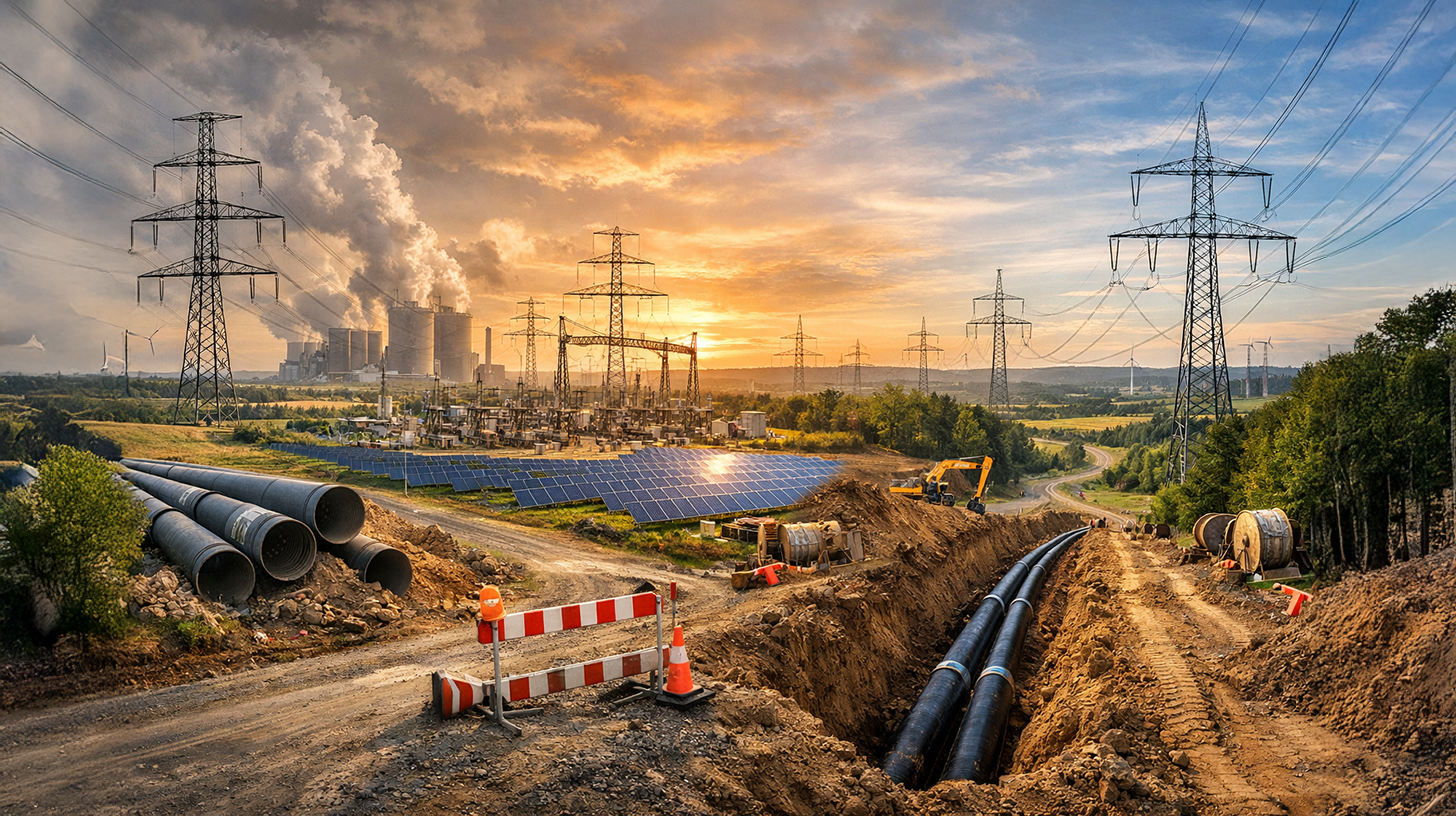
Forget the climate: The real geopolitical reason for the energy transition – Image: Xpert.Digital
Security policy instead of eco-romanticism: Why Europe's energy transition is its insurance policy for survival
Why the expansion of renewable energies is not ecological romanticism, but hard-nosed security policy
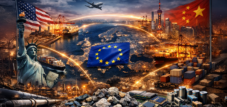
In public debate, the expansion of renewable energies is often still perceived as a purely ecological project – driven by concerns about the climate and moral obligations. However, this view falls fatally short in today's geopolitical reality. The current upheavals in the world markets, the aggressive trade policies of the USA, and the painful lessons of Russian gas dependency are forcing Europe to radically reassess its position: The energy transition is no longer a matter of "green conscience," but rather the most crucial currency of European sovereignty.
Europe faces a fundamental dilemma. Geologically disadvantaged and poor in fossil fuels, the continent has for decades become dependent on autocratic regimes or dominant superpowers. The switch from Russian pipeline gas to American liquefied natural gas (LNG) may have secured supplies in the short term, but it has merely led Europe from one dependency to another. If energy exports are used as political weapons in Washington or Moscow, Europe risks becoming a pawn in the game of foreign interests.
The following analysis explains why the massive expansion of wind and solar energy is the only realistic way to break free from this strategic stranglehold of the power blocs of the USA, China, and Russia. It is an attempt to replace geology with technology and to exchange operating costs for investment costs. We examine why decarbonization is not only the only chance to close the energy cost gap with the USA, but also why a decentralized power grid represents the best defense against military attacks. Anyone who still hinders the energy transition today is jeopardizing not only the climate, but also the geopolitical viability of an entire continent.
From importer to producer: The energy transition as the hardest currency of European sovereignty
The analysis of the events surrounding Venezuela and the aggressive trade policies of the US under Donald Trump inevitably leads to a conclusion that extends far beyond climate policy debates: For Europe, the massive expansion of renewable energies is the only available instrument to free itself from the strategic stranglehold of the three major power blocs: the US, China, and Russia. This is not primarily an environmental strategy, but a geopolitical survival strategy. Whoever controls the energy infrastructure controls the political agency of a continent. The shift away from fossil fuels toward a power-based economy is Europe's attempt to replace geology with technology.
The fundamental problem with fossil fuels is their uneven geological distribution. Oil and gas are located where they are – often in autocratic states or among geopolitical rivals. Europe has largely lost this natural lottery. As long as the European economy is based on molecules, i.e., on oil and gas, it remains vulnerable to blackmail. This was dramatically demonstrated by the loss of Russian gas supplies and is now evident again in the fragility of supply chains from South America and the dependence on American liquefied natural gas (LNG).
Renewable energies like wind and solar, however, follow a different logic. They are not scarce resources that must be fought over, but rather technologies that can be harnessed. Every wind turbine and every solar panel on European soil is a step away from the global market and towards domestic production. In a world where energy is used as a weapon, as Vladimir Putin has demonstrated and Donald Trump threatens, domestic energy production becomes the most important shield of national sovereignty.
The trap of LNG dependency and American price pressure
The current situation reveals a dangerous paradox in Europe's diversification strategy. Following Russia's attack on Ukraine, Europe has replaced one dependency with another: instead of Russian pipeline gas, the continent is now massively importing American LNG. This makes European industry directly dependent on political decisions in Washington. If Donald Trump, as suggested in the case of Venezuela, uses energy exports as leverage for political compliance, Europe will be trapped. A US president could restrict export licenses for LNG to force Europe to make concessions in trade or defense policy.
Furthermore, there is a massive competitive disadvantage. The US has extremely cheap domestic energy thanks to fracking. Europe, on the other hand, has to liquefy this gas, ship it across the Atlantic, and regasify it, which makes it physically impossible to ever achieve the same low energy prices as the US as long as it relies on fossil fuel imports.
The only way to compensate for this structural locational disadvantage lies in generating electricity whose marginal costs approach zero. Wind and solar power don't send bills. Once the plants are fully depreciated, they produce energy at unbeatable prices. In the long term, an energy system based on renewables is therefore not only politically more secure, but also the only economic opportunity for Europe to close the energy cost gap with the USA. Those who cling to fossil fuels will permanently accept higher production costs than their American competitors.
Our EU and German expertise in business development, sales and marketing
Our EU and German expertise in business development, sales and marketing - Image: Xpert.Digital
Industry focus areas: B2B, digitalization (from AI to XR), mechanical engineering, logistics, renewable energies and industry
More information here:
A thematic hub offering insights and expertise:
- Knowledge platform covering global and regional economies, innovation and industry-specific trends
- A collection of analyses, insights, and background information from our key areas of focus
- A place for expertise and information on current developments in business and technology
- A hub for companies seeking information on markets, digitalization, and industry innovations
The Price of Freedom: Europe's Inevitable Path to Independence from the Great Powers
The exchange of pipeline dictates for technology monopolies
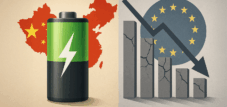
Critics rightly point out that Europe's energy transition is merely shifting its dependence on Chinese technology from Russian gas to Chinese technology. China controls large parts of the value chain for solar panels, batteries, and the critical raw materials required for them. This is a valid objection, but in risk analysis, there is a qualitative difference between dependence on a fuel and dependence on a technology.
If Russia were to turn off the gas tap, power plants in Europe would shut down within weeks, and heating systems would go cold. The effect would be immediate and catastrophic. If, on the other hand, China were to halt solar panel exports, it would be a severe blow to further expansion, but the already installed systems would continue to generate electricity. The sun shines on panels that are already installed, even without China's permission. The existing infrastructure is secure; only growth would be at risk. This is a significantly more robust position than the constant need to replenish fuel supplies.
Nevertheless, this reality compels Europe to broaden its understanding of energy autonomy. It is not enough to build wind farms; Europe must regain the industrial base to manufacture and maintain the systems itself. The EU's Net Zero Industry Act is a belated attempt to restore precisely this technological sovereignty. Without domestic production of transformers, inverters, and turbines, autonomy remains incomplete. The energy transition must therefore be understood as a re-industrialization program to avoid being vulnerable to Chinese coercion.
The deflationary effect of decarbonization
From an economic perspective, the transition to renewables represents a shift from operating costs (OpEx) to capital costs (CapEx). A gas-fired power plant is cheap to build but expensive to operate, as fuel must be purchased continuously. A wind farm is expensive to build but almost free to operate. In a world of geopolitical instability, this model is superior. Fossil fuel prices are volatile and driven by cartels like OPEC or political crises. Capital costs, on the other hand, are predictable.
Once Europe has overcome the initial high investment burden, its energy system will have a deflationary effect. It will deprive inflation, which is often driven by energy price shocks, of its breeding ground. Price stability is essential for an aging economy like Europe's. Independence from the price fluctuations of global markets makes the European economy more resilient to external shocks. While an oil price shock in Venezuela or a blockade in the Strait of Hormuz can shake the global economy, a wind turbine in the North Sea will continue to operate unaffected.
Hydrogen as a new Achilles heel or a bridge to the world
A critical point remains the need for molecules for processes that cannot be electrified, such as in the chemical industry or heavy-duty transport. Here, Europe is relying on hydrogen. However, there is a risk of repeating old mistakes if one assumes that this hydrogen can simply be imported from newly autocratic regions. The vision of obtaining hydrogen en masse from North Africa or the Middle East reproduces the old dependency patterns of the oil era.
True autonomy will only emerge if Europe maintains its technological leadership in this area and diversifies production as much as possible. Domestic electrolysis capacity is therefore strategically more important than mere import terminals. Furthermore, the hydrogen economy offers the opportunity to build partnerships with democracies in the Global South on an equal footing, instead of engaging in one-sided resource exploitation. Countries like Chile or Australia offer themselves as more politically stable partners than the traditional oil-producing states.
Security policy through decentralization
Besides the macroeconomic level, the energy transition also has a military-strategic dimension. A centralized energy system with a few large power plants and pipelines is easily vulnerable in the event of conflict – be it through physical sabotage or cyberattacks. Ukraine is demonstrating to the world how Russia deliberately attacks energy infrastructure.
A decentralized system of millions of solar panels, wind turbines, and battery storage units, on the other hand, is resilient. There is no single off switch that an adversary can use to cripple an entire country. Decentralizing the energy supply is therefore a passive contribution to national defense. It significantly raises the threshold for a successful attack on critical infrastructure. In times of hybrid warfare, this resilience is a locational advantage that should not be underestimated.
The compulsion to flee forward
The question of whether to continue the energy transition for Europe is not a matter of choice, but an absolute necessity. In a world where the US is isolating itself, China is expanding, and Russia is acting aggressively, the status quo – the import of fossil fuels – poses the greatest security risk to the continent.
Dependence on the three major power blocs can only be broken if Europe largely meets its energy needs from domestic sources. Since Europe has no significant oil or gas reserves, renewables are the only remaining option. The path is arduous, expensive, and requires massive industrial policy to avoid falling into new technological dependencies. But the alternative would be permanent geopolitical immaturity, in which European chancellors and presidents would have to beg for energy from Washington, Beijing, or Moscow.
The energy transition is therefore Europe's only chance to remain an independent actor in the multipolar world order of the 21st century. It is the price of the freedom to say "no"—be it to an American president waging trade wars or to a Russian dictator redrawing borders.
Your global marketing and business development partner
☑️ Our business language is English or German
☑️ NEW: Correspondence in your native language!

Konrad Wolfenstein
I and my team are happy to be available to you as your personal advisor.
You can contact me by filling out the contact form here wolfenstein@xpert.digital:or simply call me at +49 7348 4088 965. My email address is
I'm looking forward to our joint project.
☑️ SME support in strategy, consulting, planning and implementation
☑️ Creation or realignment of the digital strategy and digitization
☑️ Expansion and optimization of international sales processes
☑️ Global & Digital B2B trading platforms
☑️ Pioneer Business Development / Marketing / PR / Trade Fairs
🎯🎯🎯 Benefit from Xpert.Digital's extensive, five-fold expertise in one comprehensive service package | BD, R&D, XR, PR & Digital Visibility Optimization
Benefit from Xpert.Digital's extensive, five-fold expertise in a comprehensive service package | R&D, XR, PR & Digital Visibility Optimization - Image: Xpert.Digital
Xpert.Digital possesses in-depth knowledge across various industries. This allows us to develop tailored strategies precisely aligned with the requirements and challenges of your specific market segment. By continuously analyzing market trends and monitoring industry developments, we can act proactively and offer innovative solutions. The combination of experience and expertise generates added value and provides our clients with a decisive competitive advantage.
More information here: