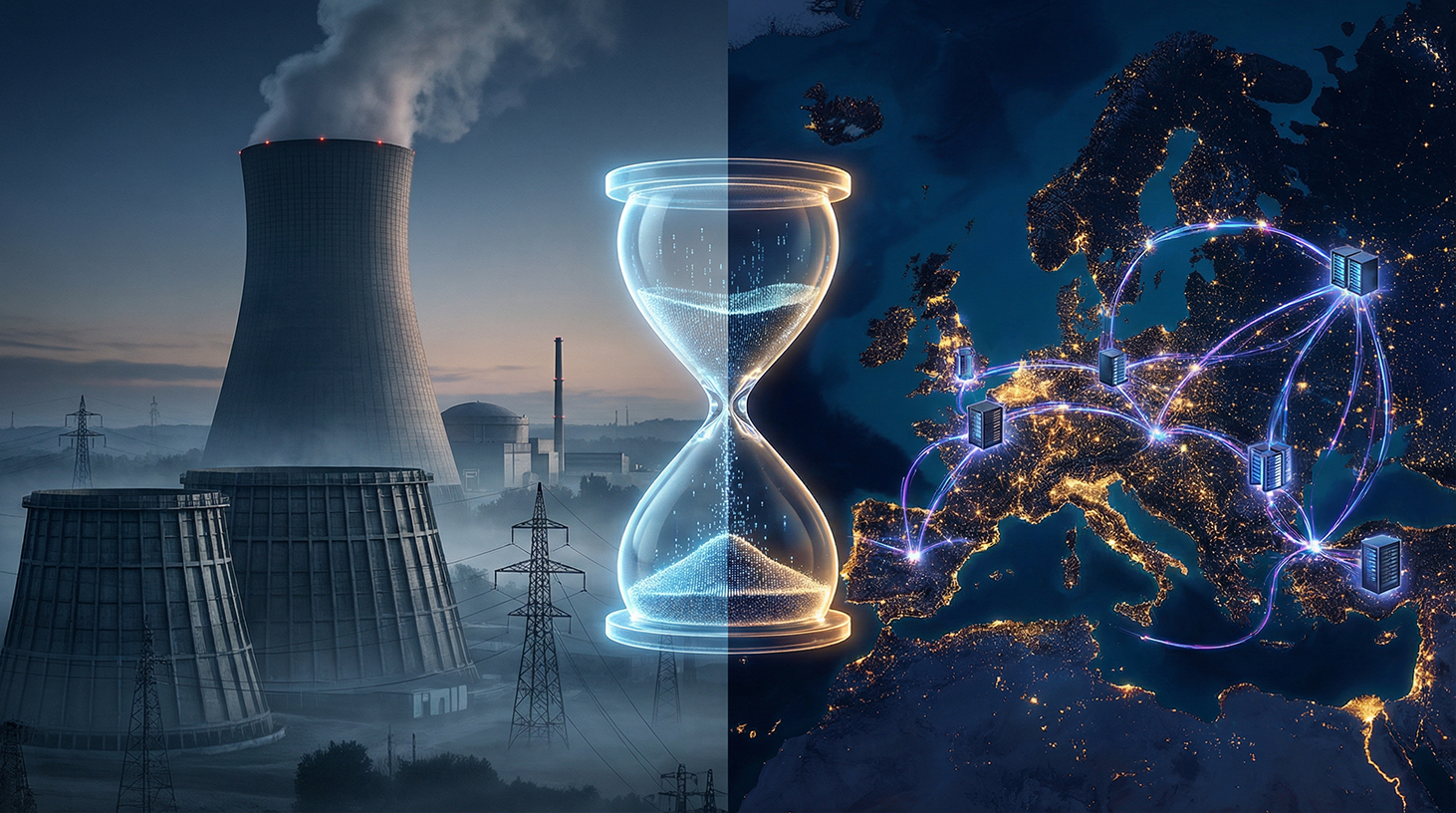
Key problem of AI infrastructure: The stranded asset risk – Those who rely on outdated structures today will pay the price tomorrow – Image: Xpert.Digital
Lobby trap instead of progress: The hidden truth about AI's electricity needs
Energy-guzzling AI: The ingenious (and ignored) alternative to giant nuclear data centers
The lack of transparency as a core political problem of AI infrastructure
Artificial intelligence's energy demands are growing exponentially – and with them, political panic. To meet the gigantic electricity requirements of planned AI data centers, a supposedly new solution has suddenly come into focus in Europe and the USA: small modular nuclear reactors (SMRs). But while politicians and industry lobbyists celebrate this nuclear savior as the only option, an unprecedented economic miscalculation is looming in the background.
Exploding construction costs, decades-long implementation times, and the immense risk of so-called "stranded assets" turn the dream of a nuclear-powered AI gigafactory into a high-risk gamble. What's particularly explosive is what's systematically omitted from the debate: a decentralized AI infrastructure. This article examines the hidden cost truths of the SMR debate and shows why we risk repeating the expensive structural errors of the past with tomorrow's technology.
The real provocation of this debate is therefore not the technical question of which infrastructure is better. The real provocation is the political one: Why is the discussion about future-proof AI infrastructure almost exclusively focused on a technology whose realization horizon lies beyond the planning horizon of AI roadmaps, whose cost history is characterized by overruns of several hundred percent, and whose subsidization is largely obscured?
Related to this:


The lack of transparency as a core political problem of AI infrastructure: The energy question as a strategic diversionary tactic
In the debates surrounding the construction of European AI gigafactories, one question dominates the public discussion: Where will all the electricity come from? The answer increasingly circulating in political circles and industry forums is: small modular nuclear reactors, so-called Small Modular Reactors (SMRs). This answer sounds technologically advanced, is politically viable, and has the advantage of winning over existing interest groups—the nuclear industry, state-owned energy providers, and nuclear research institutions. However, what is almost entirely missing from this discussion is an honest economic assessment: Are centralized AI gigafactories, powered by SMR reactors, actually the most economically sensible answer to the increasing demand for computing power? Or does this question distract from a much more fundamental structural alternative—decentralized AI infrastructure?
The International Energy Agency (IEA) predicts that global electricity consumption by data centers will more than double by 2030, reaching almost 1,000 terawatt-hours annually. Even today, a single large AI data center consumes as much electricity as a city of 50,000 inhabitants, and the really large facilities are now operating in the gigawatt range. For the US alone, the IEA forecasts an additional capacity requirement of 60 gigawatts by 2029 for data centers and AI applications alone—equivalent to the output of about 60 nuclear power plants. These figures are impressive, but they lead to a flawed line of reasoning: they thoughtlessly project today's architecture of centralized data centers into the future, instead of seriously considering alternative infrastructure models.
The hidden cost truth behind the SMR promise
The discussion surrounding Small Modular Reactors (SMRs) is characterized by a remarkable degree of optimism, which, upon closer examination, has little empirical basis. SMR proponents promise shorter construction times, lower costs through mass production, and faster scalability compared to conventional large-scale reactors. However, reality paints a considerably more sobering picture.
The global market for nuclear power plants has stagnated for years. In 2024, only six new nuclear power plants went online worldwide, while four were decommissioned – a net increase of two plants. The reasons are structural: extreme investment costs, construction times of 10 to 15 years, and financing risks that can practically only be borne by state-owned companies. The prime example of this cost explosion is Flamanville 3 in France: initially estimated at €3.2 to €3.3 billion in 2006 and planned for a construction period of five years, the power plant ultimately cost €23.7 billion after 17 years of construction.
Even the US's flagship project, the Vogtle nuclear power plant in Georgia, was initially budgeted at $14 to $15.5 billion and ended up costing $34 billion – more than double the original estimate. Westinghouse, one of the world's leading nuclear technology companies, filed for bankruptcy shortly afterward. The costs of the British Hinkley Point C plant ballooned to £32.7 billion (approximately $41.3 billion) – despite the project's initial budget of £2 billion. The rule of thumb now used by experienced industry observers is: multiply the nuclear industry's initial cost estimate by ten to arrive at a realistic figure.
For SMR plants, which to date have not a single commercially deployed modular system in the Western world, the cost situation is even more uncertain. An analysis by the Heinrich Böll Foundation from early 2024 (note: the year was logically corrected to 2024 instead of the future 2026) concludes that most SMR concepts are still in early stages of development, lack regulatory approval in the EU, and are unlikely to generate significant amounts of electricity before 2050. The Institute for Energy Economics and Financial Analysis (IEEFA) confirms this critical assessment: SMRs remain too expensive, too slow to build, and too risky to play a significant role in the energy transition over the next 10 to 15 years. According to the IEEE, investments in SMRs would divert resources from carbon-free and more cost-effective renewable energy sources that are already available today.
An often overlooked aspect of this debate is the hidden subsidies. According to calculations by the Forum for Ecological and Social Market Economy, commissioned by Greenpeace, historical support for nuclear power in Germany amounted to at least €165 billion in state subsidies between 1950 and 2008 – plus a further €92.5 billion in foreseeable future costs. However, the German government reported only less than €200 million in its subsidy reports – a difference of several orders of magnitude, attributable to an extremely narrow definition of subsidies. This calculation fails to take into account tax breaks, government guarantees, research funding, the costs of nuclear waste repositories, and – most significantly – the de facto unlimited government liability in the event of a disaster. If nuclear power plant operators were required to pay for standard market liability insurance, nuclear power would, according to these calculations, be up to €2.70 per kilowatt-hour more expensive – and thus simply uncompetitive.
The transparency deficit: When lobby interests dictate infrastructure decisions
The question of why the discussion about the energy supply for AI gigafactories focuses almost exclusively on nuclear power – and not simultaneously on decentralized alternatives – is not a technical one, but a political one. It points to a structural lack of transparency in the public infrastructure debate.
The European Union has declared the creation of AI gigafactories a strategic priority and launched a €20 billion InvestAI facility to build up to five such facilities. An AI gigafactory, as defined by the EU, comprises 100,000 or more specialized chips, and each facility, including energy supply, is estimated by the EU to cost between €3 and €5 billion. Germany has earmarked €805 million in seed funding for one such facility and is actively discussing which companies will be awarded the contract – Deutsche Telekom, the Schwarz Group, Ionos, or a Bavarian consortium. This funding structure inherently creates enormous perverse incentives: it favors centralized large-scale projects because only these meet the thresholds for the EU definition of a "gigafactory." Smaller, decentralized approaches fall through the cracks of this funding scheme, even though they could often be more attractive from an economic perspective.
The lack of transparency is also evident in the selective presentation of cost data. When politicians and industry representatives talk about SMRs, they cite optimistic manufacturer estimates. When critics point to past cost overruns, these are dismissed as isolated incidents or problems inherent in the predecessor technology. Yet there is not a single piece of reliable empirical evidence that SMRs will be more economical on a commercial scale than the large-scale reactor projects that serve as negative examples – not least because not a single commercially relevant SMR project has yet been commissioned according to Western standards.
Related to this:


The overlooked alternative: Why decentralized AI infrastructure can be the economically superior answer
The question that is surprisingly rarely asked in the entire debate about AI gigafactories and their energy supply is: Why do we need gigafactories at all? And if we do need them – why must they necessarily be centralized?
Local and decentralized AI infrastructure is currently undergoing a quiet but fundamental economic reassessment. Research from Fraunhofer Institutes shows that edge-based systems can save up to 35 percent on electricity costs compared to conventional cloud processing because they require less bandwidth and cooling capacity. A factory with 1,000 IoT sensors sending measurements every second would transmit 86 million data points to the cloud daily without edge computing; with local data filtering (edge filtering), this number is reduced to approximately 8 million – a saving of 90 percent in bandwidth and cloud storage costs. These figures are economically significant but are rarely addressed in public infrastructure discussions.
Decentralized edge data centers also offer local heat recovery, which can be used to heat residential areas, office buildings, or industrial facilities. This synergy significantly improves the overall cost balance when waste heat is considered an economically viable byproduct. Centralized gigafactories produce the same waste heat, but in a location where there is insufficient demand for its use.
It is noteworthy that the German federal government's coalition agreement explicitly aims to support decentralized infrastructures such as edge computing at distributed locations. At the same time, however, at least one European AI gigafactory is being brought to Germany – an approach that structurally contradicts the decentralized principle. This inconsistency reflects how drastically political prestige and economic rationality can diverge when it comes to infrastructure decisions.
The model of an AI infrastructure consisting of a few huge, centralized facilities replicates the outdated paradigm of centralized energy supply through large power plants – and this at a time when the energy industry itself is just beginning to internalize the advantages of decentralized generation structures. It would be a historic mistake to repeat the institutional errors of the energy industry in the area of digitalization infrastructure.
Related to this:

The Jevons Paradox and the Deceptive Logic of Efficiency
A common counterargument against the relevance of the SMR decentralization dilemma is that AI hardware is becoming increasingly efficient, and therefore energy consumption will stabilize. This argument is not entirely wrong – but it is not entirely right either, and it ignores the so-called Jevons paradox.
Microsoft CEO Satya Nadella stated in Berlin back in 2024 that the performance of AI systems doubles every six months. Current data suggests that the capabilities of AI systems are even doubling every seven months – significantly faster than the classic Moore's Law, which predicts a doubling every two years. The Chinese AI startup DeepSeek impressively demonstrated in late 2024 and early 2025 that comparable results can be achieved with a fraction of the resources previously required: DeepSeek V3 was trained in two months using only 2,048 NVIDIA H800 GPUs, a feat that Meta required 30.8 million GPU hours for a comparable model.
However, the argument that technological efficiency gains can alleviate overall energy demand falls short for a structural reason. As AI systems become cheaper and more efficient, they will also be used more intensively – and demand is growing faster than efficiency gains. The IEA confirms that while AI-related energy consumption is increasing more slowly than capacity expansion, electricity consumption by data centers will more than double to 945 TWh globally by 2030. In Germany alone, the energy demand of data centers rose to 21.3 billion kilowatt-hours in 2025, up from 20 billion kWh in 2024 and 12 billion kWh in 2015. Efficiency gains and demand growth are in constant competition, with demand historically always prevailing.
Furthermore, there is an important nuance to the DeepSeek example: despite efficient training, the model consumes up to 87 percent more energy during operation (inference) than a comparable meta-model with 70 billion parameters. The complexity of the architectures that enable more efficient training can increase energy consumption during operation. Efficiency in one area of the system, therefore, does not necessarily translate to efficiency in the overall system – a realization that planners of centralized infrastructure regularly overlook when planning capacity.
Our global industry and economic expertise in business development, sales and marketing


Our global industry and economic expertise in business development, sales and marketing - Image: Xpert.Digital
Industry focus areas: B2B, digitalization (from AI to XR), mechanical engineering, logistics, renewable energies and industry
More information here:
A thematic hub offering insights and expertise:
- Knowledge platform covering global and regional economies, innovation and industry-specific trends
- A collection of analyses, insights, and background information from our key areas of focus
- A place for expertise and information on current developments in business and technology
- A hub for companies seeking information on markets, digitalization, and industry innovations
Modular, reversible, future-proof: This is how policymakers avoid costly infrastructure mistakes
Battery storage as a game changer? The sodium-ion revolution and its implications
One of the most compelling arguments for re-evaluating the centralized SMR strategy lies in the rapid development of energy storage technologies – particularly sodium-ion technology, commonly known as salt batteries. This development is not speculative but empirically verifiable and has direct implications for the economic viability of decentralized AI infrastructures.
Sodium-ion batteries are already nearing cost parity with lithium-ion technology. According to data from IDTechEx, the average price of a sodium-ion cell is currently around $87 per kWh. Cell-level production costs are expected to fall to about $40 per kWh – a likely scenario with further scaling. For stationary storage, the price trends are even more impressive: BloombergNEF recorded a price drop for stationary storage packs to $70 per kWh in 2025 – a 45 percent year-over-year decrease, making it the steepest price fall of any battery segment.
Long-term projections are particularly interesting for strategic infrastructure planning. By 2050, sodium-ion batteries could achieve energy storage costs of €11 to €14 per megawatt-hour, assuming rapid learning rates – making them cheaper than lithium-ion technology, which is expected to cost between €16 and €22 per MWh. These figures fundamentally change the entire economic viability calculation for decentralized, solar-powered data centers. A decentralized data center that stores renewable solar power during the day and uses it at night or during periods of low wind and solar output can be operated economically with these storage costs in a way that was not even remotely realistic five years ago.
Sodium-ion batteries also offer structural advantages that are crucial for a broadly scalable infrastructure: Sodium is available in unlimited quantities and is a domestic raw material in Europe, thus eliminating strategic import dependencies. Recycling is significantly easier than with lithium batteries, as the cells contain no copper or cobalt. The depth of discharge is up to 100 percent without damaging the battery. Furthermore, the technological infrastructure for sodium-ion batteries is already in place in Germany, particularly in Thuringia and Saxony.
It is important to be honest about the limitations: Sodium-ion batteries have a lower energy density than lithium-ion batteries, which increases their weight and volume. Their average efficiency, at around 79 percent, is significantly lower than that of lithium-ion batteries at 96 percent. However, for stationary large-scale storage applications where weight and volume are not primary constraints, the lower energy density is not a decisive disadvantage. When it comes to grid-scale storage for distributed data centers, the efficiency advantage of lithium-ion batteries is less relevant than the overall cost-benefit analysis over their lifecycle.
Alongside sodium-ion technology, solid-state batteries are also experiencing exponential growth. The global market for solid-state batteries is growing at an average annual rate of up to 36.4 percent. Optimistic scenarios predict costs of $80 to $120 per kWh for solid-state cells by 2027 – and further substantial cost reductions through scaling are expected in the following decade.
Related to this:
The stranded asset risk: When the future arrives earlier than planned
Perhaps the most compelling economic argument against an unreflective decision to build SMR-powered AI gigafactories is the risk of so-called stranded assets. This term refers to investments that lose so much value due to external influences such as technological change, altered market conditions, or regulatory requirements that they can no longer generate a return.
The history of technology is replete with examples of infrastructure decisions that were considered sound at the time of planning but turned out to be costly misallocations just a few years after commissioning. In the energy sector, numerous coal-fired power plants built or expanded in the 2010s have already lost significant value or have been prematurely shut down – despite projected remaining operating lives of 30 to 40 years. The International Renewable Energy Agency (IRENA) estimates that the stranded asset risk could reach up to $20 trillion in a business-as-usual scenario.
This risk is particularly pronounced for AI infrastructure because the pace of technological development is exceptionally rapid. A small magnetic resonance (SMR) reactor commissioned today has a realistic commissioning prospect of no earlier than 2035 to 2040 – even under optimistic assumptions regarding permits, construction time, and supply chains. According to current findings, the performance of AI systems doubles every six to seven months. Within the 10 to 15 years it takes to build an SMR, the capabilities of AI systems will have improved by a factor of 20,000 to 300,000 – a magnitude at which reliable forecasts of specific infrastructure requirements are simply no longer possible.
The problem isn't just hardware uncertainty. The entire architecture of AI systems is undergoing a transformation. As DeepSeek impressively demonstrated, clever algorithm optimizations can reduce hardware requirements tenfold—without any loss of quality. New chip architectures that go beyond the von Neumann architecture and overcome the so-called "memory wall" are under development. Photon-based computers, neuromorphic chips, and quantum computers—all these technologies, once they reach commercial maturity, have the potential to dramatically reduce energy consumption per computation. The future of these technologies will be decided precisely in the 10 to 15 years it takes for an SMR to become available online.
Anyone investing in SMR-powered AI gigafactories today is committing to a single energy source for 40 to 60 years – the typical operating life of a nuclear power plant. And they are doing so in the hope that the AI industry will maintain a constant demand for precisely the kind of centralized, energy-intensive infrastructure that these reactors are intended to power during this period. From today's perspective, this is a bet that appears extremely risky.
The know-how bottleneck: The underestimated structural problem of nuclear power
Another key argument against the SMR strategy, which receives too little attention in the public debate, is the acute shortage of skilled workers in the nuclear industry. Over the past three decades, characterized by moratoria, phase-out decisions, and a lack of new construction projects, the nuclear industry has suffered significant institutional knowledge losses.
The nuclear power plant market today relies on a very small number of companies—mostly state-owned—that are even capable of building and exporting nuclear power plants. The global network of suppliers, engineers, and certified specialists for nuclear project implementation is minimal. This means that even with a favorable political decision in favor of SMRs, the bottleneck is not licensing or capital, but available expertise. If the US, Canada, the UK, France, and various EU countries all want to launch SMR programs simultaneously, they will all be competing for the same limited pool of nuclear engineering professionals.
This stands in stark contrast to the situation in the renewable energy and storage technologies sector. The global solar industry has undergone exponential scaling over the past decade, the number of skilled professionals in the renewable energy sector is steadily growing, and supply chains for solar modules, inverters, and storage technologies are well-developed and internationally diversified. Decentralized AI infrastructure can leverage this existing base of know-how, supply chains, and regulatory experience. The SMR industry, on the other hand, still needs to build such a foundation – under enormous time and cost pressures.
The national economic accounts: A direct comparison
A systematic comparison of the various factors yields the following economic situation:
| criterion | SMR-supported AI Gigafactory | Decentralized AI infrastructure with solar & storage |
|---|---|---|
| First electricity delivery | 2035–2040 (optimistic) | Immediately until 2027 |
| Capital intensity (entry) | EUR 3-5 billion per Gigafactory & SMR | Modular scaling, smaller individual amounts |
| Cost risk | Extremely high (historical exceedances 100–600%) | Low; technology costs are falling continuously |
| Technology stranding risk | Very high (40–60 years commitment) | Low profile; modularly expandable and adaptable |
| Know-how availability | Bottleneck; few global suppliers | Broad and growing skilled workforce |
| Hidden subsidies | High (liability, disposal, research) | Small amount |
| Energy storage costs (2025) | Not relevant (base load) | 70 USD/kWh (stationary, downward trend) |
| Energy storage costs (2050 forecast) | Not relevant | 11–14 EUR/MWh |
| Water consumption | High (cooling systems) | Little to none |
| Regulatory uncertainty | Very high | Medium |
| Flexibility in response to changes in demand | No | High |
| Environmental risk | High (nuclear safety, long-term waste) | Low |
The comparison shows that an SMR-based AI gigafactory would not supply electricity until 2035–2040 at the earliest (optimistically), while a decentralized AI infrastructure with solar and storage would be available immediately by 2027. In terms of capital intensity, the SMR option requires very high initial investments of around €3–5 billion per gigafactory plus SMR, whereas the decentralized solution allows for modular scaling and significantly lower individual investment amounts. The cost risk is extremely high for SMR (historical overruns of 100–600%), while for solar + storage it is low, as technology costs are continuously decreasing. The risk of technology stranding is very high for SMR due to a 40–60-year commitment, whereas the decentralized infrastructure has a low stranding risk because it is modularly expandable and adaptable. Know-how is a bottleneck for SMR with few global providers, whereas the decentralized solution has a broad and growing pool of skilled professionals. Hidden subsidies (liability, disposal, research) are high for SMR and low for solar + storage. Energy storage costs are not relevant for SMR, as it is intended for baseload power; for decentralized systems, costs are projected to reach approximately USD 70/kWh (steady-state, downward trend) in 2025 and EUR 11–14/MWh in 2050. Water consumption is high for SMR due to cooling systems, while it is low to nonexistent for solar + storage. Regulatory uncertainty is very high for SMR and moderate for the decentralized option. Flexibility in response to demand changes is almost entirely absent in SMR, whereas the decentralized solution offers high flexibility. Finally, environmental risks are high for SMR (nuclear safety, long-term waste) and low for solar + storage. Overall, the SMR option performs worse in almost every criterion – with the sole exception of reliable, weather-independent baseload power supply. However, this argument is becoming less important as advancing storage technologies, such as large-scale sodium-ion storage with longer charge/discharge cycles, make it possible to hold large amounts of energy for days and weeks, thus largely invalidating the base load argument.
The blind spot of planning logic: Why decision-makers are systematically too late
There is a structural reason why decision-makers in governments and large industrial companies repeatedly make infrastructure decisions that, in retrospect, appear to be bad investments: Institutional planning cycles are fundamentally incompatible with the pace of technological change.
Government programs, parliamentary resolutions, funding programs, and public tenders operate in cycles of four to ten years. An infrastructure project like a public transport relay station (SMR) is decided upon in a political and technological environment that will have fundamentally changed several times before commissioning. The institutional inertia created by bureaucratic procedures, lobbying by influential industry groups, and the psychological fixation on decisions made at a given time means that the actual needs and options at the time of construction no longer align with the assumptions made at the time of planning.
The technological developments of the last few centuries vividly demonstrate this acceleration: The Industrial Revolution took around 100 years to unfold its main economic effects. Electrification took approximately 50 years. The internet transformed the global economy in about 20 years. AI and the associated hardware developments are changing fundamental framework conditions in cycles of less than ten years – and with ever-increasing acceleration. The logic that was appropriate for infrastructure decisions in the 20th century is structurally unsuitable for the 21st century.
This is particularly consequential for irreversible large-scale investments with long amortization periods. A solar field can be erected within months and relatively easily modified or dismantled if needs change. A data center based on a modular architecture can be scaled and modernized. A nuclear power plant, once built, is a largely rigid structure for 40 to 60 years, the decommissioning costs of which run into the billions. The strategic value of flexibility and optionality—the ability to react to changing circumstances—is systematically underestimated in traditional investment calculations.
A nuanced conclusion: It's not an either/or situation, but rather a question of prioritization
It would be an oversimplification to claim that SMRs are essentially worthless or that decentralized infrastructure can meet every need. The reality is more nuanced.
There are specific use cases for which centralized computing power—at least for training large AI models—will still be needed in the short term. And there are legitimate arguments for nuclear power as part of a diversified, low-carbon energy mix—especially in countries that lack sufficient renewable resources. France, which maintains an existing nuclear power plant infrastructure that has been depreciated over decades, is in a fundamentally different position than a country that wants to build SMRs from scratch today.
The real problem is not the idea of small reactors per se. The problem lies in the combination of three factors: first, the discrepancy between when SMRs could deliver power and when the AI infrastructure needs that power; second, the lack of transparency regarding the true total costs, including hidden subsidies and stranding risks; and third, the strategic blindness to the fact that technological developments—both in AI hardware and energy storage—can fundamentally alter the underlying assumptions of these investment decisions in a timeframe shorter than a typical construction period.
The economically responsible answer to the energy question of the AI era is not a choice between SMR and renewable energy, between centralized and decentralized. It lies in designing infrastructure decisions to maximize optionality and minimize the risk of stranding. This means modular, reversible, technology-neutral, and transparent. And it means not shifting the costs onto the taxpayers of future generations while privatizing profits today—a pattern that, unfortunately, has all too systematically characterized the history of nuclear power in Europe.
The real provocation of this debate is therefore not the technical question of which infrastructure is better. The real provocation is the political one: Why is the discussion about future-proof AI infrastructure almost exclusively focused on a technology whose realization horizon lies beyond the planning horizon of AI roadmaps, whose cost history is characterized by overruns of several hundred percent, and whose subsidization is largely obscured? The answer to this question is not technological, but political-economic in nature – and that is precisely why it remains so stubbornly unasked in the public debate.
Your global marketing and business development partner
☑️ Our business language is English or German
☑️ NEW: Correspondence in your native language!

Konrad Wolfenstein
I and my team are happy to be available to you as your personal advisor.
You can contact me by filling out the contact form here wolfenstein@xpert.digital:or simply call me at +49 7348 4088 965. My email address is
I'm looking forward to our joint project.
☑️ SME support in strategy, consulting, planning and implementation
☑️ Creation or realignment of the digital strategy and digitization
☑️ Expansion and optimization of international sales processes
☑️ Global & Digital B2B trading platforms
☑️ Pioneer Business Development / Marketing / PR / Trade Fairs
🎯🎯🎯 Data-driven B2B industry hub as a quasi-in-house solution


The quasi-in-house solution: How Xpert.Digital closes operational gaps in B2B marketing and sales – Smart Content-Driven Business - Image: Xpert.Digital
Xpert.Digital is a data-driven B2B industry hub led by Konrad Wolfenstein . The company acts as an external, quasi-in-house solution for industrial partners, closing operational gaps in marketing, content, and sales – without requiring additional resources on the client side.
More information here: