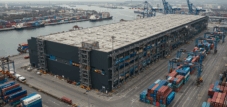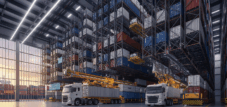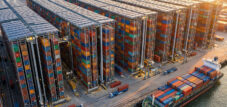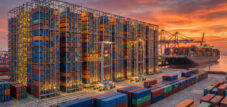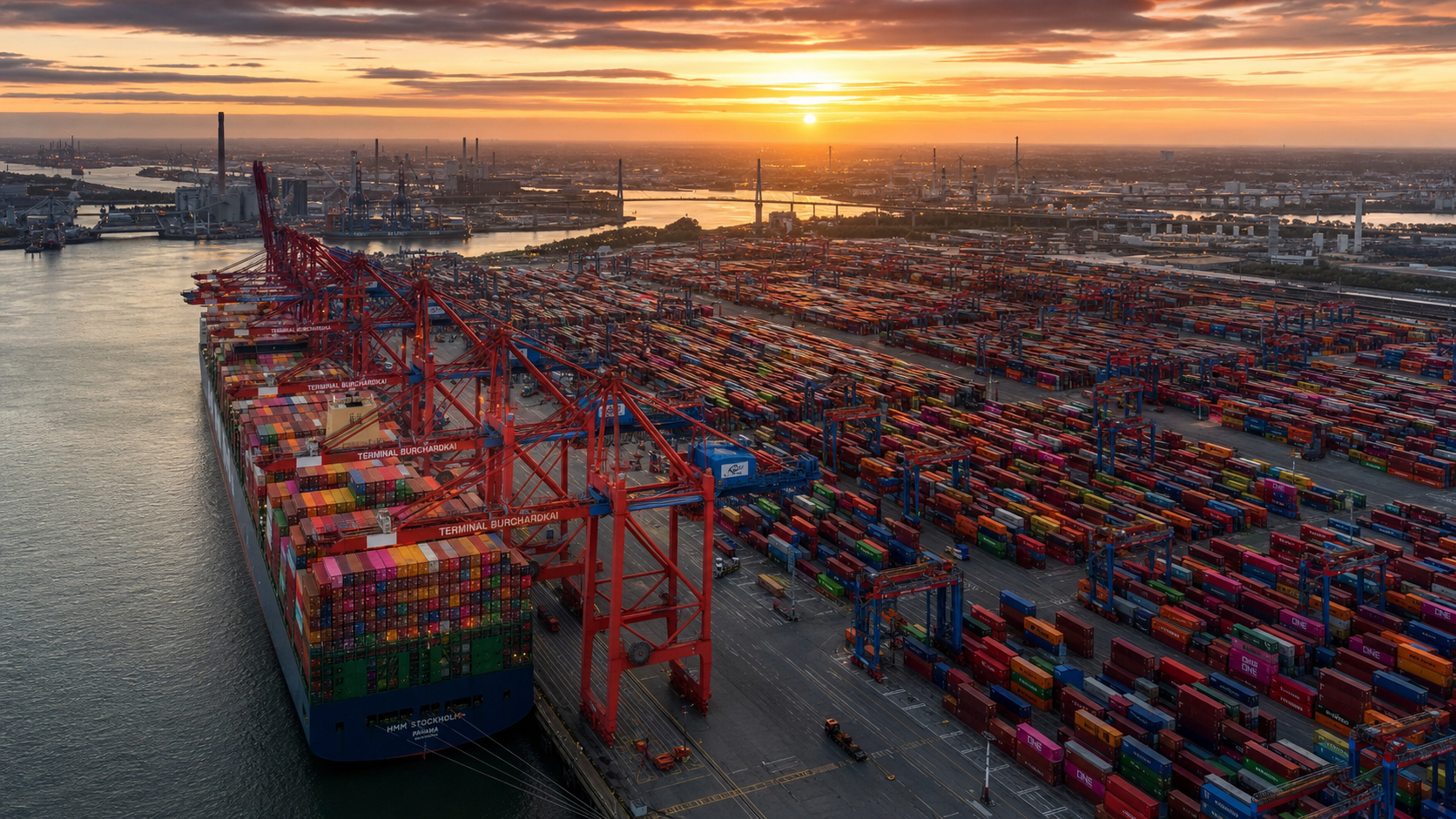
The simple steel box: Without it, the economy collapses – The incredible story of the unassuming steel box – Image: Xpert.Digital
A truck driver's ingenious idea: How a 6-meter box sparked globalization 60 years ago
How the container cost millions of jobs and liberated world trade: Why the unassuming container system is now suddenly reaching its limits
Over half a century ago, a converted freighter carrying 58 iron boxes left the port of Newark – and changed world history forever. It was the radically simple idea of an American truck driver that sparked globalization: the invention of the standardized shipping container. This unassuming steel box made our modern mass consumption possible, revolutionized global value chains, and simultaneously destroyed millions of traditional port jobs. Today, 60 years after the arrival of the first container ship in Germany, the system faces its next major transformation. Digitization, geopolitical crises, massive structural overcapacities, and the immense pressure to decarbonize are putting the shipping industry under immense pressure. A journey through the history, present, and future of a standardized box without which our modern economy would simply collapse.
Sea freight: The steel box that reshaped the world: A revolution sailed into the belly of a ship
On the surface, it wasn't a particularly dramatic moment: On May 5, 1966, the "Fairland," belonging to the American shipping company Sea-Land, docked in Bremen's overseas port, one of many merchant ships that called at German ports daily. But what this ship was carrying was no ordinary cargo. On board were standardized steel boxes, so-called containers, and their arrival marked the beginning of an economic revolution that has since fundamentally and permanently altered the entire architecture of global trade.
Burkhard Lemper, Managing Director of the Institute of Shipping Economics and Logistics (ISL) in Bremen, succinctly summarized the historical significance: It marked the start of international container shipping in Europe and thus the beginning of one of the most consequential economic transformations of the post-war era. Hardly any technological advancement in the history of transport has left a greater mark on national economies, labor markets, urban structures, and global supply chains in such a short period of time.
To understand the economic rise of the container, one must first grasp how the global trading system functioned before its introduction—or rather, how inefficient it was. In conventional breakbulk cargo handling, each item of goods was brought on board and stowed individually. Sacks, crates, barrels, and loose goods had to be loaded pallet by pallet, sack by sack, by dozens of dockworkers in a laborious, time-consuming, and physically demanding manual process. Unloading a single breakbulk ship could take days, sometimes even weeks. The result was exorbitant layover times, enormous costs due to damage and theft, and a structural impediment to the growth of international trade.
The birth of the system: A truck driver rethinks logistics
It is one of the most remarkable innovation stories of the 20th century that the revolution in global trade did not originate with a shipping consortium, a government, or a research institution, but with a truck driver from North Carolina. Malcolm McLean – sometimes spelled Malcom – was frustrated as a freight forwarder by the time wasted during transshipment at the port and came up with a radically simple solution: instead of carrying the goods into the ship's hold, lift the entire transport unit – the crate – onto the ship.
On April 26, 1956, McLean's first container ship, the converted "Ideal X," left the port of Newark, New Jersey, with 58 stackable steel containers on board, bound for Houston, Texas. The result was clear: instead of the usual $15,000, the entire port stay cost just $1,600—a cost saving of approximately 90 percent compared to the conventional method. The US authorities, initially reserved about the new type of ship, abandoned their reservations after the successful trial voyage. In North America, the container age thus began about ten years earlier than in Europe.
What made McLean's idea a systemic breakthrough wasn't just the steel box itself – transport boxes had existed in various forms for centuries. The crucial factor was standardization. The standardized containers were stackable and could be transported by ships, trains, and trucks alike, enabling for the first time a seamless, intermodal flow of goods without transshipment. The 20-foot container became the standard: 6.10 meters long, 2.44 meters wide, and 2.60 meters high – the physical formula for globalization.
Germany as an early receiver: Bremen and its pioneering role
When the "Fairland" docked in Bremen in May 1966, Germany became the second European port, after Rotterdam, to adopt this new mode of transport. Shipboard cranes had to lift the containers onto trucks, as a dedicated container crane was not yet available in Bremen's overseas port. However, the port operators reacted swiftly: construction of Bremen's first container crane began as early as 1967 – that colossal steel structure which has since become an iconic feature of modern container terminals.
The introduction of container cranes marked a significant leap in handling performance. Research data shows that container ports were able to accelerate cargo handling by a factor of 18 compared to traditional breakbulk methods. Ships were now processed in days instead of weeks. The economic implications of this efficiency gain can hardly be overstated: faster turnaround times meant higher ship utilization, lower capital costs, more reliable supply chains, and ultimately, more affordable goods for consumers worldwide.
The race for the new technology rapidly and permanently transformed the German port landscape. While the old Bremen overseas port – not deep enough for the ever-larger container ships and lacking open space for container storage – lost relevance and was finally closed in 1991, the deep-draft port of Bremerhaven emerged as the true winner of containerization. In 2025, Bremerhaven recorded a throughput of 4.9 million TEU, an increase of 10.3 percent compared to the previous year, thus confirming its position as one of the leading container ports on the North Sea.
The economic leverage effect: transport costs, globalization and value chains
No other single factor has reconfigured the economic geography of the 20th and 21st centuries as significantly as the decline in transport costs resulting from containerization. What was long perceived merely as an increase in engineering efficiency in port operations turned out to be a fundamental economic structural shift: where transport costs fall, location decisions for production, storage, and distribution shift globally.
The scientific findings are unequivocal: Without the massive efficiency and cost advantages of the container system, the globalization of recent decades would not have been possible in its current form. In the words of economic historians, the container is a direct midwife of globalized capitalism. It enabled the spatial decoupling of production and consumption on a continental and ultimately intercontinental level. Companies could now produce where labor costs, raw materials, or regulatory frameworks were most advantageous because transportation costs no longer dominated the cost structure.
This connection is particularly evident in Asia's rise to become the world's dominant manufacturing hub. Between 1970 and 2023, global sea freight volume increased sixfold – growth inextricably linked to the expansion of Asian export capacities and the integration of these economies into global value chains. World trade reached a record high of US$32 trillion in 2022, and more than 80 percent of all goods traded worldwide are transported by sea, measured by weight. In 2024, ports worldwide handled a total of approximately 920 million TEUs, representing a 6.9 percent increase compared to the previous year – in German seaports alone, this figure reached around 15 million standard containers in 2025.
The human price of efficiency: Port work in structural change
The economic success of the container has a dark side that is often overlooked in the euphoric narrative of modernization: the profound transformation of the world of work in ports and port districts worldwide. While containerization has provided billions of consumers with cheaper goods, it has destroyed a considerable number of the very jobs on which the old general cargo system was based.
Before containerization, a general cargo ship was a mass employer in the literal sense: unloading a 5,000-ton freighter required around 60 men working for a week. The container crane accomplished the same work with a fraction of the workforce in a fraction of the time. Unions in the US—where containerization began earlier—therefore put up fierce resistance to the new technology for years, well aware that it structurally undermined the bargaining power of dockworkers.
The demographic shift in the affected neighborhoods was undeniable. Shorter layover times meant sailors had less time ashore, which fundamentally altered social and economic life in port districts from Hamburg to Liverpool to New York. Abandoned docks became open spaces and ultimately sought-after urban development land. In Hamburg, the historic Speicherstadt (warehouse district) lost its original function as a storage facility for bulk goods and was designated a protected monument in 1991 – an architectural relic of a pre-industrial trading era that the container had definitively ended.
The employment effects can still be empirically observed today: Over the past four decades, port work has been dramatically transformed by containerization, digitalization, and automation. Fewer employees now handle more goods than ever before. While new job profiles have emerged—container crane operators, van carrier operators, logistics coordinators—the overall level of port employment has declined, while cargo volumes have risen rapidly. This contradiction between technological progress and job losses is a structural constant of the container age.
The market structure: Oligopolization among a few giants
While the container as a physical object is decidedly egalitarian – any shipping company can, in principle, load the same standardized box onto its vessel – the capital intensity of the container business and the persistent pressure to scale over decades have led to extreme market concentration. Today, a small handful of shipping companies control the lion's share of global container capacity.
At the top is the Geneva-based Mediterranean Shipping Company (MSC), which overtook the Danish industry leader Maersk in terms of capacity at the beginning of 2021 and, with a total fleet capacity of over six million TEU, is significantly ahead of Maersk, which follows with four million TEU. Behind it is the French company CMA CGM, then the Chinese company COSCO, and in fifth place, Hamburg's flagship shipping company, Hapag-Lloyd. This level of concentration – de facto an oligopoly of a few super-corporations – is the result of decades of mergers, acquisitions, and strategic alliances, all following the same pattern: whoever builds larger ships can transport goods more cheaply and put competitors under price pressure.
The parallel consolidation in the logistics services industry illustrates the same trend. In September 2024, the Danish group DSV signed an agreement to acquire Deutsche Bahn's logistics division, Schenker, for a transaction value of €14.3 billion. This deal was officially completed on April 29, 2025. The combined group now employs almost 160,000 people and generates pro forma revenue of approximately 310 billion Danish kroner. The merged company, DSV/Schenker, now unites ocean freight services, air freight, contract logistics, and multimodal transport solutions under one roof – an integrated response to the changing competitive landscape.
LTW Intralogistics Solutions

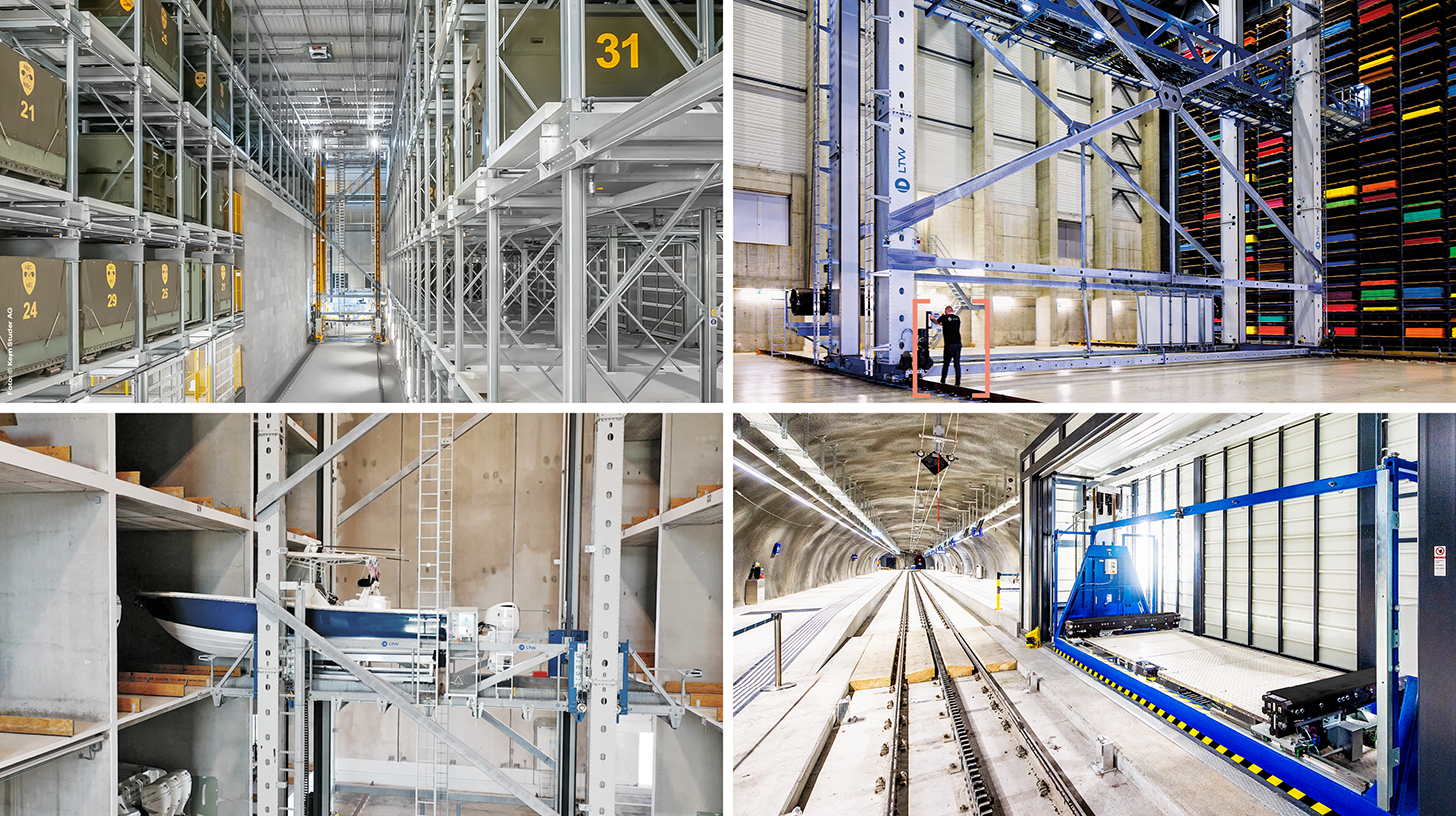
LTW Intralogistics – Engineers of Flow - Image: LTW Intralogistics GmbH
LTW offers its customers not individual components, but integrated complete solutions. Consulting, planning, mechanical and electrotechnical components, control and automation technology, as well as software and service – everything is networked and precisely coordinated.
In-house production of key components is particularly advantageous. This allows for optimal control of quality, supply chains, and interfaces.
LTW stands for reliability, transparency, and collaborative partnership. Loyalty and honesty are firmly anchored in the company's philosophy – a handshake still means something here.
Related to this:
Smart Containers: How IoT is revolutionizing logistics and making supply chains more secure
Smart boxes: The container as a data provider in the digital age
Although the basic technical concept of the container – a standardized steel box – has remained unchanged for 60 years, the container is currently undergoing a fundamental transformation in another dimension: its ability to generate and transmit data. What was previously a passive transport object is becoming, under the concept of the smart container, an active node in the digital nervous system of global supply chains.
Hapag-Lloyd is an international pioneer in this area. Germany's largest container shipping company began equipping its fleet with IoT (Internet of Things) devices in August 2022 and, according to its own figures, has now equipped over 85 percent of its dry container fleet – more than 1.6 million units – with solar-powered GPS tracking devices that transmit their location every 15 minutes. In addition to position, the installed sensors also record vibrations, ambient temperature, and other condition parameters, which are transmitted to a cloud platform via mobile networks. According to the company, the investment amounts to several hundred million euros over several years.
The operational benefits are immediate: Logistics group DSV/Schenker reports that predictability in supply chains has increased significantly thanks to smart containers – especially for sensitive and high-value goods, where real-time transparency has become a decisive competitive factor. Arrival times can be predicted more precisely, delays communicated early, and route deviations detected. Particularly during the geopolitically volatile periods of recent years – the Red Sea crisis being a prime example – this informational advantage has been of immediate economic value to shippers and freight forwarders.
At the same time, the material requirements for the physical containers themselves are changing. The rapidly increasing transport of lithium batteries – as a raw material for the global shift to electromobility – is creating new safety requirements: Due to the fire risk, the demand for containers with integrated fire protection and fire extinguishing systems is growing significantly, even though this market segment is still in its infancy.
Structural overcapacities: The shipping companies' growth model is coming under pressure
Container shipping currently finds itself in a paradoxical situation: While global container throughput continues to grow, the business model of the major shipping companies is under considerable structural pressure. The fundamental problem is an unparalleled mismatch between fleet capacity and demand growth.
The long order books that shipping companies built up during the high-interest periods of the coronavirus crisis, when freight rates multiplied and profit margins soared to historic highs, are now causing structural overcapacity in the industry. Between 2019 and 2026, the global container fleet will grow by 46 percent, according to calculations by the Danish maritime consultancy Bimco, while global freight volume will increase by only about 22 percent during the same period. This means that supply is growing more than twice as fast as demand. This order backlog of approximately 5.9 million TEU is met by a mere 2.6 million TEU of ships, many of which are over 20 years old and ready for scrapping.
The financial consequences are exemplified by Hapag-Lloyd's results: While the company closed fiscal year 2025 with increased transport volumes of 13.5 million TEU, the average freight rate fell by 8 percent to US$1,376 per TEU. EBIT plummeted by 61 percent from US$2.8 billion in 2024 to just US$1.1 billion in 2025 – despite a slight increase in total revenue to US$21.1 billion. More containers for less money: That's the concise formula of the current market environment.
Nevertheless, the container shipping system continues to prove remarkably resilient overall. A recent PwC study of German ocean-going shipping companies found that 93 percent of the companies have their ships fully utilized and 58 percent expect further growth over the next twelve months. Even the weak economy in Germany, according to the industry, is barely impacting maritime transport – seven out of ten shipping companies state that their business is practically no longer, or only minimally, dependent on German production.
Geopolitics on the water: The Red Sea as a disruptive factor and a reflection of system weakness
The vulnerability of the container system as the backbone of global trade was brutally exposed by the Red Sea crisis between 2023 and 2025. Attacks by Yemeni Houthi rebels on merchant ships in the critical strait between the Arabian Sea and the Suez Canal forced major shipping companies to completely change their routes: instead of using the shorter Suez Canal corridor, ships now took the much longer detour around the Cape of Good Hope.
The economic consequences were significant: In 2024, container traffic through the Suez Canal plummeted by approximately 90 percent. Freight rates on the key Shanghai-Rotterdam route rose by around 80 percent between 2023 and 2025. Ships rounding the Cape of Good Hope required approximately ten additional days for the passage between Asia and Europe, leading to increased fuel consumption, higher insurance premiums, and a de facto reduction in available cargo capacity—precisely during a period of structural overcapacity in the fleet. For the Suez Canal, a crucial source of foreign currency for Egypt, this resulted in a revenue collapse from US$2.4 billion in the third quarter of 2023 to US$880 million in the fourth quarter of 2024.
This episode demonstrates how fragile the seemingly unshakeable infrastructure of global trade is in the face of geopolitical disruptions. The shipping container has connected the world, but it has also made it dependent: dependent on a few critical waterways, on a handful of megaports, on the political stability of entire regions. If even one of these bottlenecks becomes blocked, supply chains on multiple continents feel the effects within weeks.
Climate change and decarbonization: The biggest challenge since McLean
Sixty years after the arrival of the "Fairland" in Bremen, container shipping faces perhaps its greatest structural challenge since the invention of the container itself: decarbonization. According to current estimates, the maritime industry is responsible for about three percent of global greenhouse gas emissions, with container shipping alone emitting around 740 million tons of CO₂ annually through its use of heavy fuel oil.
The International Maritime Organization (IMO) has set itself the ambitious goal of reducing greenhouse gas emissions by 50 percent by 2050 and lowering CO₂ intensity by 40 percent by 2030. In parallel, the EU Green Deal is intervening in the industry with its "Fit for 55" package of measures. However, transforming the propulsion systems of a global megafleet of several thousand ships is a monumental task in terms of technology, logistics, and finance.
The industry is reacting, albeit hesitantly. In 2024, 69 percent of all new orders in the container sector were for ships that can run on alternative fuels – with LNG (liquefied natural gas) representing the dominant bridge to fossil-free propulsion at 67 percent of alternative orders. Methanol and ammonia are also gaining importance as future fuels. However, according to a Deloitte analysis, up to 50 percent of currently operating container ships could still be using fossil fuels until 2050, as a large proportion of the fleet is still relatively new.
The overall economic costs of decarbonization are calculable, but substantial: Fraunhofer calculations show that emission-free container freight rates will be between 5 and 24 percent higher than conventional rates, depending on the route length. Extrapolated to the EU economy, this would mean that import prices would rise by around 0.07 percent of consumer prices in the long term – a moderate but real burden that will particularly affect price-sensitive goods.
Outlook: Between Growth and Maturity
Burkhard Lemper, the Bremen-based ISL researcher, describes the current phase of containerization with analytical objectivity: Containerization as a process is largely complete. The double-digit growth rates of container traffic that characterized the system in its early decades are a thing of the past. Lemper anticipates annual growth rates of between three and five percent under normal circumstances – a level of maturity that structurally resembles that of an economy entering its phase of normal development after the initial surge of industrialization.
The RWI/ISL Container Throughput Index showed a significant increase to 137.5 points in July 2025, signaling a surprising resilience of the global container system despite the increased US tariffs. Los Angeles and Long Beach – the most important US import ports – even recorded an all-time high of almost two million TEU in July 2025. This suggests that companies brought forward imports to anticipate tariff increases – a short-term buffer, but one that does not indicate any long-term structural change in trade.
There are currently around 35 million shipping containers in circulation worldwide. If they were lined up end to end, they would reach halfway to the moon. These figures encapsulate the entire story of an invention that began with a simple, ingenious idea from an American truck driver and permanently reshaped the world. The Bremen overseas port, where the "Fairland" first docked in 1966, no longer exists. Where dockworkers once hauled sacks and barrels, residential buildings with waterfront views now stand. The revolution triggered by the container has left its mark on the built environment – and on the constructed order of the global economy, which would be inconceivable without it.
Consulting - Planning - Implementation

Konrad Wolfenstein
I would be happy to serve as your personal advisor.
You can contact me at wolfenstein∂xpert.digital or
Just call me on +49 7348 4088 965 .
Your container high-bay warehouse and container terminal experts
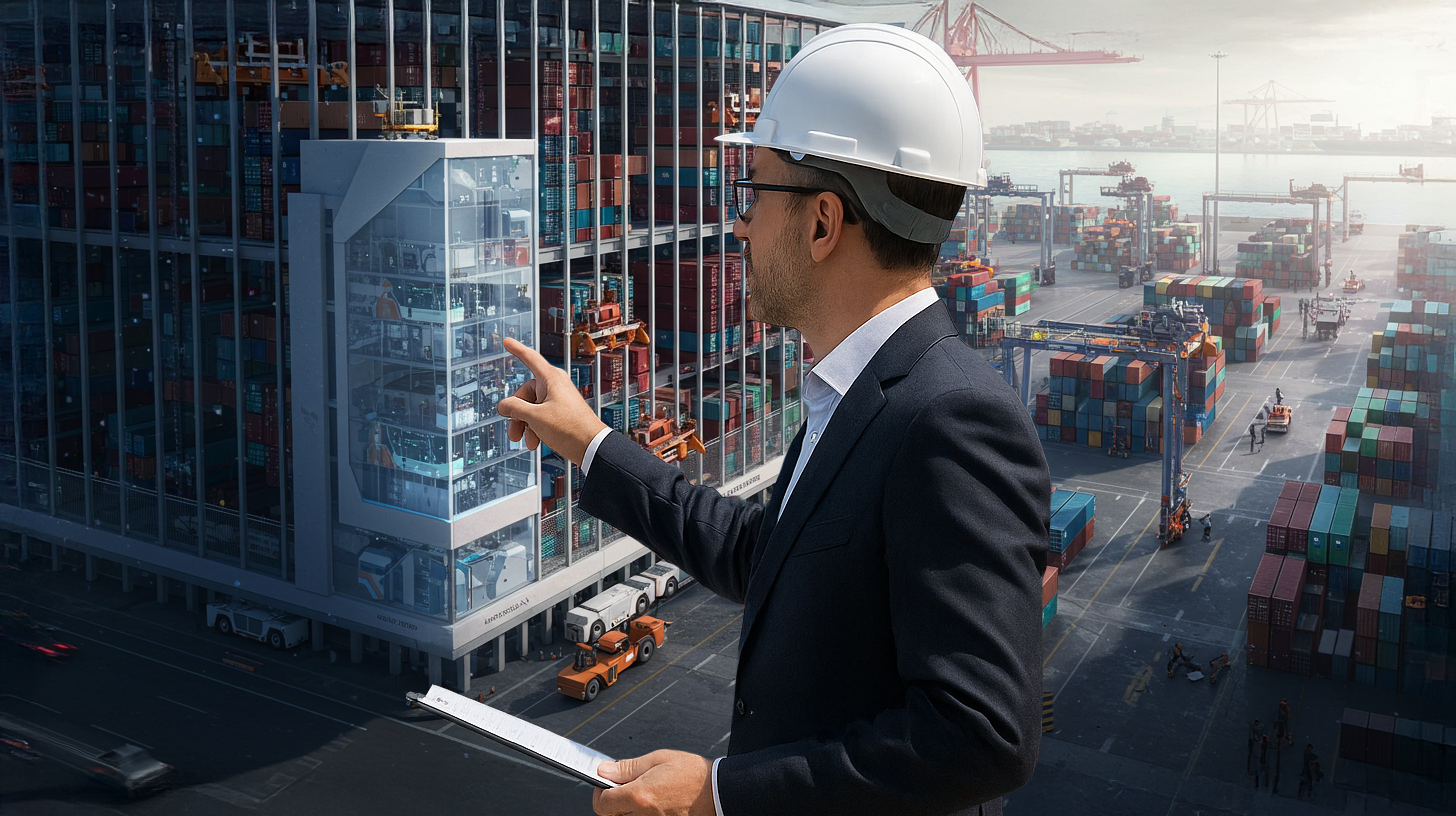
Container high-bay warehouses and container terminals: The logistical interplay – expert advice and solutions - Creative image: Xpert.Digital
This innovative technology promises to fundamentally change container logistics. Instead of stacking containers horizontally as before, they will be stored vertically in multi-story steel racking structures. This not only allows for a drastic increase in storage capacity within the same area, but also revolutionizes all processes at the container terminal.
More information here: