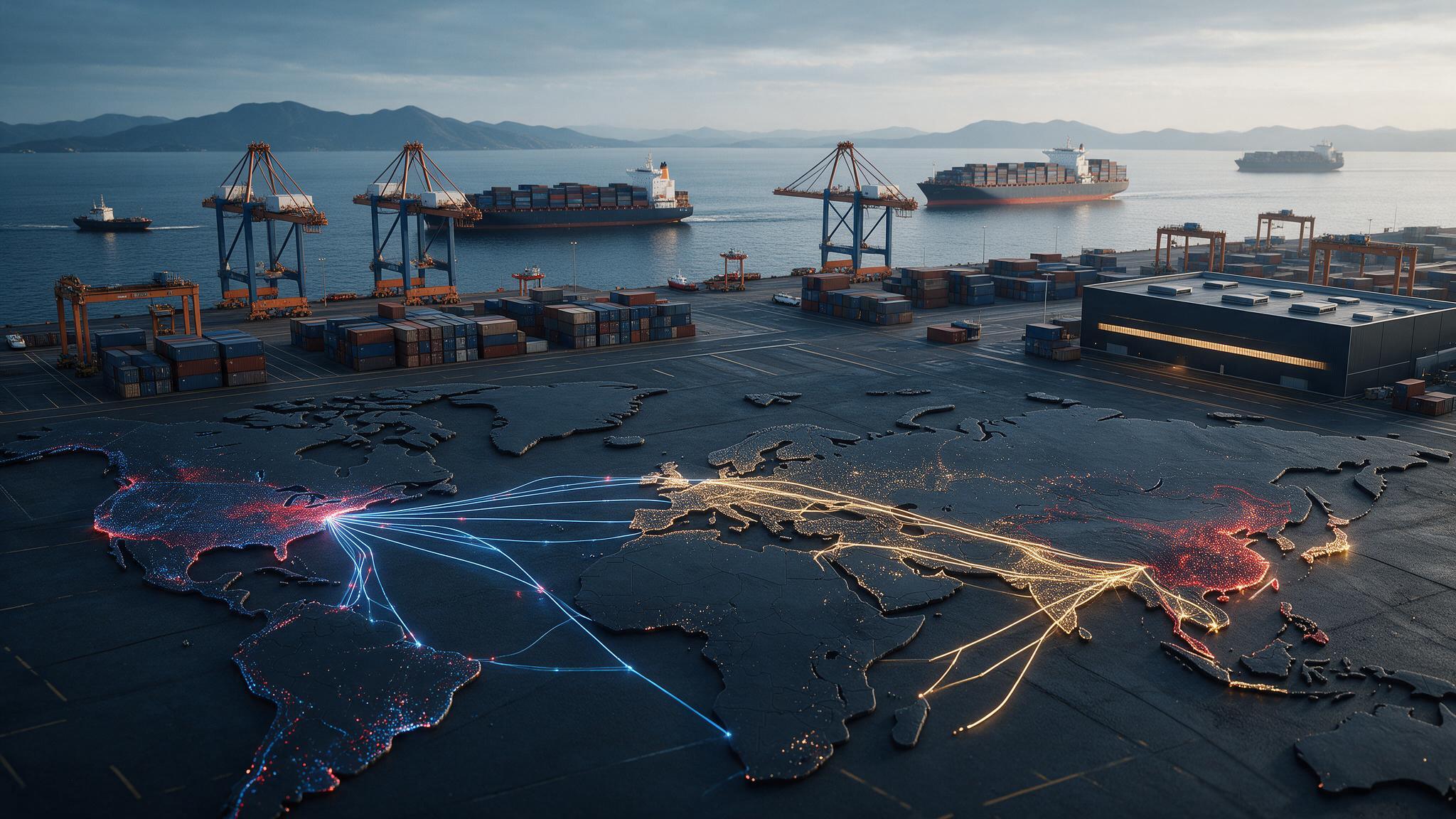
The Great Tariff Illusion: Why the US-China trade war isn't destroying supply chains (but rather lengthening them) – Creative image on the topic, created with AI: Xpert.Digital
The new world map of production: Why tariffs don't bring factories home – but send them on detours
Caught in the grip of the superpowers: What the trade war really means for Europe's industry
Are multinational corporations the winners? Who really benefits from the trade war between the US and China?
The trade conflict between the US and China is often perceived as a direct duel that will inevitably split the global economy into two isolated blocs. But this view is too simplistic. Instead of a simple economic decoupling, we are currently witnessing a complex geographical realignment of global production. Tariffs and trade barriers don't simply bring factories back to their home countries – they make supply chains longer, more expensive, and more opaque.
While multinational corporations leverage their global presence as a buffer and third countries like Mexico and Vietnam emerge as new hubs, companies in the middle of the value chain often get caught in the crossfire. Tariffs imposed on intermediate goods quickly reverse their intended purpose of protection and burden domestic industries. This article examines the true winners and losers of the new tariff policy and demonstrates why the real currency in modern global trade is not the height of the tariff barrier, but rather the sheer adaptability of a company's own production network. This is a wake-up call – especially for Germany and Europe as economic hubs, whose resilience will determine their industrial future.
The trade war relocates factories – but it doesn't divide the world
Tariffs don't destroy supply chains – they make them longer, more expensive, and more opaque
The trade conflict between the US and China is often described as a duel between the two largest economies. Economically, this view is too narrow. Tariffs don't just affect the companies whose products are directly burdened at the border. They alter prices, sources of supply, sales markets, investment decisions, and location strategies along entire value chains. A component can be considered a manufacturer's finished product in one country, become an intermediate product in a second, and, after several further processing steps, be sold in a third market. A bilateral trade barrier therefore generates multilateral consequences.
The crucial development is not a complete decoupling of the US from China, but rather a geographical reorganization of production. Direct trade flows are being partially replaced by indirect relationships. Companies are relocating individual manufacturing steps to Mexico, Vietnam, or other third countries, but continue to source components, machinery, or materials from China. The visible country of origin of a product is changing faster than the origin of its added value. Statistically, direct trade between the US and China is declining, while economic interdependence persists through intermediaries.
The consequences for third countries are contradictory. Some locations gain production, exports, and investments because Chinese goods become relatively more expensive on the US market. Others lose orders because their components were previously part of American or Chinese export products. Companies in middle production stages are particularly vulnerable: They bear higher costs for affected intermediate products and simultaneously suffer from declining demand from their customers. Those with international subsidiaries, alternative suppliers, and multiple sales markets, on the other hand, can react more quickly and gain market share.
The trade war thus does not create a simple map of winners and losers. It rewards adaptability, existing industrial capacities, and access to both economic areas. At the same time, it increases the costs of global trade and makes supply chains more politicized. The new competition for business locations is decided less by low wages alone than by infrastructure, trade agreements, legal certainty, industrial networks, and the ability to absorb additional production at short notice.
A tariff dispute is leading to a reassessment of global production
The first phase of escalation began in 2018 with several waves of additional US tariffs on Chinese goods. China responded with retaliatory tariffs on American products. Within a short time, a large portion of bilateral trade was subject to additional duties. The average US tariff on Chinese goods, weighted by imports, rose from 2.7 percent to 13.8 percent between the beginning of 2018 and the end of 2019. China's corresponding tariff on US goods increased from 5.3 percent to 16.2 percent. These averages reflected significantly higher or lower rates depending on the product category.
It is noteworthy that both countries pursued different approaches towards third countries. The US slightly increased its average tariffs on goods from other countries from 1.2 to 1.5 percent, including measures on steel, aluminum, solar panels, and washing machines. At the same time, China lowered various most-favored-nation and preferential tariffs. The average Chinese tariff on products from third countries fell from 2.6 to 2.1 percent. This not only shifted the relative competitive position of Chinese and American suppliers but also presented producers from Europe, Asia, Latin America, and other regions with new opportunities or new competition.
Tariffs operate through two fundamentally different channels. A tariff on a finished or directly traded product alters that product's competitive position in the target market. A tariff on intermediate goods, on the other hand, increases production costs in the importing country. For a factory that sources electronic components, specialty chemicals, or metal parts from abroad, an intermediate goods tariff is economically similar to an additional production tax. It can negate the perceived protection of domestic manufacturers if these manufacturers themselves rely on imported inputs.
The crucial analytical error, therefore, lies in considering only the directly protected industry. A steel tariff might help a domestic steel producer but burden machine manufacturers, vehicle producers, and construction companies. A tariff on Chinese electronics might displace Chinese finished products from the US market but simultaneously increase production costs for American companies that use Chinese components. The overall economic impact results from the sum of these opposing effects, not from the visible success of individual protected companies.
Millions of business locations reveal the movement behind the trading data
A particularly comprehensive empirical study reveals these shifts at the company level. The data basis encompasses the 50 largest economies by purchasing power parity-adjusted economic output, including the USA and China, as well as 48 third countries. For 2018, the balanced dataset contains approximately 7.7 million business locations; for 2022, this figure rises to about 10.8 million. It records public and private companies, their locations, industries, employment, revenues, and ownership structures. Among them are subsidiaries of more than 200,000 multinational corporations.
The study combines this company data with detailed customs information at the product level and with input-output tables. This makes it possible to distinguish whether an industry is affected by tariffs on its own products or by tariffs on the intermediate products it uses. Additionally, the position of an industry within the value chain is determined. A raw material or basic material producer is located near the top, a manufacturer of finished consumer goods near the bottom, while component suppliers and specialized processors are often in the middle.
Methodologically, the changes between 2018 and 2022 are compared. The study examines whether sectors with higher tariff burdens fared differently in terms of revenue, employment, or number of establishments compared to less affected sectors. Among other factors, tariff changes vis-à-vis third countries and the respective trade barriers imposed by the US and China on the country under consideration are monitored. This approach allows for a significantly more precise analysis than simply examining national export statistics.
However, correct interpretation is crucial. The results measure average reactions across many countries and industries. They do not mean that every company in Mexico or Vietnam automatically benefits from US tariffs, or that every European company loses out due to Chinese retaliatory tariffs. Location, ownership structure, product type, supplier network, capital intensity, and position in the value chain significantly alter the impact. This very heterogeneity is a key finding: the trade war does not distribute opportunities and burdens evenly, but rather concentrates them on specific companies and production stages.
Why US tariffs draw production to third countries
US tariffs on Chinese goods worsen their price position compared to similar products from countries not subject to the same tariffs. For an American importer, an identical or sufficiently similar product from Vietnam, Mexico, or Malaysia becomes more attractive. This trade diversion can initially be achieved by increasing the utilization of existing factories. If the new demand persists, investments, additional shifts, new supply contracts, and potentially new factories will follow.
Multinational companies are particularly quick to react. A Chinese corporation with an existing subsidiary in Southeast Asia doesn't have to reinvent its entire production process. It can relocate orders, machinery, personnel, final assembly, or quality control within its corporate group. Similarly, American and European corporations can supply a US customer previously supplied from China from a different plant. The advantage lies not only in lower tariffs but also in existing management structures, supplier relationships, financing options, and certifications.
The empirical results show correspondingly clear positive effects of US tariffs on the sales of multinational subsidiaries in third countries. For purely domestically operating companies, the reaction is considerably weaker and often statistically ambiguous. The trade war thus does not automatically benefit the local small and medium-sized enterprises (SMEs) of the host country. A significant portion of the adjustment takes place within global corporate networks. Production relocates without necessarily transferring ownership, technology, or strategic control to the host country.
This also explains why trade diversion can be more than just the transit of goods. If only finished Chinese products are forwarded via a third country, hardly any additional value is created there. However, if assembly, processing, testing, packaging, or parts manufacturing are relocated, local production and employment increase. In practice, the line between genuine industrial relocation and minimal change of origin is fluid. Rules of origin, local value-added shares, and customs inspections are therefore becoming key factors in the new competition between production locations.
Why Chinese retaliatory tariffs drag third countries down with them
At first glance, China's tariffs on US goods appear to create a mirror-image effect: American products become more expensive in China, meaning suppliers from third countries should gain market share. In some sectors, this is precisely what is happening, for example, when agricultural products or standardized industrial goods are easily substituted. On average, however, the tariffs have a negative impact on the production of multinational companies in third countries. This apparent asymmetry can be explained by the structure of global value chains.
Many US exports are not exclusively American products. A vehicle assembled in the US might contain engine components from Germany, electronics from Japan, wiring harnesses from Mexico, specialty steels from Europe, and software from several countries. If Chinese retaliatory tariffs reduce sales of this vehicle in China, not only will final assembly in the US decrease, but demand for complementary components from third countries will also decline. Suppliers will lose orders, even though their own products may not be directly affected by any Chinese tariffs.
This complementarity effect is particularly strong when suppliers are closely integrated into customer-specific production systems. A standardized component might be sold to other customers. However, a specially certified gearbox, a customized control unit, or a module developed solely for a specific model cannot be redirected in the short term. The loss of one end market then impacts an entire chain of specialized producers.
Furthermore, American goods that lose competitiveness in China can shift to other markets. There, they increase competitive pressure on local or European suppliers. From the perspective of a third country, two burdens thus occur simultaneously: it loses demand as a supplier of American exports and encounters additional US supply in other markets. The result is not a general advantage from the loss of a competitor, but rather a complex redistribution of demand and price pressure.
Tariffs imposed on inputs reverse the principle of protection against one's own industry
Tariffs on intermediate goods are particularly problematic from an economic perspective because they not only affect foreign suppliers but also alter the cost structure of domestic processors. If China imposes additional tariffs on American inputs, Chinese producers who require these intermediate goods become less competitive. Suppliers in third countries can then gain market share, provided they produce comparable end products or host alternative production sites of multinational corporations. This mechanism explains the positive effects of Chinese tariffs on US intermediate goods on third countries.
Conversely, US tariffs on Chinese inputs burden American manufacturers. If Chinese electronics, chemicals, machine parts, or metal products become more expensive, the costs of American finished products rise. This can also affect companies in third countries whose components are processed together with American intermediate goods or whose sales depend on the competitiveness of US end manufacturers. In the data examined, higher US tariffs on Chinese inputs are associated with lower sales of multinational subsidiaries in third countries.
This illustrates why the political rhetoric of protection and punishment is often misleading. A tariff is legally levied upon import, but economically it is distributed along the supply chain. Depending on their market power, importers, producers, retailers, and consumers bear different shares of the burden. In the first phase of the trade war, US tariffs were largely passed on to consumers through higher import prices. Chinese exporters did not lower their prices nearly enough to offset the tariffs. A significant portion of the burden thus remained with American companies and buyers.
This creates a conflict of objectives for industrial policy. Tariffs on finished products from competitors can generate additional demand for individual domestic producers. However, tariffs on intermediate goods often weaken the competitiveness of the very industrial base that is intended to be strengthened. The more complex a product and the more international its bill of materials, the greater this risk. A trade policy that classifies industries solely by their finished products underestimates dependence on imported inputs and can transform protection into a cost shock.
🎯🎯🎯 Data-driven B2B industry hub as a quasi-in-house solution


The quasi-in-house solution: How Xpert.Digital closes operational gaps in B2B marketing and sales – Smart Content-Driven Business - Image: Xpert.Digital
Xpert.Digital is a data-driven B2B industry hub led by Konrad Wolfenstein . The company acts as an external, quasi-in-house solution for industrial partners, closing operational gaps in marketing, content, and sales – without requiring additional resources on the client side.
More information here:
The role of third countries in the US-China trade conflict
Multinational corporations become shock absorbers and centers of power
Only a small proportion of all recorded production sites belong to multinational companies. In 2018, this figure was around six percent at the plant level. Nevertheless, these corporations bear the brunt of the geographical adjustment. They can shift production between subsidiaries, reorganize internal supply chains, serve sales markets from other plants, and concentrate investments where market access and cost structure appear most favorable. National companies have significantly fewer options.
The reaction is primarily taking place within existing networks. Revenues are changing more clearly than employment and the number of production sites. This suggests that corporations will initially adjust the capacity utilization of existing plants, shift delivery volumes, and repurpose existing capacities. A new factory requires land, permits, machinery, qualified personnel, and often several years of lead time. Relocating production within an existing corporate network, on the other hand, can be done much more quickly.
Chinese multinational companies are reacting particularly strongly. Their share of intra-group connections with third countries rose from 0.9 to 1.5 percent between 2018 and 2022. The starting point was low, but the relative increase was considerable. At the same time, the share of Chinese owners in subsidiary relationships within China increased significantly. This points to a two-pronged strategy: stronger domestic integration and parallel expansion of selected foreign locations.
For host countries, this development is ambivalent. Foreign investment brings capital, jobs, export volume, and often modern production processes. At the same time, a highly integrated corporate structure can bypass local suppliers. The sustainable benefits depend on whether a location has access to local skilled workers, research, logistics, energy, financing, and competitive suppliers. Only when a more dense industrial ecosystem develops from relocated assembly will lasting value creation occur. Otherwise, the country remains an interchangeable export platform whose attractiveness is primarily based on tariff differences.
Mexico and Vietnam unite the rivals instead of dividing them
Mexico and Vietnam are considered particularly visible beneficiaries of trade diversion. Both countries combine cost-effective or competitive production with strategic access to the US market. Mexico also benefits from geographical proximity, short transport routes, and the North American trade agreement. Vietnam offers an established export industry, growing electronics and textile clusters, and a favorable position within Asian supply networks.
The term "winner," however, should not be confused with economic independence. Many Vietnamese export products contain Chinese components, machinery, or materials. Chinese companies are also investing in Mexico to serve the North American market more closely. This partially replaces direct US imports from China with a chain in which Chinese intermediate goods or capital enter the US market via a third country. The connection becomes longer and less transparent, but not completely severed.
These so-called transit countries have real opportunities. Additional demand can accelerate industrialization, create jobs, and build local expertise. Vietnam shows signs in strategic industries that it has not only redirected goods but also created additional domestic value. However, this success is not automatically transferable to every country. It requires reliable infrastructure, available personnel, a competitive energy supply, functioning ports, and an administration capable of swiftly implementing investments.
At the same time, political vulnerability is growing. If the US introduces stricter rules of origin, anti-circumvention checks, or tariffs against suspected diversionary locations, the competitive advantage could quickly diminish. Transition countries must therefore offer more than just a new shipping label. They need an increasing share of local value creation, traceable supply chains, and their own technological capabilities. Only then will short-term trade diversion translate into sustainable industrial development.
The middle of the value chain is caught in a squeeze
The greatest net losses are not necessarily concentrated at the beginning or end of the production chain, but often in its middle stages. These are the locations of specialized manufacturers of components, assemblies, materials, and industrial services. They are simultaneously buyers of international intermediate goods and suppliers to other producers. As a result, the trade conflict affects them on both sides of their calculations.
When the prices of imported inputs rise, production costs increase. If, at the same time, a major customer in China or the USA loses competitiveness, sales decline. The supplier often cannot pass on the higher costs in full because its customers are also under pressure. Its margin shrinks, investments are postponed, and unused capacity is created. Companies with customized products, high certification costs, and few major customers are particularly vulnerable.
In contrast, the most upstream industries can benefit from a broader demand base. Raw materials, basic materials, or standardized industrial inputs can often be sold to multiple customers and regions. At the very end of the chain, producers of finished goods can gain market share if a Chinese or American competitor becomes more expensive due to tariffs. The data therefore show more favorable overall effects for the most upstream and most downstream sectors than for moderately downstream intermediate stages.
For company analysis, a country-specific perspective is therefore insufficient. The crucial factor is the specific position within the production network. Two companies in the same country and broadly within the same industry can experience opposing effects. A manufacturer of end devices might gain US market share, while its local component supplier loses out because it is more heavily reliant on Chinese customers. Strategic risk analyses must therefore be conducted at the product, customer, and bill of materials levels.
Regional averages obscure winners and losers
Asia and North America outside of China and the US were particularly hard hit in the first phase of the trade war. This is not surprising: Both regions are closely integrated into the production networks of the conflicting parties. In Asia, new export opportunities coincide with a strong dependence on Chinese intermediate goods and Chinese demand. In North America, Mexico combines the advantages of US market access with risks stemming from new political scrutiny and a high degree of dependence on the American economy.
Europe exhibits a smaller net effect on average, but even this average is not very reassuring. Positive and negative effects partially cancel each other out. European subsidiaries can benefit from the replacement of Chinese suppliers in the US market. At the same time, European suppliers lose out if American end products are less in demand in China or if US manufacturers lose competitiveness due to expensive Chinese inputs. A nearly neutral overall effect therefore does not signify stability, but can be the result of significant opposing shifts.
Significant differences also exist between industries. Electronics, mechanical engineering, automotive, chemicals, metals, and consumer goods each react differently because tradability, capital intensity, product standardization, and supply chain structures vary. Countries with an existing comparative advantage in an affected product can absorb new demand more easily. Capital-rich locations tend to benefit more in capital-intensive industries because machinery, skilled workers, and financing are readily available. A tariff alone does not create industrial expertise but often reinforces existing locational advantages.
The regional assessment must also differentiate between sales, employment, and new businesses. Additional sales can result from higher capacity utilization and productivity without a proportional increase in new jobs. Automated factories can handle large export increases with limited staff expansion. Conversely, labor-intensive industries can create jobs more quickly but generate less local value added. Therefore, from an economic policy perspective, it is not only whether exports increase that matters, but also what income, technologies, and supply relationships they generate within the country.
Germany and Europe can only win with their own industrial strength
For Germany and the European Union, the rivalry between the US and China presents selective opportunities. European manufacturers can position themselves as alternative suppliers in both markets, provided their products are not themselves subject to new trade barriers. Technological advantages exist, particularly in machinery, specialty chemicals, industrial measurement technology, automation, and high-quality components. At the same time, Europe is heavily dependent on both economic regions: on China as a sales market and source of supply, and on the US as a market, technology partner, and source of security.
The greatest danger, therefore, lies in a forced bloc decision. A complete decoupling from China would cause high procurement and sales costs for many European industries. However, maintaining this dependence would also be risky, particularly with regard to critical raw materials, batteries, electronics, solar technology, and selected intermediate products. The sensible strategy is not a blanket decoupling, but rather a targeted reduction of one-sided dependencies.
Diversification takes time and money. An additional supplier must be technically qualified, audited, and contractually integrated. Tools, certifications, and logistics processes must be adapted. For highly specialized components, switching suppliers can take years. Companies should therefore not only consider the current purchase price but also factor in the expected total damage from a failure, a sanction, or a sudden tariff increase. Redundancy is then not waste, but a form of insurance.
Europe can improve its position by deepening the single market, accelerating permitting processes, limiting energy and infrastructure costs, and expanding trade relations with multiple regions. Agreements with high-growth third countries are not merely export policy but also a component of industrial resilience. At the same time, the EU should prevent disparate national subsidies from fragmenting the single market. A piecemeal subsidy race will not counter the economies of scale enjoyed by the US and China; what is needed is a reliable European framework for investment, energy, data, capital, and trade.
Companies need a map of their dependencies
The most important operational consequence is that the origin of a direct supplier is insufficient to assess geopolitical risks. A European supplier may itself be heavily dependent on Chinese materials. A Mexican factory may process core Chinese components. A seemingly American product may have a high proportion of foreign intermediate goods. Companies therefore need transparency at least down to their most important sub-suppliers and critical raw materials.
A robust strategy begins with segmentation based on economic criticality and replaceability. Standard parts with multiple suppliers don't require expensive redundancy. However, redundancy makes sense for components with long lead times, high certification hurdles, or only one source of supply. The key is not maximizing the number of suppliers, but avoiding common failure causes. Two suppliers in the same industrial park, at the same port, or with the same raw material source do not constitute true diversification.
The production network should also be managed as a portfolio. Plants differ in terms of costs, market access, currency risk, political stability, energy supply, and proximity to customers. Multinational companies fared better during the trade war primarily because they were able to shift orders between existing locations. This flexibility doesn't just emerge during a crisis. It must be prepared through compatible machinery, transferable product data, uniform quality standards, and well-trained contingency processes.
At the same time, resilience should not be confused with complete regionalization. A purely national supply chain can be particularly vulnerable in the event of local energy crises, natural disasters, or labor disputes. International diversification can reduce risks, as long as it is not dependent on a single political corridor. The economically sensible solution is usually a combination of regional proximity for critical and time-sensitive components and global sourcing for standardized inputs and specialized technologies.
Industrial policy must consider networks rather than individual factories
For governments, the domino effect offers a fundamental lesson: tariffs cannot be precisely limited to a single foreign producer. They alter the behavior of importers, suppliers, subsidiaries, and competitors in many countries. A measure can benefit a visible domestic industry while simultaneously burdening less visible downstream sectors. Policy assessments should therefore consider input-output interdependencies, employment, consumer prices, investment, and potential countermeasures together.
Targeted protective measures can be justified for security reasons, for example, when critical capabilities, militarily relevant technologies, or vital supplies are affected. However, security objectives should be explicitly stated and defined as narrowly as possible. Broad tariffs are a crude instrument. They increase costs even where there is no strategic dependency and create incentives for circumvention. Procurement standards, warehousing, investment promotion, research policy, or coordinated export controls are often more effective.
Third countries also need a more sophisticated strategy than simply attracting foreign assembly plants. Tax breaks can attract investment in the short term, but in the long run, skilled workers, ports, power grids, digital administration, legal certainty, and local suppliers are crucial. Public funding should be tied to training, research, local procurement, and verifiable value creation, without creating inefficient forced localization. The goal must be a self-sufficient industrial ecosystem.
At the international level, the global trade order remains important, even if it cannot eliminate political rivalry. Reliable rules reduce uncertainty and facilitate long-term investments. Where multilateral agreements are unattainable, plurilateral agreements for specific technologies, raw materials, or environmental goods can provide stability. The more transparent rules of origin, subsidies, and safety exemptions are, the lower the risk that companies will build costly capacities based on short-term political signals.
The data points in a certain direction, but not as to a final world order
The study, covering the period from 2018 to 2022, offers an exceptionally broad view of the first phase of the trade war, but it has limitations. The comparison is essentially based on two points in time. This makes long-term adjustments visible, while short-term fluctuations and the precise timing are captured less accurately. Furthermore, part of the study period coincides with the pandemic, which massively impacted production, trade, and location decisions. Extensive controls can reduce this overlap, but not eliminate it entirely.
The company data used covers millions of operating sites, but it is not a perfect global census. Revenues, employment, and ownership structures may be captured with varying degrees of completeness depending on the country. Furthermore, the classification of products by industry and the calculation of indirect tariffs require assumptions. The results are therefore best understood as robust patterns: multinational companies react more strongly, US and Chinese tariffs produce different effects on third countries, and position in the value chain is crucial.
Furthermore, trade policy has evolved since the first escalation phase. Traditional tariffs are now complemented by export controls, investment screening, subsidies, local production requirements, and technology restrictions. These instruments function differently than a simple price surcharge at the border. An export control can completely prevent a shipment, while a subsidy creates new capacity, and a tariff primarily alters relative prices. The next phase of the restructuring will therefore be more strongly influenced by technology, capital, and security regulations.
Nevertheless, the central insight remains valid. Political barriers do not simply dissolve international production networks. Companies circumvent, shift, replace, and extend connections. The visible map of trade changes faster than the invisible structure of technology, capital, and intermediate goods. Therefore, those who only look at bilateral import figures may observe an apparent decoupling, even though the indirect dependency persists.
The real winner is adaptability
The trade war between the US and China has not ended global supply chains, but rather restructured them. US tariffs on Chinese goods open up sales opportunities for third countries because companies are shifting production and export platforms. Chinese retaliatory tariffs on US products can burden these same third countries if their intermediate goods complement American exports. Tariffs on intermediate goods generate further repercussions because they increase the costs of domestic industries and affect related locations abroad.
The winners are therefore not automatically specific countries, but primarily companies and regions with existing industrial infrastructure. This includes spare capacity, a skilled workforce, reliable energy, efficient logistics, access to trade agreements, and a network of local suppliers. Multinational corporations possess a structural advantage because they can shift production within existing subsidiaries. National companies only benefit more significantly once they are integrated into these new networks.
For Europe and Germany, the challenge lies in reconciling openness with risk management. Neither a naive return to the old globalization nor costly isolationism is convincing. Companies must recognize critical dependencies, qualify alternative sources of supply, and make production sites more flexible. Policymakers must shape infrastructure, energy, capital markets, research, and trade relations in such a way that industrial adaptation in Europe remains economically viable.
The provocative conclusion is this: tariffs don't simply bring production home. They send it on detours. These detours can bring investment and employment to individual third countries, but often increase transport, control, and coordination costs. They create new dependencies, while old ones only partially disappear. The global production apparatus doesn't become more nationalized as a result, but more complex. Therefore, what matters is not who erects the highest tariff barrier, but who possesses the most adaptable production network.
📈🚀 From visibility to trust 👀🤝 Your scalable path with Xpert.Digital


From visibility to trust: Your scalable path with Xpert.Digital - Image: Xpert.Digital
In industrial B2B, sustainable business relationships rarely emerge overnight. They develop step by step – through visibility, professional relevance, recurring touchpoints, and growing trust. Xpert.Digital's 4-stage model addresses precisely this: It offers a structured path that begins with a manageable entry point and can evolve into deeper collaboration in business development if needed.
Instead of relying on loud marketing promises, this model puts the relationship at the forefront. Companies start with clearly defined, easily calculable measures and then decide, based on their own experience, how far they want to expand the collaboration. A key factor for this undisturbed trust-building process: The platform completely avoids annoying advertising ads, so the editorial focus remains solely on the companies' expertise.
More information here:
Your global marketing and business development partner
☑️ Our business language is English or German
☑️ NEW: Correspondence in your native language!

Konrad Wolfenstein
I and my team are happy to be available to you as your personal advisor.
You can contact me by filling out the contact form here wolfenstein@xpert.digital:or simply call me at +49 7348 4088 965. My email address is
I'm looking forward to our joint project.