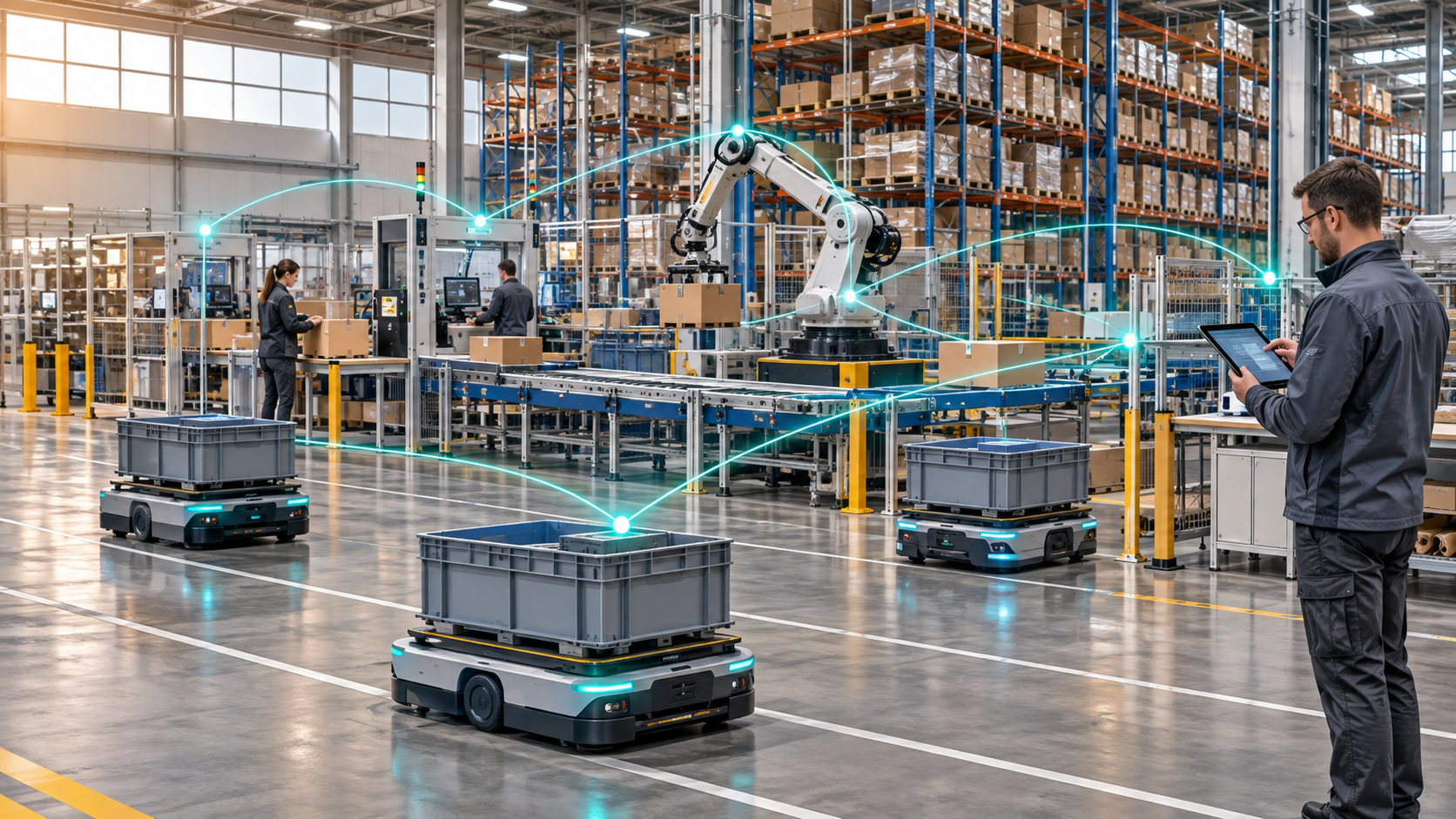
The intelligent distribution center: Why control will determine competitiveness in the future – Creative image on the topic, with AI: Xpert.Digital
The warehouse of the future: Why more robots alone are not enough
Warehouse automation: How technology becomes a real competitive advantage
Pick faster, deliver later? The costly mistake of many warehouses
Robots, conveyor systems, and intelligent software are transforming work in distribution centers. But more automation doesn't automatically translate into lower costs or faster deliveries. If individual areas move ever-increasing volumes of goods, but downstream processes can't keep pace, new bottlenecks emerge instead of genuine productivity gains. The crucial factor, therefore, is how well technology, employees, data, and processes interact. This article shows what companies should consider when modernizing their warehouses – from selecting suitable systems and realistically calculating profitability to data security, energy consumption, and the role of personnel. Ultimately, competitive advantage doesn't come from having as many robots as possible, but from a distribution center that reliably and economically aligns its resources with the entire flow of goods.
Those who only automate faster will, in the worst case, produce faster downtime
The future of the distribution center is not determined by the number of robots installed, the length of a conveyor system, or the maximum speed of a sorting system. What matters is whether a company can coordinate its flow of goods, inventory, employees, and technical equipment in such a way that reliable, deliverable orders are generated from existing resources. Automation remains an important component in this process. However, its economic value is only realized when the individual components function as a cohesive operating system.
This shifts the benchmark for investments in intralogistics. The primary goal is no longer the maximum performance of a single machine, but rather an economically viable overall process: from goods receipt through storage and order picking to on-time handover to transport. A highly productive picking area is of little use if packing stations are overloaded, supplies are lacking, or completed shipments miss their scheduled departure time.
The distribution center of the future should therefore be understood less as a collection of automated islands. It is a networked decision-making system that continuously links physical processes with business objectives. Its efficiency arises from the interplay of mechanics, software, data quality, and human expertise. The key economic question is no longer solely which activities can be technically automated. It is which combination of automation and control intelligence will sustainably reduce the cost per reliably fulfilled customer order.
The economic pressure arises from conflicting demands
Distribution centers must fulfill multiple objectives simultaneously, which often conflict with each other during operation. Customers expect short delivery times, high availability, and reliable commitments. At the same time, companies want to limit their inventory, use space efficiently, and control personnel costs. Additional items, diverse sales channels, and fluctuating order structures further increase the coordination effort.
This situation becomes particularly challenging when a single location serves multiple business models. Supplying branches with larger packaging units follows different processes than shipping individual items to end customers. Urgent spare parts require different prioritization than planned replenishment deliveries. Returns must be inspected, assessed, and, if necessary, restocked. The sheer number of orders processed daily is an inadequate representation of this complexity.
Cost pressures are also increasing the pressure to act. In Germany, average labor costs in the manufacturing and service sectors amounted to €45.00 per hour worked in 2025. This was 3.6 percent higher than the previous year and around 29 percent higher than the EU average at that time. These macroeconomic figures are not specific inventory costs, but they illustrate the importance of carefully utilizing available working time. For a concrete investment calculation, location-specific total costs must be considered.
An automation strategy focused solely on staff reduction falls short. Equally relevant from an economic perspective are unfilled shifts, lengthy training periods, avoidable searches, and additional work due to errors. The benefits of an improved organization can lie in handling higher volumes with the same team, managing peak workloads, and reducing quality issues. Productivity, therefore, does not necessarily mean fewer employees, but rather, first and foremost, more usable output from the resources employed.
The robotics boom proves demand, but not yet profitability
The growing importance of automated goods movements is evident in the development of service robotics. In 2024, approximately 102,900 professional service robots were sold worldwide in the transport and logistics sector. This represents a 14 percent increase compared to the previous year. More than half of the professional service robots recorded were used in this application area. The category primarily includes mobile systems for the transport and handling of goods.
These figures demonstrate the significant changes in the technological foundation of intralogistics. However, they do not prove either the complete automation of warehouse operations or a uniform economic success of the installed systems. Service robotics statistics are based on collected supplier data and should not be equated with a complete count of all warehouse robots deployed worldwide. Similarly, a growing sales volume does not directly imply a specific return on investment.
For operators, this leads to a sobering conclusion: The widespread adoption of a technology indicates its practical relevance, but it does not replace an independent economic analysis. An autonomous mobile robot can effectively handle a long, regularly recurring transport route. However, the same robot can be economically disappointing if it frequently waits for available transfer points or primarily travels short distances with low utilization.
It is not the movement itself that creates value, but its integration into a necessary process. Automated transport is particularly valuable when it relieves a bottleneck, reduces physically demanding tasks, or reliably secures a time-critical connection. A machine that merely transports existing clutter through a building more quickly, on the other hand, does not necessarily improve the bottom line.
Why local peak performance can weaken the overall system
A common problem with automation decisions is the isolated consideration of individual functional areas. Receiving, warehousing, order picking, packing, and shipping are each given their own performance targets. Every department tries to improve its key performance indicators. However, what seems sensible locally can lead to additional waiting times and higher inventory levels in the overall process.
A simplified example illustrates the relationship. Let's assume the order picking department can process 1,200 order items per hour, while the downstream packaging department, under the same conditions, can only handle 900 items. Further increasing the picking capacity does not initially increase the shipping throughput. Instead, it exacerbates the backlog before packaging. Additionally, it ties up space, containers, and transport capacity.
Under these assumptions, a coordinated release of work is often more valuable than further accelerating the upstream process. The control system must determine how much material the downstream system can actually handle. Only then should it release further orders or redistribute resources.
The bottleneck is not necessarily always in the same place. In the morning, incoming goods can limit the available stock, at midday order picking, and in the late afternoon shipping processing. Product structure, staffing levels, and departure times all affect the effective capacity.
The economic goal is therefore not to fully utilize every machine at all times. A deliberately maintained capacity reserve can be beneficial if it cushions short-term peaks in demand. The crucial factor is whether the overall system fulfills customer orders with minimal waiting time, rework, and unnecessary capital commitment.
Operational intelligence bridges the gap between plan and reality
Planning describes how a distribution center should operate under expected conditions. Operational control, on the other hand, must deal with the conditions that actually occur. A delayed goods receipt, a broken workstation, or an unexpected surge in orders can quickly invalidate a seemingly sound daily plan.
Operational intelligence means recognizing such changes in a timely manner, assessing their impact, and initiating appropriate measures. Simply displaying current data on a screen is not enough. A comprehensible decision-making process must exist between perception and action.
A concrete example is prioritization before a fixed shipping departure. The system must not only identify which orders are urgent, but also check whether the required items are available, whether supplies can be provided in time, and whether packaging capacity is available. Otherwise, orders might be expedited that are no longer achievable in terms of completion.
An economically sound management approach therefore distinguishes between urgency and actual controllability. It concentrates scarce resources where intervention can still alter the outcome. At the same time, it considers the consequences for other projects.
Real-time processing is not an end in itself. A technical fault message may need to be processed within seconds. In contrast, a personnel transfer between departments might be more appropriate at longer intervals. The crucial factor is a response speed that suits the specific process. More data and more frequent interventions don't automatically improve operations if they merely create disruption.
Software should connect responsibilities, not create additional silos
The technical foundation of an intelligent distribution center consists of several interconnected software functions. A warehouse management system, often referred to as a WMS, manages, among other things, inventory, storage locations, and orders. A warehouse control system, or WCS, coordinates automated systems and material movements. An execution level, often called a WES, can coordinate priorities, work releases, and resource allocation across departments. However, the specific functional boundaries vary depending on the vendor and system architecture.
From an economic perspective, it's not crucial whether a company procures three separate products. What matters is whether the necessary tasks are covered seamlessly. If existing systems already adequately handle operational coordination, an additional software layer can create unnecessary complexity. Even execution system providers point out that a separate WES is unnecessary if its functions are already available in other systems.
A viable architecture therefore requires clear responsibilities. Which system maintains the binding inventory? Who is authorized to approve orders? Which authority decides in the case of competing priorities? How are feedback reports processed if a connection is temporarily down?
Unclear answers not only cause technical problems. They also complicate troubleshooting and increase the cost of later changes. If multiple systems independently optimize the same process, conflicting decisions can arise.
The best architecture is therefore not necessarily the one with the most features. It is the one whose responsibilities, interfaces, and fallback mechanisms are well-suited to operations. Integration means not just data exchange, but a coordinated decision-making logic.
Real-time transparency is only as valuable as the underlying data
A control center displaying up-to-date key performance indicators (KPIs) can give the impression of complete control. In reality, its reliability depends on whether the displayed data is complete, timely, and technically accurate. A physically present item is of little use if it has been booked to the wrong storage location. Similarly, digitally available inventory is problematic if it is actually damaged or blocked.
Data quality must therefore be understood as a business responsibility. This includes unambiguous master data for articles, reliable dimensions and weights, correct packaging hierarchies, and traceable status messages. Especially in automated systems, faulty master data can directly translate into malfunctions.
An incorrectly entered weight, for example, can lead to unsuitable handling. Inaccurate dimensions affect storage location selection, container occupancy, and packaging decisions. Missing information about blocked stock levels can result in orders being released that cannot be fully processed.
The economic damage is not solely caused by the original error. It also includes search efforts, interruptions, manual clarification, and potentially a missed shipping deadline. These consequential costs often remain invisible in traditional performance reports.
Companies should therefore make data quality measurable. Relevant metrics include the frequency of inventory discrepancies, the number of manual corrections, and the processing time for unresolved cases. A modern distribution center doesn't need as much data as possible, but rather reliable information with a clear meaning.
The investment calculation must reflect the entire life cycle
Automation projects are often compared based on purchase price and expected personnel savings. This perspective is too narrow. A sound evaluation must consider all significant cash flows over the intended usage period.
The initial investment includes not only the technology itself, but also software, interfaces, structural modifications, fire protection measures, training, and commissioning. In addition, there are internal project hours and potential productivity losses during the transition. Especially at existing sites, integration into ongoing operations can account for a significant portion of the total cost.
During operation, costs arise for maintenance, spare parts, energy, licenses, technical support, and security measures. Software updates and adaptations to new product structures must also be considered. A solution that initially appears inexpensive can become costly if every expansion requires complex custom programming.
The benefits extend beyond just avoided working hours. Also relevant are additional manageable orders, fewer errors, less damage, shorter lead times, and avoided external storage space. However, these advantages cannot be multiplied. If an increase in productivity is already valued as a reduction in personnel costs, it cannot simultaneously be fully monetized as additional capacity.
Particular caution is required regarding the impact on revenue. Increased technical capacity only generates additional contribution margin if there is actually corresponding demand. A plant does not earn money from theoretically possible orders. Economic benefit only arises from realistically usable output.

Expert partner in warehouse planning and construction

The importance of investment appraisal in automation
A transparent calculation example demonstrates the limitations of simple amortization targets
The extent to which the assessment depends on the assumptions can be demonstrated using a purely hypothetical example. A distribution center invests five million euros in automation and software integration. After ramp-up, annual gross cost savings of one million euros are expected. Additional operating costs amount to 250,000 euros annually.
This leaves an annual net effect of €750,000 before taxes and financing. Under these assumptions, the simple amortization period is approximately six and a half to seven years. However, this calculation does not take into account the timing of the payments, any potential residual value, or the uncertainty of the expected benefits.
If the benefits are lower or the ramp-up takes longer, the result worsens. Conversely, avoided expansion projects or actually achieved additional contribution margins can improve profitability. It is crucial to report such effects separately and not include them in the calculation as a general future expectation.
Equally important is the distinction between freed-up working time and saved expenditures. When employees take on other tasks, a valuable capacity effect may occur. However, a direct reduction in personnel costs only occurs when corresponding expenditures are actually eliminated or avoided.
The investment decision should therefore include several scenarios. A baseline scenario describes realistic expectations, a stress scenario anticipates lower volumes or higher costs. A growth scenario shows how additional demand would affect the project. This reveals whether a project is only viable under favorable conditions or remains sustainable even with deviations from these conditions.
Flexible capacity has a value beyond average utilization
A distribution center isn't built for a single average day. It must be able to handle seasonal peaks, changing product lines, and shifts in the business model. This results in an economic value of adaptability that is easily underestimated in simple cost comparisons.
Modular solutions allow for a gradual increase in capacity. Additional workstations, vehicles, or storage areas can be added later with appropriate technical preparation. This prevents companies from having to finance a large capacity reserve right from the start.
However, scalability is not an unlimited promise. Additional robots require traffic space, loading capacity, and available transfer points. More picking stations are of no help if warehouse access or packaging is already at capacity. Software and the network must also be able to handle increasing loads.
The economic analysis should therefore differentiate between theoretical expandability and practically usable additional performance. A sound expansion concept describes not only which components can be added, but also what subsequent investments will be required.
Flexibility often comes at an initial cost. Standardized interfaces, reserves in power supply and network infrastructure, or prepared expansion areas may increase the initial investment. However, they can pay off if they enable faster and less disruptive adjustments later on. Their value lies in avoiding rigidity, not necessarily in immediately visible cost savings.
Personnel will not become redundant, but will instead become a bottleneck in a different way
With increasing automation, the importance of human labor is shifting. Repetitive transport tasks and standardized manual operations can be partially automated. At the same time, the demands on maintenance, process understanding, data management, and fault management are growing.
Exceptions remain particularly important. Damaged packaging, unknown product conditions, or conflicting inventory information cannot be resolved simply by speeding up the normal process. A high-performing facility requires employees who can identify the root causes and make informed decisions.
Training must therefore begin early. Explaining a new system only after technical acceptance treats the workforce as an afterthought. It makes more sense to incorporate practical experience into process design from the outset. Employees are often familiar with the deviations that are missing from idealized process descriptions.
Work organization also needs to be adapted. When a small group of technical specialists becomes responsible for a large part of the operation, new dependencies arise. Deputization arrangements, clear documentation, and regular drills then become integral parts of operational safety.
From an economic perspective, a distinction must be made between physical relief and mere intensification of work. Automation can reduce distances and improve ergonomics. However, it can also lead to a higher work rate. It is only sustainable in the long term if the remaining tasks are safe, manageable, and designed in a sound organizational manner.
Resilience requires controlled disruptions rather than promises of omnipotence
A more interconnected system can detect malfunctions more quickly and enable alternative processes. At the same time, closer coupling can lead to individual errors spreading further. Whether automation increases resilience therefore depends significantly on its architecture.
A central failure should not necessarily bring all processes to an uncontrolled standstill. Companies need defined fallback states: Which orders can still be completed? Which assets remain accessible? Which information must be available locally? And how is a consistent state achieved after restoration?
Redundancy should be economically justified. A duplicate design for every component would often be disproportionate. A more sensible approach is to evaluate redundancy based on the extent of damage, the probability of failure, and the restart time. Critical handover points deserve more attention than easily replaceable individual workstations.
Spare parts supply and service concepts should also be considered. High technical availability on paper is of little use if a rarely needed component is unavailable for a long time when needed. Equally important is the question of whether the team itself can resolve minor malfunctions.
Resilience, therefore, does not mean eliminating every interruption. It means surviving disruptions with limited economic damage. A system is robust when its weaknesses are known and its operation remains controllable even under adverse conditions.
Networking increases the benefits and responsibilities for security
The integration of warehouse management, plant control, and external services creates transparency. At the same time, it increases the number of technical access points and dependencies. Therefore, IT security and operational security must not be planned separately.
Operators face practical questions: Who is allowed to access systems remotely? How are permissions granted and revoked? Which systems are allowed to communicate with each other? How can updates be performed without unnecessarily jeopardizing operations?
A particular challenge is the differing lifespans of the components. Mechanical systems can be used for a long time, while software, operating systems, and communication components have different renewal cycles. Therefore, any investment must also include a realistic modernization plan.
Data backup alone is not enough. The crucial factor is whether recovery actually works in an emergency. This requires knowing responsibilities, backup levels, and restart sequences. Even a technically available backup system offers only limited protection if no one has practiced using it.
From an economic perspective, such measures are not merely additional costs. They protect the ability to serve customers and generate revenue. At the same time, security requirements should remain proportionate and be based on the specific risk. The goal is manageable operations, not a theoretically perfect but practically unmaintainable system landscape.
Energy and land area belong in the same productivity calculation
Automation is often evaluated primarily based on labor productivity. However, for location economics, space and energy productivity are also important. Compact warehouse technology can make better use of existing space and postpone building expansion. At the same time, additional drives, charging equipment, and IT systems increase technical energy consumption.
Whether the overall operation becomes more efficient as a result must be examined on a site-specific basis. Higher electricity consumption can be economically justifiable if significantly more orders are processed in the same area. Conversely, an energy-efficient individual component is not automatically advantageous if it causes long waiting times or additional transport.
Therefore, key performance indicators such as energy consumption per shipped unit or space requirements per economically usable storage capacity are meaningful. Here, too, the basis for comparison must be correct. A location with many small individual orders cannot be readily compared to a facility for standardized pallet movements.
Additionally, the temporal profile of energy demand is relevant. Charging processes and simultaneously starting up systems can place demands on the electrical infrastructure. Therefore, an operating concept should consider not only annual consumption but also peak loads.
The ecological and economic assessments can complement each other, but they are not identical. Lower energy consumption is an advantage. Whether a specific investment is ultimately convincing also depends on its lifespan, utilization, maintenance, and the alternatives it avoids.
Artificial intelligence needs clearly defined decision spaces
Artificial intelligence can perform various tasks in a smart distribution center. These could include predicting workload, detecting unusual operating conditions, or suggesting maintenance measures. However, its economic benefit depends on whether it solves a specific decision problem better than existing methods.
Not every operational task requires a learning model. For fixed safety rules or clearly defined dependencies, classical control logic and mathematical optimization may be more suitable. The name of a solution is less important than its demonstrable effect.
Particular caution is advised when a model encounters conditions that differ from its previous data. New products, modified packaging, or a different order profile can limit the reliability of earlier samples. Therefore, a viable application must be monitored and adjusted as needed.
Furthermore, it should remain transparent which decisions may be automated. A recommendation regarding personnel allocation has different consequences than a direct intervention in plant control. The greater the potential for damage, the more clearly approvals, limits, and fallback procedures must be defined.
The long-term goal is not a decision-making world that is as devoid of human input as possible. It is a sensible division of labor: software processes large amounts of information and recognizes patterns, while humans are responsible for goals, rules, and exceptions. Autonomy is therefore a graduated capability, not a general characteristic of the entire site.
The restructuring begins with the order profile, not the technical catalog
A sound economic modernization project begins with an analysis of actual operations. How are orders distributed throughout the day? Which items are frequently ordered together? How significant are the differences in volume and structure between normal operations and peak times? Where do waiting times, errors, and manual interventions occur?
Average values are rarely sufficient. Two locations with identical daily volumes can have very different requirements. One might process a steady stream, while the other handles a large portion of its volume in just a few hours. Equally crucial are item dimensions, packaging units, and the number of items per order.
Based on this, several solution options should be compared. Sometimes fundamental automation makes sense. In other cases, modified storage strategies, improved replenishment planning, or adjusted order release procedures can already achieve significant improvements. Technology should solve a proven problem, not be justified retrospectively.
The implementation should proceed in manageable steps. A clearly defined use case makes it easier to verify assumptions and identify organizational problems early on. At the same time, a pilot project should not be so artificially simplified that it barely reflects the later operational reality.
The transition is particularly important for existing sites. Parallel operation, system conversions, and phased commissioning require dedicated resources. A project plan that only describes the end state underestimates the journey there.
The right key performance indicators (KPIs) link technology with business success
A modern distribution center requires a balanced system of key performance indicators (KPIs). Technical availability and throughput remain important, but are not sufficient on their own. They must be linked to service quality, total costs, and capital commitment.
A key metric is the cost per fully and promptly completed order. This links productivity to the actual customer outcome. Additionally, error rate, lead time, and the number of subsequent interventions are useful indicators. Lead time should not only be considered as an average; particularly long outliers can cause significant problems for customers.
Work in progress also deserves attention. Many started but unfinished orders can indicate poor coordination. A high level of activity across all departments is not sufficient proof of success if backlogs are simultaneously growing.
For investments, a comparison of the originally expected benefits with the actual results is also recommended. Which savings have actually translated into cash flow? Which capacity is being used? What additional costs have been incurred? Only in this way can companies learn from their projects and improve future decisions.
The key performance indicators (KPIs) must not create conflicting incentives. If order picking is measured solely by speed and packaging solely by accuracy, conflicts can arise. A shared focus on successfully completing the order, on the other hand, strengthens the overall system.
The future competitive advantage lies in manageable complexity
The high-performance distribution center of the future is not necessarily the largest, most expensive, or most automated. A location is competitive when it can meet its specific demand economically, reliably, and flexibly.
This requires the collaborative design of people, processes, data, and technology. Real-time transparency provides the foundation, intelligent material flow control translates information into action, and scalable infrastructure keeps development options open. Only their combination enables an operation that not only reacts to changes but also mitigates their consequences early on.
The clear economic perspective is therefore this: companies should not buy as much automation as possible, but rather improve the performance of their overall system. Additional technology is justified where it demonstrably eliminates bottlenecks, increases quality, or creates economically viable flexibility. Where this effect is lacking, even a technically impressive system can tie up capital without correspondingly increasing customer value.
The next stage of intralogistics development is therefore not simply about greater autonomy. It consists of better-founded and faster-implementable decisions. Those who combine planning and actual execution transform a warehouse into a robust component of their competitive strategy. Those who merely accelerate individual movements, on the other hand, risk simply raising existing problems to a higher technical level.
Your intralogistics experts

Consulting, planning and implementation of complete solutions for high-bay warehouses and automated storage systems - Image: Xpert.Digital
More information here:
Your global marketing and business development partner
☑️ Our business language is English or German
☑️ NEW: Correspondence in your native language!

Konrad Wolfenstein
I and my team are happy to be available to you as your personal advisor.
You can contact me by filling out the contact form here wolfenstein@xpert.digital:or simply call me at +49 7348 4088 965. My email address is
I'm looking forward to our joint project.
☑️ SME support in strategy, consulting, planning and implementation
☑️ Creation or realignment of the digital strategy and digitization
☑️ Expansion and optimization of international sales processes
☑️ Global & Digital B2B trading platforms
☑️ Pioneer Business Development / Marketing / PR / Trade Fairs
Our global industry and economic expertise in business development, sales and marketing


Our global industry and economic expertise in business development, sales and marketing - Image: Xpert.Digital
Industry focus areas: B2B, digitalization (from AI to XR), mechanical engineering, logistics, renewable energies and industry
More information here:
A thematic hub offering insights and expertise:
- Knowledge platform covering global and regional economies, innovation and industry-specific trends
- A collection of analyses, insights, and background information from our key areas of focus
- A place for expertise and information on current developments in business and technology
- A hub for companies seeking information on markets, digitalization, and industry innovations