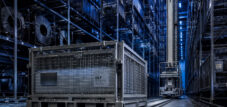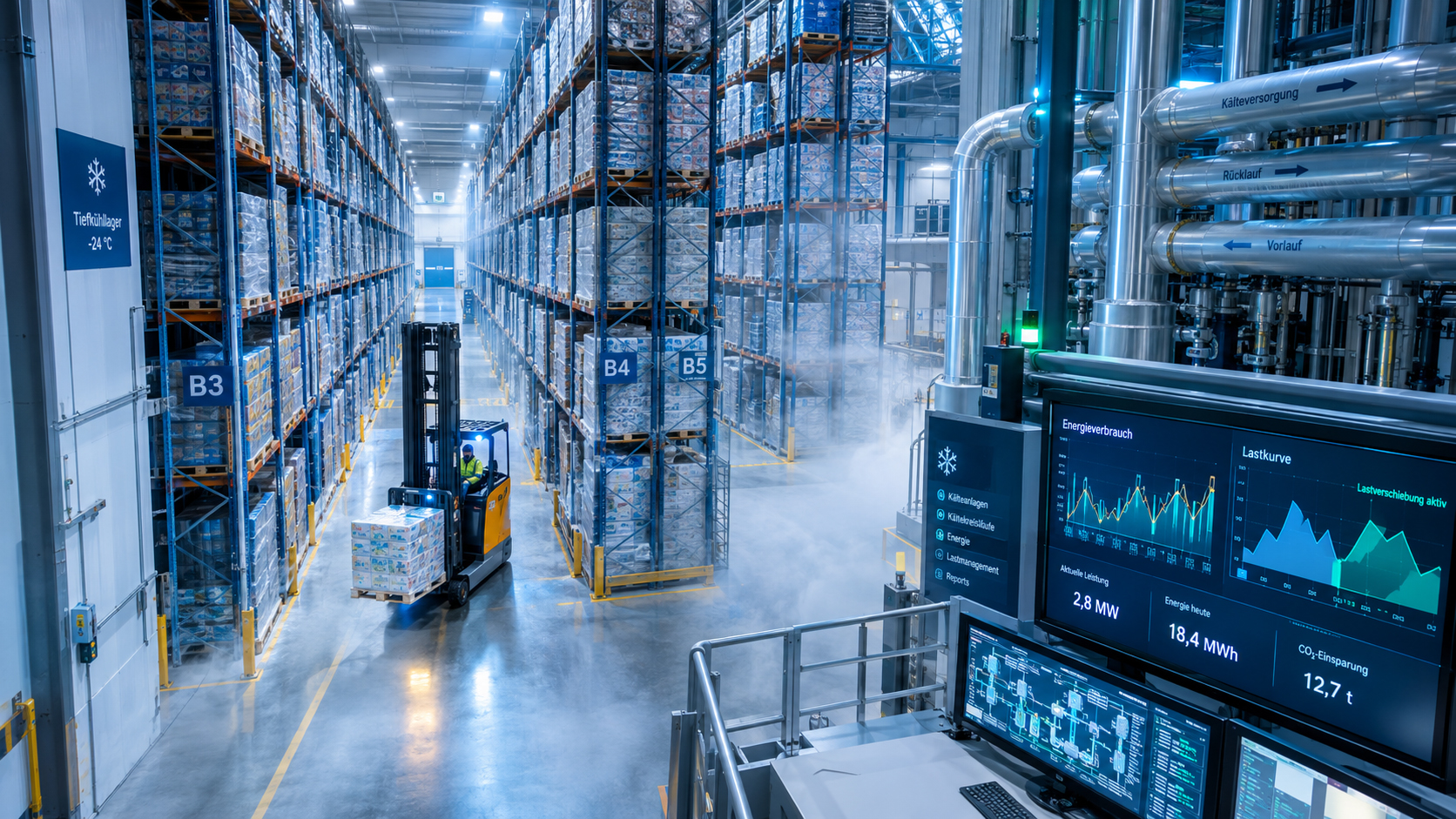
Why cold chain logistics is becoming a game-changer for our network: Sub-zero temperatures with a system – The hidden powerhouse in the high-bay warehouse – Creative image on the topic, with AI: Xpert.Digital
Frozen capital: How intelligent refrigeration systems reduce electricity costs by up to 50%
Cold as an energy storage medium: The underestimated energy miracle of German logistics
How supermarkets and cold storage facilities are beating the volatile electricity market
For a long time, cold chain logistics was viewed in the business world primarily as one thing: a necessary evil and an extremely energy-intensive cost center. However, given exploding energy prices, volatile power grids, and ambitious climate targets, operators of refrigerated and deep-freeze warehouses are now under enormous pressure to adapt. But what if these gigantic refrigeration systems could no longer just passively consume electricity, but instead be transformed into lucrative, active energy assets?
This paradigm shift is currently taking place in the logistics industry. Modern refrigerated and deep-freeze warehouses are being transformed into so-called virtual power plants with the help of intelligent control technology, dynamic electricity tariffs, and the smart use of the stored goods as thermal storage. They relieve the strain on the electricity grid during peak times, absorb surplus renewable energy cost-effectively, and open up entirely new business models for companies.
Read the following article to learn how refrigeration technology, once considered an “energy guzzler,” is becoming a system-relevant lever for the industrial energy transition, why the choice of refrigerant and algorithm determines future competitiveness, and what gigantic flexibility potential still lies untapped in our cold storage facilities.
Why frozen goods are becoming the deciding factor in the energy transition
Refrigeration logistics has long been considered a mere cost factor in the supply chain, a necessary evil for perishable goods. This view is now outdated, as refrigeration systems have long since become an independent energy factor. In Germany, technical refrigeration accounts for an annual final energy demand of approximately 60 to 90 terawatt-hours, which, depending on the year of study and the definition used, corresponds to between 12 and 16 percent of the country's total electricity consumption. This makes refrigeration technology an energy consumer of a comparable magnitude to entire industrial sectors, and it is increasingly moving from the shadow of purely operational cost considerations to the center of companies' strategic energy planning. The food industry's share is particularly striking, traditionally accounting for two-thirds of total refrigeration demand, followed by building air conditioning and other industries. Anyone who takes these figures seriously quickly realizes that refrigeration logistics is no longer just a technical add-on to the supply chain, but a lever with macroeconomic relevance.
The invisible cost block in the daily operations of cold storage facilities
The energy dimension is particularly striking in the practical operation of refrigerated and frozen food logistics facilities. At dedicated frozen food sites, refrigeration often accounts for around 75 percent of total electricity consumption, while at sites handling fresh, non-frozen goods, this figure is approximately 50 percent. Compressors, condensers, and evaporators operate continuously, frequently around the clock, and older, inefficient systems can consume almost twice as much energy as modern, well-regulated systems. The refrigeration system is therefore, in many cases, by far the largest single item in a logistics site's operating costs, often significantly more than personnel, building rent, or material handling equipment. Precisely because margins in refrigerated logistics are traditionally tight, every kilowatt saved becomes a direct competitive advantage, and energy efficiency is no longer merely an ecological benefit, but an economic necessity.
Refrigerant selection as a strategic decision for operators
A key lever for increasing efficiency lies in the choice of refrigerant and system architecture. For large volumes, such as those typical in high-bay deep-freeze warehouses, ammonia is the established standard because central systems using this refrigerant are durable, often operating for twenty years or more, easy to maintain, and particularly energy-efficient at high capacities. Carbon dioxide is gaining importance as a refrigerant because it is suitable for low-temperature ranges and is also regulatory-friendly, while synthetic, fluorinated refrigerants are increasingly restricted by the European F-Gas Regulation. Large logistics companies are therefore systematically converting their existing systems to natural refrigerants such as carbon dioxide and ammonia, with efficiency gains of around 15 percent and CO2 savings of several thousand tons per year per site appearing realistic. This conversion is not merely a technical detail, but a strategic decision with a long-term capital commitment, as the choice of refrigerant determines the operating cost structure and regulatory compliance of a system for decades to come.
Control engineering and plant design as underestimated profit drivers
Besides the choice of refrigerant, control technology plays a crucial role in determining the actual energy efficiency achieved. Variable-speed compressors continuously adjust their output to the actual cooling demand, instead of operating in an inefficient start-stop mode that generates unnecessary peak loads and reduces efficiency. High-speed doors, airlocks, and strip curtains at entrances and exits significantly reduce heat gain through open doors without impeding the flow of goods, while LED lighting with motion sensors in deep-freeze areas not only saves electricity but also reduces the heat load in the warehouse itself. Experts estimate the overall efficiency potential of existing refrigeration systems at up to 30 percent for pure refrigeration applications and even up to 70 percent for combined air conditioning systems, provided that temperature levels, control technology, refrigerant, system type, and thermal insulation are consistently optimized. Crucially, the entire system must be considered, as compressors, fans, heat exchangers, and pumps are in constant interaction, and isolated improvements to individual components can even be counterproductive without holistic coordination.
Cold as a battery: How frozen food becomes an energy storage device
Perhaps the most surprising development of recent years is the realization that refrigeration systems are far more than mere consumers; they are functional energy storage devices. Physically, the temperature of the refrigerated goods can be interpreted as the fill level of a storage unit: if the temperature drops, the storage unit fills up; if it rises again, it empties. This thermal inertia allows the refrigeration process to be decoupled from actual electricity generation, meaning that cooling can be produced precisely when electricity is cheap or in surplus, and the compressor can remain idle during peak hours. A full freezer is particularly thermally inert; the stored goods themselves act as a storage medium, and the colder the storage and the larger the quantity stored, the greater the available buffer capacity. Studies show that a temperature reduction of just one Kelvin in an average-sized cold storage warehouse for chilled goods already corresponds to an energy storage capacity of more than four megawatt-hours, illustrating the enormous storage capacity of even medium-sized systems.
From cost center to virtual power plant
This principle has already been successfully implemented in practice on several occasions. Cold storage facilities in Northern Germany have been integrated into virtual power plants to react flexibly to market conditions. In the event of a temporary surplus of renewable energy, a thermal storage system is built within the cold storage facility, which can be used at a later time. A central cold storage facility in Mannheim is already integrated into an exchange-oriented electricity procurement management system, where electricity procurement is systematically optimized according to spot market prices. Meanwhile, another cold storage facility is preparing to participate in the minute reserve market and must guarantee a four-hour shift in the tendered load. For Schleswig-Holstein alone, the balancing power potential for the cold storage facilities there has been estimated at 25 to 50 megawatts, while a single larger cold storage facility has been identified as having a technically and economically viable load shifting potential of approximately 43 megawatts of electrical capacity. Simulations at the Fraunhofer Institute for Integrated Systems and Device Technology also show that integrating a cold storage system and strategically shifting cooling generation from daytime to nighttime hours can save more than 18 percent of electrical energy costs. These figures prove that cold chain logistics is not just a passive consumer of the energy transition, but can become an active building block for stabilizing volatile power grids.

Expert partner in warehouse planning and construction

Refrigeration technology as electricity storage: This is how companies can drastically reduce their energy costs
Price volatility as a new basis for calculation in refrigeration technology
The economic attractiveness of this flexibility is further enhanced by the increasing volatility of the electricity markets. In 2025, the average price spread on the German day-ahead market was around €130 per megawatt-hour between the cheapest and most expensive hour of the day, which corresponds to approximately 13 cents per kilowatt-hour. In 573 out of 8,760 hours of the year, the wholesale price was even negative. Since October 2025, the day-ahead auction has also been settled in 96 quarter-hour increments instead of 24 hours, further increasing the granularity of potential optimizations. A mathematical operational optimization study within the FlexKälte research project of the Fraunhofer Institute for Environmental, Safety, and Energy Technology examined ten sample locations, including a cold storage facility, a large bakery, a meat processing plant, a supermarket, a hospital, and two data centers. Compared to the standard reference operation, it determined savings in electricity procurement costs of 35 to 54 percent and a reduction in CO2 emissions of 22 to 39 percent. Such magnitudes demonstrate that the intelligent use of price signals is no longer just an academic exercise, but can become a tangible competitive advantage for operators of temperature-controlled warehouses who invest early in control technology and market access.
Technical implementation: Between sensors, algorithm and safety limits
The practical implementation of a price-controlled refrigeration system follows a clear pattern that can be described in five steps. First, the operator needs a dynamic electricity tariff with hourly or quarter-hourly connection to the exchange price, for which a smart metering system is usually required. Next, the permissible temperature range is defined, for example, minus 18 degrees Celsius as the target value for frozen goods with a defined tolerance range above and below this temperature. The day-ahead prices are obtained via a programming interface or the tariff provider and fed into a control logic that uses programmable logic controllers (PLCs), smart home relays, or specialized energy management software to link compressor activation to off-peak hours and block it during peak periods. Crucially, clearly defined safety limits with automatic alarms are always in place to ensure that the cold chain never exceeds the critical upper limit and product safety is never compromised. Increasingly, systems with artificial intelligence are also being used, which create forecasts for the next 24 to 72 hours based on real-time data and load profiles and derive automated, economically optimized schedules for plant control, taking into account both consumption and any self-generation from photovoltaics.
Photovoltaics and cold storage as a symbiotic duo
The flexibility of refrigeration systems becomes particularly effective when combined with on-site power generation from photovoltaics. Cold storage facilities often have large, unused roof areas that offer ideal conditions for solar panels, and combining them with thermal storage significantly increases the self-consumption rate of the self-generated electricity, thus systematically avoiding expensive grid electricity purchases. A study on load shifting in supermarket refrigeration systems in combination with a photovoltaic system found a cost-saving potential of around 17 percent for 2015 when the cooling system's power demand was strategically directed to periods of low spot market prices. The combination with battery storage is also increasingly being discussed, with thermal storage offering an economic advantage over electrical storage in many applications due to lower costs per kilowatt-hour, provided the necessary operating strategy and control technology are in place. For operators, this means that investments in photovoltaics and intelligent refrigeration control systems are mutually reinforcing and should be considered together, rather than evaluated in isolation.
Why standards and business models are still lacking
Despite the enormous technical potential, widespread market penetration remains limited, primarily due to structural reasons. Standardized communication protocols connecting the automation systems of refrigeration plants and buildings with those of power grids and power plants are still lacking, leaving much of the theoretically available flexibility potential untapped in practice. Furthermore, there is a shortage of sufficiently attractive, standardized tariffs from which reliable business models for operators could develop. Cooperation between grid operators, energy suppliers, and refrigeration plant operators requires individual agreements, which are administratively complex. While individual load shifting agreements with the grid operator can already save up to 80 percent of grid fees, which range from 1.2 to 3.2 cents per kilowatt-hour depending on the grid area, achieving these savings demands technical expertise and negotiation skills that many small and medium-sized cold storage operators simply lack. The crucial factor for broader market penetration therefore lies less in the technology itself, which is largely mature, but in the standardization of interfaces and the simplification of regulatory and contractual frameworks.
System relevance beyond the individual cold storage room
The macroeconomic dimension of this issue becomes clear when considering the total theoretically available flexibility. Estimates suggest that household refrigerators in Germany alone could provide a load-shifting potential of up to two gigawatts if only every second refrigerator were integrated into a systematic load management system, while commercial refrigeration and freezing applications offer an additional technical load-shifting potential of around 1,200 megawatts electrically, with a shift duration of one to two hours. For comparison, this corresponds roughly to the output of a medium-sized conventional power plant unit, which, however, does not cause any additional emissions and is already largely in place without the need for new infrastructure. Given the rising redispatch costs in the German electricity grid, which are projected to reach well over €300 per megawatt-hour for grid reserve capacity in the assessment period of 2026 to 2027, every additional, cost-effectively available flexibility from the refrigeration sector becomes significantly systemically important for grid stability and the avoidance of expensive balancing measures.
Heat waves and dark periods of calm weather pose a stress test for the industry
The increasing frequency of so-called heat waves, i.e., weather conditions with high cooling demand and simultaneously low renewable energy generation, demonstrates the growing relevance of proactive energy management in refrigeration technology. Energy service providers now recommend a comprehensive package of measures to industrial companies to avoid cost explosions during such critical periods. These measures include combining spot and futures market procurement, strategically shifting energy-intensive processes from the critical evening hours between 7 and 10 p.m. to more favorable midday hours, and systematically activating thermal storage systems through pre-cooling during sunny, low-cost periods. Since such weather conditions are relatively predictable meteorologically, adjusting plant operations in the short term based on weather and market forecasts can significantly mitigate economic surprises. For operators of cold storage facilities, this means that the traditional, static operating mode with a constant temperature level is increasingly being replaced by a dynamic, proactive approach that integrates weather data, market prices, and product safety in real time.
An industry in transition
Refrigerated logistics is at a turning point, transforming from a mere cost factor into a strategic asset that generates value from both a business and energy perspective. The combination of highly efficient system technology using natural refrigerants, intelligent, price-driven operations, and the use of the stored goods themselves as thermal storage unlocks savings potential that far exceeds what traditional efficiency measures alone could achieve. At the same time, it is becoming clear that the technical feasibility currently lags behind the economic and regulatory realization of this potential, representing a significant, previously underestimated opportunity for both forward-thinking investors and the energy sector as a whole. Those who invest today in the energy-efficient modernization and digital controllability of their refrigeration systems not only improve their cost position but also become part of an infrastructure that is increasingly crucial for the stability of an electricity system increasingly dominated by renewable energies.
Your intralogistics experts

Consulting, planning and implementation of complete solutions for high-bay warehouses and automated storage systems - Image: Xpert.Digital
More information here:
Your global marketing and business development partner
☑️ Our business language is English or German
☑️ NEW: Correspondence in your native language!

Konrad Wolfenstein
I and my team are happy to be available to you as your personal advisor.
You can contact me by filling out the contact form here wolfenstein@xpert.digital:or simply call me at +49 7348 4088 965. My email address is
I'm looking forward to our joint project.
☑️ SME support in strategy, consulting, planning and implementation
☑️ Creation or realignment of the digital strategy and digitization
☑️ Expansion and optimization of international sales processes
☑️ Global & Digital B2B trading platforms
☑️ Pioneer Business Development / Marketing / PR / Trade Fairs
Our global industry and economic expertise in business development, sales and marketing


Our global industry and economic expertise in business development, sales and marketing - Image: Xpert.Digital
Industry focus areas: B2B, digitalization (from AI to XR), mechanical engineering, logistics, renewable energies and industry
More information here:
A thematic hub offering insights and expertise:
- Knowledge platform covering global and regional economies, innovation and industry-specific trends
- A collection of analyses, insights, and background information from our key areas of focus
- A place for expertise and information on current developments in business and technology
- A hub for companies seeking information on markets, digitalization, and industry innovations