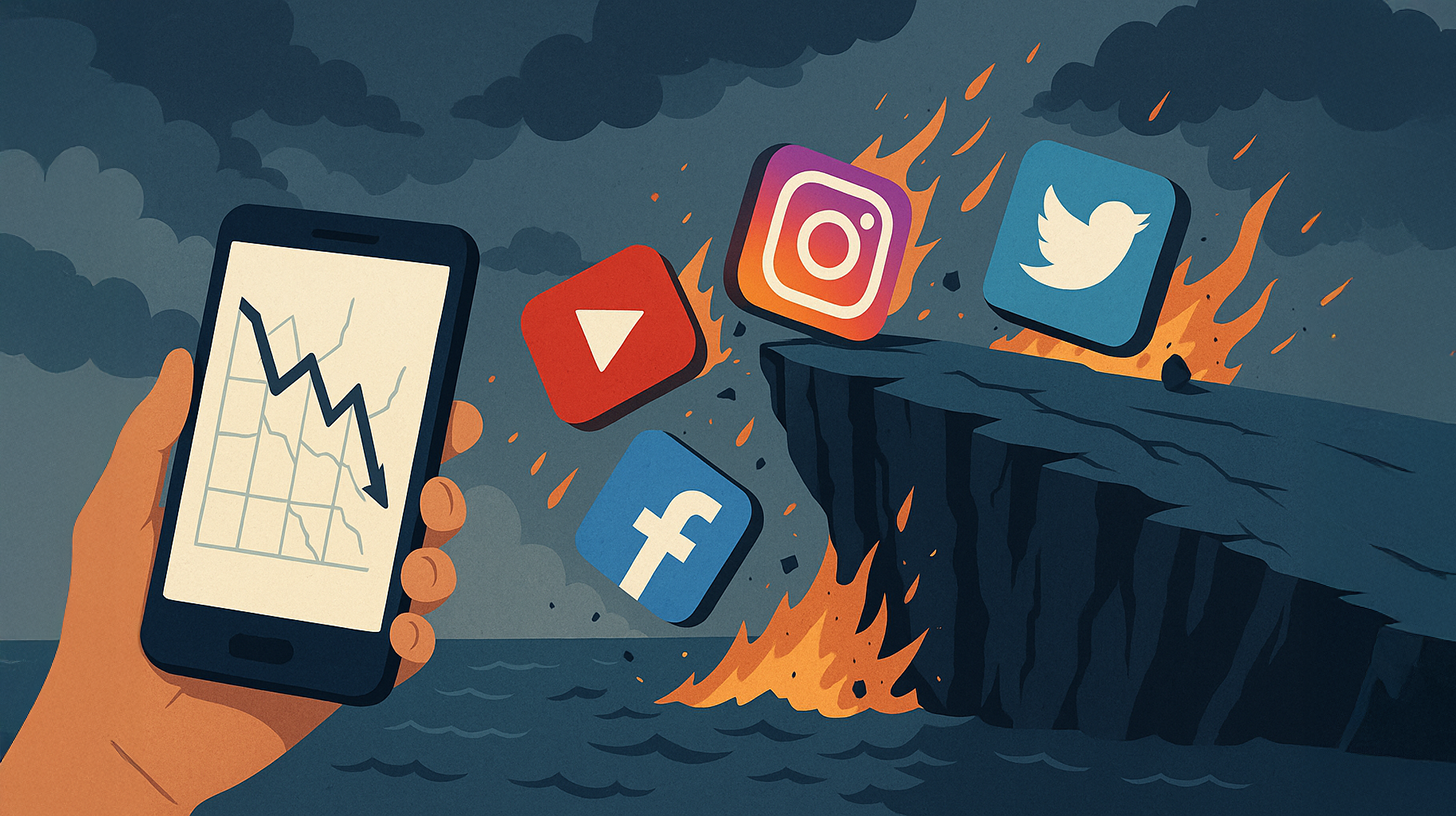
The great social media collapse: Why social media no longer delivers organic traffic – Image: Xpert.Digital
The Great Exodus: Why Social Media is Becoming a Dead End for Complex Products
### From Newsfeed to Shopping Mall: The Silent Revolution That's Changing Your Marketing ### TikTok Dances Instead of Tech Details: Is Your B2B Marketing Facing Extinction? ### The 3-Second War: How Algorithms Make Sophisticated Content Invisible ###
No news, just shopping? This is how companies now need to radically rethink their approach
Social media, once digital marketplaces for information, news, and professional exchange, are undergoing a fundamental and irreversible transformation. What was considered a reliable channel for B2B communication and a traffic driver for news portals has morphed into a gigantic, algorithm-driven entertainment and shopping platform. This transformation is not a gradual development, but rather the result of deliberate strategic decisions by giants like Meta, who are intentionally deprioritizing news and political content to focus on short videos and social commerce.
The figures vividly illustrate this paradigm shift: Facebook traffic to news sites has plummeted, while formats like Instagram Reels and TikTok dominate the digital landscape, shrinking users' attention spans to mere seconds. Simultaneously, social commerce is exploding, establishing platforms like TikTok as powerful sales channels where impulse purchases are made directly within the app.
While this development opens up new opportunities for consumer goods brands, it poses existential challenges, particularly for B2B companies, mechanical engineering firms, and providers of products requiring explanation. How can complex, technical solutions be communicated when algorithms only reward quick, emotional stimuli? This article analyzes the underlying causes of this significant exodus, examines the concrete effects on various industries, and outlines the strategic adjustments now necessary to survive in the newly fragmented media landscape.
Related to this:


The great exodus from social media – the shift to entertainment and social e-commerce
Social media is undergoing a fundamental transformation with far-reaching implications for how companies reach their target audiences. What was once a reliable source for news dissemination and B2B communication is increasingly evolving into a pure entertainment and shopping platform, posing new challenges, especially for products and services that require explanation.
The dramatic decline in news traffic
The numbers speak for themselves: Between 2023 and 2024, Facebook's referral traffic plummeted by a dramatic 48 percent, while X (formerly Twitter) saw a decline of 27 percent. This development marks the end of an era in which news publishers relied on the continuous stream of passive users from social media platforms. Organic traffic to news websites, which still reached over 2.3 billion monthly visits in mid-2024, fell to below 1.7 billion by May 2025—a loss of more than 600 million monthly visits in just a few months.
This development did not occur by chance, but is the result of deliberate strategic decisions by the platform operators. Meta systematically deprioritized news and political content in order to focus more on entertaining formats such as short videos and to avoid regulatory disputes. The removal of the Facebook News tab in the US, Australia, and several European countries was the symbolic culmination of this strategic realignment. Meta justified this radical step by pointing out that the use of the news function had declined by over 80 percent and that users primarily accessed the platform for social interaction and entertainment, not for news consumption.
The dominance of entertainment content
The shift towards entertainment-focused content is particularly evident in the development of short video formats. TikTok, Instagram Reels, and YouTube Shorts have become the dominant content formats, with Reels on Instagram generating 52 percent more impressions than other formats, while TikTok achieves a remarkable 84 percent greater reach. The average user's attention span is concentrated within the first three seconds of a video, forcing content creators to condense their messages to an extreme degree.
This development has fundamental implications for content strategy. Short videos of up to three minutes in length, originally only 15 seconds, allow companies to create creative content with music, effects, and filters; however, these formats are primarily suitable for easily communicated, visually appealing products. The algorithm-driven approach of these platforms favors content that generates immediate attention and leads to rapid interactions.
Related to this:

Social commerce as a new sales platform
Alongside its focus on entertainment, social commerce is developing into a significant economic force. Studies predict a global market volume of $1.2 trillion by 2025. With campaigns like "TikTok Made Me Buy It," TikTok has established itself as a powerful e-commerce tool, and its high-performance algorithm enables even smaller brands to achieve broad reach. The launch of TikTok Shop in Europe, expected to reach Germany in 2025, will allow for direct purchases within the platform, eliminating any breaks in the user experience.
This development is fundamentally changing consumer behavior. Seven out of ten shoppers worldwide (53 percent in Germany) have already made purchases via social media, and the same percentage expect social media platforms to become their primary online marketplace by 2030. In Germany, Instagram is cited as the preferred social media platform for shopping by 34 percent of respondents. Seamless in-app checkout, which enables the entire purchasing process from product discovery to payment within the platform, is becoming the standard.
Challenges for B2B and products requiring explanation
This transformation presents significant challenges for companies with complex products that require explanation. While social commerce is ideally suited for easily marketable everyday products that can be sold through visual presentation and emotional appeal, B2B companies and providers of complex services are at a disadvantage.
Products requiring explanation are characterized by technical complexity, specific use cases, or customer uncertainty regarding their functionality. These products require additional information or instructions so that customers can understand and use them effectively. Simple, direct advertising is often insufficient for such offerings. Instead, detailed content must be provided that addresses the problems and needs of the target group and demonstrates how the product can solve them.
Short attention spans and a preference for quickly consumable content on entertainment-focused platforms directly contradict the requirements of complex B2B communication. This requires time for detailed explanations, technical specifications, and building trust through demonstrated expertise.
Our recommendation: 🌍 Limitless reach 🔗 Connected 🌐 Multilingual 💪 Sales power: 💡 Authentic with strategy 🚀 Innovation meets 🧠 Intuition


From local to global: SMEs conquer the world market with a clever strategy - Image: Xpert.Digital
In an era where a company's digital presence determines its success, the challenge lies in creating an authentic, personalized, and far-reaching presence. Xpert.Digital offers an innovative solution that positions itself as the intersection of an industry hub, a blog, and a brand ambassador. It combines the advantages of communication and sales channels in a single platform and enables publication in 18 different languages. Cooperation with partner portals and the ability to publish articles on Google News and a press distribution list with approximately 8,000 journalists and readers maximize the reach and visibility of the content. This represents a crucial factor in external sales and marketing (SMarketing).
More information here:
Content, context, and communication: Social media marketing reimagined
Special impacts on industry and mechanical engineering
Mechanical engineering, as a traditionally B2B-oriented industry, faces particular challenges. Many companies in this sector are still hesitant to engage intensively with social media marketing, even though the opportunities are certainly there. A study shows that over 50 percent of German mechanical engineering companies use social media, but often without a well-thought-out long-term strategy.
The challenge lies in the nature of the products: mechanical engineering companies offer highly complex, technical solutions that require detailed explanation and personal consultation. These cannot be conveyed in 15-second videos or through viral trends. While entertainment content aims for emotional responses and spontaneous purchasing decisions, B2B decisions are based on rational, long-term considerations and often involve multiple decision-makers.
Nevertheless, social media marketing also offers advantages for the mechanical engineering sector: increased brand awareness, direct customer dialogue, cost-efficient marketing strategies, and positioning as a thought leader. Employer branding is particularly important, as the German mechanical engineering industry is suffering from a shortage of skilled workers. By providing authentic insights into daily work life, companies can reach potential applicants on platforms such as Facebook, Instagram, and TikTok.
Related to this:


The role of passive usage and algorithmic recommendations
Another critical aspect of current developments is the increasing importance of passive use and algorithmic recommendations. Studies show that passive use of social media—simply consuming content without active interaction—negatively impacts users' well-being and leads to feelings of isolation. Daily use of social media websites for more than two hours is associated with a significant increase in feelings of loneliness.
This passive use, however, characterizes a large part of today's social media consumption. Germans spend an average of 1 hour and 41 minutes per day on social networks, with the average German user using 5.5 platforms per month. TikTok leads the way with 35 hours of monthly usage, followed by YouTube with 15 hours, Facebook with 11 hours, and Instagram with 10.5 hours.
The platforms' algorithms are optimized to keep users engaged for as long as possible by delivering content that encourages repeated viewing, liking, or tapping. This algorithmic control favors entertainment content that triggers immediate emotional responses over informative or educational content that requires time for reflection.
Strategic adjustments for B2B companies
In light of these developments, B2B companies need to fundamentally rethink their social media strategies. LinkedIn remains the most important platform for 90 percent of B2B companies, but Instagram is also gaining traction in the B2B sector. In 2022, B2B companies invested twice as much time in their Instagram activities as in the previous year.
Successful B2B social media strategies prioritize quality over quantity. Content with genuine added value, offering concrete solutions to industry-relevant challenges, generates significantly more interaction than superficial content. For example, carousel posts on Instagram achieve 21 percent more reach than simple single images, provided they offer structure and added value.
For products that require explanation, special online marketing tools are recommended: content marketing through blog articles, white papers and e-books for the understandable communication of complex topics; webinars and online demos for interactive product presentations; SEO and SEA for visibility in relevant search queries; email marketing and marketing automation for lead nurturing over longer periods.
The fragmentation of the media landscape
This development is leading to an increasing fragmentation of the media landscape. While previously a few large platforms generated the majority of traffic, attention is now spread across a multitude of specialized channels and formats. X, for example, has seen a 38 percent decrease in weekly post frequency, which is attributed to migration to other platforms such as Threads, Bluesky, or Mastodon.
This fragmentation presents both a challenge and an opportunity for companies. On the one hand, it becomes more difficult to achieve broad reach; on the other hand, niche markets emerge where specialized content can connect with an interested target audience. Niche communities and micro-influencers are gaining importance because they offer authentic content for specific interest groups.
Related to this:

Effects on different age groups
The exodus from social media shows clear age-related differences. Sixteen percent of 16- to 29-year-olds have already left a social network because they considered its messages unreliable. In the 30- to 59-year-old age group, this figure was 14 percent, while among those over 60, it was only 7 percent. This trend suggests that younger users are becoming more critical and selective in their social media use.
At the same time, younger users show a preference for passive consumption. A Swiss study shows that young people spend more time watching what others post than showing themselves. 57 percent of the young people surveyed cited entertainment as their primary reason for using social media. Only a small proportion of young people are actively visible, which leads to a distorted perception.
Technological developments and their consequences
The integration of artificial intelligence is fundamentally changing the social media landscape. AI tools are not only used for content creation, but also for personalized recommendations and chatbots. Meta already allows users in the US to create AI-generated stickers, and AI image editing directly within the Instagram app is expected to follow.
These technological developments reinforce the trend toward entertainment content, as AI algorithms are optimized to maximize engagement and dwell time. Content that conveys complex information or stimulates reflection is systematically disadvantaged because it does not generate the immediate reactions that algorithms consider a success indicator.
Regulatory challenges and platform policy
The regulatory landscape significantly influences the development of social media. Meta's announcement to abolish fact-checking in the US and replace it with "Community Notes" marks a fundamental shift in direction. This decision comes against the backdrop of Donald Trump's second term and demonstrates how political developments affect platform policies.
In Europe, Meta is responding to regulatory requirements with drastic measures. From October 2025, Meta will no longer allow political ads on Facebook, Instagram, and WhatsApp in the EU, in response to the new regulation on the transparency of political advertising. These developments reinforce the platforms' tendency to focus on apolitical entertainment content.
The digital transformation of B2B communication: Strategies for tomorrow
The significant shift away from social media as a news source and B2B communication channel is irreversible. Companies with complex products must develop alternative strategies that take these changing usage patterns into account.
Successful approaches combine different channels: direct marketing and newsletters for direct customer contact; webinars and virtual events for detailed product presentations; content marketing on proprietary platforms for comprehensive information dissemination; LinkedIn as the primary B2B social media platform for professional communication; targeted use of Instagram and YouTube for visual product demonstrations.
Companies must prepare for the fact that social media will increasingly play a role in the early awareness phase, while detailed information gathering and purchasing decisions will shift to other channels. The integration of various communication channels will be crucial for the success of complex B2B marketing strategies.
The transformation of social media into entertainment and shopping platforms is unstoppable. Companies that develop alternative communication strategies in a timely manner and place their valuable content on more suitable channels will be more successful in the long run than those that try to cram complex messages into a system that is no longer designed for that purpose.
Your global marketing and business development partner
☑️ Our business language is English or German
☑️ NEW: Correspondence in your native language!

Konrad Wolfenstein
I and my team are happy to be available to you as your personal advisor.
You can contact me by filling out the contact form here wolfenstein@xpert.digital:or simply call me at +49 7348 4088 965. My email address is
I'm looking forward to our joint project.