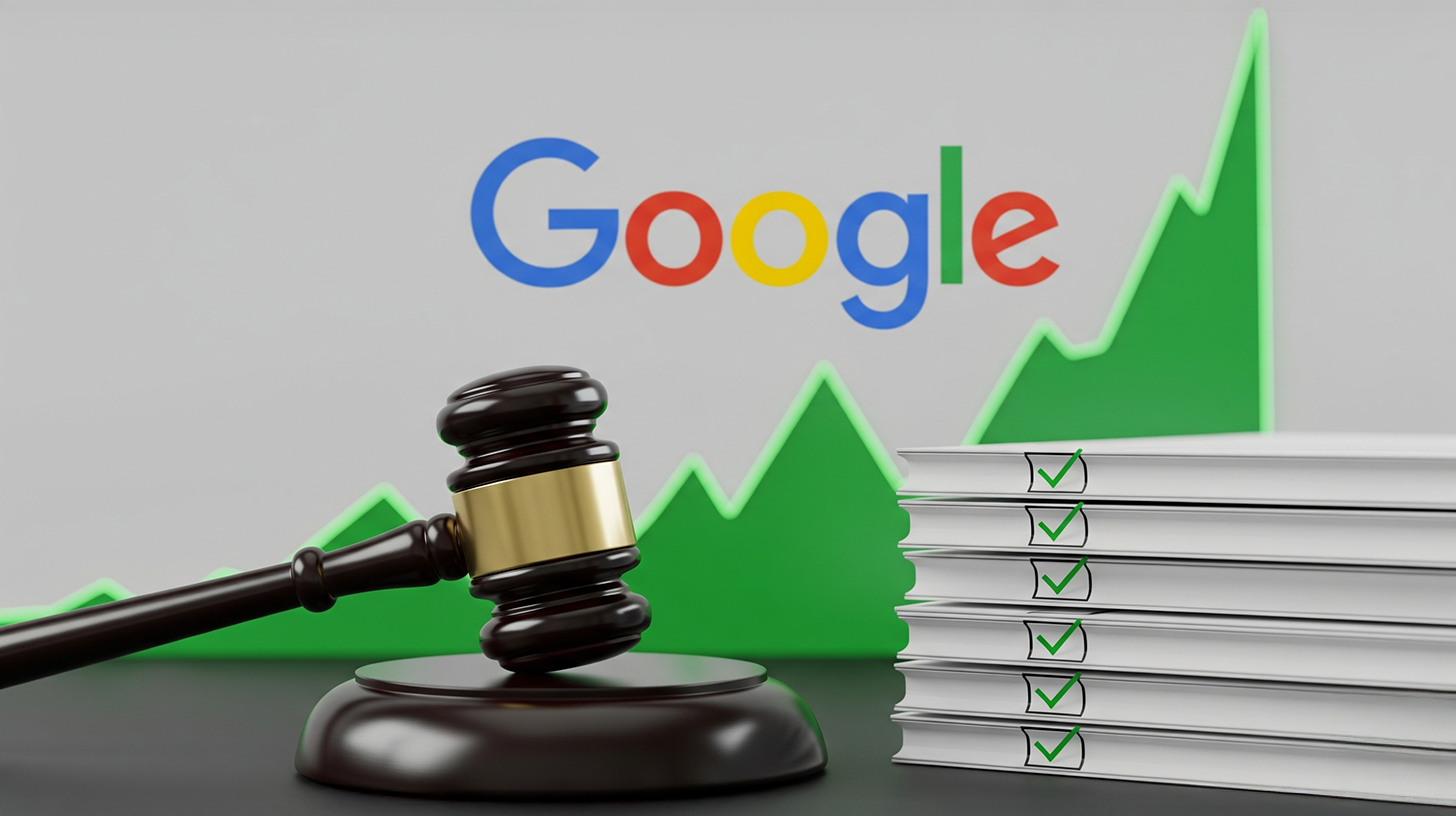
The Google verdict: Monopoly upheld, breakup rejected, the stock market's reaction and what conditions are imposed? – Image: Xpert.Digital
A complete victory? Why Google emerges as the big winner despite the court ruling – After the landmark verdict: These 3 things are changing now for Google (and the competition)
AI saves Google: How ChatGPT & Co. saved the tech giant from being split up
In one of the most important and longest-awaited antitrust cases in modern economic history, a US court has decided Google's fate. After a five-year legal battle initiated by the US government, nothing less than the breakup of the tech giant was on the table. The demands were drastic: the forced sale of the globally dominant Chrome browser and the Android operating system. But in a landmark ruling, Federal Judge Amit Mehta rejected these radical measures and saved Google from being split up.
The verdict is by no means an acquittal. The judge unequivocally confirmed that Google holds a monopoly in web search and has defended it using anti-competitive methods. Instead of breaking up the company, however, the court imposed significant restrictions: Google must now share parts of its most valuable data – the search engine index – with competitors like Microsoft and AI companies like OpenAI. Furthermore, exclusive contracts that stifle competition will be prohibited, although payments worth billions to partners like Apple will remain permissible in principle. The ruling, which was also influenced by the rise of AI competitors like ChatGPT, marks a turning point for the regulation of "Big Tech" and will shape the digital landscape for years to come, while champagne corks popped on the stock market and Alphabet shares soared to a record high.
Related to this:


What was the background to the legal proceedings against Google?
The legal proceedings against Google stem from a 2020 lawsuit filed by the US Department of Justice at the end of Donald Trump's first term. The lawsuit was the result of a years-long investigation into Google's market practices, which accused the company of abusing its dominant position in the search engine market.
The case is being hailed as the most important antitrust case of a generation. The lawsuit received support from both Republican and Democratic politicians, which is rather unusual in today's polarized US political landscape. Republican Senator Josh Hawley called it perhaps the most important antitrust case of a generation, while Democratic Senator Elizabeth Warren called for swift, vigorous action against Google.
The case spanned five years of intense legal battles. These revolved around fundamental questions of market power in the digital economy and how large a technology company can become before it raises antitrust concerns.
What specific monopoly position did Google hold?
Federal Judge Amit Mehta had already ruled over a year ago that Google holds a monopoly in web search and defends it against competitors using unfair means. The company controls approximately 90 percent of the search engine market and rakes in the lion's share of global online advertising spending.
Google's dominance is impressive: According to various sources, Google's global market share is over 91 percent. In the US, Google's market share is approximately 86.99 percent, followed by Bing with only 7.02 percent and Yahoo with 3.11 percent. Even alternative search engines like DuckDuckGo only achieve a market share of 2.42 percent.
This dominance was built through years of strategic practices. The report by the US House Judiciary Committee stated that Google had cemented its monopoly in internet search over 20 years by acquiring more than 200 competitors or their successful technologies.
What were the main accusations against Google?
The main allegations focused on several practices deemed anti-competitive. A key issue was the exclusive agreements with other companies. For example, Google pays Apple billions of dollars to have Google Search pre-installed on iPhones. According to information from the trial, Apple receives billions of dollars for this pre-installation.
Another important point was Google's relationship with Mozilla, the developer of the Firefox browser. For Mozilla, the pre-installation of Google Search in Firefox is a key source of revenue. Last year alone, Google is said to have spent around $26 billion on exclusive rights to its search engine.
The Justice Department argued that Google had created a wall around its search engine monopoly through these payments to hardware and web browser manufacturers. The company was accused of systematically excluding alternative search engines from the market through these practices and making it difficult for consumers to choose other options.
What drastic measures did the US government originally demand?
The US government had made far-reaching demands that would have amounted to a complete breakup of the Google corporation. The main demand was the forced sale of the Chrome browser, by far the most successful internet browser worldwide. Chrome is not only used on the majority of all smartphones globally, but is also responsible for a large portion of Google's advertising revenue.
Furthermore, Google should divest itself of its Android apps. The Android operating system would also have had to be sold, which would have meant a massive blow to Google's business model. Analysts valued Chrome alone at up to $100 billion.
Further demands included requiring Google to license its own search index to counteract a monopoly. Additionally, all deals should be terminated in which Google pays other browser developers, such as Firefox and Apple, substantial sums of money to have its search engine set as the default.
The Justice Department also wanted the possibility of a future spin-off of Google's most widely used mobile operating system, Android, to remain explicitly on the table. These measures would have split the company into several separate entities.
What was Judge Amit Mehta's actual decision?
Judge Amit Mehta rejected the far-reaching demands of the US government and ruled that Google does not have to sell Chrome or Android. In his 230-page ruling, he wrote that the government had gone too far with its demands.
The judge explained that conditions imposed in antitrust proceedings should be exercised with a healthy dose of restraint, which he had done in this case. He said: There are good reasons not to disrupt the system and to let market forces take their course. He also noted that the government had gone too far in demanding the company's breakup.
Mehta noted that while Google remains the dominant search engine, the rise of AI services like ChatGPT, Perplexity, and Claude has changed the landscape, and these offerings could potentially be game-changers. Many people are already using these alternatives instead of traditional search engines for information gathering.
Despite rejecting the most drastic measures, the judge nevertheless imposed significant conditions on Google. These are intended to ensure that competition in the search engine industry is promoted without completely breaking up the company.
What restrictions were actually imposed on Google?
Although Google is allowed to keep Chrome and Android, the company must still make significant concessions. A key condition is that Google must share some data from its search engine with competitors. This includes parts of the search engine index that Google creates when crawling the internet, as well as some information about user interactions.
This data is intended to help rival search engines like Microsoft's Bing and DuckDuckGo, as well as AI companies like ChatGPT developer OpenAI and Perplexity, in developing their competing products. This represents a significant opening of Google's previously tightly guarded data repositories.
Another important condition concerns Google's business practices. The company is no longer allowed to enter into exclusive agreements that would prevent device manufacturers from pre-installing competing products. This affects services such as web search, Chrome, and the AI software Gemini.
However, Google retains significant leeway: The company will still be able to pay other companies like Apple or Firefox developer Mozilla to pre-install or prominently feature its services. This means that the lucrative deals with Apple and Mozilla can continue, albeit under less restrictive conditions.
How did the stock market react to the verdict?
Financial markets clearly interpreted the ruling as a victory for Google. Shares of its parent company, Alphabet, rose by as much as seven percent in after-hours trading. Apple's stock also climbed three percent, as it too benefited from the more lenient decision.
The stock market reaction was so positive that Alphabet shares climbed to a new all-time high. In after-hours trading, the stock surpassed the $229 mark, reaching a new record high. This development reflected the relief of investors who had feared that a breakup of the company could lead to significant losses in value.
SlateStone Wealth fund manager Robert Pavlik explained the positive reaction by saying that there had been doubts as to whether Google, given the numerous political hostilities, had anything to seriously fear from government authorities. The markets interpreted the ruling as confirmation that the worst-case scenarios would not materialize.
Analysts estimated the potential value of Chrome alone at up to $100 billion. The fact that this business unit was able to remain within the company was seen as a huge value driver for Alphabet's stock.
What parallels exist with previous cartel proceedings?
The proceedings against Google bear striking similarities to the famous Microsoft antitrust case of 1998. At that time, the US Department of Justice sued the software giant Microsoft for making it difficult for users and PC manufacturers to use a web browser other than Microsoft Internet Explorer.
Microsoft's bundling of browser and operating system was considered the reason for the company's great success and, under the 1890 antitrust law, was deemed an illegal monopoly. Microsoft argued at the time that the two products belonged together – an argument that Google also uses today.
A court initially ruled that Microsoft should be broken up, but the company successfully appealed. Ultimately, the Justice Department opted for a settlement: Microsoft remained intact and, in return, agreed to grant competitors access to the technical details of its interfaces.
Interestingly, in 1998, when the Microsoft lawsuit was underway, Google was still a fledgling startup and advertised with the motto "Don't be evil" to differentiate itself from the giant Microsoft corporation. Today, with a revenue of $162 billion, Google is itself one of the largest companies in the world.
What significance does the first browser war have for today's procedures?
The first browser war between Microsoft and Netscape, from 1995 to 1998, offers important insights for Google's current approach. At that time, Netscape Navigator's market share plummeted from over 80 percent to under four percent, while Internet Explorer rose from under three percent to over 95 percent during the same period.
Microsoft employed similar strategies to those Google uses today: The company bundled its browser with the Windows operating system, making it difficult for other browsers to establish themselves. This aggressive market behavior led to numerous lawsuits from competitors, with Microsoft usually settling out of court through substantial monetary payments.
The consequences of Microsoft's monopoly were clearly visible: After the release of Internet Explorer 6, the development team was almost completely disbanded, and it took five years before a new version was released. Its widespread use led to websites being optimized to function only in Internet Explorer, thus excluding users of alternative browsers from certain services.
The Justice Department's current lawsuit against Google is based on the Microsoft case, but has a narrower focus, which increases its chances of success. However, history also shows that even successful antitrust cases don't necessarily lead to lasting change.
How has the search engine market developed over the years?
The development of the search engine market demonstrates how monopolies can form and solidify in the technology sector. Google started as a small search engine in 1997 and today dominates with a global market share of over 91 percent. This development was not foreseeable from the outset, but rather the result of strategic decisions and market practices.
Market shares vary slightly across different regions of the world, but Google's dominance is evident everywhere. In Europe, Google's market share is 91.91 percent, followed by Bing with only 3.87 percent. Even in technologically advanced markets like Germany or the United Kingdom, Google achieves market shares of over 90 percent.
It is noteworthy that Google does not dominate in only a few markets. In China, Baidu leads with 75.54 percent, ahead of Bing with 11.47 percent, while Google only reaches 3.56 percent. In Russia, Google (48.08 percent) and Yandex (49.02 percent) share the market relatively evenly.
The competition struggles to assert itself against Google's established position. Microsoft Bing, despite massive investments, only achieves a global market share of around 3.19 percent. Alternative search engines like DuckDuckGo, which specialize in data privacy, remain niche players with less than one percent market share.
Our recommendation: 🌍 Limitless reach 🔗 Connected 🌐 Multilingual 💪 Sales power: 💡 Authentic with strategy 🚀 Innovation meets 🧠 Intuition


From local to global: SMEs conquer the world market with a clever strategy - Image: Xpert.Digital
In an era where a company's digital presence determines its success, the challenge lies in creating an authentic, personalized, and far-reaching presence. Xpert.Digital offers an innovative solution that positions itself as the intersection of an industry hub, a blog, and a brand ambassador. It combines the advantages of communication and sales channels in a single platform and enables publication in 18 different languages. Cooperation with partner portals and the ability to publish articles on Google News and a press distribution list with approximately 8,000 journalists and readers maximize the reach and visibility of the content. This represents a crucial factor in external sales and marketing (SMarketing).
More information here:
Google ruling: Monopoly upheld, breakup averted – conditions on data sharing and pre-installations; payments to Apple/Mozilla remain permitted
What role do payments to Apple and other partners play?
Google's payments to partners like Apple are a central component of the antitrust allegations. According to information from the trial, Apple receives billions of dollars for having Google Search pre-installed on iPhones. Reports indicate that these payments to Apple can amount to more than $18 billion annually.
These sums represent not only a significant cost factor for Google, but also an important source of revenue for Apple. The agreement ensures that millions of iPhone users automatically use Google as their search engine without actively choosing another option. This considerably strengthens Google's market position.
The situation is similar for Mozilla, the developer of the Firefox browser. For Mozilla, the pre-installation of Google Search is a key source of revenue. Without these payments, it would be difficult for Mozilla to continue developing and operating the free browser.
Judge Mehta's ruling generally allows these payments to continue. Google may still pay other companies like Apple or Mozilla to pre-install or prominently feature Google services. However, exclusive agreements that would prevent device manufacturers from pre-installing competing products are prohibited.
Related to this:
How does the situation differ in Europe?
In the European Union, regulation has already led to changes. Users are now explicitly asked which search engine they want to use. However, Judge Mehta rejected such a mandatory selection requirement for the US, which is intended to prevent tacitly made default settings.
The EU has taken a hard line against Google in the past. Between 2017 and 2019, the European Union repeatedly imposed billions of euros in fines on the company for abusing its market power and disadvantaging other firms. The corporation had to pay billions in fines in total.
The Digital Markets Act (DMA) introduced further regulations. Since March 2024, users of Google services have been able to choose whether these services should be linked and thus whether personal data should be shared. Users can now decide whether to link Google Search, YouTube, advertising services, Google Play, Google Chrome, Google Shopping, and Google Maps.
These European regulations go in some respects beyond what the US court demanded of Google. However, they also demonstrate that regulatory intervention is possible without completely destroying the company's business model.
What impact will the ruling have on data usage?
A key aspect of the ruling concerns the handling of user data. Google will now have to share certain data from its search engine with competitors. This includes parts of the search engine index that Google creates when crawling the internet, as well as some information about user interactions.
This data sharing is of enormous importance, as Google's search engine index is one of the company's most valuable data repositories. It should help rival search engines like Microsoft's Bing and DuckDuckGo, as well as AI companies like ChatGPT developer OpenAI and Perplexity, to improve their competing products.
However, other legal proceedings concerning Google's data usage are also underway. A German court has already ruled that Google violated the General Data Protection Regulation (GDPR) during account registration. The Berlin Regional Court criticized Google for leaving consumers unclear during registration about which of its more than 70 services would have their user data processed for.
The issue of data privacy is also highlighted by class action lawsuits filed by German consumers. Organizations like Privacy ReClaim offer Android users the opportunity to pursue potential claims for damages due to unlawful data collection. They argue that Android phones send massive amounts of data about their users to Google every day without a sufficient legal basis.
What are the next legal steps?
The current ruling is by no means the end of the legal battles. Google announced its intention to appeal even before the verdict was handed down. The internet giant first had to await the decision regarding the consequences before it could also challenge the ruling in the antitrust case.
It could therefore be years before a final decision is reached. The appeals process will likely go through several instances, and it is quite possible that higher courts will reach different conclusions than Judge Mehta.
A further major antitrust case by the Department of Justice against Google's advertising technology business is already underway. Just last week, Google suffered another setback in court: A judge in the state of Virginia ruled that the company had achieved a monopoly position in online advertising platforms through unfair competition. A second trial regarding punitive measures will follow in this case as well.
The legal challenges for Google are far from over. The company must prepare for further legal proceedings and potential appeals that could further jeopardize its business practices and market position.
What role does the Trump administration play in this process?
The political dimension of the proceedings is complex. The original lawsuit was filed back in 2020, at the end of Donald Trump's first term. Interestingly, the Trump administration has continued its hard line against Google even after returning to office.
Even under the new Trump presidency, the US Department of Justice maintained its position that Google should be broken up due to its overwhelming market power. This demonstrates a remarkable continuity in antitrust policy across different administrations.
Trump had previously criticized Google and even called for the company to be prosecuted for alleged election interference. He claimed that the internet search engine displayed a disproportionate number of negative stories about him, while only positive articles appeared about his rival, Kamala Harris.
Although Trump is considered pro-business and has expressed skepticism about potentially breaking up tech companies, his administration appears determined to continue the proceedings against Google. While the most recent steps in the ongoing antitrust case were taken under the leadership of Trump's predecessor, Joe Biden, this continuity suggests that the issue enjoys bipartisan support.
What significance do artificial intelligence and new competitors have?
In his ruling, Judge Mehta acknowledged that the rise of AI services like ChatGPT, Perplexity, and Claude has changed the landscape. These services could potentially be game-changers, as many people are already using these alternatives instead of traditional search engines to gather information.
This development was a key factor in the judge's decision. He noted that while Google remained the dominant search engine, the new AI-based services could pose a real challenge to Google's position. This distinguishes the current situation from previous monopoly cases where no such technological changes were on the horizon.
Google itself argued in court that the government's demands were backward-looking and pointed to competition from AI-powered services for its search engine. The company emphasized that services like ChatGPT already constituted competition and challenged the traditional search engine monopoly.
The Justice Department, however, argued the opposite, emphasizing that because of the growing importance of AI, restrictions on Google were particularly necessary. There was a risk that the company would use the same methods it employed with its search engine to achieve dominance in the AI sector as well. Therefore, any restrictions needed to be forward-looking.
What impact will the ruling have on Chrome and Android?
Although Google is allowed to keep Chrome and Android, these products remain central to the company's business model. Chrome is by far the world's most successful internet browser and is used on the majority of smartphones worldwide. It is also responsible for a large portion of Google's advertising revenue.
The value of these products is enormous: analysts have estimated the value of Chrome alone at up to $100 billion. Android, as the world's most widely used mobile operating system, is also invaluable to Google, as it gives the company direct access to billions of users.
The decision allowing Google to retain these business units was received positively by the stock market. Investors had feared that a breakup could lead to significant losses in value, as these products are so closely linked to Google's advertising business.
Nevertheless, Chrome and Android are now subject to certain restrictions. Google is no longer allowed to enter into exclusive agreements for the distribution of its services such as web search, Chrome, or the AI software Gemini. This could change the way these products are marketed and used in the long term.
How do experts and industry assess the verdict?
Reactions to the verdict were mixed. From the perspective of the financial markets, it was clearly a success for Google, as evidenced by the seven percent increase in its share price in after-hours trading. Investors had feared the worst and were relieved that the most drastic measures had been averted.
Google itself criticized the government's initial demands as radically interventionist and announced it would appeal. The company argued that the imposed restrictions were already sufficient and that a breakup would have been disproportionate.
Critics of the ruling, however, argue that the measures don't go far enough. They fear that Google could continue to use its dominant position to disadvantage competitors. The privacy movement and consumer protection groups would likely have preferred stricter restrictions.
The international perspective is also interesting: While the US tends towards a moderate approach, the EU has already implemented stricter measures. This could lead to different competitive conditions in different markets.
What does this ruling mean for the future of technology regulation?
The Google ruling sets important precedents for the regulation of large technology companies. It shows that the courts are willing to recognize and sanction monopolies, but not necessarily willing to completely break up established companies.
The case could have repercussions for other major technology companies. Companies like Amazon, Apple, Meta, and Microsoft are closely monitoring the proceedings, as they all hold similar market positions in their respective fields. The ruling could serve as a guideline for which practices are considered acceptable and which are deemed anti-competitive.
At the same time, the case also highlights the limitations of traditional antitrust enforcement in the digital economy. The complexity of modern technology companies and their business models makes it difficult to find simple solutions. The ruling attempts to strike a balance between preserving competition and preventing the breakup of successful companies.
Judge Mehta's emphasis on new technologies like AI as potential game changers suggests that future regulation may focus more on technological developments and less on structural changes. This could represent a new paradigm in technology regulation.
What are the most important findings from the Google ruling?
The Google ruling marks a significant turning point in the history of technology regulation. While Judge Amit Mehta upheld Google's monopoly in web search, he rejected the US government's drastic demands to break up the company. Instead, he imposed moderate restrictions aimed at promoting competition without destroying the corporation.
The most important measures include the obligation to share data with competitors and a ban on exclusive agreements that could hinder competitors. At the same time, Google may continue to pay partners like Apple and Mozilla for pre-installing its services.
The ruling demonstrates a pragmatic approach to regulating dominant technology companies. It acknowledges the realities of the modern market, where new technologies like AI are challenging traditional business models. This approach could serve as a model for future antitrust proceedings.
For Google, the ruling initially represents a significant relief, as evidenced by the positive stock market reaction. The company can retain its most valuable assets and essentially continue its business model unchanged. However, the imposed conditions are not trivial and could have long-term consequences for Google's market position.
The case is not yet closed, however. Google has already announced its intention to appeal, and other antitrust proceedings are pending against the company. A final assessment of the impact will only be possible in the coming years, when it becomes clear how effective the imposed measures are in promoting competition.
The case also highlights the complex challenges of regulating the digital economy. While traditional antitrust approaches may not always be appropriate, the need to control market power and ensure fair competition remains. The Google ruling attempts to navigate this difficult balancing act and could be a landmark decision for the future of technology regulation.
Your global marketing and business development partner
☑️ Our business language is English or German
☑️ NEW: Correspondence in your native language!

Konrad Wolfenstein
I and my team are happy to be available to you as your personal advisor.
You can contact me by filling out the contact form here wolfenstein@xpert.digital:or simply call me at +49 7348 4088 965. My email address is
I'm looking forward to our joint project.