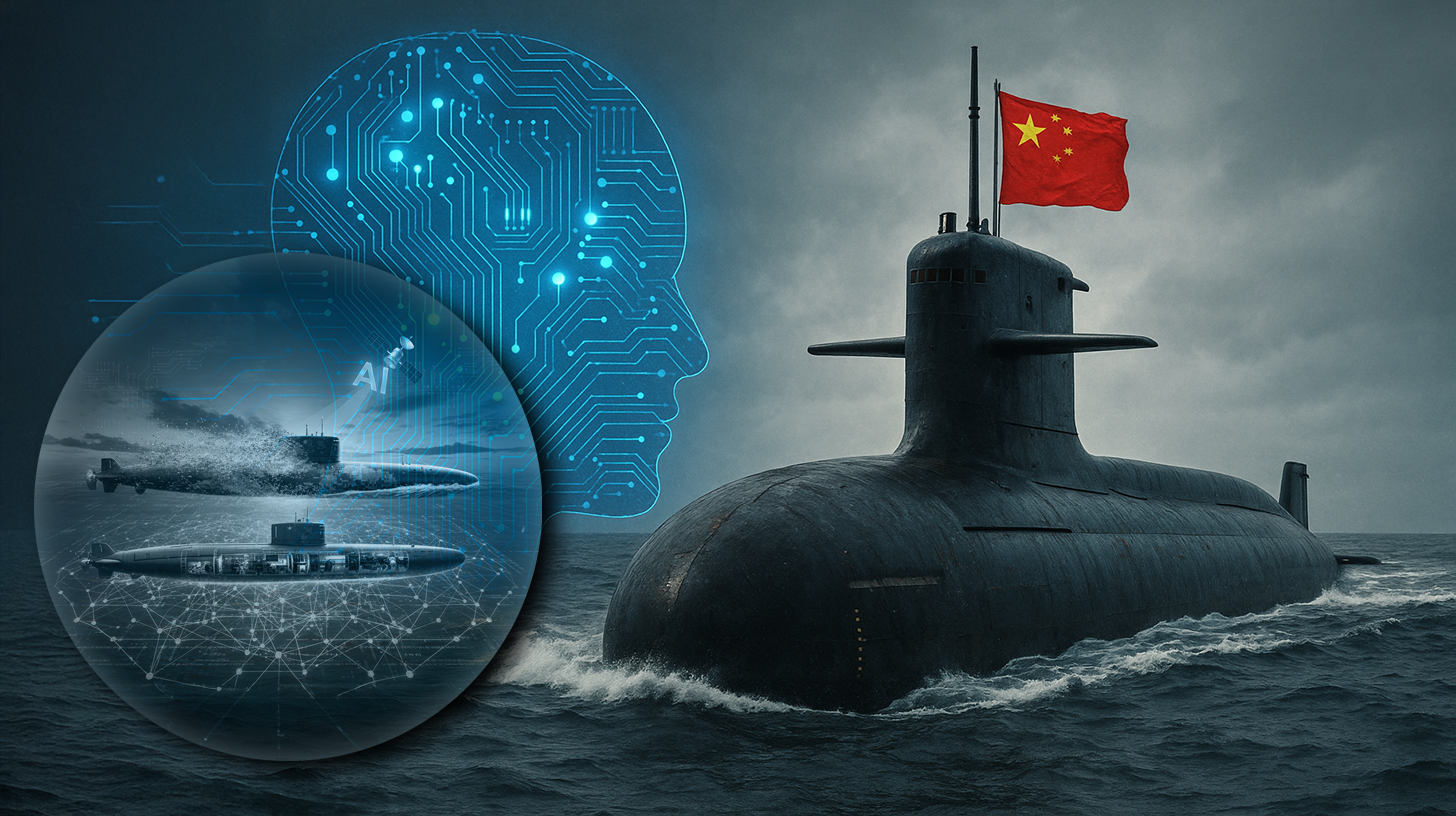
China's AI ends the era of invisible submarines – Is the future of submarines without underwater camouflage coming to an end? – Image: Xpert.Digital
China's super AI is on the hunt: Only 1 in 20 submarines can still escape - How a new AI weapon unmasks the invisible submarines
### End of an era: Why the Navy's most powerful weapon is suddenly vulnerable ### Threat to world peace? How AI is tipping the balance of nuclear deterrence ### From sonar to quantum hunting: The high-tech revolution taking place underwater ###
Can submarines still hide? A new technology says a resounding no
For decades, they were considered the invisible hunters of the deep sea, the ultimate guarantee of a nation's nuclear second-strike capability: submarines. Their ability to glide undetected through the oceans made them one of the most powerful strategic instruments of the world's superpowers. But this era of impenetrable camouflage is drawing to a close. A technological revolution, driven by artificial intelligence (AI), threatens to transform the oceans into a glass battlefield where there is no longer any hiding place.
At the forefront of this development are Chinese researchers who have created an AI-powered system that is rewriting the rules of underwater warfare. Computer simulations paint a grim picture: the survival rate of an enemy submarine could plummet to just five percent. Through the intelligent networking of sonar buoys, quantum sensors, and oceanographic data, the AI can predict maneuvers, detect deceptions, and adapt hunting strategies in real time—more effectively than any human commander.
This technological leap has far-reaching consequences. It not only calls into question the multi-billion-dollar stealth programs of Western navies, but also shakes the foundations of the global security architecture. If the supposedly invulnerable, nuclear-armed submarines can suddenly be located and engaged, the delicate balance of nuclear deterrence is jeopardized. The following sections examine the technologies behind this new form of submarine hunting, analyze its impact on maritime warfare, and show how Western nations are responding to this existential threat.
How does artificial intelligence change submarine detection?
The development of artificial intelligence has the potential to fundamentally change underwater warfare. Chinese researchers have developed an AI-powered anti-submarine system that, according to current computer simulations, could reduce the survival chances of enemy submarines to just five percent. This means that out of 20 submarines, only one would escape detection and subsequent attack.
The system operates as an intelligent commander in the oceans, utilizing data from various sensors such as sonar buoys, underwater sensors, radar, and oceanographic parameters like seawater temperature and salinity. Unlike traditional search methods, the AI can make real-time decisions and adapt to the countermeasures taken by submarines.
What technologies are behind the new submarine detection system?
Modern submarine detection is based on several advanced technologies interconnected through AI. The three-layer architecture system comprises a perception layer that combines real-time data from various sensors, a decision-making component, and a human-machine interaction layer.
Sonar buoys play a central role in this. These devices, approximately 13 centimeters wide and 91 centimeters long, are deployed into the water from aircraft or ships and operate both as a radio transmitter on the surface and as hydrophones underwater. Modern systems like the DIFAR sonar buoys can detect acoustic signals in the frequency range of 5 to 2,400 Hz and operate for up to eight hours at depths of up to 305 meters.
Magnetic anomaly detection is another important component. Submarines are primarily made of ferromagnetic materials and distort the Earth's magnetic field in their vicinity. This magnetic signature can be measured from aircraft, with modern AI systems helping to distinguish the weak signals from interference.
Why have previous submarine camouflage methods become less effective?
Traditional submarine stealth technologies focused on reducing the acoustic signature through sound-dampening materials, angular hull shapes, and shrouded propellers. While these methods were quite effective against conventional sonar systems, they reach their limits against AI-powered multi-sensor systems.
The new AI systems also react to typical submarine countermeasures such as zigzag maneuvers, the use of decoys, or hiding in resting positions. Even when submarines use unmanned drones for deception, the AI retains its detection capabilities.
A particular problem arises from climate change, which alters underwater acoustics. Rising sea temperatures and changing salinity levels affect sound propagation in water, presenting both opportunities and risks for submarine operations.
What role do quantum sensors play in submarine detection?
China has also developed drone-based quantum sensors capable of detecting submarine magnetic anomalies with high precision. These systems utilize coherent population trap atom magnetometers with rubidium atoms whose energy levels are influenced by magnetic fields.
In offshore tests near Weihai, the system achieved a detection accuracy of 2.517 nanoteslas, which could be improved to 0.849 nanoteslas after correction. This technology is particularly effective in low latitudes such as the South China Sea, where the Earth's magnetic field runs almost parallel to the surface and conventional sensors have weaknesses.
How does the three-layer AI architecture for submarine hunting work?
The system, developed by Chinese researchers, operates through a complex three-layer structure. The perception layer combines real-time data from sonar, radar, magnetic anomaly detectors, and oceanographic sensors to create dynamic underwater environment maps.
The decision-making layer analyzes this data and determines search strategies as well as necessary responses to submarine maneuvers. The third layer enables natural language communication between the system and human operators, thereby reducing the cognitive load on the soldiers.
The system can coordinate various AI agents for automated decision-making and enables fully integrated multi-domain tracking across air, surface, and underwater platforms.
Hub for Security and Defense - Advice and Information


Hub for Security and Defense - Image: Xpert.Digital
The Security and Defence Hub offers expert advice and up-to-date information to effectively support companies and organizations in strengthening their role in European security and defence policy. Working closely with the SME Connect Defence Working Group, it particularly promotes small and medium-sized enterprises (SMEs) that wish to further develop their innovative capacity and competitiveness in the defence sector. As a central point of contact, the Hub thus creates a crucial bridge between SMEs and European defence strategy.
Related to this:
How AI is ending the age of invisible submarines: Autonomous drones and AI are revolutionizing underwater warfare
What does this mean for nuclear deterrence?
Submarines are a key component of the nuclear triad, which consists of land-based missiles, strategic bombers, and sea-based systems. Ballistic missile submarines (SSBNs) are considered the most survivable element of this triad because they are difficult to detect and provide a credible second-strike capability.
The US currently operates 14 Ohio-class SSBNs, each capable of carrying up to 20 submarine-launched ballistic missiles with multiple independently homing warheads. These submarines are specifically designed for stealth and the precise delivery of nuclear warheads.
Should submarines lose their ability to operate relatively undetected, this would have significant consequences for their deterrent potential. The Department of Defense plans to deploy up to 70 percent of the nation's nuclear warheads on SSBNs, underscoring their strategic importance.
How are Western navies reacting to this development?
The US Navy has already begun developing its own AI-powered submarine detection systems. Charles River Analytics received a one-million-dollar contract to develop the MAGNETO system, which uses AI to identify enemy submarines based on their magnetic signatures.
The MAGNETO system uses a hierarchical approach that progressively refines signal identification through successive stages. This enables real-time data processing and ensures that only relevant signals are forwarded for more detailed analysis.
Ultra Maritime has developed Sea Spear, a lightweight, deployable sonar system that quickly and cost-effectively improves submarine detection capabilities. The system can be deployed from manned or unmanned surface and underwater platforms and expands to a high-performance, long-range array.
What impact will this technology have on maritime warfare?
The introduction of AI-powered anti-submarine warfare could herald the end of the era of "invisible" submarines. This would represent a fundamental shift in maritime strategy, as submarines have played a crucial role in naval supremacy since World War II.
Modern stealth submarines like the German Type 212CD with its angular hull designed to minimize sonar signature, or Sweden's A-26 Blekinge class, could become less effective against these new detection systems. Adapting stealth principles from aviation to the underwater domain is proving more complex than initially anticipated.
The integration of unmanned underwater vehicles (UUVs) with nuclear-powered Virginia-class submarines is already transforming underwater warfare. This breakthrough technology improves autonomous launch and recovery operations and strengthens electronic warfare as well as intelligence, surveillance, and reconnaissance operations.
How are countermeasures and defense strategies evolving?
The development of advanced detection technologies simultaneously leads to innovative countermeasures. Just as radar systems evolved to combat stealth aircraft, sonar systems are also becoming more sophisticated in detecting stealth submarines.
China is working on AI-controlled torpedoes that can distinguish real submarines from underwater decoys. Early tests show that the system can differentiate real targets from decoys with an average accuracy of 92.2 percent. The system improved detection rates from about 61 percent to over 80 percent, even against advanced decoys.
The Royal Navy is planning Project CABOT, a persistent barrier in the North Atlantic consisting of networked unmanned vehicles equipped with advanced sensor systems. This barrier promises transformative strategic importance and revolutionary development speed.
What are the challenges in implementation?
The implementation of AI-based anti-submarine systems presents various technical and strategic challenges. The magnetic field signals from submarines are extremely weak – approximately 0.2 nanotesla at a distance of 600 meters, or 13.33 nanotesla at 500 meters for a 100-meter-long submarine.
Interference from other metallic objects and electrical devices presents another problem. AI and machine learning help to isolate and extract relevant signals from the surrounding noise.
The US Navy is pursuing a phased approach to implementing tactical and evolutionary anti-submarine warfare using AI technology. The goal is not to replace acoustic operators with machines, but rather to support them with AI-assisted technology during training and operations.
What international repercussions are to be expected?
China's development of advanced anti-submarine technologies has already triggered international reactions. Experts see these systems as crucial for China's ability to protect its aircraft carriers and ensure successful amphibious operations.
It is also significant that Chinese airborne anti-submarine warfare aircraft are tasked with protecting Chinese ballistic missile submarines as they travel to their patrol and launch sites. China views airborne anti-submarine warfare as a key enabler of its naval nuclear deterrence.
Thales has developed BlueScan, an integrated acoustic system that enables real-time multi-sensor data fusion and analysis of heterogeneous data. Thanks to artificial intelligence, it enhances collaborative anti-submarine warfare to strategically position navies for the complex challenges of tomorrow.
What could the future of underwater warfare look like?
The future of underwater warfare will be revolutionized by the integration of autonomous platforms and real-time data integration. Artificial intelligence, autonomous platforms, and real-time data integration are changing the way navies detect, track, and neutralize submarines.
The development of stealth-capable autonomous underwater drones opens up new possibilities. These vehicles can use their self-generated soundscape as a passive sonar source to map the seabed without having to transmit active sonar signals.
The most important response to AUV platforms and systems would be to strengthen maritime control by upgrading and expanding current surface, underwater, and air capabilities. This requires a comprehensive realignment of maritime defense strategies and significant investment in new technologies.
The era of "invisible" submarines, long a cornerstone of maritime deterrence, could indeed come to an end due to these technological developments. This would fundamentally alter not only maritime warfare but also the entire balance of nuclear deterrence, necessitating new strategic considerations for all naval powers worldwide.
Consulting - Planning - Implementation

Markus Becker
I would be happy to serve as your personal advisor.
Head of Business Development
Chairman SME Connect Defense Working Group
Consulting - Planning - Implementation
Konrad Wolfenstein
I would be happy to serve as your personal advisor.
You can contact me at wolfenstein∂xpert.digital or
Just call me on +49 7348 4088 965 .