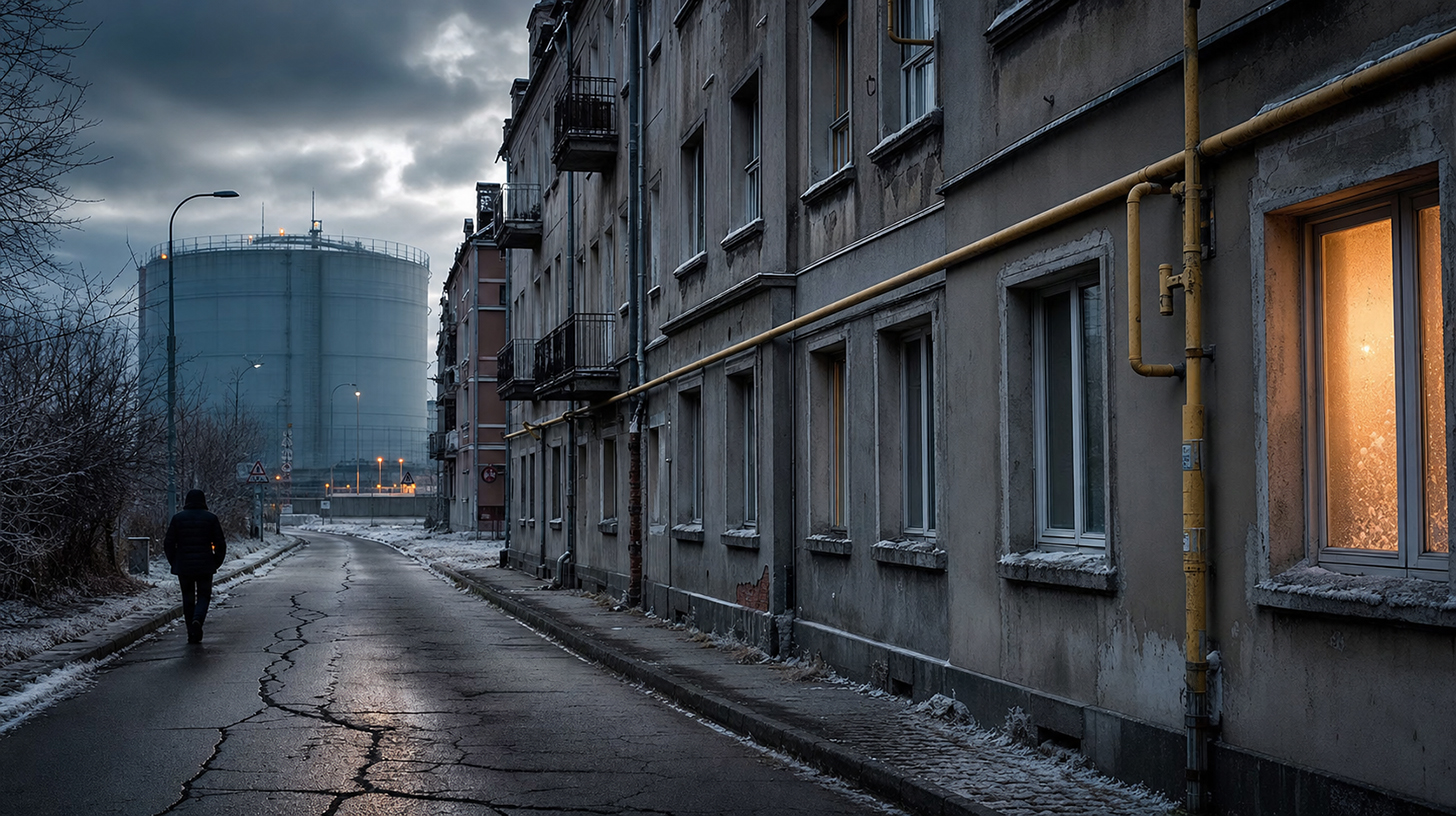
The fatal gas trap: Why millions of German households are threatened with the next heating shock – Image: Xpert.Digital
Setback for the energy transition: How a new law is misleading millions of consumers
Two gas crises in four years: How Germany is jeopardizing its energy security
“More serious than all oil shocks”: IEA chief sounds the alarm over Germany’s heating chaos
Germany is stumbled headlong into the next energy crisis. Two severe gas crises within just four years have ruthlessly exposed the fatal dependence on fossil fuels – and yet millions of households continue to heat with natural gas. While international experts are issuing urgent warnings about the geopolitical and financial risks, politicians are sending disastrous signals and backtracking on the energy transition. Anyone who opts for a new gas heating system today is walking straight into an incalculable cost trap due to massively rising CO₂ prices and uncertain supply chains. Our comprehensive analysis shows why your own boiler room has long since become a matter of national security and why switching to heat pumps, district heating, and geothermal energy is now unavoidable.
Prisoner in his own basement: Germany's expensive gas dependency for heating
The wake-up call is long overdue – but Germany is still hesitating
Two major gas crises within four years: This isn't just bad luck, but the result of a structural vulnerability that Germany has been carrying for decades. Anyone who falls into the same trap twice has to ask themselves whether they even want to get out of it. When it comes to heating, Germany is displaying a stubbornness that is no longer tolerable given the current situation. Around three-quarters of all heating systems in Germany are still powered by fossil natural gas or heating oil – a situation that, in times of crisis, becomes an immediate threat to security of supply and purchasing power.
Fatih Birol, head of the International Energy Agency (IEA), unequivocally stated in a FAZ interview in March 2026 what many energy and economic experts have long known: Europe, and Germany in particular, must break free from its dependence on gas – especially for heating. The population must be motivated to switch to alternative technologies such as heat pumps through incentives and transparent information. This is no longer a visionary concept for the future, but an urgent appeal in light of a situation that has dramatically worsened since the start of the Iran-Iraq War at the end of February 2026.
The current crisis is the second major one in four years. The first was the gas crisis of 2021/2022, when Russia's invasion of Ukraine suddenly made Germany acutely aware of how dependent the country had become on a single supplier. On average, between 2016 and 2020, around 50 percent of Germany's gas imports came from Russia – in 2020 and 2021, this figure even reached 55 percent. What was acknowledged at the time as a strategic error has, in its consequences, still not been fully overcome.
Two crises, one pattern – and no end in sight
Since September 2022, Russia has ceased supplying gas to Germany. The loss of this enormous quantity had to be compensated for by imports from other countries and the accelerated construction of liquefied natural gas (LNG) terminals along the German coast. This was achieved remarkably quickly, and Germany avoided a complete gas shortage in the winter of 2022/2023 – but at what cost? Gas prices skyrocketed to historic highs, inflation ran rampant, and billions of euros were poured into emergency measures. The government had to nationalize gas storage facilities, support energy suppliers, and introduce gas price caps to maintain social stability.
But the structural core of the problem remained untouched: millions of households continued to heat with gas, and the number of gas-fired heating systems remained largely constant. According to the chimney sweep trade, around 15 million gas-fired heating systems were registered in 2024 – a decrease of just 0.17 percent compared to the previous year. This is not a transformation of the energy system; it is stagnation. At the same time, natural gas consumption rose by 8.9 percent in the 2024/2025 heating season compared to the previous year – a total of 594,314 gigawatt hours of gas were consumed, with industry accounting for an increase of 10.1 percent.
The second crisis, triggered by the Iran-Iraq War and the closure of the Strait of Hormuz, brutally exposes the ongoing vulnerability. Birol warns that the current situation is more serious than all previous post-war oil price shocks combined: Eleven million barrels of oil per day and approximately 140 billion cubic meters of gas supply have disappeared from the market – exceeding the combined effect of the 1973 and 1979 oil crises and the Russian gas shortage following the Ukraine war. Birol also explicitly criticizes Germany's nuclear phase-out: "The situation wouldn't be so bad today if Germany still had its nuclear power plants."
The boiler room as a geopolitical weak point
What many people consider a purely technical question – what type of heating system is in their basement – has developed into a geopolitical vulnerability. Those who heat with gas are directly linked to global supply shortages, price shocks, and political crises. The 2025 Heating Cost Index for Germany shows that households with gas heating will pay an average of 15 percent more in heating costs in 2025 than in the previous year. Since 2022, heat pumps have consistently been cheaper than fossil fuel heating systems. Nevertheless, around 19.9 million of the nearly 33 million heating systems in Germany are still powered by fossil fuels – more than half of the total building stock.
The issue of heating is therefore not just a climate protection issue; it is a matter of national security. Every gas heating system that is not replaced by a renewable energy system in the coming years represents another lever that external actors can use against Germany in times of crisis. The IEA explicitly states this in its country report Germany 2025: Germany should set clear and binding targets for phasing out heating systems based on fossil fuels. Long-term regulatory clarity and stability are needed to promote investment in clean heating systems.
What is particularly troubling is the political reaction: instead of emphasizing the urgency, the federal government is backtracking. The CDU/CSU and SPD agreed in their coalition agreement to replace the Building Energy Act with a new Building Modernization Act, which is scheduled to come into force on July 1, 2026. The current requirement to operate new heating systems with 65 percent renewable energy will be eliminated. In the future, citizens will have free choice when installing a heating system – even if that still means a new gas boiler.
Our EU and German expertise in business development, sales and marketing
Our EU and German expertise in business development, sales and marketing - Image: Xpert.Digital
Industry focus areas: B2B, digitalization (from AI to XR), mechanical engineering, logistics, renewable energies and industry
More information here:
A thematic hub offering insights and expertise:
- Knowledge platform covering global and regional economies, innovation and industry-specific trends
- A collection of analyses, insights, and background information from our key areas of focus
- A place for expertise and information on current developments in business and technology
- A hub for companies seeking information on markets, digitalization, and industry innovations
Existing buildings as a stumbling block: How the energy transition can still succeed
The energy transition is gaining momentum – but still far from the finish line
However, there are also encouraging signs. A real turnaround has taken place in new construction: More than two-thirds of residential buildings completed in 2024 – exactly 69.4 percent – use heat pumps as their primary heating energy source. Compared to 2014, when the share was still at 31.8 percent, this figure has more than doubled. And an even stronger shift is emerging in building permits: 81.0 percent of the residential buildings approved in 2024 are intended to be heated primarily with heat pumps.
A remarkable turnaround is also taking place in the heating market. In the first quarter of 2025, sales of gas-fired boilers fell by 48 percent, and sales of oil-fired boilers plummeted by 81 percent – while sales of heat pumps rose by 35 percent, climbing their market share to 42 percent. The German Heat Pump Association (BWP) anticipates around 300,000 units sold in 2025, an increase of over 50 percent compared to the previous year. These are encouraging figures – but the existing 15 million gas-fired boilers demonstrate just how enormous the task still is.
The gap between new construction and the vast stock of older buildings is the real core problem. According to McKinsey, the renovation rate for existing buildings averaged only 0.8 percent between 2000 and 2020 – and even a mere 0.6 percent in the fourth quarter of 2024. The investment required nationwide for a climate-neutral heat supply by 2030 is between 245 and 430 billion euros. This enormous investment volume illustrates why the energy transition cannot be left solely to the market – and why government incentives, reliable framework conditions, and clear targets are indispensable.
The CO₂ price as a silent accelerator
Regardless of political debates, a force is at work that will become increasingly important in the coming years: the CO₂ price. It is rising continuously and structurally increasing the cost of fossil fuel heating systems. Consumers who invest in a new gas heating system today are falling into a cost trap: In the coming years, operating costs will rise continuously due to the increasing CO₂ price and declining numbers of gas network users – the remaining customers will have to share the network costs. At the same time, the operating costs of heat pumps are falling because the price of electricity is to be reduced through government relief measures: The electricity tax is to be reduced by 2 cents per kilowatt-hour and network charges by a further 2 cents.
The paradox of the current debate surrounding the reform of the heating law is that it is taking place precisely at the moment when the market is already shifting towards heat pumps. Abolishing the 65 percent rule is therefore not only problematic from a climate policy perspective, but also risky from an energy policy perspective: it sends the wrong signal to millions of consumers who are currently making their heating decisions. Anyone who opts for a new gas heating system now is committing themselves for 20 to 30 years to an energy source whose geopolitical and economic risks have been brutally demonstrated twice in the last four years.
Why district heating and geothermal energy are underestimated
Besides heat pumps for individual buildings, there are two other components of a gas-independent heat supply that are often overlooked in the German debate: district heating and geothermal energy. Especially in densely populated urban areas, district heating is often the more efficient solution because the infrastructure is already in place and can be gradually converted to renewable sources – large heat pumps, geothermal energy, waste heat from industry and data centers. While district heating consumption also increased by 24.1 percent to 59.4 kWh/m² in the 2024/2025 heating season, this was due to the colder winter – not a structural decline.
Despite favorable geological conditions in large parts of Germany, geothermal energy remains significantly underdeveloped. Yet it offers the advantage of a baseload-capable, completely weather-independent heat source. McKinsey explicitly identifies the expansion of geothermal energy as one of the pragmatic drivers that could advance the energy transition. The fact that this path has so far been largely neglected is due less to technical obstacles than to a lack of regulatory frameworks and lengthy permitting processes.
Skilled workers, funding, planning security: The triangle of the energy transition
In its 2025 report on Germany, the IEA identifies three crucial obstacles to an accelerated energy transition in the heating sector: a shortage of skilled workers, a lack of investment security in existing buildings, and uncertainty about future framework conditions. In the plumbing, heating, and air conditioning sector, at least 12,000 jobs are currently vacant. Even if all political and economic conditions were right, there would still be a lack of qualified tradespeople to carry out the necessary installations.
The funding system, however, has proven effective. In the first quarter of 2025, more than 63,500 applications for heat pump subsidies were approved – the KfW (German Development Bank) now operates so efficiently that complete applications are often approved within minutes. This demonstrates that well-designed government subsidies can indeed generate market momentum.
The real problem is the uncertainty surrounding planning. As long as owners and tenants don't know what regulations will apply in five years, they will hesitate to make large investments in new heating systems. The IEA states unequivocally that abolishing or weakening the Building Energy Act would directly contradict its own recommendations. A policy that sets clear parameters and then weakens them shortly after implementation produces precisely the paralysis everyone is complaining about.
Between energy policy and national security
It is time to reframe the energy transition – not as a bothersome climate protection task, but as a strategic imperative of national security. If two gas crises in four years are not enough of a wake-up call, then the problem is not a lack of evidence, but a lack of political will. Germany must understand that every gas heating system that continues to operate represents a direct dependence on global energy markets and geopolitical constellations over which Berlin has virtually no influence.
The good news is: the technological alternatives exist and are ready for the market. Heat pumps, district heating, and geothermal energy are not future technologies; they are solutions for today. The market is already moving in the right direction. What's lacking is the political courage not to slow this development down, but to consistently accelerate it – with stable funding conditions, clear objectives, and a regulatory framework that creates investment security instead of undermining it. That Germany was structurally unprepared for two gas crises is not fate. It is a choice. And this choice can – and must – be changed.
🎯🎯🎯 Data-driven B2B industry hub as a quasi-in-house solution


The quasi-in-house solution: How Xpert.Digital closes operational gaps in B2B marketing and sales – Smart Content-Driven Business - Image: Xpert.Digital
Xpert.Digital is a data-driven B2B industry hub led by Konrad Wolfenstein . The company acts as an external, quasi-in-house solution for industrial partners, closing operational gaps in marketing, content, and sales – without requiring additional resources on the client side.
More information here: