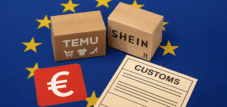
Customs trick revealed: Is the EU customs revolution flopping? How Temu and Shein easily circumvent the new EU fees – Image: Xpert.Digital
The €3 shock fails to materialize: Why the new "Temu customs duty" plays into the hands of the budget platforms
The EU customs revolution is flopping: This is why Temu and Shein continue to grow despite the new fees
Gigantic camps in Europe: The secret strategy behind Temu's merciless march to victory
Since July 1, 2026, a noticeably different wind has been blowing through European online retail: The customs-free allowance of €150 for small shipments, valid for decades, has been abolished. It has been replaced by a flat "Temu duty" of three euros – a direct attack by the EU on the massive influx of cheap parcels from Asia that have been flooding the market for years. The stated goal: to protect domestic retailers and curb unfair competition. However, initial data analyses paint a surprising and worrying picture for European trade. While air freight at major hubs is plummeting, the market power of Chinese giants like Temu, Shein, and AliExpress continues to grow unabated. The reason is as simple as it is ingenious: The platforms have long since factored the duty into their prices and are circumventing it with a clever logistics offensive on European soil. Read here why the three euros will not stop the rise of discount shops, who the real losers of the reform are, and why the most pressing problem – product safety – remains unresolved.
Related to this:

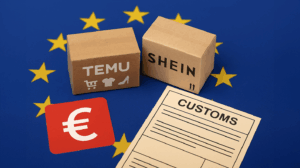
The so-called "Temu customs duty" is hitting China's air freight hard – but the low-cost platforms are already one step ahead
The end of a regulatory era in online retail
The so-called de minimis rule, the customs exemption for goods below a certain threshold, had been in effect in the EU for decades and was originally designed for the smallest postal shipments of no commercial significance. What began as a bureaucratic simplification for letter mail became, in the digital age, a structural competitive advantage for multi-billion-dollar Asian retail conglomerates. Temu alone claims to have 116 million monthly active users in the EU. The platform consistently utilized the direct shipping model: individual packages were flown by air freight from China or Hong Kong directly to European consumers, declared below the customs exemption threshold and thus incurring no significant duties. The business model was so efficient that freight capacity on the Asia-Europe route increased sharply for years.
The European Commission only reacted after years of pressure from European chambers of commerce, trade unions, and consumer associations. In December 2025, the Council of EU finance ministers agreed to abolish the duty-free allowance. The regulation came into force on July 1, 2026: Since then, a flat customs duty of three euros has been levied on each category of goods – technically defined by the six-digit CN code – in a small parcel. A parcel containing a T-shirt and a watch thus costs six euros in customs duty, regardless of the actual value of the goods. The transition period lasts until July 1, 2028, when the EU Customs Data Hub is scheduled to become operational and replace the flat-rate system with regular tariff customs rates.
In addition, there is the regulatory framework provided by the Digital Services Act: In May 2026, the European Commission fined Temu €200 million because the platform had not adequately assessed the systematic risks of illegal products on its platform. Formal DSA proceedings have been underway against Shein since February 2026 for selling illegal products and using manipulative design practices. The interplay between customs reform and platform regulation thus marks a fundamental paradigm shift compared to the regulatory laissez-faire approach of previous years.
Freefall in the air: What cargo data reveals
The speed with which the market reacted to the new tariff surprised even industry observers. According to data from the Dutch air freight analyst Rotate, the cargo capacity offered on the direct route between China, Hong Kong, and Europe fell by 19 percent in the first few days after July 1, 2026, compared to the previous year. Between July 2 and 8, total capacity on Asia-Europe routes was eight percent lower than in the same period of the previous year.
The decline was particularly drastic at the most important e-commerce hubs. Hong Kong, for years the most important shipping hub for Chinese platform goods destined for Europe, lost 47 percent of its relevant freight capacity. Budapest, which in recent years had assumed a central role as a transshipment point for low-cost parcels from China to continental Europe, recorded a decline of around 45 percent. Rotate also registered above-average declines at other e-commerce hubs such as Liège and Madrid.
These figures, however, must be interpreted with methodological caution. EU customs is not the sole cause of this development. Even before the cut-off date, carriers and logistics providers had begun to redirect their freight flows between European airports to avoid national special charges and rising handling costs at traditional hubs. The simultaneous effect of customs and ongoing restructuring makes a clear statistical separation of these two influences difficult. The figures show how quickly freight flows react to changing costs – not necessarily how much actual demand has fallen.
Global air freight data provides further context: In June 2026, worldwide air freight volumes still increased by nine percent compared to the previous year. Air freight volumes from China and Hong Kong to Europe fell by eight to nine percent in the last week of June – a clear indication that market participants had already begun pricing in the tariff adjustment before the official deadline. The average spot price for air freight from Asia-Pacific to Europe in the same month was US$5.26 per kilogram, still 38 percent higher year-on-year. The structural demand boom of previous years therefore did not reverse abruptly, but rather is undergoing a deliberate slowdown.
What the price shock does to buyers
The crucial economic question behind any tariff regime is not whether it redirects freight flows, but whether it destroys demand or merely shifts it. The answer is nuanced. A representative survey conducted by the market research institute YouGov among 10,280 German adults provides a clear picture of expected consequences: Should orders from platforms like Temu, Shein, or AliExpress become more expensive on average due to customs and processing fees, 50 percent of these shops' existing customers would order less frequently – that corresponds to 30 percent of the total German population. Another 15 percent would refrain from ordering altogether. Only 22 percent stated that they would maintain their purchasing behavior unchanged.
These figures sound dramatic, but they must be viewed in the context of the actual market dynamics of recent months. The average order frequency of German households at Chinese online shops rose from 5.4 orders in 2024 to 7.3 in 2025. That's an increase of 35 percent in just one year. During this period, the platforms were not stagnating, but rather experiencing steep growth. This cushion makes them more resilient to a moderate slowdown in purchase frequency than it might initially appear.
The generational differences in purchasing behavior are also revealing. Older consumers – the so-called Boomers and Generation X – are more sensitive to price increases and would more frequently forgo purchases altogether. Generation Z, on the other hand, tends to adjust its behavior only moderately; six percent of Gen Z buyers even stated that they would order more frequently if prices rose – a phenomenon that can be interpreted socially and psychologically as reactance behavior to perceived restrictions. It is also noteworthy that the YouGov Brand Monitor identified 14.6 percent of the German population as Temu's core target group for the period from July 2025 to June 2026, compared to 12.4 percent in the previous year. Thus, brand relevance continued to grow despite all the regulatory announcements.
The market share figures confirm the unbroken growth trend: In the second quarter of 2026, Asian platforms such as Temu, Shein, and AliExpress already accounted for 5.3 percent of German online retail sales – a record high. The German E-Commerce and Distance Selling Association (bevh) registered sales growth of more than 20 percent for these providers compared to the same period of the previous year. By comparison, German online retail as a whole grew by only 5.1 percent during the same period. In the online fashion retail segment, more than one in six orders already came from Temu and similar platforms.
Related to this:


The clever counter-move: European warehouses as a way to circumvent customs duties
The major platforms' real strategic response to customs is not a defensive, but an offensive repositioning of their supply chains. Temu, currently the most significant player in this field, has established a total of ten warehouses in eight European countries over the past twelve months. The goal is explicitly stated: in the medium term, up to 80 percent of all European orders are to be fulfilled from warehouses within the EU. This shift from direct air freight shipments from China to European distribution via sea freight and local delivery fundamentally alters the entire cost structure.
The logic behind this is economically compelling: To put it simply, sea freight containers cost roughly one-sixth of what air freight costs. If large quantities of goods are consolidated and shipped to Europe, temporarily stored in regional warehouses, and then delivered within a few days, not only is the air freight margin eliminated, but also the new flat-rate customs duty – because this applies to direct shipments from third countries to end consumers, not to goods imported into European warehouses that are subsequently distributed as intra-EU shipments. Temu has established partnerships for this model with national logistics providers in Germany (DHL), France (La Poste), Spain (Correos), Italy (Poste Italiane), the Netherlands, Austria, and the UK.
This approach is remarkable for several reasons. First, it reduces delivery times from two to three weeks to just a few days – a competitive advantage previously reserved for European retailers. Second, according to the company, it lowers logistics costs per item by around 60 percent. Third, it opens up access for Temu to product categories that were previously difficult to serve via direct shipping: bulky furniture, regionally differentiated assortments, or time-sensitive seasonal goods. Paradoxically, customs has thus accelerated, rather than hindered, the professionalization of platform logistics.
Rico Back, former CEO of the GLS Group and Royal Mail and current Managing Partner of the consulting firm SKR, sums up the implication: The new regulations do not change the fundamental price difference between direct imports from China and European goods. Individual shipments will become less attractive, while consolidated shipments (AI note: There was a stylistic inconsistency in the original; I correct this to "consolidated shipments") will gain in importance, while consolidated shipments via EU warehouses with subsequent distribution within Europe will become more significant. The shift towards distribution closer to the EU will accelerate considerably from the summer onwards, as shipments always follow the most efficient logistics structure – and this structure is currently shifting.
📈🚀 From visibility to trust 👀🤝 Your scalable path with Xpert.Digital


From visibility to trust: Your scalable path with Xpert.Digital - Image: Xpert.Digital
In industrial B2B, sustainable business relationships rarely emerge overnight. They develop step by step – through visibility, professional relevance, recurring touchpoints, and growing trust. Xpert.Digital's 4-stage model addresses precisely this: It offers a structured path that begins with a manageable entry point and can evolve into deeper collaboration in business development if needed.
Instead of relying on loud marketing promises, this model puts the relationship at the forefront. Companies start with clearly defined, easily calculable measures and then decide, based on their own experience, how far they want to expand the collaboration. A key factor for this undisturbed trust-building process: The platform completely avoids annoying advertising ads, so the editorial focus remains solely on the companies' expertise.
More information here:
Who really benefits from the "Temu customs"? A look at the winners and losers
Fiscal dimension: Who profits from customs revenues?
A frequently overlooked aspect of the new customs regime is its fiscal architecture. The three-euro flat-rate duty is not a consumer protection levy, but rather an own resource of the EU. According to established EU budgetary rules, national customs authorities retain 25 percent of the collected duties as collection costs; 75 percent goes to the EU budget. The European Commission expects additional customs revenue of around one billion euros annually from the abolition of the de minimis rule.
The actual revenue impact, however, will depend on how quickly and completely the major platforms adapt their supply chains to the EU warehousing model. Every import transaction processed through a European distribution center evades direct shipment duties. In the medium term, the fiscal return from the reform could therefore fall significantly short of expectations – even though the administrative burden for national customs authorities remains considerable. The German Customs and Finance Union (BDZ) has already warned that new duty obligations are of little use if IT systems, interfaces, and control capacities do not grow accordingly. With millions of small shipments daily, the authorities are already reaching the limits of their capacity.
In addition, a handling fee will be introduced from November 2026 onwards, levied on top of the standard customs duty. This fee is intended to compensate national customs authorities for the immense administrative costs. Its final amount was still being finalized at the time of publication. This will result in a double cost structure for consumers: the customs duty itself plus the handling fee. Platforms using the EU warehousing model largely avoid both of these costs, thus gaining a further relative advantage over smaller providers who continue to rely on direct shipping.
Related to this:
Product safety and market surveillance: The real deficit
A thorough analysis of the "Temu tariff" would be incomplete without examining the broader regulatory context. The tariff addresses a fiscal distortion of competition—the tax and duty disparity between EU suppliers and low-cost importers. However, the structural problem with direct shipments from China concerns not only tariffs, but above all product safety and market surveillance.
The figures are alarming: In 2023, the German Federal Network Agency inspected around 5,000 shipments of goods from third countries and found that 92 percent of these goods did not comply with EU regulations. The German Retail Federation (HDE) reported that around 60 percent of the delivered products were unfit for sale due to violations of chemical legislation. The consumer organization Stiftung Warentest found serious safety defects in toys, jewelry, and electrical appliances from Temu and Shein. In its DSA investigation against Temu, the European Commission found that a very high percentage of the tested chargers failed basic safety tests and that a significant proportion of the tested baby toys exhibited safety risks of medium to high severity.
The three-euro customs duty solves none of these problems. It makes direct-ship parcels more expensive, but it doesn't systematically improve the inspection of their contents. As long as market surveillance authorities are chronically underfunded and can only conduct random checks, the product safety problem will remain structurally persistent – regardless of whether a parcel incurs a three-euro customs duty or not. The TÜV Association has therefore already called for the consistent use of the DSA's control and sanctioning powers, ensuring sufficient resources for customs and market surveillance across the EU, and lowering the 45-million-user threshold for stricter transparency obligations.
The liability architecture of the new customs law does contain one significant improvement: online marketplaces will henceforth be legally considered "deemed importers," meaning fictitious importers. They must withhold customs duties and value-added tax at the point of purchase and remit them to the authorities. This at least transfers fiscal compliance responsibility to the platforms – and creates incentives for more thorough product control, because liability risks coincide with the import of goods.
Competitive shifts: Who loses, who wins
The medium-term consequences of the tariff vary considerably for different market participants. For European retailers, particularly small and medium-sized enterprises (SMEs), the tariff offers only limited relief. It moderately increases the cost of the platforms' direct-to-consumer model, but it does not eliminate the fundamental price difference based on significantly lower production costs, different labor standards, and state industrial subsidies in China. The new EU warehousing model of the large platforms also reproduces this structural cost advantage: Temu, according to its own figures, is currently losing around one billion dollars annually in the European market, financed by its Chinese parent company, PDD Holdings, to acquire market share. This growth capitalism at the expense of profitability is fundamentally incompatible with the cost structures of European SMEs.
For the air freight industry at existing e-commerce hubs, the short-term effects are significant. DHL and Leipzig/Halle Airport anticipate a temporary dip rather than a structural collapse. However, the structural shift from air freight to sea freight containers, as already underway at Temu and other hubs, will alter freight capacities on the China-Europe route in the medium and long term. Airports like Budapest, which are heavily reliant on e-commerce transit traffic, will be more severely impacted by the restructuring of supply chains than universal hubs.
For large logistics providers, however, new business models are opening up. DHL, La Poste, Correos, and Poste Italiane are already Temu's logistics partners for European domestic distribution. The flow of goods isn't disappearing—it's simply being reorganized, as Rico Back puts it. Those who own the infrastructure for European e-commerce fulfillment networks are gaining market share at the expense of independent air freight operators who have previously benefited from the direct shipping model.
Limits of the regulatory strategy: Why three euros are not enough
The impact of the new tariff is real, but limited. Three euros per product category, based on an average price of, say, eight euros for a T-shirt at Temu, represents a cost increase of almost 40 percent calculated per package weight – which sounds like a competitive shock. But the price difference between a Temu T-shirt for eight euros and a comparable product at a German fashion retailer for 25 to 40 euros cannot be closed by a three-euro tariff. Studies suggest that the introduction of the flat tariff could lead to price increases of up to ten percent for imported goods. Even that is not enough to eliminate the structural advantage of the platforms.
The interim solution also has an inherent weakness: it is to be replaced by regular, product-specific customs tariffs in 2028, once the EU Customs Data Hub is operational. Until then, the flat-rate system remains a simplification that reflects neither the actual market values nor the specific customs tariffs of the respective product categories. A cheap plastic toy and an inexpensive electronic component pay the same flat rate of three euros – even though their regular customs duties and the associated complications for product conformity and market surveillance are very different.
The competitive distortion addressed by the tariff is therefore real – however, the chosen solution is structurally unambitious. Sustainable, fair competition between Asian low-cost platforms and European suppliers would require the full application of regular customs tariffs to all product categories, drastically improved market surveillance with sufficient personnel and IT infrastructure, consistent enforcement of the Digital Services Act and product safety directives, and reform of the system of state export subsidies beyond the framework of the WTO. The "Temu tariff" is a first step on a very long road.
Between regulatory success and strategic adaptation
The first few weeks after July 1, 2026, confirmed what logistics experts had predicted: Customs is shifting freight flows faster than it is destroying demand. Hong Kong and Budapest are losing capacity, while European distribution centers and sea freight corridors are gaining in importance. Temu, Shein, and AliExpress had already fully priced in their strategic response and, in some cases, implemented it operationally—long before the customs measures came into effect.
The true impact of the "Temu tariff" won't be seen in the freight data from the first weeks of July, but rather in market shares over 12 to 18 months. If Temu fulfills 80 percent of its European orders from local warehouses, the flat tariff on direct shipments is simply irrelevant to its core business. The Chinese platforms aren't victims of regulation—they're the players adapting to it most quickly. For European retailers, that's the truly worrying takeaway from this regulatory episode.
Your intralogistics experts

Consulting, planning and implementation of complete solutions for high-bay warehouses and automated storage systems - Image: Xpert.Digital
More information here:
Your global marketing and business development partner
☑️ Our business language is English or German
☑️ NEW: Correspondence in your native language!

Konrad Wolfenstein
I and my team are happy to be available to you as your personal advisor.
You can contact me by filling out the contact form here wolfenstein@xpert.digital:or simply call me at +49 7348 4088 965. My email address is
I'm looking forward to our joint project.
☑️ SME support in strategy, consulting, planning and implementation
☑️ Creation or realignment of the digital strategy and digitization
☑️ Expansion and optimization of international sales processes
☑️ Global & Digital B2B trading platforms
☑️ Pioneer Business Development / Marketing / PR / Trade Fairs
Our global industry and economic expertise in business development, sales and marketing


Our global industry and economic expertise in business development, sales and marketing - Image: Xpert.Digital
Industry focus areas: B2B, digitalization (from AI to XR), mechanical engineering, logistics, renewable energies and industry
More information here:
A thematic hub offering insights and expertise:
- Knowledge platform covering global and regional economies, innovation and industry-specific trends
- A collection of analyses, insights, and background information from our key areas of focus
- A place for expertise and information on current developments in business and technology
- A hub for companies seeking information on markets, digitalization, and industry innovations