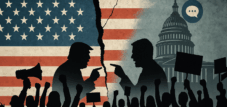
The divided republic: Political polarization in the USA and its economic consequences – Image: Xpert.Digital
Escape from the extremes: Why more and more Americans are turning away from the major parties
The radicalized republic: Why US democracy is losing its ability to compromise
Historic low: Why US citizens no longer trust their own institutions
The political extremes in the US are growing rapidly, while the political center is increasingly eroding. What once began as mere differences of opinion on substantive issues has long since developed into a deep, identity-based divide that is shaking the foundations of American democracy. Unlike European multi-party systems such as Germany's, which are institutionally designed for compromise, the US two-party system is increasingly transforming political differences into insurmountable obstacles. The result is a historic loss of trust in government institutions, above all in Congress and the Supreme Court. But this polarization is not just a democratic warning sign—it is proving to be a massive economic drag. Through a lack of investment, chronic political uncertainty, and institutional paralysis, this division is costing the country hundreds of billions of dollars annually. This text examines the deep causes of this fragmentation, compares the US development with European resilience models, and shows why the American crisis poses a threat far beyond its own borders.
When democracy devours itself – and the economy pays the bill
Two nations in one country – an assessment of the division
The political landscape of the United States at the beginning of the 21st century presents itself in a state unprecedented for a consolidated Western democracy: Roughly 14 percent of the US population places itself on the far left of the political spectrum, while at the opposite end, a full 21 percent of respondents occupy a far-right position. The political center, traditionally the backbone of a stable democracy, reaches only 16 percent. What these figures reveal in their stark clarity is alarming from a democratic perspective: Larger segments of the population are concentrated at the ideological fringes than in the center. This is not a cyclical fluctuation, but rather the expression of a structural transformation of the political system.
These figures gain further analytical significance when compared to the comparative scale of European democracies. In France, political extremes reach similarly high levels: 11 percent place themselves on the far left, 20 percent on the far right, while the center also accounts for only 11 percent. Germany, however, shows a significantly different pattern: there, the political center comprises 24 percent, and extreme positions are considerably less prevalent. Spain is generally closer to the center but also exhibits a dispersion across the entire political spectrum. This divergence between Anglo-Saxon and continental European models of democracy is no coincidence but reflects fundamental differences in institutional architecture, electoral tradition, and political culture.
From disagreement to identity-based division
To grasp the depth of American polarization, it is not enough to describe the shift in policy positions. The German Institute for International and Security Affairs (SWP) in Berlin aptly describes the crucial qualitative leap: Polarization initially means that policy positions on key domestic and social issues have developed in opposite directions—the Democrats are becoming more liberal, the Republicans increasingly conservative. The real turning point, however, lies in the transition from mere polarization of opinion to identity-based societal division. In this form of division, political debate is no longer primarily about policy differences, but about the fundamental characteristics of social groups, that is, their identities. And identities, this is the crucial point, are not negotiable, unlike political opinions.
The historical roots of this development run deep. The political realignment began in the 1960s when the Democratic Party in the US Congress decided to support legal equality for the Black population. As a result, white, conservative voters, particularly in the Southern states, migrated to the Republicans, while liberal whites and people of color became the foundation of the Democratic coalition. Since then, Republican politicians, from Richard Nixon to Newt Gingrich to Donald Trump, have increasingly steered their party toward a strategy based on mobilizing the core white, conservative constituency. The result, over decades, has been a fusion of partisan preferences with ethnic, religious, cultural, and ideological identities, making the divide virtually insurmountable.
Political divisions in the US have increased by 64 percent since the late 1980s, with almost all of this growth occurring after 2008. The disappearance of a common external enemy after the end of the Cold War, the 2008 financial crisis, which proved to be a societal amplifier of economic inequality, and the technological transformation of the media landscape have all combined to accelerate this dynamic. The political and social upheavals that are now becoming visible have thus had an incubation period of several decades, which explains why short-term policy corrections are rarely sufficient.
The European counter-image and the lessons of institutional research
A comparison of polarization patterns in the US and Europe reveals both structural parallels and fundamental differences that are crucial for understanding democratic stability. Political polarization has increased significantly in Europe since the global financial crisis. In Spain, polarization has grown considerably since the Catalan crisis and the political fragmentation following the 2016 elections. In Germany and France, peaks in polarization coincided with the refugee crisis and social movements such as the Yellow Vests.
The difference lies not in the existence of polarization, but in its institutional effect. European multi-party systems generally force coalition formation, which represents a kind of institutionalized imperative of compromise. The American two-party system, on the other hand, transforms political differences into zero-sum games: whoever wins, wins everything; whoever loses, loses everything. This structural feature significantly increases the incentives for maximizing group identities and for mobilization through the construction of enemy images. Germany illustrates this particularly clearly: the pronounced centrist vote of 24 percent is not a cultural accident, but rather the expression of a political system that institutionally rewards compromise and consensus.
Research findings from the Bank of Spain confirm that polarization and legislative gridlock are closely correlated in Spain, Germany, and France: the more polarized a country, the more pronounced the legislative paralysis. The USA demonstrates this in an extreme way: for years, Congress has been barely able to reach basic budgetary agreements, and government shutdowns are a recurring phenomenon.
The erosion of institutional trust
Perhaps the most alarming symptom of American polarization is not the ideological alienation itself, but the systematic erosion of trust in the institutions that make democratic processes possible. The Gallup Institute, which has measured institutional trust in the US for decades, recorded a historic low in 2022: Only 27 percent of Americans expressed high or very high trust in the most important national institutions—a drop of nine points from 2020. With a trust rating of 7 percent, Congress is the least respected constitutional body in the country.
The situation is particularly dire regarding the Supreme Court, a constitutional body whose authority rests precisely on its bipartisan legitimacy. In September 2025, 43 percent of Americans considered the Supreme Court too politically conservative—the highest figure ever recorded by the Gallup Institute. The Supreme Court's approval rating has fallen to just 42 percent, and trust in the entire federal judiciary, at 49 percent, is among the lowest ever recorded in Gallup's poll. The partisan divide in trust in the judiciary now stands at 58 percentage points—a new record high.
The political divide is even more dramatic when it comes to economic and consumer behavior. In March 2025, the consumer sentiment index for Democrats stood at just 41.3 points, for independents at 55.7 points, while for Republicans it reached 87.4 points. This enormous gap demonstrates that political identity in America now also structures the economic perception of one's own situation – regardless of objective economic indicators.
A joint study by Bright Line Watch and UCLA Law School, conducted in May 2026, revealed an alarming finding: 94 percent of legal experts surveyed view the current president as the greatest threat to the rule of law in decades. Even among right-wing experts, 73 percent share this assessment. Only 30 percent of legal experts believe that the Supreme Court will rule impartially in cases involving the government.
The disappearance of the center and the rise of the independents
The deep division in the country correlates with a paradoxical development: While more and more citizens are aligning themselves with the ideological extremes, formal affiliation with the two major parties is steadily declining. Recent Gallup data shows that 45 percent of adult Americans consider themselves politically independent—the highest figure since the surveys began. Both Republicans and Democrats now only garner around 27 percent each. This trend is particularly pronounced among younger generations: Both Generation Z and Millennials report being disproportionately likely to say they do not belong to either party.
This phenomenon of a growing proportion of independent voters coupled with intensifying polarization appears contradictory at first glance, but can be explained by the concept of affective polarization: Many citizens no longer identify positively with one party, yet reject the other with increasing intensity. They vote against something, not for something. This emotionalization of politics—political scientists refer to it as affective polarization—is more difficult to manage in its societal volatility than purely policy-based differences because it lacks rational mechanisms for resolution. International research has shown that American affective polarization is comparable in intensity to that in Southern Europe, but unlike in Germany or the Netherlands, it has steadily increased since the 1990s.
Trump's approval ratings among independents fell to just 28 percent by March 2026, a historic low for this voter group. His overall approval rating stood at 37 percent, a net decline of minus 20 points. This level of structural distrust in the incumbent president is not a personal phenomenon, but rather an expression of a systemic crisis in which no political leader is capable of permanently uniting societal majorities.
Echo chambers, media landscape and the architecture of division
Political polarization is not a spontaneous natural phenomenon, but is systematically reinforced by a specific media and communication architecture. In the US, a media system has emerged over the last three decades that no longer serves the shared information space of a democratic society, but instead produces segmented information bubbles for ideologically pre-sorted target groups. Television channels like Fox News or MSNBC explicitly cater to political camps, thereby creating echo chambers in which convictions are not questioned, but confirmed.
The role of social media is particularly relevant in this context. Algorithmically curated information environments foster the emergence of groups that mutually reinforce their perceptions of reality and attitudes, becoming detached from the rest of society. The crucial mechanism is not that social media primarily produce extreme content, but rather that they technologically amplify existing tendencies toward selective information consumption. Furthermore, algorithmic systems favor emotional and outrageous content because it generates more interaction—a mechanism that structurally rewards extremism.
The 24-hour news cycle and the constant presence of political conflicts in digital environments expose the population to a continuous stream of political outrage and perceived threat. Economists and social psychologists have shown that this chronic state of political stress strains cognitive capacities, reduces decision-making quality, and contributes to societal fragmentation in the long term. In a knowledge-based economy like the American one, this kind of politically induced mental overload also has a measurable economic dimension.
The economic price of division – hidden costs in the trillions
The economic consequences of political polarization have been significantly underrepresented in public debate to date, but are increasingly documented in economic research. Political polarization harms economic growth through three main channels: it reduces capital investment, impairs the formation of human capital, and lowers overall factor productivity. A study analyzing data from 168 countries found that polarization suppresses output growth and capital formation and has negative effects on public debt – across all income groups and political systems.
The evidence is particularly precise at the company level: studies show that an increase in political polarization of one standard deviation reduces corporate investment by an average of 1 percent, which corresponds to 16 percent of the average investment rate. This effect proves to be causal, not merely correlational: political polarization generates affective uncertainty about future political stability, increases perceived policy uncertainty, and leads to dynamic political inefficiency, all of which translate into a decline in investment and employment in affected regions.
The macroeconomic scale is staggering. Research on economic policy uncertainty suggests that persistent political instability can reduce overall economic output by 1 to 2 percent of GDP—through lower investment, delayed hiring decisions, and reduced productivity. In an economy the size of the United States, this translates to hundreds of billions of dollars in lost economic output annually. Even conservative estimates suggest that reducing political uncertainty could boost annual growth by 0.3 to 0.5 percentage points; accumulated over 20 years, this amounts to a difference of 6 to 10 percent of GDP.
The costs of political paralysis manifest themselves in concrete events. The longest government shutdown in American history caused $9 billion in compensation delays for federal employees and reduced GDP by 0.2 percent in the first quarter of 2019. However, these singular events are merely the visible tip of a system that chronically operates below its own productive potential. Businesses and institutions devote enormous resources to lobbying, litigation, and continuity planning in response to unstable political environments—a massive misallocation of capital and human resources, from an economic perspective.
The erosion of social capital is particularly relevant. Economists have demonstrated that interpersonal trust plays a measurable role in economic performance: countries with higher generalized trust exhibit higher GDP per capita and faster economic growth. Trust reduces transaction costs, simplifies contractual relationships, and facilitates knowledge transfer. Political polarization undermines this social capital by leading citizens to view neighbors and colleagues as ideological adversaries—with direct consequences for cooperation, networking, and ultimately, overall macroeconomic performance.
Our US expertise in business development, sales and marketing


Our US expertise in business development, sales and marketing - Image: Xpert.Digital
Industry focus areas: B2B, digitalization (from AI to XR), mechanical engineering, logistics, renewable energies and industry
More information here:
A thematic hub offering insights and expertise:
- Knowledge platform covering global and regional economies, innovation and industry-specific trends
- A collection of analyses, insights, and background information from our key areas of focus
- A place for expertise and information on current developments in business and technology
- A hub for companies seeking information on markets, digitalization, and industry innovations
How US democracy is at a tipping point – consequences for Europe and Germany
Institutional erosion and democratic resilience
In a widely acclaimed analysis published in 2024, the German Institute for International and Security Affairs (SWP) in Berlin described how the US is approaching a dangerous tipping point where further—even minor—changes could have dramatic and potentially irreversible consequences for American democracy. This assessment has since been reinforced. In the Democracy Index of the V-Dem Institute at the University of Gothenburg, the US plummeted from 20th to 51st place within a single year—at an unprecedented pace. The researchers describe President Trump's second term as a rapid and aggressive concentration of power in the presidential office.
In Western Europe and North America, the state of democracy in 2025 will be at its lowest level in more than 50 years – primarily due to the increasing autocratization tendencies in the USA. The Economist Intelligence Unit ranks the USA 34th in its 2025 Democracy Index, recording its lowest ever score for government effectiveness. The USA has been classified as a "flawed democracy" since 2016 and is now considered the most significant negative outlier among Western democracies.
Pew Research documented in 2026 that a majority of Americans believe the US used to be a good role model for other countries, but no longer is. This judgment is remarkable in its starkness: Citizens themselves perceive a fundamental loss of credibility for their political system on the world stage. Congress, originally conceived as an institutional check on the executive branch, is increasingly neither willing nor able to fulfill its constitutionally mandated oversight function due to the growing political polarization.
The increasing politicization of the judiciary is a particularly alarming development. The Supreme Court currently exhibits a 65-point approval gap between Republicans (79 percent) and Democrats (14 percent)—a figure that structurally undermines the court's function as a nonpartisan arbiter. A legal system that half the population fundamentally distrusts loses its legitimizing function. The fact that only 30 percent of legal experts believe the Supreme Court is impartial in politically relevant decisions is a finding that shakes the foundations of the American rule of law.
Inability to compromise as a systemic risk
A democracy without a willingness to compromise is a democracy in existential crisis. The American system of separation of powers depends on bipartisan cooperation, and this willingness has been declining for years. Instead, constitutional instruments such as impeachment, originally conceived as the ultimate measure against blatant abuse of power, are increasingly being used as partisan tactics. The consequence is that the instruments of democratic control are eroding—not through formal abolition, but through rampant abuse that undermines their effectiveness and legitimacy.
The development of the American budget process is particularly symptomatic. The longest government shutdown, the trade conflicts, and the politically motivated fluctuations in environmental, tax, and immigration policies demonstrate how this system of mutual obstruction causes real economic damage. For companies that must make long-term investment decisions, government policy that fundamentally reverses every four to eight years means a structural increase in risk: projects are delayed, return expectations are raised, and short-term strategies are favored—all reactions that undermine long-term economic efficiency.
Research conducted by the Banco de España, which is closely affiliated with the European Central Bank, shows that the link between political polarization and legislative gridlock is particularly strong in France and Germany. Conversely, this means that societies that reduce polarization also regain political agency. This finding is becoming increasingly relevant to economic policy discourse, especially in light of the global challenges posed by climate change, technological structural change, and geopolitical fragmentation, which require long-term and consistent political strategies.
The German special path – and its limits
In this international comparison, Germany presents a remarkable contrast. The pronounced political center of 24 percent, the relatively high institutional stability, and the more consensus-oriented political system are not self-evident constants, but rather the result of a specific historical experience. The Federal Republic explicitly conceived its constitution, the Basic Law, as a response to the collapse of the Weimar Republic – with strong institutional safeguards against polarization and political extremism, from the five-percent threshold to the concept of a militant democracy.
Nevertheless, it would be wrong to consider Germany immune to polarization tendencies. Here, too, the refugee crisis, economic uncertainties, and the challenges of digitalization have led to an increase in affective polarization. A study by the Konrad Adenauer Foundation on political polarization in Germany has shown that while there is no extreme ideological polarization, there is a growing alienation between political camps, which is reflected in a negative mutual assessment. The difference from the American case lies less in the absence of polarizing forces than in the institutional and cultural capacity to moderate these forces.
The multi-party system necessitates coalition building and thus structural compromises; the federal architecture distributes power across multiple levels; and the historically grounded skepticism toward political extremism has a normative presence that is largely absent in America. Whether these institutional buffers will hold up in a world of increasingly digital public spheres, global disinformation campaigns, and growing economic inequality remains an open question.
Systemic crisis or course correction – possible trajectories
The analytically relevant question is no longer whether democratic erosion is taking place in the USA – this has been demonstrated by a broad research base – but rather which trajectories are plausible for further development. The spectrum ranges from long-term stabilization through institutional resilience to a constitutional crisis in which different constitutional bodies arrive at incompatible conclusions regarding the resolution of contentious situations.
There are systemic forces that favor stability: American civil society remains vibrant, the economy is performing well despite political turmoil, and the institutions at the federal court level below the Supreme Court still demonstrate considerable resilience. The historically high percentage of independent voters (45 percent) could, if channeled politically, become a renewal movement that compels both established parties to exercise restraint. And democratic institutions have repeatedly proven in the past that they can remain functional even under considerable pressure.
In contrast, there are structural risk factors: Identity-based divisions can hardly be resolved through normal political processes. The media market continues to provide strong incentives for polarization. The geopolitical position of the US in a fragmented world order requires foreign policy predictability and alliance loyalty, which is systematically undermined by domestic instability. And the economic imbalances, considered one of the deepest drivers of polarization, have been exacerbated rather than mitigated by technological structural change.
Global implications and European interests
American polarization is not a purely domestic phenomenon. Its global consequences particularly affect the US's economic and security partners, above all Germany and Europe. The volatility of American trade policy, which shifts from one administration to another under polarized conditions, creates massive planning uncertainty for export-oriented economies like Germany. The questioning of multilateral institutions, the erosion of NATO ties, and the withdrawal from international climate agreements are direct consequences of a domestic policy that increasingly sacrifices foreign policy predictability.
From a European perspective, this presents a twofold challenge: On the one hand, strategic dependencies on an unstable partner must be reduced, which requires an accelerated development of European own capacities in defense, technology, and energy. On the other hand, there is a genuine interest in stabilizing American democracy because the alternative—a permanently paralyzed or authoritarian America—would destabilize the global order in which European economic and security interests are embedded.
The EIU analysis is revealing in this context: countries ranked higher in the Democracy Index demonstrably exhibit lower operational risks; institutional quality, the rule of law, and property rights are strong predictors of economic growth. What holds true for America as an international investment location also applies, by analogy, to the global order as a whole: institutional credibility is a prerequisite for economic prosperity – and not the other way around.
Perspectives for cohesion and democratic renewal
Any serious analysis of American polarization must ultimately address the question of whether and how a course correction is possible. Research offers no easy answers here, but it does provide some structured findings. First, polarization is not a one-way street. Germany has shown that affective polarization can also decrease under certain conditions. Second, institutional reforms can alter the incentive structures that promote polarization. Electoral reforms such as ranked-choice voting, restructuring the gerrymandering system, and strengthening independent election authorities could reduce the dominance of extreme positions in primary elections.
Thirdly, economic policy measures that reduce the subjective and objective feeling of economic insecurity are simultaneously measures against polarization. The research literature is unanimous in its finding that economic inequality and fear of downward mobility are among the most significant drivers of political extremism. Investments in infrastructure, education, and regional economic development in structurally weak regions are therefore not only a social welfare imperative but also crucial for stabilizing democracy.
Fourth: The media landscape needs structural incentive changes that reward outrage maximization less and strengthen factual reporting. This is both a regulatory and a cultural challenge, for which other democratic societies certainly offer approaches and models – even if direct transfers are not possible due to the particular American tradition of press and freedom of expression.
The reintegration of the political center—those 16 percent who barely have a voice in the US today—is ultimately the decisive criterion for the success or failure of democratic renewal. Not as an ideological compromise between two extremes, but as the restoration of a shared political space in which substantive policy differences can be addressed without existential threats. This is more difficult than any economic policy reform—but it is the prerequisite for everything else.
Your global marketing and business development partner
☑️ Our business language is English or German
☑️ NEW: Correspondence in your native language!

Konrad Wolfenstein
I and my team are happy to be available to you as your personal advisor.
You can contact me by filling out the contact form here wolfenstein@xpert.digital:or simply call me at +49 7348 4088 965. My email address is
I'm looking forward to our joint project.
☑️ SME support in strategy, consulting, planning and implementation
☑️ Creation or realignment of the digital strategy and digitization
☑️ Expansion and optimization of international sales processes
☑️ Global & Digital B2B trading platforms
☑️ Pioneer Business Development / Marketing / PR / Trade Fairs
🎯🎯🎯 Data-driven B2B industry hub as a quasi-in-house solution


The quasi-in-house solution: How Xpert.Digital closes operational gaps in B2B marketing and sales – Smart Content-Driven Business - Image: Xpert.Digital
Xpert.Digital is a data-driven B2B industry hub led by Konrad Wolfenstein . The company acts as an external, quasi-in-house solution for industrial partners, closing operational gaps in marketing, content, and sales – without requiring additional resources on the client side.
More information here: